SF Bay Oyster Reef Restoration: A Volunteer’s Guide
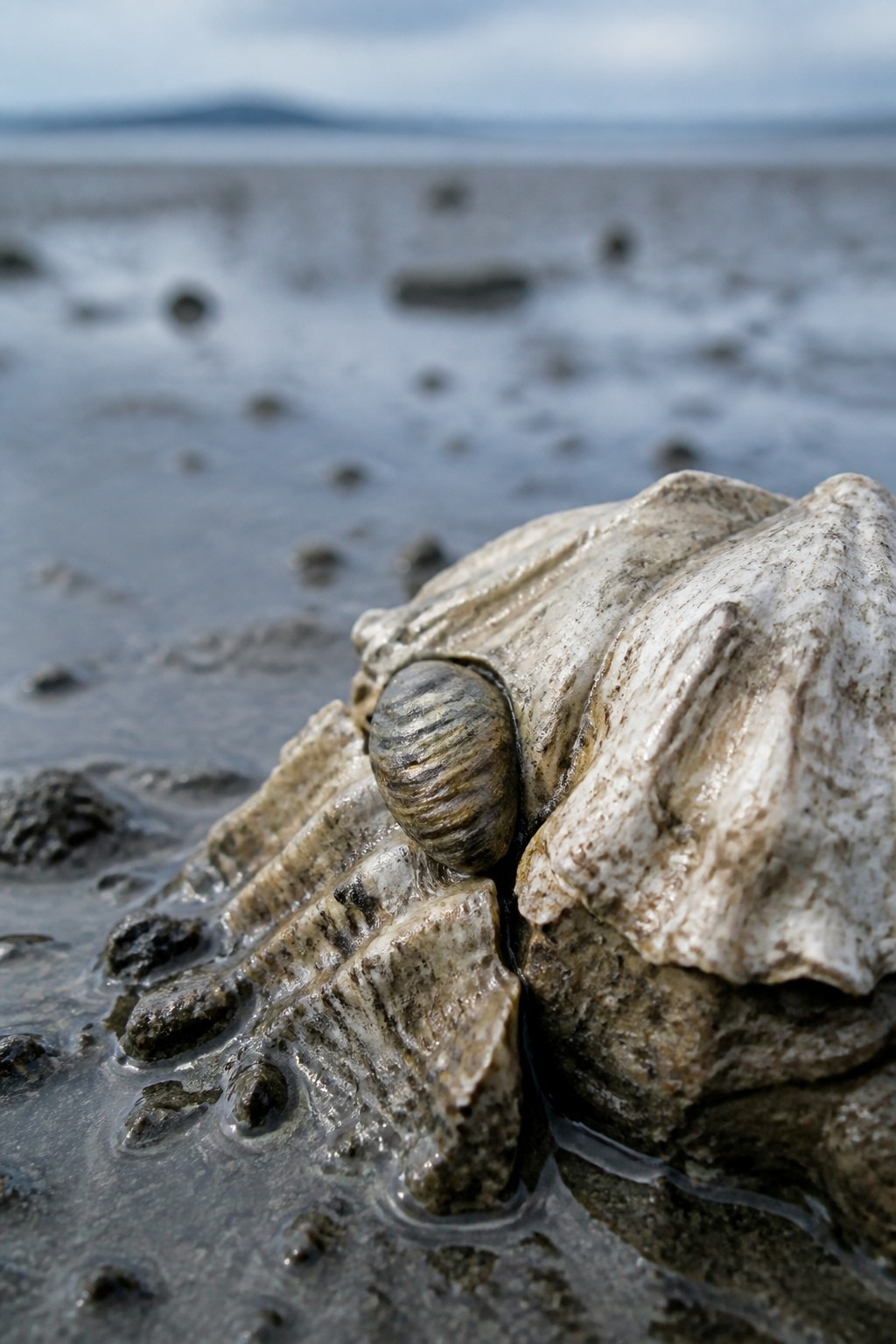
Low tide at Point Pinole, and a dozen San Francisco Bay oyster reef restoration volunteers are kneeling in cold gray mud, tipping buckets of bleached shell onto a concrete dome the size of a beach ball. Nobody is dressed for glamour. Rubber boots, wet gloves, a thermos going cold on the tailgate. What they are doing looks like nothing — scattering old shells onto the flats of the largest estuary on the West Coast. But each shell is a landing pad. Within weeks, microscopic larvae of Ostrea lurida, the only oyster native to this coast, will drift in on the tide, smell the calcium, and cement themselves down for life. That is how you rebuild something a city spent 150 years erasing.
The Bay once held oyster beds so vast that 19th-century boats dredged them by the ton. Then the Gold Rush arrived, and with it a slower catastrophe. This is the story of what broke the reefs, what it takes to put them back one Saturday at a time, and — honestly — where the effort is failing as well as winning.
Key Facts
- Volunteers are restoring the Olympia oyster (Ostrea lurida), the only oyster native to the West Coast, in San Francisco Bay.
- The native beds were destroyed by Gold Rush over-harvesting and by hydraulic-mining silt that buried the bay floor.
- The Watershed Project deployed 100 community-built reef balls at Point Pinole in 2013; about 30,000 oysters had colonized them by fall 2016.
- The SF Bay Living Shorelines Project launched in 2012 (California State Coastal Conservancy with USGS), and more than 2 million oysters settled on the constructed reef near San Rafael.
- The reefs cut wave energy by 30-50%, and larvae settle on shell-rich baycrete and orient toward reef sounds.
In short: Volunteers are rebuilding San Francisco Bay’s lost native Olympia oyster reefs by seeding cured shell and baycrete structures onto the mudflats. Gold Rush harvesting and mining silt had erased them. The Living Shorelines Project has settled over two million oysters, and the reefs cut wave energy by 30 to 50 percent.
The bay that forgot its own oysters
Before San Francisco was San Francisco, the Olympia oyster was everywhere in these shallows. Small — an adult fits on a silver dollar — but abundant enough to feed the Ohlone for millennia and, later, the Gold Rush boomtown. Then three things hit at once.
Over-harvesting stripped the natural beds fast; hungry miners ate them faster than the slow-growing natives could reproduce. Hydraulic mining in the Sierra foothills blasted whole hillsides into slurry, and that sediment washed down the rivers and buried the Bay floor in silt — smothering the hard shell surfaces oyster larvae need to attach to. And a warming, polluting, industrializing shoreline finished the job. By the early 20th century the native oyster was, for practical purposes, gone from San Francisco Bay. Growers switched to imported Eastern and Pacific oysters and never looked back.
Here’s the part that stings: we knew how to break it, and then we forgot the Bay had ever been any different. An entire ecosystem — the reefs, and the fish, crabs, and birds that lived on them — slid out of living memory. Restoring it means first convincing people it existed.
A Saturday in the life of San Francisco Bay oyster reef restoration volunteers
The work is unglamorous and that is exactly why it works. It runs on ordinary people showing up. There are three main jobs, and most volunteers cycle through all of them.
The first is shell collection. Restaurants and oyster bars around the Bay — in San Francisco, Sausalito, Berkeley, and Alameda — save their empty shells instead of trashing them. Volunteers and groups like the Wild Oyster Project haul the shells to a curing yard, where they sit outdoors for months to weather off any bacteria or residue. Recycled shell is the single best surface a baby oyster can land on, so this is quiet, smelly, genuinely important work.
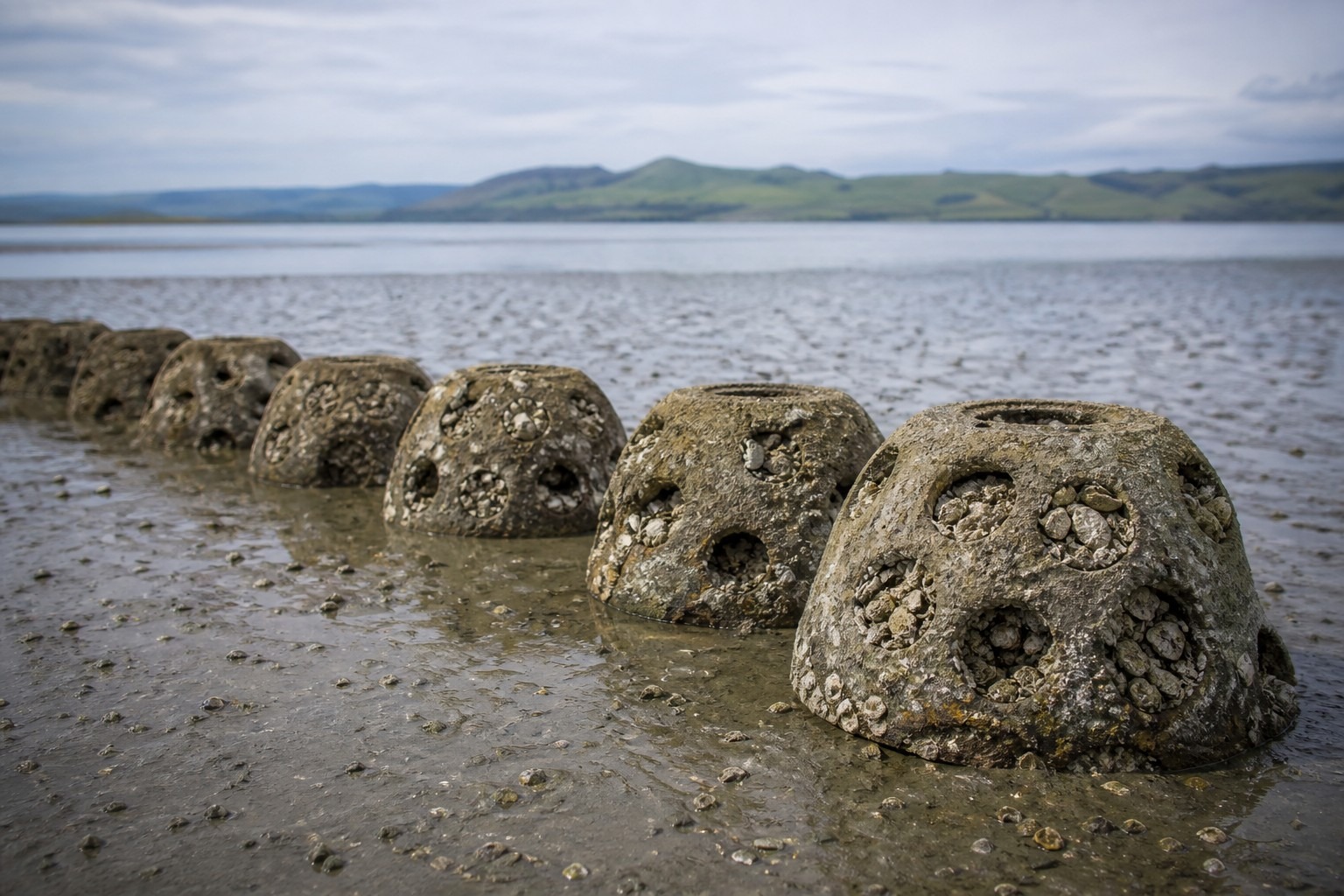
The second is the build. Cured shell gets packed into mesh bags or set into concrete “reef balls” and “baycrete” structures, then carried out onto the mudflats at low tide and arranged into a reef footprint. The Watershed Project famously deployed 100 community-built reef balls at Point Pinole in 2013 — structures shaped, filled, and placed largely by volunteers.
The third is monitoring, and it is the one that separates real restoration from a feel-good photo op. Twice a year, volunteers return to the same plots, count juvenile oysters (called spat), measure them, and log what else has moved in. Those counts are the data that tell scientists whether a reef is alive or just a pile of rocks.
{IMAGE_2}
Building a reef out of concrete, crushed shell, and sound
You cannot just dump rocks and hope. A working reef is engineered, and the material has a name volunteers use like it’s obvious: baycrete. It’s a low-slump concrete blended with native sand, gravel, and crushed oyster shell, cast into rough-surfaced blocks and domes. The crushed shell matters because oyster larvae are picky landlords — they respond to the chemical signature of oyster shell, a cue that says “your kind lived here and survived.”
And — this is the strange, wonderful part — larvae also appear to listen. Research on oyster settlement has found that the larvae orient toward the crackle-and-snap soundscape of a healthy reef: snapping shrimp, feeding fish, the low churn of a living community. A silent patch of mud says nothing. A noisy one says “home.” Some restoration experiments have even tested playing reef sounds to draw larvae in.
Then there’s siting. Set a reef too low and it drowns; too high and it bakes at low tide. Get the elevation, wave exposure, and salinity wrong and the most beautiful baycrete dome in the Bay will stay empty. Design is destiny here — which is a polite way of saying a lot of reefs are built to fail, and the good crews are the ones who learned where not to build.
Two million oysters, and a wall that quietly lowers the waves
The flagship effort is the San Francisco Bay Living Shorelines Project, launched in 2012 by the California State Coastal Conservancy with the U.S. Geological Survey and partners. According to Marilyn Latta, the project manager at the State Coastal Conservancy who oversees the sites, the goal was never oysters for their own sake — it was to test oysters and eelgrass together as living infrastructure.
The numbers earned the headlines. More than two million native Olympia oysters have settled on the constructed reef near San Rafael. Out at Point Pinole, roughly 30,000 oysters had colonized those 100 volunteer-built reef balls by the fall of 2016, monitored twice a year by volunteers coordinated through the Watershed Project. And the reefs measurably calm the water: early data from the Living Shorelines sites show wave energy dropping 30 to 50 percent behind the structures.
Why care about oysters filtering water and blunting waves? Because a single oyster filters several gallons of bay water a day, and a reef of them clears plankton and sediment, brightening the shallows enough for eelgrass to grow. That eelgrass, in turn, shelters juvenile Dungeness crab, bay shrimp, salmon, sturgeon, and the small fish that feed the Bay’s egrets and herons. One structure, an entire neighborhood of life.
- 2M+ — native Olympia oysters recruited on the constructed reef near San Rafael (Living Shorelines Project)
- ~30,000 — oysters on 100 volunteer-built reef balls at Point Pinole by fall 2016
- 30–50% — drop in wave energy measured behind the reefs
- 2012 — year the SF Bay Living Shorelines Project broke ground
- 50,000 → 5.5 million — Olympia oysters at Fidalgo Bay, WA, from 2002 to 2023
- 80%+ vs 30–40% — five-spine crab infestation, bottom vs. suspended culture
A seawall that raises itself
Concrete seawalls have one fatal flaw against sea-level rise: they’re a fixed height. The sea comes up; the wall does not. An oyster reef does something a poured wall can’t — it keeps growing. As oysters recruit, die, and are recruited over again, the reef accretes, and by slowing the water it lets the mudflat behind it catch and hold sediment, building the marsh upward. A living shoreline can, in principle, rise to keep pace with the water in front of it.
That’s the framing bayfront neighborhoods should sit with. A reef that cuts incoming wave energy by a third to a half is a flood-defense asset, not just a science project — softer, cheaper, and self-repairing where a bulkhead is brittle and static. For low-lying stretches of Richmond, San Rafael, and the East Bay flats, a belt of oysters and eelgrass offshore is a first line that mends itself after every storm.
None of this replaces hard engineering where a city truly needs a levee. But treating the Bay’s own biology as infrastructure — instead of paving over it — is the most sensible long-term bet on this shoreline, and it’s the one most competitors selling either pure concrete or pure optimism tend to miss.
When the reef dies: the part the good-news stories skip
Restoration is hard, and sometimes it simply fails. That truth is missing from most cheerful accounts, so here it is straight.
In 2023, the Giant Marsh living-shoreline site near Richmond took a beating. A run of extreme heat combined with unusually low salinity — too much freshwater pouring into the Bay — stressed the oysters past their limit, and the population crashed. Native oysters tolerate a wide range of conditions, but not everything at once, and a warming, more erratic climate stacks the odds against them.
Then there are the villains. Mud blister worms bore into oyster shells, weakening them and leaving unsightly, sometimes fatal, blisters. Invasive drills and crabs prey on the young. Samuel Chan, an aquatic-invasions specialist at Oregon State University, has documented how heavily the introduced five-spine (Asian) shore crab hammers restored oysters — with infestation rates topping 80 percent in bottom-set culture versus 30 to 40 percent in suspended systems, a stark argument for how much design choices matter.
And oysters aren’t the only species with a claim to the mudflat. At Upper Newport Bay in Southern California, marine ecologist Danielle Zacherl of California State University, Fullerton, found eelgrass overgrowing oyster plots — it spread across three of four experimental plots, effectively outcompeting the oysters the project was trying to establish. Two native species we want, tangled in a fight for the same real estate. As Smithsonian Environmental Research Center biologist Chela Zabin, a leading voice in West Coast native-oyster ecology, has long emphasized, the native oyster’s slow, patchy recovery is exactly why steady long-term monitoring — not one triumphant press release — is the honest measure of success.
Five and a half million reasons to keep going
Does patient, volunteer-driven restoration actually work over the long haul? The clearest answer comes from farther up the coast. In Fidalgo Bay, Washington, retired marine scientist Paul Dinnel and the Skagit County Marine Resources Committee started in 2002 with essentially nothing — the native oyster there was locally gone. They seeded the bay and set out big pots of old shell for larvae to grab.
Two decades of volunteers scattering shell and counting spat turned roughly 50,000 oysters in 2002 into about 5.5 million by 2023. The population is now considered self-sustaining — the reef is reproducing on its own. Dinnel’s own summary of the milestone was blunt and human: it’s “a heck of a lot more than the zero that we started with.”
That’s the proof San Francisco’s crews are working toward. It doesn’t happen in one grant cycle, and it doesn’t happen without people willing to come back season after season to a muddy flat and count tiny shells. Fidalgo Bay is what a generation of Saturdays looks like when it finally pays off.
How to get your boots muddy this month
Getting involved is genuinely easy, and you need no experience. The main Bay Area groups — the Watershed Project, the Wild Oyster Project, and the State Coastal Conservancy’s Living Shorelines program — run public volunteer events year-round: shell-recycling shifts, reef-ball builds, and the twice-yearly monitoring days.
Expect the practical stuff. Events happen at low tide, so start times swing with the tide chart, not the clock. You’ll want warm layers, boots or shoes you can ruin, gloves (usually provided), sun protection, and water. Sessions typically run two to four hours, tools and training are supplied on site, and monitoring days are family-friendly enough for older kids who don’t mind mud. Check each organization’s events page for the next date and sign up in advance, since mudflat access is often capped.
Quick answers
How do I volunteer for oyster restoration in the Bay Area? Sign up through the Watershed Project, the Wild Oyster Project, or the State Coastal Conservancy’s Living Shorelines program. They post shell-recycling, reef-building, and monitoring events; no experience is required and gear is provided.
Why are oysters important to San Francisco Bay? Native Olympia oysters filter the water (several gallons per oyster per day), build reef habitat for crab, fish, and birds, help eelgrass grow, and their reefs cut wave energy by 30–50%, softening the blow of sea-level rise.
What are reef balls? Dome-shaped concrete structures — often made of “baycrete,” a mix of concrete, native sand, gravel, and crushed oyster shell — placed on the mudflat to give oyster larvae a hard, chemically inviting surface to settle on.
Are the restored oysters safe to eat? No — these are restoration reefs, not a harvest. The oysters are there to filter water and build habitat, and taking them is prohibited. Enjoy them where they are.
Sources and notes
- California State Coastal Conservancy — San Francisco Bay Living Shorelines Project
- U.S. Geological Survey — Living Shorelines: Restoring Eelgrass and Olympia Oysters for Habitat and Shore Protection
- The Watershed Project — Point Pinole reef-ball program and Wild Shorelines monitoring
- Skagit County Marine Resources Committee — Fidalgo Bay native oyster restoration reports
- Smithsonian Environmental Research Center — West Coast native oyster (Ostrea lurida) research
Strip away the grant language and the science, and what’s left is stubborn and oddly moving: people kneeling in the mud on their weekends, rebuilding something their great-grandparents’ generation destroyed, on a timescale most of them won’t see finished. San Francisco Bay oyster reef restoration volunteers aren’t just saving a small gray shellfish — they’re proving that a broken shoreline can be coaxed back to life, one bucket of shell at a time, if enough of us keep showing up. The reef doesn’t need heroes. It needs Saturdays.
Frequently Asked Questions
Q: What are volunteers restoring in San Francisco Bay?
The Olympia oyster (Ostrea lurida), the only oyster native to the West Coast, which was effectively gone from the Bay by the early 20th century. Volunteers collect and cure restaurant shells, build reefs from mesh bags and concrete baycrete structures, and monitor them twice a year, counting juvenile oysters called spat to see whether a reef is alive or just a pile of rocks.
Q: Why did the native oysters disappear?
Three blows landed at once. Gold Rush over-harvesting stripped the beds faster than the slow-growing natives could reproduce. Hydraulic mining in the Sierra foothills washed silt down the rivers, burying the hard shell surfaces larvae need to attach to. And a warming, polluting, industrialising shoreline finished the job, erasing the reefs from living memory entirely.
Q: How do the reefs get baby oysters to settle?
Larvae are picky. They respond to the chemical signature of crushed oyster shell mixed into baycrete, a cue that their kind survived there, and they also orient toward the crackle-and-snap soundscape of a healthy reef made by snapping shrimp and feeding fish. Some experiments even play reef sounds to draw larvae in. Correct elevation, wave exposure and salinity are essential.
Q: Is the oyster restoration working?
In measurable ways, yes. More than two million native Olympia oysters have settled on the constructed reef near San Rafael, and roughly 30,000 colonized 100 volunteer-built reef balls at Point Pinole by fall 2016. Early data from the Living Shorelines sites show wave energy dropping 30 to 50 percent behind the structures, so the reefs also protect the shoreline.
Illustrations are AI-generated. Article fact-checked and human-edited. Our editorial standards.