World’s Oldest Story Cave Painting: 51,200 Years
The world’s oldest story cave painting is a red-ochre hunting scene at least 51,200 years old, painted on the ceiling of Leang Karampuang cave in the Maros-Pangkep karst of South Sulawesi, Indonesia. It shows a wild pig and three small human-like figures — and that makes it not only the oldest figurative cave art ever found, but the oldest surviving narrative: the earliest known moment a human being used pictures to tell a story.
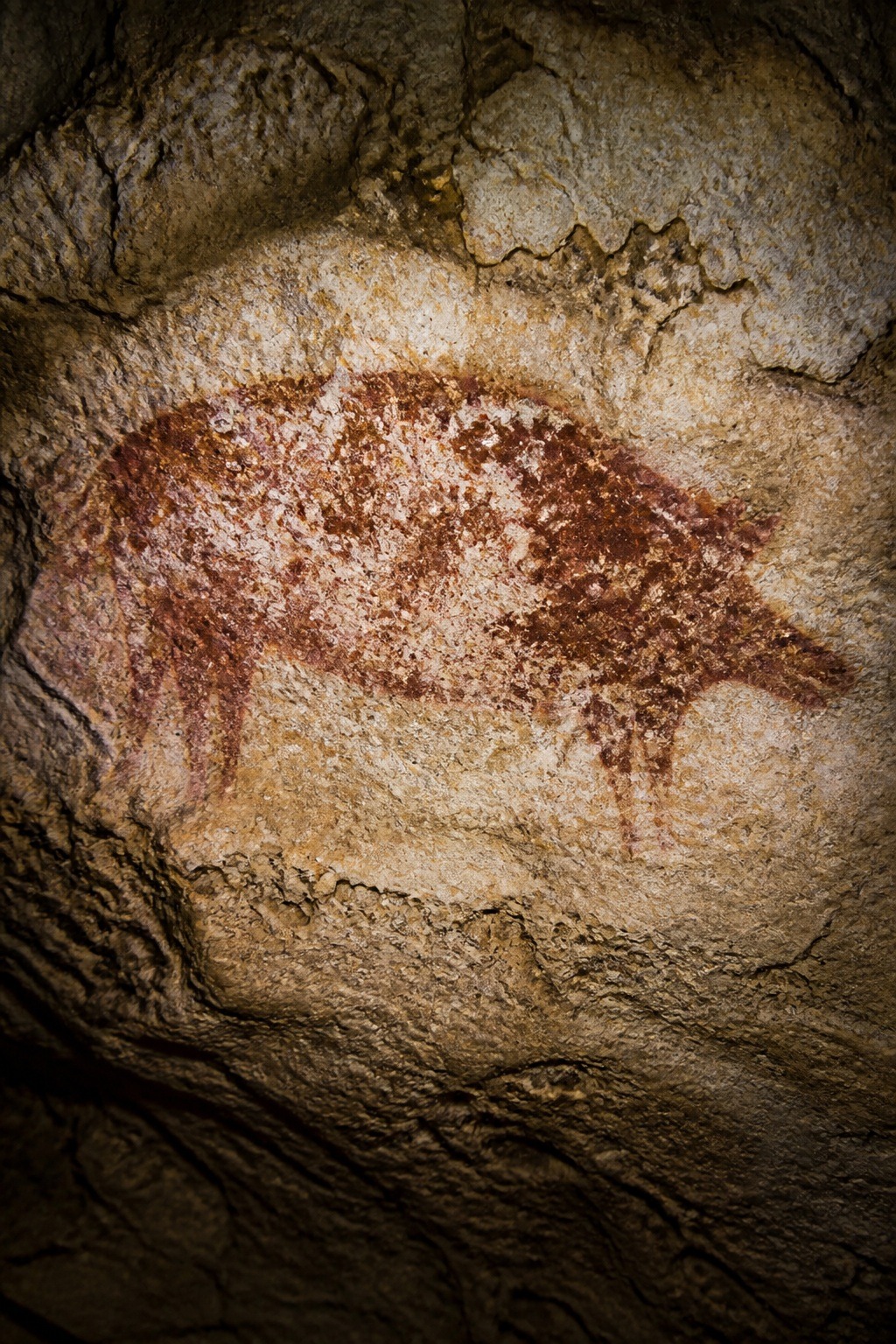
- Where: Leang Karampuang cave, Maros-Pangkep karst, South Sulawesi, Indonesia.
- What: a 92 × 38 cm red-ochre panel — one large Sulawesi warty pig (Sus celebensis) and three smaller part-human figures, one seeming to hold a stick or spear, another touching the pig’s snout.
- Age: at least 51,200 years — older than any cave art in Europe by roughly 15,000 years.
- Who dated it: a team led by Adhi Agus Oktaviana (BRIN), with Adam Brumm and Maxime Aubert (Griffith University) and Renaud Joannes-Boyau (Southern Cross University), published in Nature on 3 July 2024.
- How: laser-ablation uranium-series dating of the calcite crust that formed over the paint.
Key Facts
- The painting is a 92 x 38 cm red-ochre panel in Leang Karampuang cave, Maros-Pangkep karst, South Sulawesi, Indonesia, dated to at least 51,200 years old
- It depicts one large Sulawesi warty pig (Sus celebensis) and three smaller part-human figures, making it the oldest known figurative cave art and oldest surviving narrative
- The dating team was led by Adhi Agus Oktaviana (BRIN), with Adam Brumm and Maxime Aubert (Griffith University) and Renaud Joannes-Boyau (Southern Cross University), published in Nature on 3 July 2024
- The age was found using laser-ablation uranium-series dating of calcite crust; the laser beam samples slices about one-third the width of a human hair
- The Leang Bulu’ Sipong 4 hunting scene, first dated to 43,900 years in 2019, was pushed back to at least 48,000 years using the same method; the Karampuang art is older than European cave art by roughly 15,000 years
In short: A red-ochre panel in Leang Karampuang cave, Sulawesi, dated to at least 51,200 years, shows a wild pig and three part-human figures interacting in one scene. Published in Nature on 3 July 2024, it is the oldest known figurative cave art and the earliest surviving example of visual storytelling, predating European art by about 15,000 years.
What is actually painted on the wall?
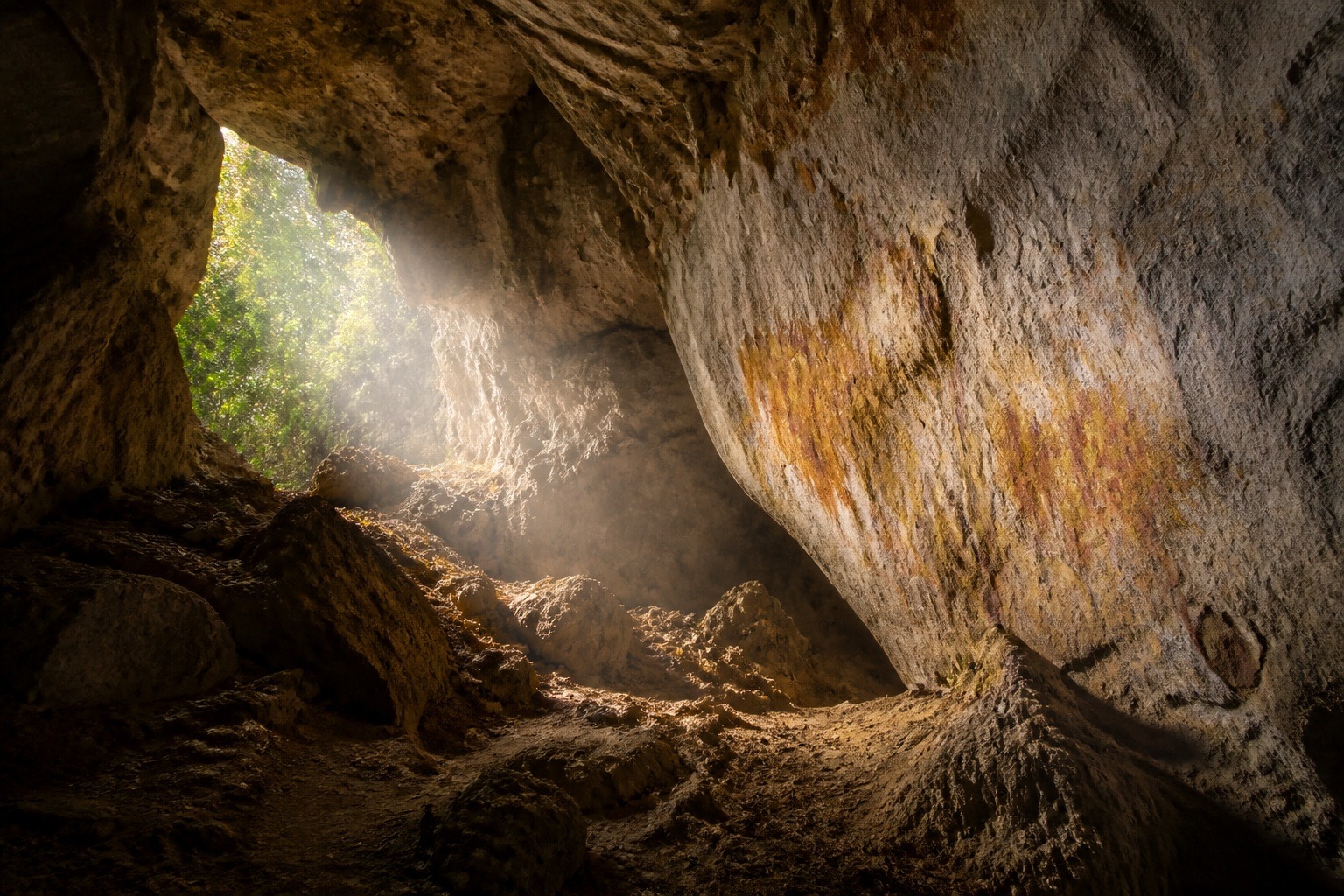
Stand under the panel and the scene is small — smaller than a bath towel — and badly faded. But the composition is unmistakable once your eye adjusts. A stout-bodied pig dominates the centre. Around and above it hover three figures with human-like postures and limbs, rendered at a fraction of the pig’s size. One appears to hold a long object toward the animal. Another reaches out, hand near the pig’s head.
That arrangement is the whole point. These are not separate doodles that happen to share a wall. They interact. They face each other, gesture, and combine into a single event unfolding in one frame — a hunt, or a ritual, or a myth. Grouping figures so they act on one another is the visual grammar of storytelling, and here it is, tens of thousands of years before writing.
Turns out the researchers who reported the find, Adam Brumm and Adhi Agus Oktaviana among them, argue in Nature that this is the earliest evidence of exactly that cognitive leap: not just drawing a thing, but staging a scene.
{IMAGE_2}
Why a pig, of all animals?
The star of the oldest scene humans ever painted is a pig. Not a mammoth, not a lion — a pig. And that is not an accident of taste.
The animal is Sus celebensis, the Sulawesi warty pig, found nowhere else on Earth. On Pleistocene Sulawesi it was the staple game animal, and it shows up again and again across the island’s rock art. There is a survival logic behind the obsession. Tropical forests are notoriously poor in fat; lean meat alone can’t sustain a human diet for long. A wild pig’s body fat was one of the few reliable calorie-dense foods available, which made Sus celebensis less a menu item than a lifeline.
So when Ice Age Sulawesans painted a pig at the centre of their oldest story, they were painting the thing their lives revolved around — the way later cultures painted their gods, their kings, their harvests. The pig is the protagonist because the pig was survival itself.
Therianthropes: the oldest trace of mythology?
Here is the detail most retellings skip. The three “hunters” are not fully human. Earlier Sulawesi panels — and the researchers’ reading of this one — describe therianthropes: figures that blend human and animal features, a person with, say, the head or tail of a beast.
Why does that matter so much? Because a therianthrope is something that does not exist in the physical world. To paint one, a mind has to imagine a being it has never seen — and expect other minds to understand it. That is the machinery of religion, folklore, and the supernatural: shared belief in things that aren’t literally there.
If these figures really are part-animal, the panel is not just the oldest art. It may be the oldest physical fingerprint of mythology — of humans telling each other about spirits, ancestors, or gods. Strip away the geography and one fact stays uncomfortable for the old textbooks: people at the edge of Ice Age Indonesia were already thinking in symbols and stories long before anyone in Europe picked up an ochre crayon.
How do you date the world’s oldest story cave painting?
You can’t carbon-date the ochre itself — mineral pigment holds no useful radiocarbon. So the team dated the rock instead, using a method with a mouthful of a name: laser-ablation uranium-series imaging. In plain English, it works like this.
Water seeping over cave walls leaves behind microscopic layers of calcite — the same stuff as stalactites — that slowly bury the paint. That calcite contains traces of uranium, which decays into thorium at a known, clock-steady rate. Measure the ratio and you get an age. Crucially, calcite sitting on top of the pigment must have formed after the paint went on — so its age is a minimum age for the art beneath.
The breakthrough was the laser. Renaud Joannes-Boyau of Southern Cross University helped develop a technique that fires a beam about one-third the width of a human hair, sampling the calcite in ultra-thin slices right at the paint surface. The older bulk-sampling method dissolved a chunk of crust and averaged everything in it — including younger calcite from later seepage — which dragged the estimate downward. When Sulawesi panels were re-measured this way, several jumped thousands of years older. The famous Leang Bulu’ Sipong 4 hunting scene, first dated to 43,900 years in 2019, was pushed back to at least 48,000. The same tool is now being aimed at cave art worldwide — and some of it is about to get a lot older on paper.
Older than Lascaux by 34,000 years
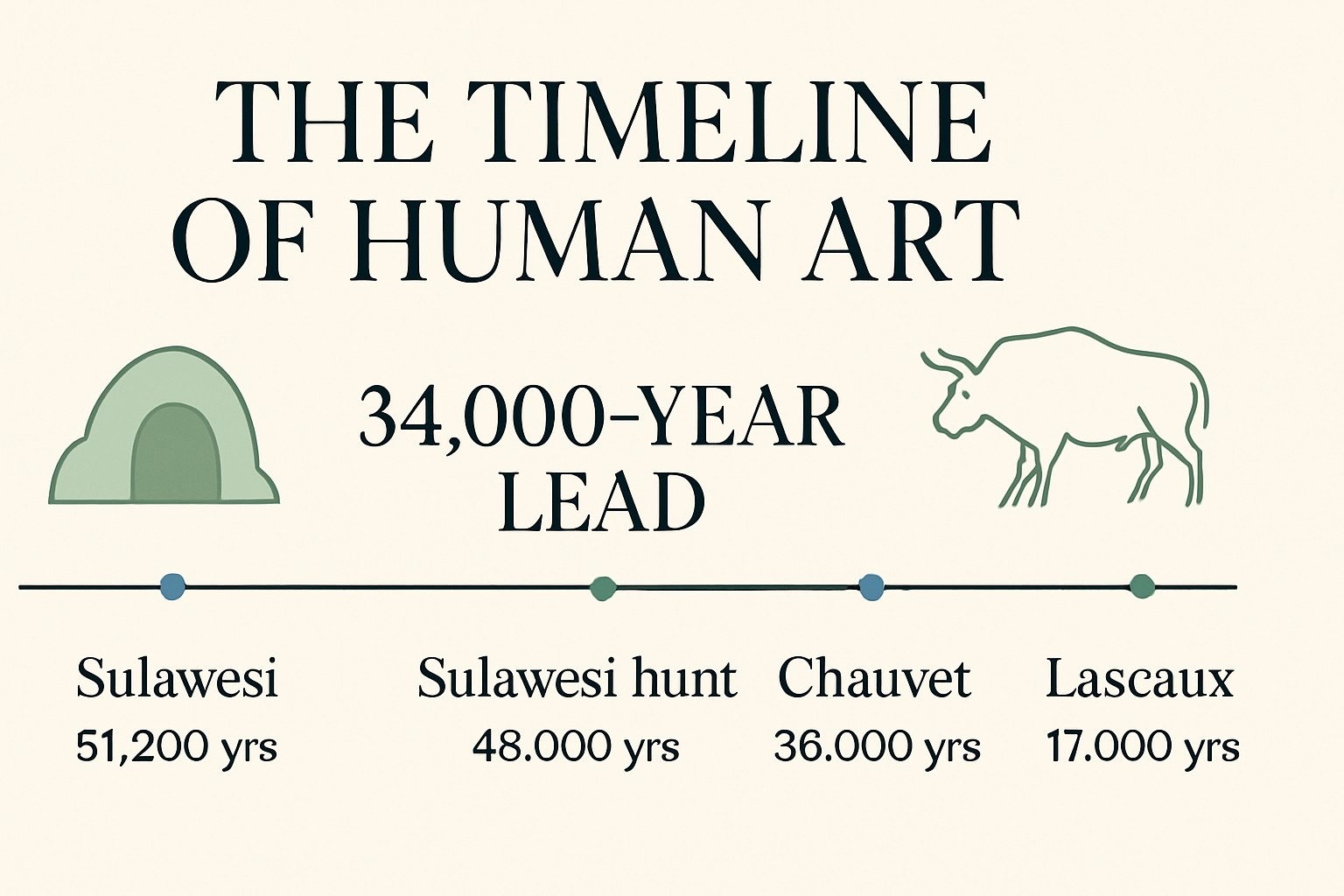
For a century, the story of human art was told from Europe outward: the painted bulls of Lascaux, the lions of Chauvet, the “birth of the imagination” in Ice Age France. Sulawesi quietly detonates that timeline. Here is how the headline sites line up.
| Site | Location | Minimum age | What it shows |
|---|---|---|---|
| Leang Karampuang | Sulawesi, Indonesia | ≥ 51,200 yrs | Pig + human-like figures (a narrative scene) |
| Leang Bulu’ Sipong 4 | Sulawesi, Indonesia | ≥ 48,000 yrs | Therianthropes hunting wild pigs & dwarf buffalo |
| Chauvet | France | ~ 36,000 yrs | Lions, rhinos, horses (mostly single animals) |
| Lascaux | France | ~ 17,000 yrs | Bulls, horses, deer |
The gap is not close. The Sulawesi scene predates Chauvet by around 15,000 years and Lascaux by roughly 34,000. Humans were composing scenes in tropical Indonesia before the ancestors of Lascaux’s painters had left anything we would recognise as figurative art. The “cradle of art” was never a single cradle — and it certainly wasn’t only European.
On the road to Australia
Sulawesi’s location makes the discovery even richer. The island sits along the island-hopping corridor that anatomically modern humans travelled on their way to Sahul — the Ice Age landmass that joined Australia and New Guinea — which people reached by roughly 65,000 years ago.
That means storytelling wasn’t invented after our species settled down somewhere comfortable. It was already luggage on the journey. The same populations moving through these islands carried the cognitive kit for symbolic art with them, and Australia’s own ancient rock-art traditions sit at the far end of that same road. The Sulawesi caves are a snapshot of the imagination in transit.
The 2026 twist: even older hand stencils
Just when the 51,200-year figure looked settled, Sulawesi produced another surprise. In January 2026, a study in Nature led by Christopher Standish reported hand stencils at Liang Metanduno on Muna island, off the Sulawesi coast, dated to at least 67,800 years old — older still.
Does that dethrone Leang Karampuang? Not exactly, and the distinction matters. A hand stencil is powerful evidence of symbolic behaviour, but it is a single mark, not a scene. It doesn’t depict an event or characters acting on one another. So the Muna stencils extend the timeline of Sulawesi rock art deeper into the Pleistocene, while Leang Karampuang keeps its specific crown: the oldest known figurative art and the oldest surviving narrative. One record is about age; the other is about the birth of storytelling. Both belong to the same astonishing island.
A painting that is dying
There is a hard truth under all of this. The oldest story humans ever painted may not survive the century.
The rock surface is exfoliating — flaking away in scales — as salt crystallises inside the limestone and heat and humidity swing through the caves. Coralloid mineral growths, sometimes called “cave popcorn,” creep across the pigment and slowly consume it. Researchers who have worked the site describe watching sections erode between visits. The image that waited 51,000 years for us to notice it is disappearing now, in real time.
Which is why the same laser scientists are racing to record every panel in high-resolution 3D and multispectral imaging — so that even if the physical paint is lost, the story it tells is not. The most valuable thing we can do with the oldest picture on Earth is make sure we still have it after the wall is gone.
Quick answers
What is the world’s oldest story cave painting? A red-ochre panel at Leang Karampuang cave in South Sulawesi, at least 51,200 years old, showing a wild pig and three human-like figures in a single interacting scene.
How old is it exactly? A minimum of 51,200 years, based on uranium-series dating of the calcite over the paint. It could be older; the method gives a floor, not a ceiling.
Is it older than Lascaux and Chauvet? Yes — by about 34,000 years over Lascaux and 15,000 over Chauvet, overturning the idea that figurative art began in Europe.
Aren’t there older cave marks? Yes. Hand stencils on nearby Muna island were dated to ~67,800 years in 2026, but a stencil isn’t a narrative. Leang Karampuang remains the oldest known scene.
Sources and notes
- Oktaviana, A. A., Joannes-Boyau, R., Brumm, A., Aubert, M., et al. (2024). “Narrative cave art in Indonesia by 51,200 years ago.” Nature, vol. 631.
- Aubert, M., Brumm, A., Oktaviana, A. A., et al. (2019). “Earliest hunting scene in prehistoric art.” Nature, vol. 576 (Leang Bulu’ Sipong 4).
- Standish, C. D., et al. (2026). “Rock art from at least 67,800 years ago in Sulawesi.” Nature (hand stencils, Muna island).
- Griffith University and Indonesia’s National Research and Innovation Agency (BRIN) — research announcements on the Maros-Pangkep dating program.
Next time the “cradle of art” comes up, picture a small cave in Sulawesi, a fat wild pig, and three half-human figures frozen mid-story on the ceiling — painted 51,200 years ago by people who already knew that pictures could carry meaning across time. If you ever get the chance to look at high-resolution scans of the Maros-Pangkep panels, do it soon. The paint is fading, but the story it started is still ours to keep.
Frequently Asked Questions
Q: Where is the world’s oldest story cave painting and how old is it?
It is a red-ochre hunting scene on the ceiling of Leang Karampuang cave in the Maros-Pangkep karst of South Sulawesi, Indonesia. The 92 by 38 cm panel is dated to at least 51,200 years old, making it not only the oldest figurative cave art ever found but also the oldest surviving narrative. That is older than any cave art in Europe by roughly 15,000 years, overturning the long-held view that figurative art began in Ice Age France.
Q: What does the painting actually show?
The panel shows one large Sulawesi warty pig (Sus celebensis) at the centre, with three smaller human-like figures around and above it, rendered at a fraction of the pig’s size. One figure appears to hold a long object toward the animal, and another reaches out with a hand near the pig’s head. The figures interact, gesture, and combine into a single event in one frame, a hunt, ritual or myth, which is the visual grammar of storytelling tens of thousands of years before writing.
Q: Why did the artists paint a pig instead of a large predator?
The animal is Sus celebensis, the Sulawesi warty pig, found nowhere else on Earth and the staple game animal of Pleistocene Sulawesi. Tropical forests are notoriously poor in fat, and lean meat alone cannot sustain a human diet for long, so a wild pig’s body fat was one of the few reliable calorie-dense foods available. The pig was survival itself, which is why Ice Age Sulawesans placed it at the centre of their oldest story.
Q: How was the painting dated without carbon-dating the ochre?
Mineral pigment holds no useful radiocarbon, so the team dated the rock instead using laser-ablation uranium-series imaging. Water seeping over cave walls leaves microscopic calcite layers that bury the paint; that calcite contains uranium which decays into thorium at a steady rate, so measuring the ratio gives an age. Because the calcite formed after the paint went on, its age is a minimum age for the art. A laser about one-third the width of a human hair samples ultra-thin slices at the paint surface.
Illustrations are AI-generated. Article fact-checked and human-edited. Our editorial standards.