Is the Bayeux Tapestry Embroidered or Woven?
Short answer to the question everyone asks — is the Bayeux Tapestry embroidered or woven? It’s embroidered. The most famous “tapestry” in the world is not a tapestry at all in the modern sense: it’s a 68-metre strip of plain linen with the entire story of 1066 stitched onto its surface in coloured wool. The name is a centuries-old misnomer, and once you know why, you never look at the thing the same way again.
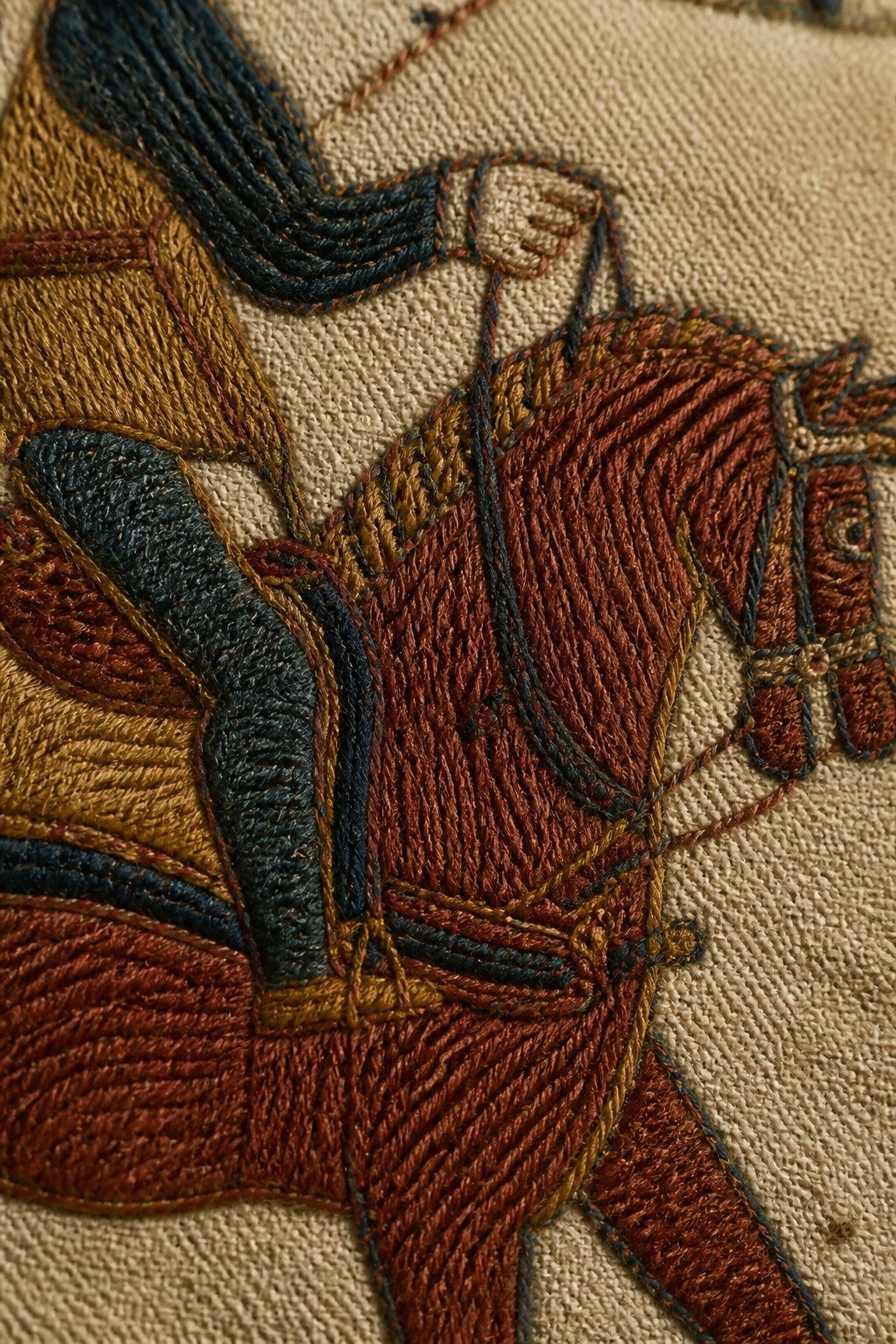
- Technique: embroidery — wool thread needled onto woven linen. Not weaving.
- Size: nearly 70 metres long (68.3 m to be exact), about 50 cm tall, made of 9 joined linen panels.
- Palette: roughly 10 wool colours, all from just 3 dye plants; 4 embroidery stitches.
- Story: the Norman Conquest of 1066 — Harold’s oath, the Battle of Hastings, even Halley’s Comet.
- Made & seen: the 1070s, probably by English embroiderers in Canterbury; on loan at the British Museum, London, 10 September 2026 – 11 July 2027.
Key Facts
- The Bayeux Tapestry is an embroidery, worked in wool thread on a woven linen ground, not a woven tapestry
- It is 68.3 metres long and about 50 cm tall, made of 9 joined linen panels
- Its palette uses roughly 10 wool colours coaxed from just 3 dye plants: woad (blue), madder (red), and dyer’s rocket (yellow)
- Four stitches were used: stem, chain, split, and couching (the ‘Bayeux stitch’)
- It was made in the 1070s, probably by English embroiderers in Canterbury, and goes on loan at the British Museum from 10 September 2026 to 11 July 2027
In short: The Bayeux Tapestry is an embroidery, not a woven tapestry: a 68.3-metre linen strip covered in wool imagery telling the story of the 1066 Norman Conquest. Made in the 1070s, likely by English embroiderers in Canterbury, it uses just three dye plants, ten colours, and four stitches.
Is the Bayeux Tapestry embroidered or woven?
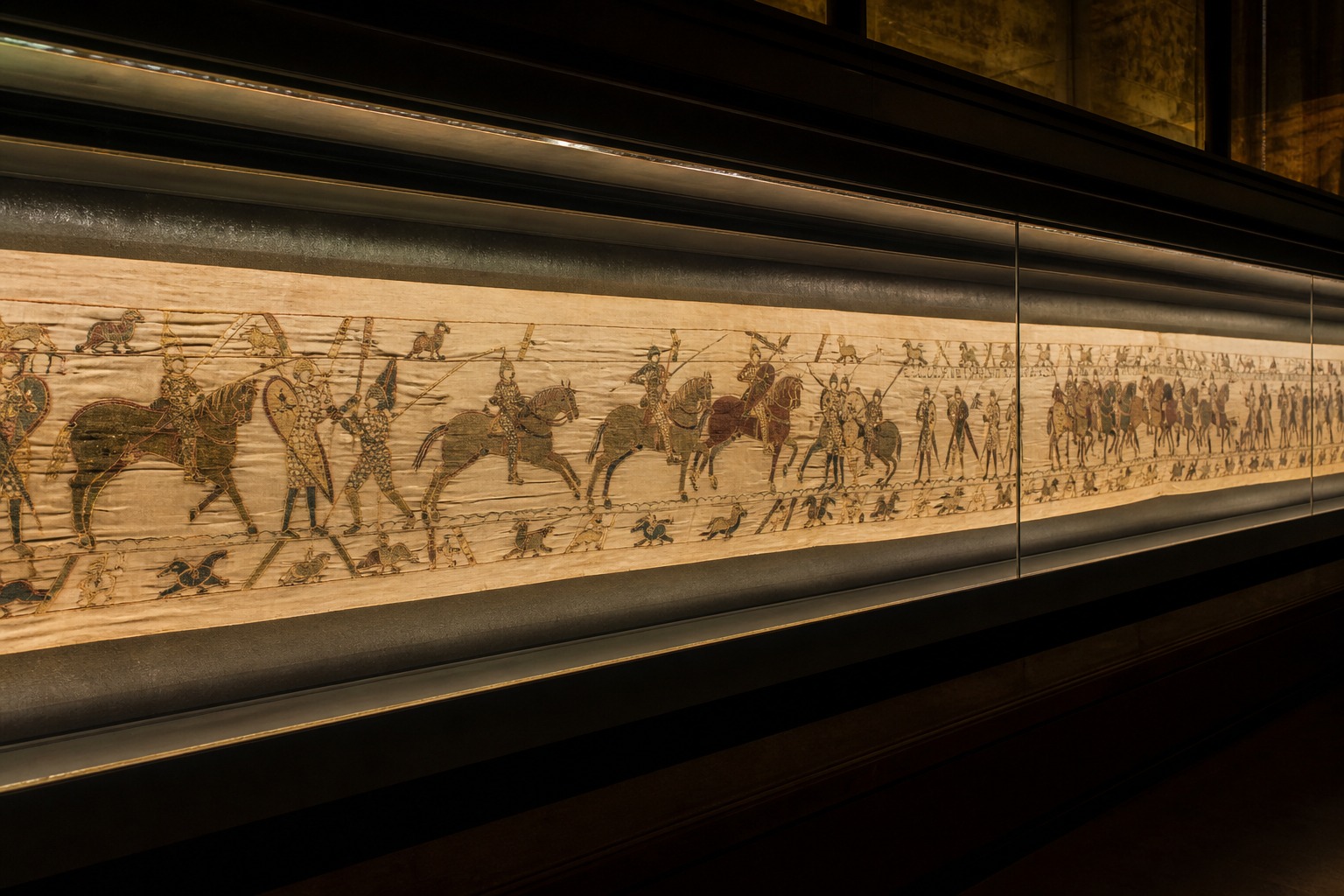
Embroidered. Full stop. Every art historian, conservator, and textile scientist who has examined it agrees: the Bayeux Tapestry is an embroidery, worked in wool on a linen ground. The Musée de la Tapisserie de Bayeux, which has cared for the object for generations, calls it exactly that — “an embroidery.”
So why the confusion? Because we call it a tapestry, and a real tapestry is woven. Two completely different crafts got fused into one household word, and the word won. It stuck so hard that most people picture looms and shuttles when the truth involves a needle and a lot of very patient hands.
The distinction isn’t pedantry. It changes what the object is — how it was planned, who made it, and how fast it could physically be produced.
Tapestry vs embroidery: the difference that changes everything
Here’s the thing that competitors mention but rarely make click. In a true woven tapestry, the picture and the cloth are born together. The image doesn’t sit on the fabric — the image is the fabric. A weaver builds it thread by thread on a loom, interlacing coloured wefts through the warp so that a hunting scene or a coat of arms emerges as the cloth itself grows. Pull it apart and there’s nothing underneath, because the picture goes all the way through.
Embroidery works the other way around. You weave a plain blank cloth first. Then, separately, you draw or stitch a design onto its surface with a threaded needle. The Bayeux strip is exactly this: linen woven in a simple over-under (tabby) weave, left completely blank, and only afterwards covered in wool imagery. Cut the wool away and you’d still have the linen — undecorated, but intact.
{IMAGE_2}
| Woven tapestry | Embroidery (the Bayeux method) | |
|---|---|---|
| How the image is made | Coloured threads interlaced on a loom, at right angles | Wool stitched onto an already-finished cloth with a needle |
| Order of work | Cloth and picture created at the same time | Blank cloth woven first, picture added afterward |
| Where the picture “lives” | All the way through the fabric | On the surface only |
| Real-world example | The Lady and the Unicorn (Paris); most museum “tapestries” | The Bayeux Tapestry |
How it was actually made
The materials are almost shockingly simple for something so ambitious. The ground is linen, woven plain. The drawing is done entirely in wool. And the colour — every blue sky, every red cloak, every green hill across 68 metres — comes from only three plants.
Woad gave the blues. Madder root gave the reds, oranges, pinks and browns. Dyer’s rocket (also called weld) gave the yellows. From that tiny botanical toolkit, medieval dyers coaxed somewhere between eight and ten distinct shades, including a near-black from heavily mordanted woad. An entire war epic, painted in the colours of three roadside weeds.
- 3 dye plants — woad (blue), madder (red), dyer’s rocket (yellow)
- ~10 wool colours coaxed from those three
- 4 stitches — stem, chain, split, and couching (the “Bayeux stitch”)
- 9 linen panels sewn into one continuous band
- 68.3 m long × ~50 cm tall
Four stitches did all the work. Stem, chain and split stitch handle the outlines and fine detail. The fourth — couching, nicknamed the “Bayeux stitch” — is the clever one: lay down long threads to flood a shape with colour, then tack them flat with tiny cross-stitches. It fills large areas fast, which matters a great deal when you have a battlefield of horses to cover and, presumably, a deadline.
Then why is it called a “tapestry”?
Blame the language, not the makers. When the piece was created, the medieval French word tapisserie (and its Latin cousins) simply meant a decorative hanging — anything you draped on a wall to warm and adorn it. It carried no promise about how the thing was made. Woven, stitched, painted on cloth: all “tapestry.”
The narrower, technical meaning — “tapestry” as a specific loom-woven fabric — hardened later. By then the label had been fixed to the Bayeux hanging for centuries. So the name isn’t really wrong; it’s archaic. It’s a word that got trapped in amber before the language grew a more precise one.
Calling it woven, in other words, isn’t a blunder so much as a fossil — a term that predates the distinction it now seems to break.
Who really made it — and the Queen Matilda myth
A romantic old story says the embroidery was the work of Queen Matilda, wife of William the Conqueror, and her ladies — or, in another version, a convent of pious nuns. In France it’s still sometimes affectionately called “La Tapisserie de la Reine Mathilde.” It’s a lovely image. It’s also almost certainly wrong.
Modern scholarship points somewhere less royal and more professional: skilled Anglo-Saxon embroiderers, working in England, most likely in or around Canterbury in Kent. The clues are in the object itself. The Latin captions use spellings that betray English hands, and several scenes echo manuscripts known to have been at Canterbury’s monasteries. English needlework — opus anglicanum — was famous across Europe at the time, the luxury embroidery brand of its day. This wasn’t a hobby project. It was a commission executed by experts.
And the commissioner? The consensus finger points at Bishop Odo of Bayeux, William’s ambitious half-brother, who appears in the story with suspicious prominence. English artisans, a Norman patron, a French cathedral as the destination — the object was cross-Channel from the very first stitch.
What the strip shows, and where it was built to hang
Read left to right, the 68 metres unspool like a graphic novel a millennium ahead of its time. Harold of England sails to Normandy and swears an oath to William. He returns, is crowned king, and a hairy star streaks the sky — Halley’s Comet, blazing over the coronation like a bad omen (which, for Harold, it was). Then the fleet, the horses, the shield wall, and the chaos of the Battle of Hastings in October 1066, arrows and falling men and all.
Where was this meant to be seen? A striking 2019 study offers an answer. Christopher Norton, an art historian at the University of York writing in the Journal of the British Archaeological Association, matched the embroidery’s dimensions against the plan of the 11th-century Bayeux Cathedral. His conclusion: the strip was tailored to fit the nave, hung around its north, south and west walls, its scenes deliberately spaced to fall between the doorways and pillars. Whoever designed it, Norton argues, must have stood inside that cathedral and measured.
That reframes the whole thing. It isn’t a painting that happens to be long. Its length is architecture — a story cut to the shape of a specific room.
See it in London: the 2026–2027 British Museum loan
For the first time in nearly a thousand years, the embroidery is coming to England. While its home museum in Normandy undergoes renovation, the Bayeux Tapestry goes on loan to the British Museum in London, on display in the Sainsbury Exhibitions Gallery from 10 September 2026 to 11 July 2027. The last time it was on British soil, the events it depicts were still living memory.
Curators plan to show it flat and in one continuous length in a purpose-built case — a viewing experience the object has rarely, if ever, had. Demand has been extraordinary: early ticket releases sold out fast, with further batches scheduled across the run. If you want to test the “embroidery, not weaving” point with your own eyes, this is the chance of several lifetimes. Get close, and you can see the wool sitting on the linen — proof, thread by thread, of everything above.
Common questions
Is the Bayeux Tapestry a real tapestry? No. It’s an embroidery — wool stitched onto woven linen. A real tapestry has its image woven into the cloth on a loom. The name is a historical misnomer.
Who made the Bayeux Tapestry? Most likely professional English (Anglo-Saxon) embroiderers, probably in Canterbury, in the 1070s. It was almost certainly commissioned by Bishop Odo of Bayeux — not, as legend claims, by Queen Matilda or a group of nuns.
How long is it? About 68.3 metres (nearly 70) long and roughly 50 centimetres tall, made from 9 linen panels sewn together.
Where can I see it? Normally the Musée de la Tapisserie de Bayeux in Normandy, France. From 10 September 2026 to 11 July 2027 it’s on special loan at the British Museum in London.
Sources
- Musée de la Tapisserie de Bayeux (Bayeux Museum) — official analysis of the embroidery, materials, dyes and stitches
- Christopher Norton, University of York — “Viewing the Bayeux Tapestry, Now and Then,” Journal of the British Archaeological Association (2019)
- British Museum — press releases on the 2026–2027 Bayeux Tapestry loan and exhibition
- Smithsonian Magazine — reporting on the Norton study and the British Museum loan
The next time someone calls it a tapestry, you’ll know the truth stitched underneath the name: it’s an embroidery, one blank strip of linen and a war’s worth of wool. And if you can stand in front of it in London before July 2027, do — the difference between woven and stitched is invisible in photographs and unmistakable in person.
Frequently Asked Questions
Q: Is the Bayeux Tapestry embroidered or woven?
It is embroidered. Every art historian, conservator, and textile scientist who has examined it agrees the Bayeux Tapestry is an embroidery, worked in wool on a linen ground. The Musee de la Tapisserie de Bayeux, which has cared for the object for generations, calls it exactly that, an embroidery. The confusion comes from the word ‘tapestry,’ since a real tapestry is woven, but here the linen was woven blank first and the wool imagery added afterward with a needle.
Q: What is the difference between a tapestry and an embroidery?
In a true woven tapestry the picture and the cloth are born together: a weaver interlaces coloured wefts through the warp on a loom, so the image goes all the way through the fabric. Embroidery works the other way around. You weave a plain blank cloth first, then draw or stitch a design onto its surface with a threaded needle. The Bayeux strip is linen woven in a simple over-under weave, left blank, then covered in wool imagery.
Q: What materials and colours were used to make it?
The ground is plain woven linen and the drawing is done entirely in wool. Every colour across 68 metres comes from only three plants: woad gave the blues, madder root gave reds, oranges, pinks and browns, and dyer’s rocket (weld) gave the yellows. From that toolkit medieval dyers coaxed between eight and ten distinct shades, including a near-black from heavily mordanted woad. Four stitches did all the work: stem, chain, split, and couching, the ‘Bayeux stitch.’
Q: Who actually made the Bayeux Tapestry?
A romantic old story credits Queen Matilda, wife of William the Conqueror, and her ladies, or a convent of nuns. It is almost certainly wrong. Modern scholarship points to skilled Anglo-Saxon embroiderers working in England, most likely in or around Canterbury in Kent. The clues are in the object: the Latin captions use spellings that betray English hands, and several scenes echo manuscripts known to have been at Canterbury’s monasteries. English needlework, opus anglicanum, was famous across Europe.
Illustrations are AI-generated. Article fact-checked and human-edited. Our editorial standards.