Halley’s Comet in the Bayeux Tapestry: A 1066 Omen
Late April, 1066: a smear of cold fire hangs over the English sky, and half a kingdom stops to stare — the moment that, stitched into dyed wool a few years later, became the Halley’s Comet Bayeux Tapestry scene the whole world now recognises. Five men crane their necks toward a blazing star with a whip of a tail. Above them runs a line of clumsy Latin. Below them, almost hidden, ghostly ships drift in the border. It is the oldest surviving artwork of the most famous comet in history — and, it turns out, one of the earliest pieces of political spin ever sewn into cloth.
Key Facts
- The Bayeux Tapestry is embroidery of coloured wool on bleached linen, roughly 70 metres (about 230 feet) long and half a metre tall, telling the Norman conquest across 58 scenes.
- The comet appears in scenes 32 and 33, between Harold’s coronation and the news reaching the new king; the Battle of Hastings was fought on 14 October 1066.
- The stitched Latin reads ISTI MIRANT STELLA (“These men marvel at the star”), which is grammatically wrong — a trained scribe would have written isti mirantur stellam.
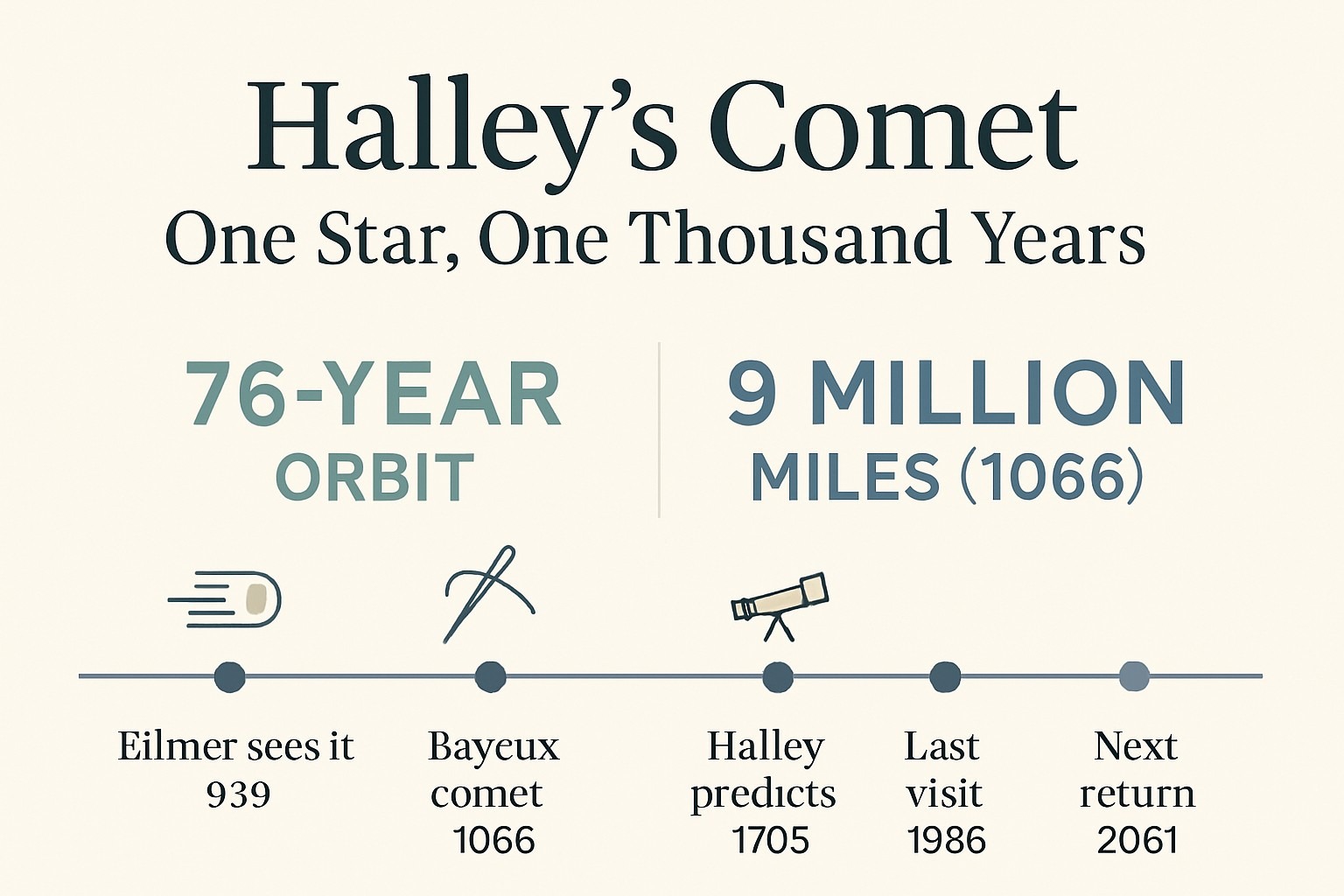
- Eilmer, a monk at Malmesbury Abbey, reportedly saw the comet around 989 as a boy and again in 1066 — about 77 years apart, close to Halley’s orbital period of about 76 years.
- In November 2025 Michael Lewis (British Museum) and Simon Portegies Zwart (Leiden Observatory) published an analysis (arXiv 2511.14809) arguing the comet was placed retrospectively for political reasons.
In short: The Bayeux Tapestry’s scenes 32-33 show Halley’s Comet (1P/Halley) over England in 1066, the oldest surviving artwork of the comet. A 2025 study by Lewis and Portegies Zwart argues it was stitched in retrospectively as political propaganda linking Harold’s broken oath to his downfall.
A star with hair, stitched into linen

First, the object itself. The Bayeux Tapestry isn’t a tapestry in the strict weaver’s sense — it’s embroidery: coloured wool worked onto a strip of bleached linen roughly 70 metres long (about 230 feet) and half a metre tall. Across its 58 scenes it tells one story, the Norman conquest of England in 1066, from Harold Godwinson’s fateful trip to Normandy to the bloody end at the Battle of Hastings on 14 October.
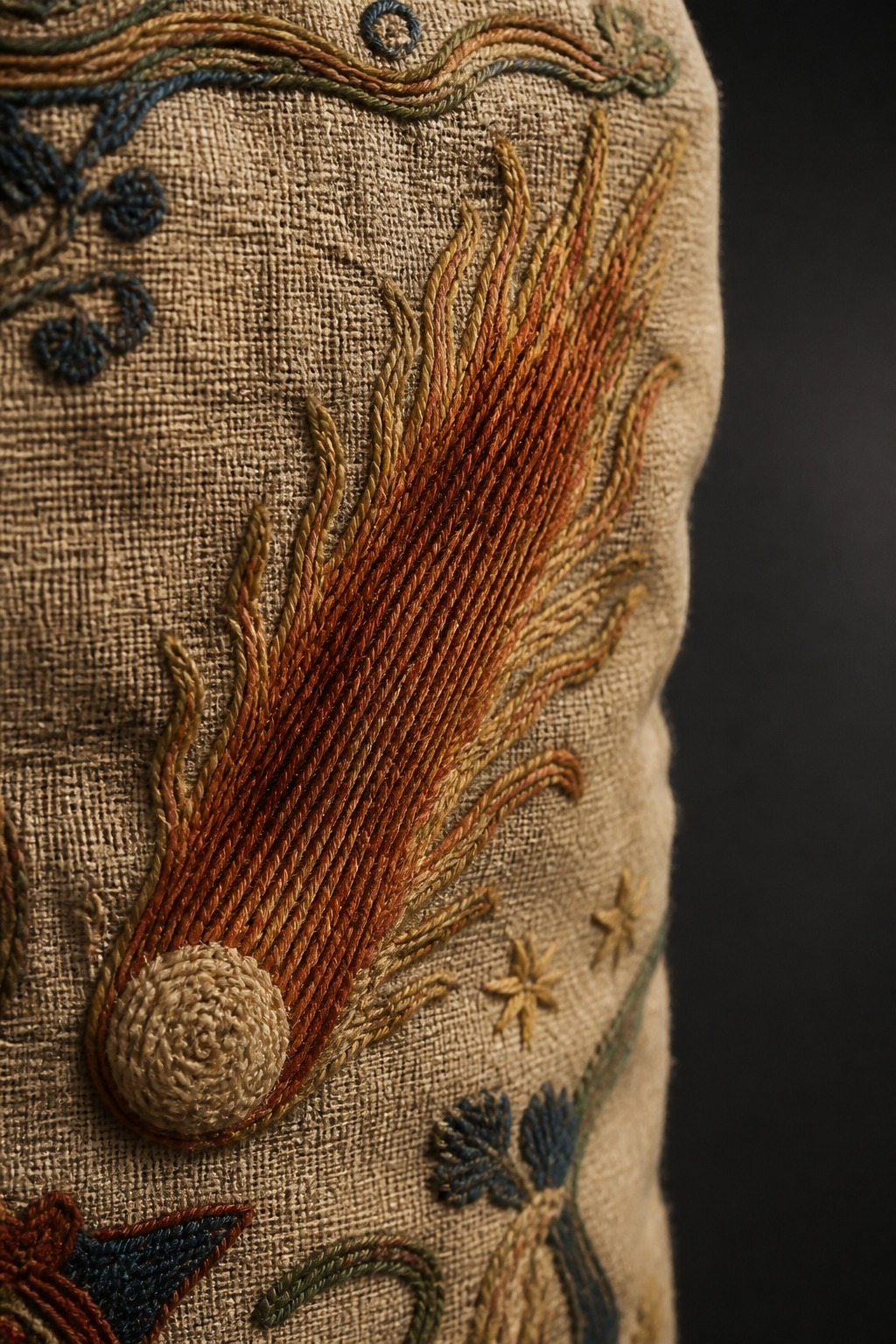
Somewhere near the middle, the needlework stops being a chronicle of men and boats and does something stranger. It looks up. A comet erupts across the top of the fabric, rendered as a spoked orb trailing a flaming plume — what medieval writers called a “hairy star,” which is exactly what the word comet means (from the Greek komē, hair). The English who saw it in 1066 had no idea what it was. We do. It was Comet 1P/Halley, swinging past Earth on its long loop around the Sun, and this scrap of embroidery is the first time a human being ever drew it.
Isti Mirant Stella — the men who marvelled at the star
Stitched above the pointing courtiers are three words: ISTI MIRANT STELLA. Translated loosely, “These men marvel at the star.” Here’s a small detail most explainers skip: the Latin is wrong. A trained scribe would have written isti mirantur stellam. The tapestry’s version is broken grammar — a hint that the makers were craftspeople following a design, not classical scholars, and a reminder that this is a workshop object, made by hand, mistakes and all.
The scene sits deliberately. To the left, the previous panels show Edward the Confessor dying childless and Harold being crowned king of England. Then, immediately, the star. The courtiers who point at it are not curious astronomers. They are afraid. In the visual grammar of 1066, a comet was never a neutral event.
Where the comet hides: scenes 32 and 33
If you ever stand in front of the real thing in Bayeux, Normandy, look for scenes 32 and 33. That’s where the comet lives, wedged between Harold’s coronation and the first news of it reaching the new king. Harold is shown slumping on his throne as courtiers gesture upward — the body language of a man watching his luck curdle.
Now drop your eyes to the lower border. Along the bottom of the tapestry runs a decorative strip, mostly animals and knotwork. But directly beneath the comet, the embroiderers stitched something else: the faint outlines of ships, empty and waiting. Most visitors walk straight past them. They shouldn’t. Those phantom ships are widely read as a foreshadowing of the invasion fleet William of Normandy would soon launch across the Channel — a visual whisper that the star in the sky and the boats on the horizon are the same doom, arriving in two acts.
{IMAGE_2}
Eilmer of Malmesbury, the monk who knew the star would return
And here is the story almost no one tells. While frightened Englishmen were reading the 1066 comet as a curse, one man recognised it as a returning visitor. His name was Eilmer, a monk at Malmesbury Abbey — the same Eilmer remembered as the “flying monk,” who decades earlier had strapped on homemade wings, leapt from the abbey tower, glided a short distance, and broken both legs on landing.
According to the chronicler William of Malmesbury, writing his Gesta Regum Anglorum around 1125, Eilmer had seen this comet once before — as a small boy, during its appearance around the year 989. When it blazed back into the sky in 1066, the old monk reportedly cried out that he had seen it before, decades earlier, and knew what it meant. William records him saying to the star, in effect: “You’ve come, have you? … you source of grief to many mothers.” Roughly seventy-seven years separated his two sightings — startlingly close to Halley’s true orbital period of about 76 years.
Let’s be honest about what that does and doesn’t mean. Eilmer did not calculate an orbit. He did not predict a date. That mathematical triumph belonged to Edmond Halley, who used Newton’s physics in the early 1700s to prove the comet was periodic and forecast its 1758 return. But Eilmer, more than six centuries earlier, did the harder-to-imagine thing: he looked at a light in the sky and understood, from memory alone, that it was the same light coming back. That is proto-astronomy from a Benedictine cloister — and it deserves far more airtime than it gets.
Omen or propaganda? What the 2025 research argues
For centuries the comet on the tapestry was treated as honest reporting: something scary happened in the sky, so the artists recorded it. New scholarship pushes back hard. In November 2025, Michael Lewis of the British Museum and astronomer Simon Portegies Zwart of Leiden Observatory published an analysis (posted as a research paper, arXiv reference 2511.14809) arguing that the comet was placed in the tapestry retrospectively and for political reasons — not as a diary entry, but as a message.
Their reasoning is elegant. The tapestry never even calls the object a comet or Halley; it just shows a hairy star and lets the picture do the talking. And crucially, the makers weren’t trying to log an accurate astronomical date. They positioned the star to sit right on the seam between Harold’s coronation and his downfall — so that anyone reading the cloth would connect the heavens’ displeasure to Harold’s broken oath to William. Read that way, the comet in the tapestry isn’t reportage at all; it’s the eleventh-century equivalent of a campaign ad, and a ruthlessly effective one.
The timeline trick in the Halley’s Comet Bayeux Tapestry
This is where the whole thing gets deliciously sneaky. Harold was crowned on 6 January 1066. The comet? It didn’t reach its closest, brightest pass until the spring — perihelion, its nearest point to the Sun, fell on 20 March 1066, and it blazed to naked-eye brilliance across late April. In other words, the star appeared months after Harold already sat on the throne.
But the tapestry stitches it in the instant after the crown touches his head. Cause, then effect: crime, then heavenly judgment. It’s a sleight of hand with a needle. By collapsing the real calendar, the Norman version of events made the sky itself look like a witness for the prosecution — God frowning on a usurper. Did the Anglo-Saxons who actually watched the comet in April read it the same way? Almost certainly not; to them it was raw dread, not a verdict on Harold. The tidy moral came later, from the winners.
From embroidery to orbit: the science, and 2061
Strip away the medieval terror and what’s left is a ball of ice, dust and rock a few kilometres across, on a fixed schedule. Halley’s Comet loops the Sun roughly every 76 years. In 1066 it passed within about 9 million miles of Earth — one of its closer historical approaches, which is partly why it looked so alarmingly bright.
The comet has kept its appointments ever since: seen in 1758 (as Halley predicted), 1835, 1910, and most recently in 1986, when the European Space Agency’s Giotto probe flew close enough to photograph its dark, peanut-shaped nucleus up close. Right now Halley is out beyond Neptune, drifting toward the far end of its orbit. It turns around and starts back toward us for a return that peaks on 28 July 2061.
- ~76 years — average time between returns
- 20 March 1066 — perihelion (closest approach to the Sun) during the conquest year
- ~9 million miles — how close it swept past Earth in 1066
- ~70 m (230 ft), 58 scenes — length and span of the Bayeux Tapestry
- 28 July 2061 — next perihelion; the next time you could see it
Do the arithmetic on that last date and something quiet happens. A child born today could stand in a field in 2061 and watch the exact same object that terrified Harold’s court and inspired a Malmesbury monk — the through-line from a strip of wool to a live sky, unbroken across a thousand years.
Quick answers
Is the star in the Bayeux Tapestry really Halley’s Comet? Yes. The inscription only calls it a star, but the depiction — a bright body with a long “hairy” tail — and the date (1066) match Halley’s documented pass. It’s regarded as the earliest known artwork of the comet.
What does “Isti mirant stella” mean? Roughly, “These men marvel at the star.” The Latin is grammatically irregular; a classical writer would have used mirantur stellam.
Where is the comet on the tapestry? Scenes 32–33, just after Harold’s coronation, with courtiers pointing up in alarm — and, in the lower border below, faint “phantom” ships.
When will Halley’s Comet return? Its next close pass peaks around 28 July 2061.
Sources and notes
- Michael Lewis (British Museum) and Simon Portegies Zwart (Leiden Observatory), “The significance of Halley’s Comet in the Bayeux Tapestry” (research paper, November 2025)
- William of Malmesbury, Gesta Regum Anglorum (“Deeds of the English Kings,” c. 1125) — the account of Eilmer of Malmesbury
- NASA — history features on Halley’s Comet and the Battle of Hastings (perihelion, distance, 76-year cycle, next return)
- European Space Agency (ESA) — “Comet Halley depicted on the Bayeux Tapestry” and the Giotto mission
- Bayeux Museum, Normandy — official custodian of the tapestry; scenes 32–33
- Science Museum, London — “Halley’s Comet: Collisions with history”
Nine centuries later, the trick still works: stand in front of that star and you feel a jolt of the same awe the courtiers felt. But the real marvel isn’t the omen the Normans wanted you to read — it’s that a frightened medieval workshop, a leaping monk, and a modern telescope are all looking at the same faithful visitor, and that in 2061 you may get your own turn to look up.
Frequently Asked Questions
Q: What does the Latin inscription ISTI MIRANT STELLA mean?
It translates loosely as “These men marvel at the star,” stitched above the pointing courtiers. The Latin is actually grammatically wrong; a trained scribe would have written isti mirantur stellam. This error hints that the makers were craftspeople following a design rather than classical scholars, and it reminds us the tapestry is a hand-made workshop object, complete with mistakes.
Q: Where exactly is the comet on the tapestry?
The comet appears in scenes 32 and 33, wedged between Harold’s coronation and the first news of it reaching the new king. Harold is shown slumping on his throne as courtiers gesture upward. Directly beneath the comet, in the lower border, the embroiderers stitched faint outlines of empty ships, widely read as foreshadowing William of Normandy’s invasion fleet.
Q: Who was Eilmer and why does he matter?
Eilmer was a monk at Malmesbury Abbey, remembered as the “flying monk” who once strapped on homemade wings, leapt from the tower and broke both legs. According to chronicler William of Malmesbury (writing around 1125), Eilmer had seen the comet as a boy around 989 and recognised it returning in 1066 — roughly 77 years later, from memory alone, an early act of proto-astronomy.
Q: What does the 2025 research argue about the comet?
In November 2025 Michael Lewis of the British Museum and astronomer Simon Portegies Zwart of Leiden Observatory published an analysis (arXiv 2511.14809) arguing the comet was placed in the tapestry retrospectively for political reasons, not as a diary entry. The makers positioned the star on the seam between Harold’s coronation and his downfall, linking the heavens’ displeasure to Harold’s broken oath to William.
Illustrations are AI-generated. Article fact-checked and human-edited. Our editorial standards.