Pazyryk Tattoos: The Frozen Chieftain’s Animal Ink
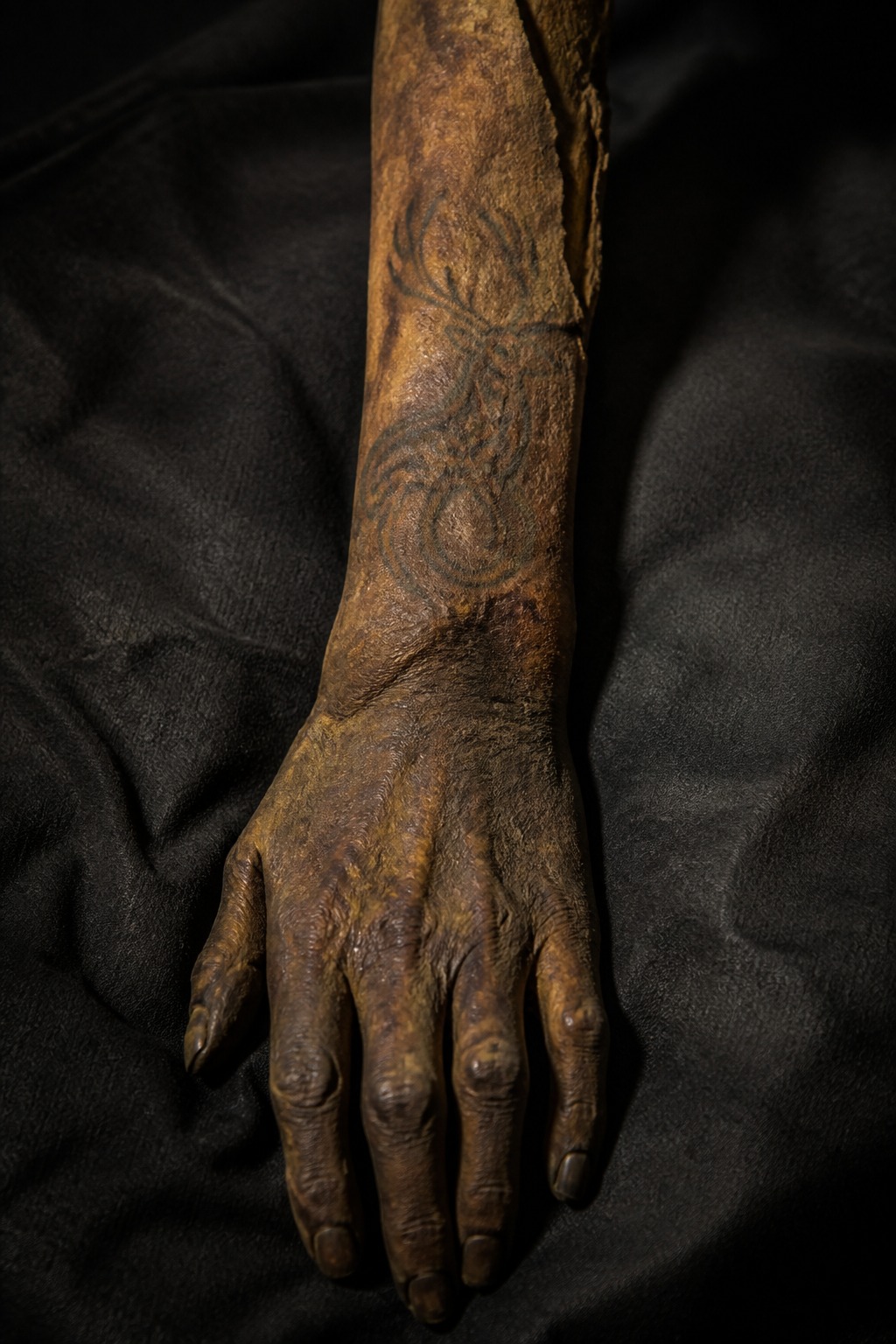
For something like 2,300 years, the Pazyryk tattoos on a Siberian chieftain’s frozen skin lay in the dark at the bottom of a looted grave — and came out in sharper detail than a lot of ink from the last hundred years. The man was thickset, powerfully built, and about fifty when he died. Up his right arm ran six fantastical antlered beasts. A big cat with a coiling tail crossed his chest. And none of it was meant to be seen again.
Bottom line: The famous “animal style” tattoos belong to an Iron Age horse people of the Altai Mountains; their bodies survived because permafrost — helped, oddly, by the grave robbers who broke the tombs open — froze the skin solid for two and a half millennia.
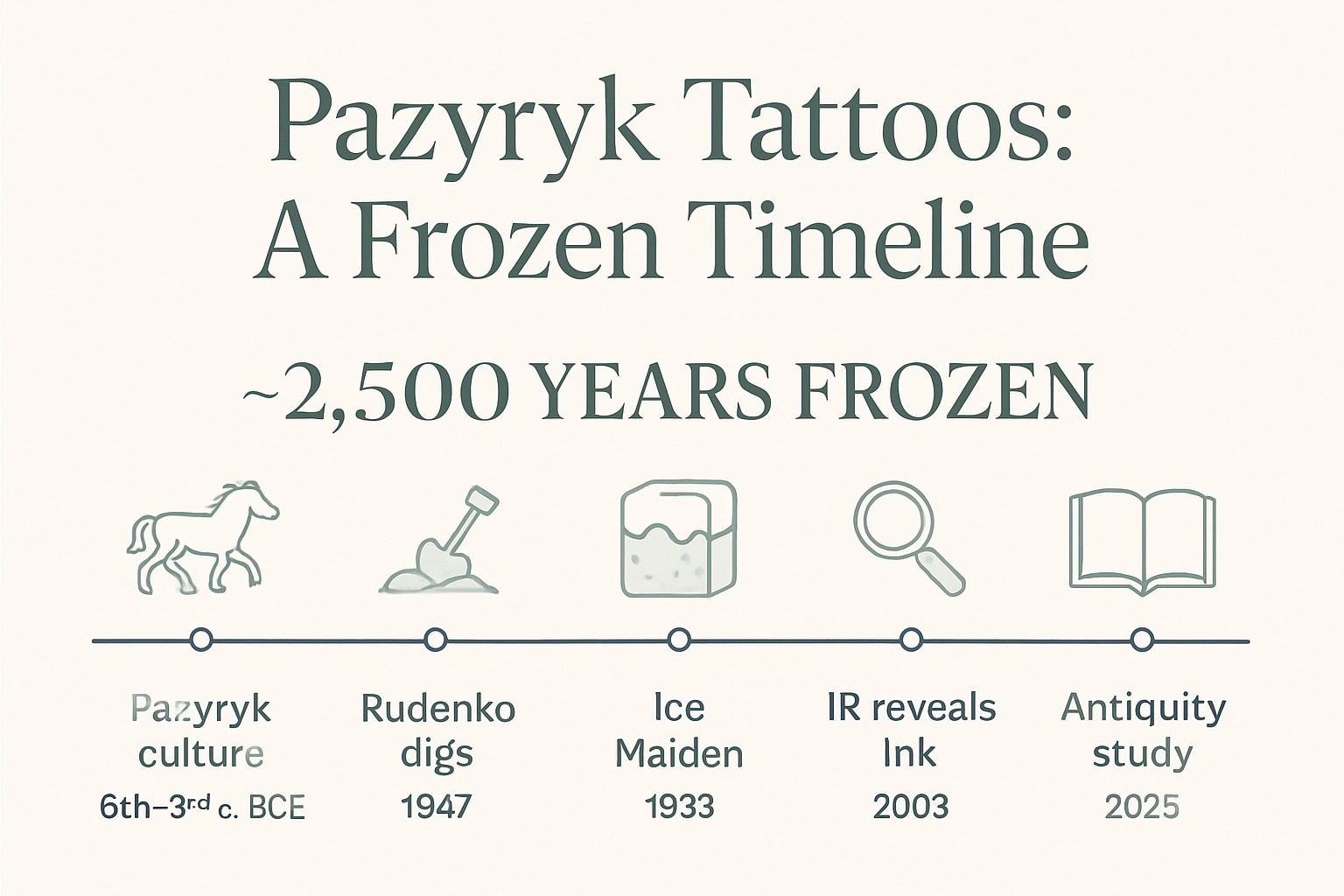
- 6th–3rd century BCE — when the Pazyryk culture rode the Altai steppe
- ~2,300–2,500 years — the age of the preserved tattooed skin
- ~50 — the Barrow 2 chieftain’s likely age at death
- 6 — antlered beasts inked from his wrist to his shoulder
- 1947–48 → 2025 — from Sergei Rudenko’s frozen digs to the latest near-infrared study
Key Facts
- The Pazyryk culture rode the Altai steppe from the 6th to 3rd century BCE; the preserved tattooed skin is about 2,300-2,500 years old.
- The Barrow 2 chieftain, about 50 at death, had six antlered beasts inked from wrist to shoulder and a big cat across his chest.
- Soviet archaeologist Sergei Rudenko excavated the great barrows in 1947-48; permafrost preserved the bodies after grave robbers broke the tombs.
- The pigment was soot hand-poked into the skin with multi-point and single-point tools, using no machine.
- A July 2025 near-infrared study by Gino Caspari, Daniel Riday and Aaron Deter-Wolf was published in the journal Antiquity.
In short: The Pazyryk tattoos are figurative animal-style designs on the frozen skin of Iron Age Altai horse people, about 2,300-2,500 years old. Grave robbers who broke the tombs let in water that froze and preserved the bodies. A 2025 near-infrared study showed the soot ink was hand-poked, revealing the tattooist’s technique.
The frozen man in Barrow 2 — who the Pazyryk were
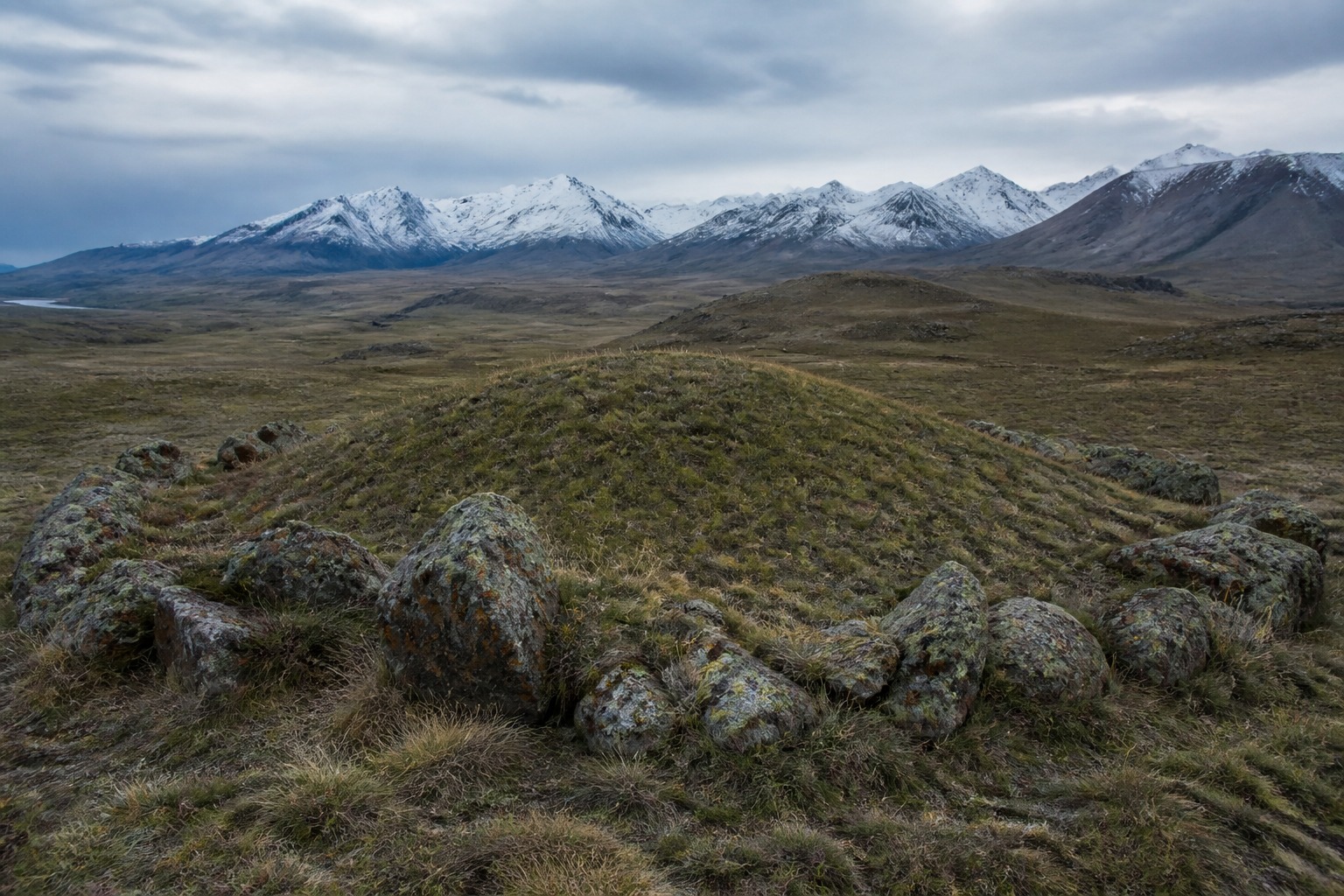
The Pazyryk were not a lost civilisation of cities and temples. They were nomads — Iron Age herders and horsemen of the Scythian world, riding the high grasslands of the Altai where Russia, Kazakhstan, Mongolia and China now meet. They left no writing. What they left instead were their dead, buried under kurgans: low stone-and-earth mounds raised over deep timber chambers.
Soviet archaeologist Sergei Rudenko excavated the great Pazyryk barrows in 1947 and 1948. Barrow 2 gave up its most human find — the body of a chief, muscular and grey by the standards of his day, his skin still carrying its art. The right arm, wrist to shoulder, bore six antlered creatures with their hindquarters wrenched around. A feline sprawled across the chest. Two stags and a leaping mountain ram climbed the left arm; a long fish ran down the right shin.
Turns out the animals weren’t random decoration. They were a language — one the whole steppe could read.
Robbed, flooded, frozen — how grave robbers saved the skin
Here is the counter-intuitive part that most accounts skip in a single line. The tombs survived because they were robbed.
Not long after each burial, looters tunnelled in for the gold. That breaking of the seal let meltwater and rain seep down into the chamber. In the Altai’s climate the water didn’t drain — it froze, and stayed frozen, forming a permanent lens of ice around the coffin and its contents. The robbers took the treasure and, without meaning to, left behind something they’d never have valued: a deep-freeze.
Congelation, not embalming, is what preserved these bodies. No resins, no natron, no ritual chemistry — just cold. That ice held skin, hair, felt, wool and the world’s oldest surviving pile carpet for over two thousand years, until a spade broke the spell. It’s a strange debt to owe: the thieves who wrecked the graves are the reason we can still read the ink.
Reading the ink — the Scythian ‘animal style’
Every figure on the chieftain belongs to what art historians call the Scythian animal style: stylised beasts, muscled and coiled, often shown at the moment their bodies twist back on themselves. Predators bite prey. Antlers dissolve into flourishes. Real animals — deer, argali sheep, big cats, fish — share the skin with pure inventions: griffins and horned, hook-beaked carnivores that never walked the steppe.
{IMAGE_2}
On this man the deer dominate the right arm, the most visible surface when he moved or fought. The feline on the chest, tail spiralling, sits over the heart. Scholars reading the Hermitage mummies note the same grammar again and again across Pazyryk finds — the same handful of creatures, the same torque of the hindquarters — which suggests the images were shared symbols, not personal doodles. A man wore his affiliations the way a later warrior wore a crest.
What near-infrared light revealed about the tattooist’s hand
In July 2025 a team led by archaeologist Gino Caspari of the Max Planck Institute of Geoanthropology, working with tattoo practitioner Daniel Riday and researcher Aaron Deter-Wolf, published a study in the journal Antiquity that changed what we can say about how the marks were made. Their subject was a different Hermitage mummy — a Pazyryk woman — but the craft it exposed applies straight across to the chieftain.
Using high-resolution near-infrared imaging, which cuts through the darkened, leathery skin to the pigment beneath, they mapped line width, tool marks and where the ink pooled. The pigment was soot — burnt plant material rubbed into hand-poked punctures, the same basic method traditional tattooers still use today. No machine. No single magic needle. Thick lines came from clustered multi-point tools; fine detail from a single point.
The most human detail is the asymmetry. On the woman’s right forearm the composition is layered and anatomically sophisticated, planned across what the researchers judge to be at least two sittings; the left arm is thicker-lined and flatter, as if done by a less practised hand — or the same hand on a worse day. Overlapping line-ends and blots of built-up pigment mark the places the artist paused, perhaps to re-load soot or swap tools. That detail matters more than the beasts themselves: it turns an “ancient artefact” back into two people — a client and a tattooist — grinding through a long, painful session by firelight.
Pazyryk tattoos vs Ötzi’s marks: why this figurative ink is exceptional
Ötzi the Iceman, the Copper Age body from the Alps, is older and carries more individual marks — but they are worlds apart from the Altai art. Ötzi’s are simple: short lines, dots and crosses, clustered over joints and the lower back, and many researchers suspect they were therapeutic, placed where a body aches. The Pazyryk work is something else entirely — large, representational, animal, and displayed.
| Pazyryk chieftain | Ötzi the Iceman | |
|---|---|---|
| Age of tattoos | ~2,300–2,500 years (6th–3rd c. BCE) | ~5,300 years (c. 3250 BCE) |
| Style | Large figurative animals — deer, big cat, ram, fish, griffins | ~61 simple lines, dots and crosses |
| Placement | Arms, chest, lower leg — visible limbs | Over joints and lower back — mostly hidden |
| Likely purpose | Status, identity, symbolic display | Possibly therapeutic / pain-point |
| Preserved by | Permafrost ice lens inside a kurgan | Glacier ice in the Alps |
So which is the “oldest tattoo”? Ötzi holds that record. But for the oldest known figurative tattoos — pictures rather than marks — the Pazyryk bodies are the headline act, and the only place we can watch Iron Age representational tattooing at this level of detail.
What the marks meant — and the Ice Maiden’s contested afterlife
Nobody can hand you a caption for these images; the Pazyryk wrote nothing down. But the placement is a strong clue. Tattoos ran along the forearms and other exposed skin — surfaces a person shows the world — which points away from private ritual and toward public identity: rank, kin, a warrior’s record, maybe a claim of protection borrowed from the animal shown. On the steppe, where you couldn’t check a stranger’s lineage, a body could be a badge.
The most famous Pazyryk mummy isn’t the chieftain at all. In 1993 archaeologist Natalia Polosmak, of the Institute of Archaeology and Ethnography in Novosibirsk, excavated a young woman on the Ukok Plateau — the “Siberian Ice Maiden,” or Princess of Ukok — her shoulder marked with a beautifully drawn deer. Centering her has quietly pushed the more thoroughly documented man out of the frame, which is a shame, because his skin carries the richer gallery.
Her discovery also opened a wound. Many Indigenous Altai people regard the removal of the Ice Maiden as a desecration, and some have linked local misfortunes — earthquakes, hardship — to a “curse” and pressed for her reburial. There is no scientific basis for a curse. There is a real, unresolved ethical question about who owns the ancient dead, and it deserves to be stated plainly rather than sold as a ghost story.
A melting archive — the clock on Siberia’s frozen tombs
The ice that saved these bodies is not guaranteed forever. Warming across the Altai is thinning the permafrost that keeps the un-excavated frozen kurgans intact, and researchers — Caspari among them — have warned that many still-buried tombs may thaw, rot, and vanish before anyone reaches them. Each frozen barrow is a sealed archive of skin, textile and story. Once the lens of ice melts, the record inside doesn’t wait for an archaeologist. It simply decays.
Which is the quiet urgency behind a 2,500-year-old tattoo. What we can read today, we can read only because water froze in a robbed grave and stayed frozen. The next generation of these mummies may not be so lucky — and the imaging tools that finally let us see the tattooist’s hand are, right now, in a race with the thaw.
Frequently asked questions
How old are Pazyryk tattoos? Roughly 2,300 to 2,500 years old. The Pazyryk culture flourished in the Altai Mountains between about the 6th and 3rd centuries BCE, and the tattooed bodies recovered from their frozen kurgans date to that window — making them the oldest known figurative (picture-based) tattoos yet studied.
How were the Pazyryk mummies preserved? By ice, not embalming. After looters breached the tombs, water seeped in and froze into a permanent lens of ice around the burial chamber. That deep-freeze — a process called congelation — preserved skin, hair, tattoos and textiles for over two millennia in the Altai permafrost.
What do the tattoos actually show? Scythian “animal style” art: antlered deer, a big cat, a leaping mountain ram and a fish on the Barrow 2 chieftain, alongside mythical griffins and horned carnivores on other Pazyryk bodies — stylised, muscular beasts, often with their hindquarters twisted back on themselves.
Are the tattooed chieftain and the Siberian Ice Maiden the same person? No. The chieftain is a man from Pazyryk Barrow 2, excavated by Rudenko in the late 1940s. The Ice Maiden — the Princess of Ukok — is a woman found by Natalia Polosmak in 1993 on the Ukok Plateau. Two different mummies, often confused.
Sources and notes
- Caspari, G., Riday, D., Deter-Wolf, A., Vavulin, M. & Pankova, S. (2025). “High-resolution near-infrared data reveal Pazyryk tattooing methods.” Antiquity (Cambridge University Press).
- Sergei Rudenko, Frozen Tombs of Siberia: The Pazyryk Burials of Iron Age Horsemen.
- The State Hermitage Museum, St Petersburg — Pazyryk collection and the tattooed Barrow 2 chieftain.
- Natalia Polosmak / Institute of Archaeology and Ethnography, Novosibirsk — excavation of the Ukok “Ice Maiden” (1993).
- Smithsonian Magazine — reporting on the 2025 near-infrared imaging of Pazyryk tattoos.
The chieftain of Barrow 2 was tattooed to be seen by his own people, then buried to be seen by no one. Two and a half thousand years later, a beam of infrared light finally gave him back an audience. The question now is how many of his neighbours, still locked in the ice, we can reach before the ground that hid them lets them go.
Illustrations are AI-generated. Article fact-checked and human-edited. Our editorial standards.