Why Is Mining Banned in Antarctica? The 2048 Myth
Ask why is mining banned in Antarctica and you’ll usually hear the same tidy story: a treaty froze the continent for fifty years, and in 2048 the ban lifts and the bulldozers roll in. Almost every part of that is wrong. Mining in Antarctica is banned with no expiry date at all — and the reason involves a last-minute betrayal of an oil treaty the world had already signed, an ocean too violent to drill, and a Russian survey ship that may have just changed the whole conversation.
Key Facts
- Mining is banned by the Madrid Protocol (Protocol on Environmental Protection to the Antarctic Treaty), signed in 1991 and in force since 1998; Article 7 prohibits all mineral activity except research.
- The ban has no expiry date; 2048 is only the earliest a Consultative Party may request a review under Article 25.
- The 1959 Antarctic Treaty (in force 1961) froze territorial claims and set the continent aside for peace and science, but said nothing about mining.
- CRAMRA, the 1988 Wellington Convention, would have allowed regulated mining but never entered force after Australia and France refused in 1989.
- Evidence to the UK Parliament in 2024 revealed Russia’s Rosgeo had run Weddell Sea surveys suggesting up to 511 billion barrels of oil.
In short: Mining is banned in Antarctica by the 1991 Madrid Protocol, whose Article 7 prohibits all mineral activity except research, with no expiry date. The widely repeated 2048 deadline is only the earliest a country may request a review of the Protocol, not an automatic end to the ban.
So, why is mining banned in Antarctica — and does the ban really expire?
Here’s the direct answer. Mining is banned in Antarctica because of the Protocol on Environmental Protection to the Antarctic Treaty — the Madrid Protocol — signed in 1991 and in force since 1998. Its Article 7 is one blunt sentence: any activity relating to mineral resources, other than scientific research, is prohibited. Coal, iron, oil, gas, gold — all of it, off limits.
And the ban does not expire in 2048. That date is the single most repeated error about Antarctica, and it has been copied from explainer to explainer for a decade. What 2048 actually marks is the first year any member country is allowed to ask for a review of the Protocol. Asking for a review is not the same as lifting a ban. As we’ll see, the legal bar to ever legalising mining is so high it was arguably designed never to be cleared.
So the honest version is stranger than the myth: this is a permanent prohibition wearing a rumour of a deadline.
Two agreements, two jobs: what 1959 froze and 1991 banned
Most of the confusion comes from mashing two different treaties into one. They were signed thirty-two years apart and they do completely different things.
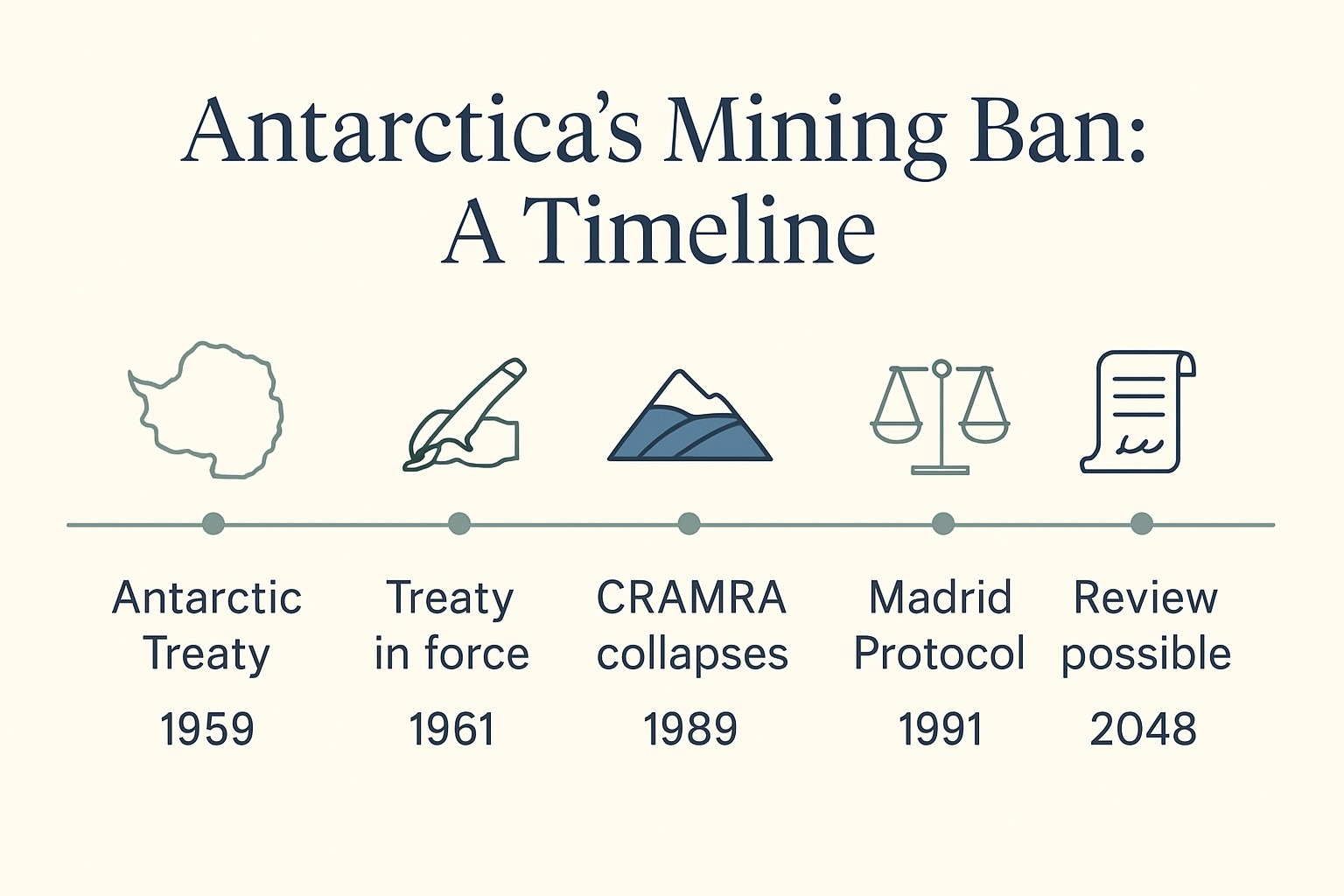
December 1959. Twelve nations — including Cold War rivals the United States and the Soviet Union — sign the Antarctic Treaty in Washington. It comes into force in 1961. Its famous Article IV doesn’t ban mining at all. What it does is freeze the seven overlapping territorial claims (Britain, Argentina and Chile were claiming much of the same wedge of ice) and set the continent aside for peace and science. No new claims, no military bases, no nuclear tests. It’s a masterpiece of “let’s agree to disagree” — but on minerals, it says nothing.
That silence is why a second agreement was needed. The table below is the clean version competitors rarely lay side by side:
| Antarctic Treaty (1959) | Madrid Protocol (1991) | |
|---|---|---|
| In force | 1961 | 1998 |
| Main job | Froze territorial claims; peace and science only | Banned all mineral activity except research (Article 7) |
| Says about mining | Nothing | Prohibited, indefinitely |
| The “2048” link | — | 2048 = earliest a review can be requested, not an expiry |
The treaty that almost legalised digging: the 1988 near-miss
Now the part almost no one tells. The mining ban very nearly went the other way — completely.
Through the 1980s the treaty nations spent six years negotiating the opposite of a ban. In June 1988, in Wellington, New Zealand, they adopted the Convention on the Regulation of Antarctic Mineral Resource Activities — CRAMRA, the Wellington Convention. Its purpose was to allow mining, under strict rules. After six years of work, it was done. The door to regulated Antarctic mining was open.
Then two men slammed it shut. In May 1989 Australian Prime Minister Bob Hawke announced his country would not sign, calling mining incompatible with protecting the Antarctic environment. France’s Prime Minister Michel Rocard — reportedly pushed hard by the oceanographer Jacques Cousteau, and with a global Greenpeace “World Park Antarctica” campaign roaring in the background — joined him. Because the treaty system runs on consensus, two refusals were enough. CRAMRA never entered force. In its place came the Madrid Protocol and its outright ban.
{IMAGE_2}
Turns out the reason mining is banned today is not some inevitable environmental awakening. It hinged on two heads of government changing their minds at the last possible moment.
The “50-year clock” myth — what actually happens in 2048
So where does 2048 come from? The Madrid Protocol entered into force in 1998, and its Article 25 says that fifty years after that date — 2048 — any Consultative Party may call for a conference to review how the Protocol is working. That is the whole of it. A meeting can be requested. Nothing automatically switches off.
And lifting the mining ban at such a review is deliberately close to impossible. Any change would need to be agreed by a majority that includes three-quarters of the countries that were Consultative Parties when the Protocol was adopted in 1991. Even then, the ban cannot legally be dropped unless a binding legal framework governing how mining would be regulated is already in force first — a framework that does not exist and that nobody is building. Miss any one of those conditions and Article 7 simply stands.
Could a determined bloc of nations tear the whole thing up anyway? In theory a country could withdraw from the Protocol entirely. But doing so would mean walking away from the entire Antarctic Treaty System that also protects its research stations and its frozen territorial claims — a diplomatic price no signatory has shown any appetite to pay.
What’s buried under the ice — and the 511-billion-barrel question
There is genuinely a lot down there. Geologists have long known Antarctica holds coal seams (the Transantarctic Mountains contain some of the world’s largest), iron ore in the Prince Charles Mountains, and traces of copper, chromium, platinum and gold. Offshore, the sedimentary basins hint at oil and gas.
Which brings us to the freshest twist — one most top-ranking explainers, written in 2016 or 2019, never saw coming. In evidence presented to the UK Parliament’s Environment Audit Committee in mid-2024, it emerged that Russia’s state geological company Rosgeo had run seismic surveys in the Weddell Sea suggesting as much as 511 billion barrels of oil — roughly double Saudi Arabia’s proven reserves. The surveys, aboard the research vessel Akademik Alexander Karpinsky, reportedly intensified between 2020 and 2024. Awkwardly, the area sits inside the sector Britain claims.
- ~511 billion barrels — Russian (Rosgeo) survey estimate for the Weddell Sea; unverified, and Russia calls it “research”
- ~35% — iron content of Antarctic ore, versus 60%+ in commercially mined deposits
- Over US$100/barrel — estimated cost to extract Antarctic oil, per the Australian Antarctic Program
- 2 km+ — thickness of ice covering much of the rock
One caveat matters enormously, and honesty demands it: that 511-billion figure is a Russian estimate, not independently confirmed in open science, and Moscow has never formally declared a “discovery.” Russia insists the work is scientific. British officials and outside analysts suspect it looks a great deal like prospecting dressed as research — which is exactly the grey zone the Protocol struggles to police.
Why nobody is mining anyway — the brutal economics
Even if the ban vanished tomorrow, the drills wouldn’t start. This is the piece the “coming Antarctic gold rush” headlines quietly skip.
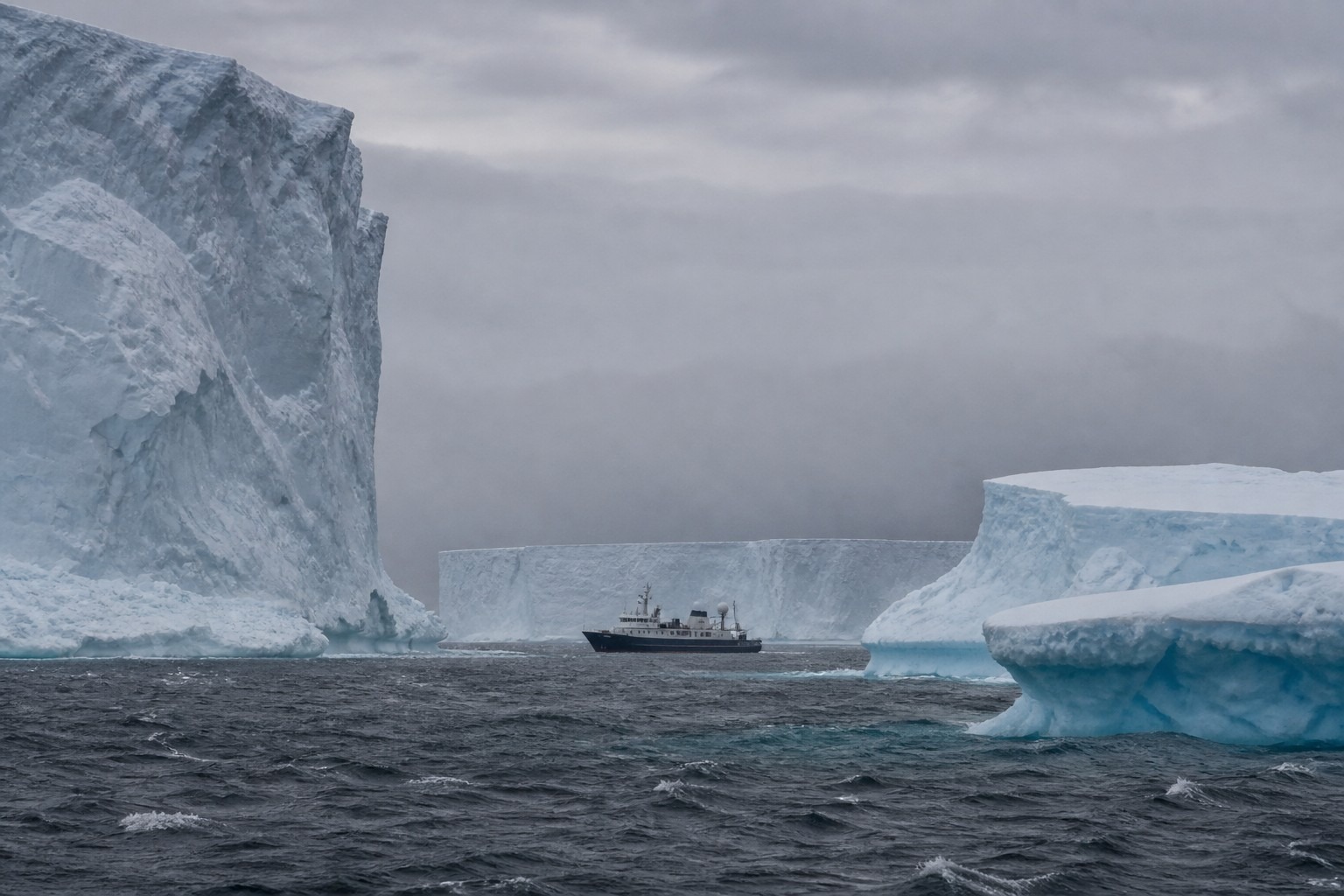
Consider what extraction would actually mean. You’d be working through two kilometres or more of ice, in months of darkness, with icebergs the size of cities drifting across your operation, resupplied across the Southern Ocean — the stormiest water on Earth. The Australian Antarctic Program estimates Antarctic oil would cost well over US$100 a barrel to extract. The iron ore runs about 35% iron when miners elsewhere dig 60%-plus with roads and ports already built.
The real threat to Antarctica isn’t a 2048 gold rush with excavators; it’s the quiet survey ship calling prospecting “science” today, planting a flag of knowledge for a future when technology or desperation might change the maths.
Who enforces a ban with no police?
Here’s the uncomfortable answer: nobody, exactly. There is no Antarctic police force, no coast guard, no court on the ice. The ban holds because member states agree it should, and because the treaty grants them the right to inspect one another’s stations and ships without warning. It is, in the end, a gentlemen’s agreement backed by transparency and reputation.
That works remarkably well when everyone wants it to work. It strains when a powerful state starts running “scientific” surveys over 500 billion barrels of oil. The continent is legally reserved for peace and science — the kind of curiosity-driven research that turns up wonders like Antarctica’s Blood Falls — and the whole system depends on that word “science” meaning what it says.
Belief vs evidence
The myths around this topic are unusually sticky. Here’s how the common beliefs hold up:
| Common belief | What the evidence says |
|---|---|
| “The ban expires in 2048.” | No expiry. 2048 only lets a country request a review; lifting the ban needs a supermajority plus a mining regime that doesn’t exist. |
| “One treaty banned mining in 1959.” | The 1959 Treaty froze claims and said nothing on mining. The 1991 Madrid Protocol banned it. |
| “A gold rush is coming.” | Extraction is uneconomic — 2 km of ice, US$100+/barrel oil, low-grade ore. The near-term risk is prospecting-as-science, not mines. |
| “Someone owns Antarctica.” | Seven nations claim slices; the Treaty freezes those claims. No claim is internationally settled, and most countries recognise none. |
In short: mining is banned in Antarctica by the 1991 Madrid Protocol, indefinitely and with no 2048 expiry — a ban that only exists because two prime ministers killed an opposite treaty in 1989. The real pressure now isn’t the calendar; it’s whether “scientific research” quietly becomes a doorway to the oil beneath the Weddell Sea.
Sources and notes
- Protocol on Environmental Protection to the Antarctic Treaty (Madrid Protocol, 1991) — Secretariat of the Antarctic Treaty; Articles 7 and 25
- The Antarctic Treaty (1959) — Secretariat of the Antarctic Treaty; Article IV
- Australian Antarctic Program — the Madrid Protocol and Antarctic mineral economics (iron content, oil extraction cost)
- Convention on the Regulation of Antarctic Mineral Resource Activities (CRAMRA, 1988) — Polar Record, Cambridge University Press; British Antarctic Survey
- UK Parliament Environment Audit Committee — evidence on Russian (Rosgeo) Weddell Sea seismic surveys, 2024
Antarctica remains the one continent humanity agreed to leave alone — not because we ran out of reasons to want what’s under it, but because, so far, we’ve kept choosing not to reach. Whether that choice survives the century is the real question the ice is holding for us.
Frequently Asked Questions
Q: Why is mining banned in Antarctica?
Because of the Madrid Protocol, signed in 1991 and in force since 1998. Its Article 7 flatly prohibits any activity relating to mineral resources other than scientific research, so coal, iron, oil, gas and gold are all off limits. The ban grew out of last-minute refusals in 1989 that killed an earlier treaty, CRAMRA, which had been designed to allow regulated mining.
Q: Does the Antarctic mining ban expire in 2048?
No, and that is the most repeated error about Antarctica. The Madrid Protocol has no expiry. Its Article 25 says that fifty years after it entered force, in 2048, any Consultative Party may call a conference to review how it is working. Requesting a review is not lifting the ban, and the legal bar to ever legalising mining is deliberately near-impossible to clear.
Q: What is the difference between the two Antarctic treaties?
The 1959 Antarctic Treaty (in force 1961) froze the seven overlapping territorial claims and set the continent aside for peace and science, but said nothing about mining. The 1991 Madrid Protocol is the one that actually banned mineral activity indefinitely. Mashing the two together is the source of most myths about a 2048 expiry of the ban.
Q: Is there anything worth mining in Antarctica?
Geologically, yes. Antarctica holds large coal seams in the Transantarctic Mountains, iron ore in the Prince Charles Mountains, and traces of copper, chromium, platinum and gold, with oil and gas hinted at offshore. Evidence to the UK Parliament in 2024 revealed Russia’s Rosgeo had run Weddell Sea surveys suggesting up to 511 billion barrels of oil, roughly double Saudi Arabia’s proven reserves.
Illustrations are AI-generated. Article fact-checked and human-edited. Our editorial standards.