Coral IVF Great Barrier Reef: How Baby Reefs Are Born
Coral IVF on the Great Barrier Reef is assisted reproduction for coral: scientists scoop up the eggs and sperm released during the reef’s once-a-year mass spawning, fertilise them in floating pools, raise the larvae, then deliver the babies straight onto damaged reef. It works because it fixes nature’s cruellest bottleneck — in the wild, fertilisation succeeds maybe one time in a million, and this technique lifts the odds roughly a hundredfold. Below is how it actually works, the hard numbers, the honest limits, and where the science stands after the 2024–2025 breakthroughs that most older articles never mention.
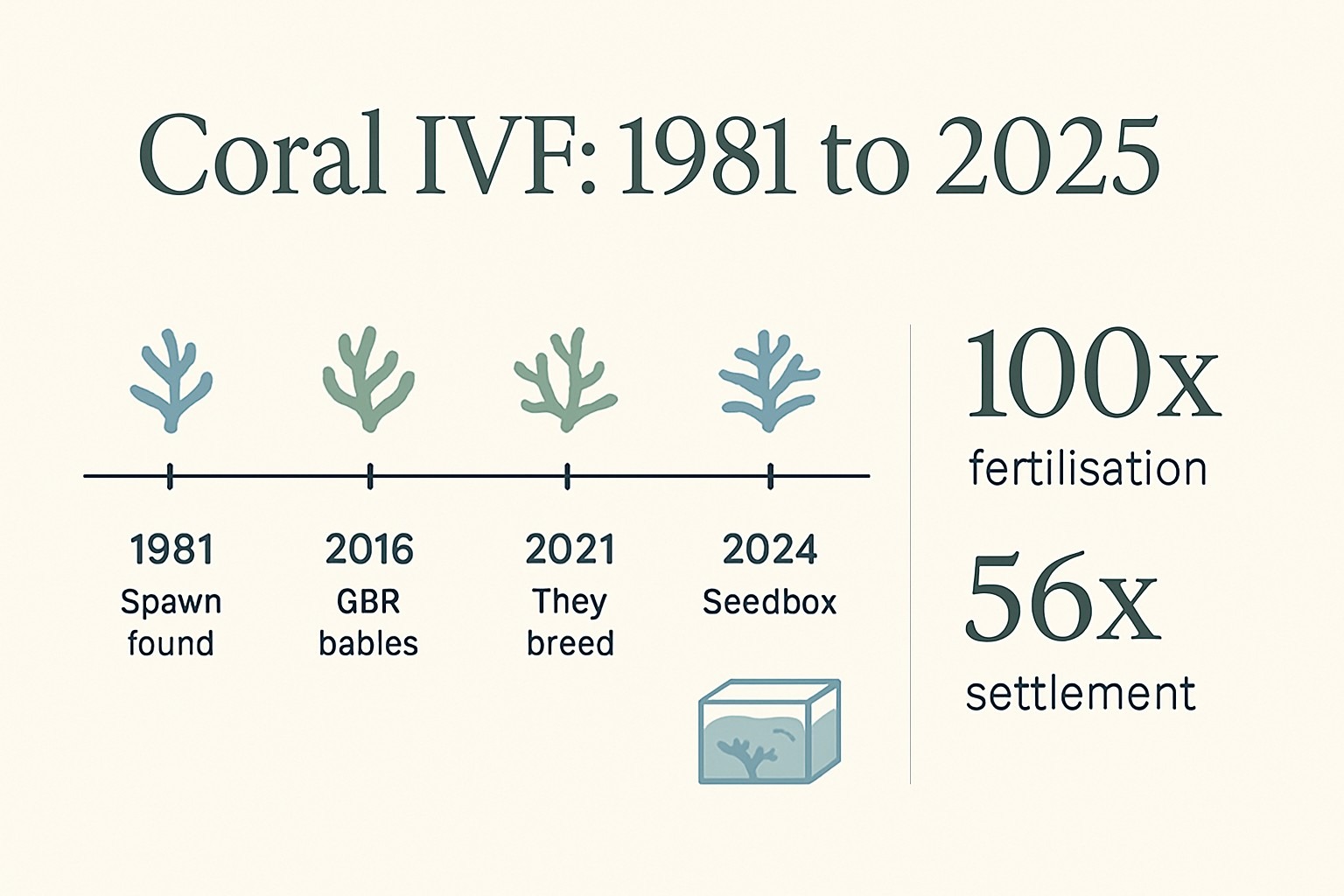
- What it is: collect spawn → float in pools/tanks → fertilise → rear larvae → deploy to damaged reef patches.
- The payoff: natural fertilisation ~1-in-a-million; coral IVF lifts it about 100× to roughly 1-in-10,000.
- The 2024 leap: a “larval seedbox” at Lizard Island produced settlement up to 56× natural levels across thousands of square metres.
- Pioneer: Distinguished Professor Peter Harrison, Southern Cross University — who helped document coral mass spawning back in 1981.
- Timing: the whole method hinges on the few nights after the October or November full moon, when the reef spawns.
Key Facts
- Coral IVF collects spawn during the reef’s annual mass spawning, fertilises it in floating pools, rears the larvae, and deploys them to damaged reef.
- Natural fertilisation succeeds about 1 in a million; coral IVF lifts it roughly 100-fold to about 1 in 10,000.
- It was pioneered by Distinguished Professor Peter Harrison of Southern Cross University, who helped document coral mass spawning in 1981.
- The 2024 larval seedbox (CSIRO with Southern Cross University) drove settlement up to 56 times natural levels at Lizard Island across thousands of square metres.
- The method hinges on the few nights after the October or November full moon, when the reef spawns.
In short: Coral IVF is assisted reproduction for coral: scientists catch the eggs and sperm from the reef’s annual mass spawning, fertilise them in floating pools, rear the larvae and deliver them to damaged reef. It lifts fertilisation odds about a hundredfold, and a 2024 seedbox raised settlement up to 56 times natural levels.
What is coral IVF, in plain English?
Think of it as a fertility clinic for a reef. Corals reproduce by broadcasting eggs and sperm into open water on a single synchronised night each year. Almost all of it is wasted. Coral IVF simply catches that flood before the ocean can scatter it, does the matchmaking in a protected pool, and then returns the resulting larvae to the exact stretch of reef that needs them.
The idea is deliberately low-tech. No gene editing, no lab-grown coral from scratch — just the reef’s own offspring, given a sheltered head start. Peter Harrison, who leads the work at Southern Cross University, likens it directly to human IVF: same eggs, same sperm, same species, only with the odds of a successful start dramatically improved.
And that framing matters, because it tells you what coral IVF is not. It is not manufacturing new coral. It is rescuing the reproduction the reef is already attempting — and mostly losing.
Why does nature only win one time in a million?
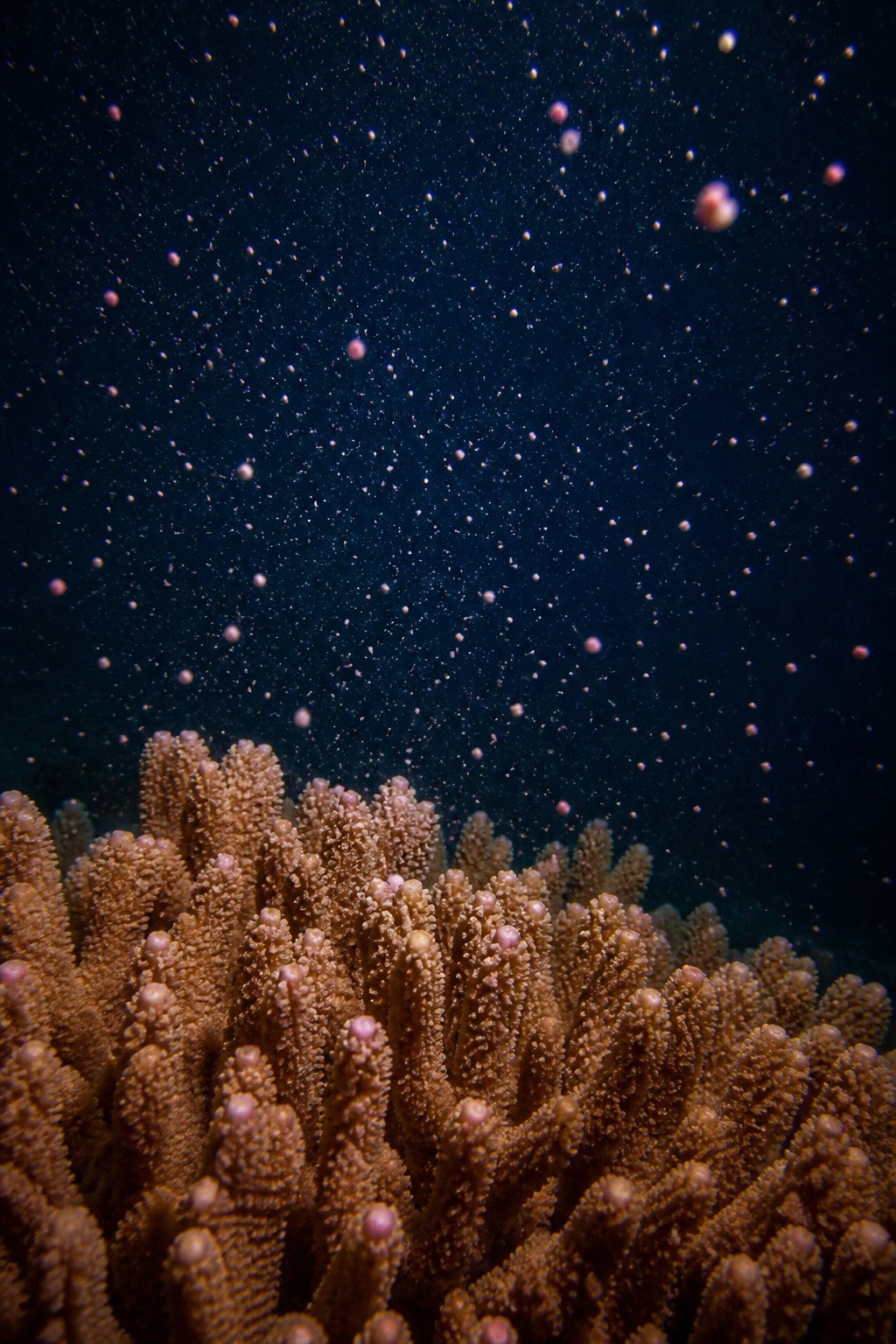
Here’s the thing about broadcast spawning: it’s a numbers game the coral almost always loses. On the night of the spawn, colonies release tiny bundles of eggs and sperm that float to the surface like an upside-down snowstorm. For a new coral to form, an egg has to meet sperm from a different colony of the same species before currents, waves, and hungry plankton-feeders sweep them apart.
They usually don’t meet. The eggs and sperm drift, dilute into billions of litres of seawater, and become fish food within hours. Even in a healthy year, the fraction that fertilises and survives to settle is vanishingly small — the “one in a million” figure researchers use is a rough shorthand for just how steep the odds are.
Now add the modern problem. Repeated mass-bleaching events have thinned out adult colonies, so on many damaged reefs there simply aren’t enough neighbours spawning close enough together for the maths to work at all. Fewer parents, more distance, more dilution. That is the exact failure coral IVF is designed to short-circuit.
{IMAGE_2}
How does coral IVF work, step by step?
The whole operation is a five-step relay against the clock, and it only runs for a handful of nights a year.
1. Collect the spawn. On spawning nights — a few evenings after the full moon in late spring — divers and boat crews position fine mesh nets and cones over spawning colonies to capture the rising egg-and-sperm bundles. 2. Float it in pools. The catch goes into large floating enclosures or tanks on the surface, where the concentration is high instead of hopelessly diluted. 3. Fertilise. Packed together, eggs and sperm from different colonies actually find each other, and fertilisation rates climb. 4. Rear the larvae. Over the next several days the fertilised eggs develop into swimming larvae, tended in the pools until they’re ready to settle. 5. Deploy. The mature larvae are released — or now, boxed and delivered — onto degraded reef patches, where they can attach to the seafloor and grow into new colonies.
The single hardest part is timing. Miss the spawn by a night and there’s nothing to collect until next year, which is why crews spend weeks reading water temperature and lunar cues to be in the right place at the right hour.
The seedbox breakthrough: a delayed-release nursery
Until recently, the last step was the leakiest. You could rear millions of healthy larvae and still watch currents wash most of them off the target reef before they settled. The 2024 fix is almost comically simple: put them in a box.
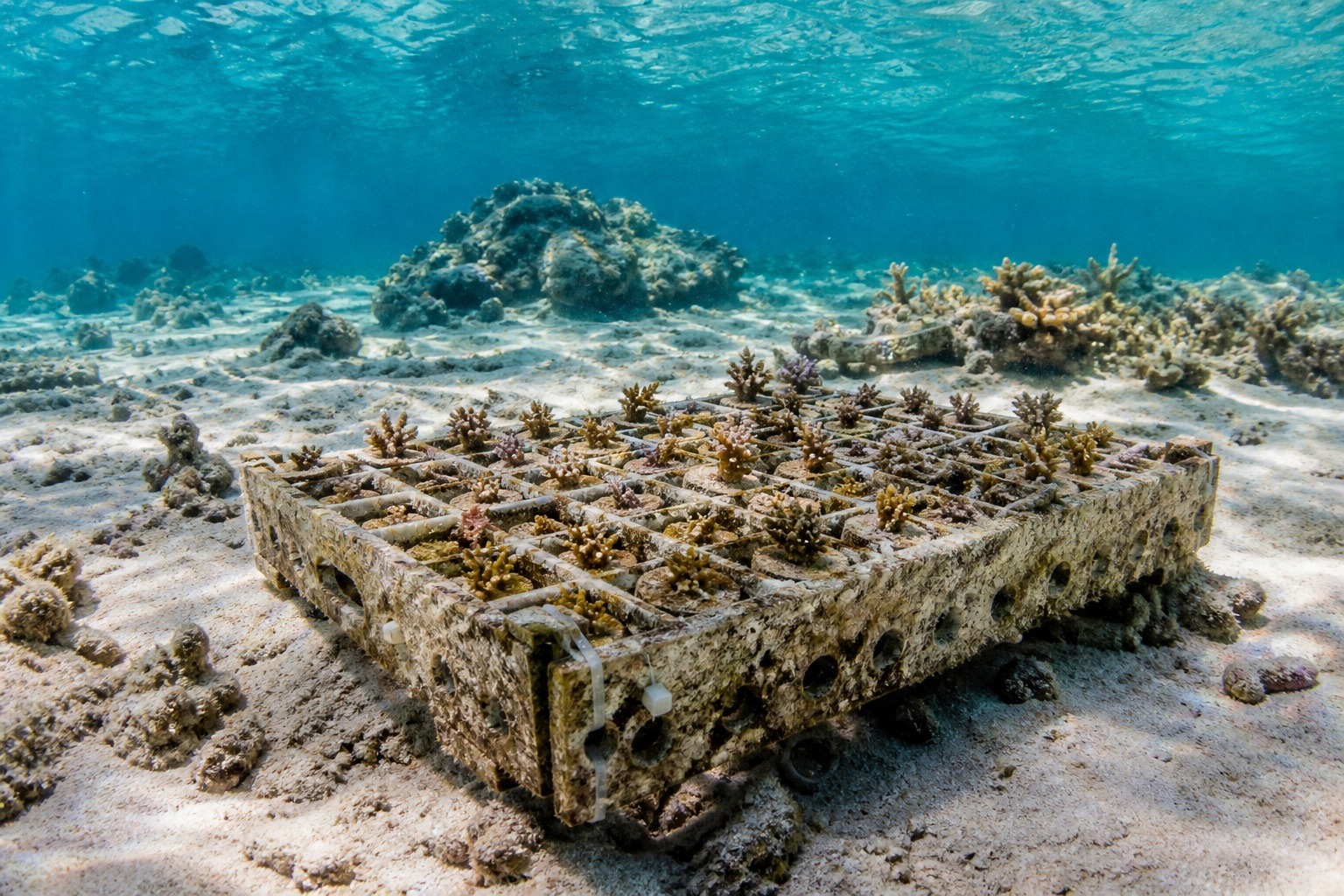
The “larval seedbox,” developed by Australia’s national science agency CSIRO with Southern Cross University, is a modular underwater container that sits on the reef and acts as both nursery and delivery device. It holds the larvae in place, shields them from the currents that would otherwise disperse them, and releases them gradually onto the reef surface below — buying the babies precious time to find a home. In a trial at Lizard Island in 2024, seedboxes drove coral settlement up to 56 times higher than natural levels, across thousands of square metres. Those results were detailed in a 2025 preprint and reported publicly that November.
What makes the seedbox a genuine leap isn’t the settlement number alone — it’s that the device is cheap, reusable, and modular. Scale a restoration method by stacking more identical boxes and you have something a reef program can actually afford to repeat, year after year, reef after reef.
Does coral IVF actually work? The 2016 babies that grew up
This is the question that separates a hopeful press release from real science, and coral IVF now has an answer most restoration techniques can’t offer: a full life cycle, observed.
In the summer of 2016–17, one of the first Great Barrier Reef trials planted coral babies onto damaged reef near Heron Island, off Gladstone. Those larvae grew from microscopic specks into colonies the size of dinner plates. They survived a bleaching event. And in 2021 — during that year’s mass spawning — they released eggs and sperm of their own, becoming the first coral population on the Reef bred through IVF to reproduce naturally. Turns out you can close the loop.
That 2021 milestone is the proof point older articles miss. It means coral IVF doesn’t just add colonies; it can restart the reef’s own reproduction, so a restored patch begins seeding the water around it. Harrison’s broader work, in the Philippines since 2012, found re-seeded corals reaching dinner-plate size and breeding within about three years — consistent evidence across two countries, not a single lucky reef.
Can coral IVF outrun bleaching at reef scale?
Now for the honesty this topic badly needs. The Great Barrier Reef covers roughly 344,000 square kilometres. Coral IVF, across all its trials, has restored on the order of thousands of square metres. A square kilometre is a million square metres — so the restored area is a rounding error against the whole system, and it would be dishonest to pretend otherwise.
Call it what it is: coral IVF is a scalpel, not a cure. It can rebuild specific high-value or badly-hit patches, jump-start reproduction on reefs too degraded to recover alone, and buy time — but it cannot out-plant its way past the underlying driver, which is a warming ocean delivering bleaching events more often than reefs can bounce back.
The scientists doing the work are the first to say so. Tools like the seedbox are aimed at making restoration cheaper and faster so it can cover more ground, and at targeting the places that matter most. None of it substitutes for cutting the carbon emissions heating the sea. Both things are true at once: coral IVF is genuinely working, and on its own it is nowhere near enough.
Who invented coral IVF — and how can you help?
The trail starts in 1981, when Peter Harrison — then a PhD student — was part of the team that documented coral mass spawning around Magnetic Island, near Townsville, a synchronised reproductive event science hadn’t formally recorded before (the group published it in 1984). That discovery is the foundation the whole technique stands on: you can only harvest a spawn you know is coming.
From there the method matured. Harrison ran the first larval-restoration trials on dynamite-damaged reefs in the Philippines from 2012, brought the approach to the Great Barrier Reef in 2016, and today the effort spans research institutions including CSIRO, the Australian Institute of Marine Science (AIMS), and the Great Barrier Reef Foundation. In 2024, AIMS began training tourism and marine operators near Cairns and Port Douglas in larval seeding — part of a citizen-science push (the Boats4Corals model) that turns dive boats into restoration crews.
So can an ordinary person help? To a point, yes — and honestly. Choosing reef tour operators involved in restoration or citizen science, supporting the research foundations doing this work, and understanding why the reef matters all feed the effort. But the single biggest lever isn’t on the reef at all; it’s the global emissions that decide how often the water gets too hot. Coral IVF gives the reef a fighting chance. What it fights against is up to the rest of us.
| Year | Milestone |
|---|---|
| 1981 | Mass coral spawning documented on the Great Barrier Reef (Harrison and colleagues; published 1984). |
| 2012 | First larval-restoration trials on damaged reefs in the Philippines. |
| 2016 | First Great Barrier Reef trial; coral babies planted near Heron Island. |
| 2021 | Those 2016 corals spawn — the Reef’s first breeding IVF population. |
| 2024–25 | Lizard Island seedbox trial: settlement up to 56× natural levels; Whitsundays and Boats4Corals scaling. |
Questions readers ask
How does coral IVF work? Crews collect the eggs and sperm corals release during the annual mass spawning, concentrate them in floating pools so fertilisation succeeds, rear the fertilised larvae for several days, then deliver those larvae onto damaged reef — increasingly using a seedbox that holds them in place until they settle.
Who invented coral IVF? The technique grew out of Distinguished Professor Peter Harrison’s work at Southern Cross University, building on the 1981 discovery of coral mass spawning and his larval-restoration trials in the Philippines and on the Great Barrier Reef.
Does coral IVF actually work? Yes, at the patch scale. Corals planted in 2016 survived bleaching, grew to dinner-plate size, and reproduced on their own by 2021 — a full life cycle. The open question is scale, not whether the biology works.
Can coral IVF save the whole Great Barrier Reef? Not by itself. It has restored thousands of square metres of a reef spanning 344,000 square kilometres, so it’s a targeted repair tool, not a system-wide fix. Slowing ocean warming remains the decisive factor.
Sources and notes
- Southern Cross University — Coral IVF program and Professor Peter Harrison’s research (1981 mass-spawning discovery; Philippines and Great Barrier Reef trials).
- Great Barrier Reef Foundation — “What is Coral IVF?” explainer and reporting on the first IVF corals breeding in 2021.
- CSIRO — larval seedbox technology announcement and Lizard Island results (up to 56× settlement).
- Australian Institute of Marine Science (AIMS) — coral larval seeding and operator training near Cairns and Port Douglas (Boats4Corals).
- Peer-reviewed and preprint literature on larval-supply reef restoration (Harrison and colleagues), reported 2024–2025.
The practical takeaway: coral IVF is real, it’s proven at small scale, and after the 2024 seedbox breakthrough it’s finally getting cheaper to repeat — but it’s a repair kit, not a cure. If you visit the Great Barrier Reef, choosing operators tied to restoration or citizen science puts your trip on the reef’s side; the larger fight over the reef’s future is decided by how fast the ocean keeps warming.
Frequently Asked Questions
Q: What is coral IVF?
It is assisted reproduction for coral. Scientists scoop up the eggs and sperm released during the reef’s once-a-year mass spawning, fertilise them in floating pools, raise the larvae, then deliver the babies onto damaged reef. Pioneer Peter Harrison likens it to human IVF: the same eggs, sperm and species, only with the odds of a successful start dramatically improved.
Q: Why does natural coral reproduction fail so often?
Broadcast spawning is a numbers game the coral usually loses. Colonies release eggs and sperm into open water on one synchronised night, and most of it dilutes into billions of litres of seawater or is eaten within hours. Natural fertilisation succeeds maybe one time in a million, and bleaching has thinned adult colonies so fewer neighbours spawn close enough together.
Q: How much does coral IVF improve the odds?
Catching the spawn before the ocean scatters it and concentrating it in pools lifts fertilisation roughly a hundredfold, from about one in a million to around one in ten thousand. The 2024 larval seedbox, developed by CSIRO with Southern Cross University, went further, driving settlement up to 56 times natural levels at Lizard Island across thousands of square metres.
Q: What is the larval seedbox?
It is a modular underwater container that sits on the reef and acts as both nursery and delivery device. It holds reared larvae in place, shields them from the currents that would otherwise wash them off target, and releases them gradually onto the reef below. Because it is cheap, reusable and modular, a reef program can stack more boxes and repeat the method affordably.
Illustrations are AI-generated. Article fact-checked and human-edited. Our editorial standards.