The School Where Kids Pay Fees With Plastic Waste
A school where kids pay fees with plastic waste sounds like a stunt — a headline built for sharing — but it is a real classroom in Pamohi, a village on the edge of Guwahati in Assam, India. The tuition is not money. It is a weekly bag of the crushed bottles and snack wrappers that families once burned in their yards. Hand over the trash, and your child learns. That single idea — turn a pollution problem into a currency for education — has quietly jumped countries, and the version almost nobody writes about is unfolding in Indonesia, inside mosques.
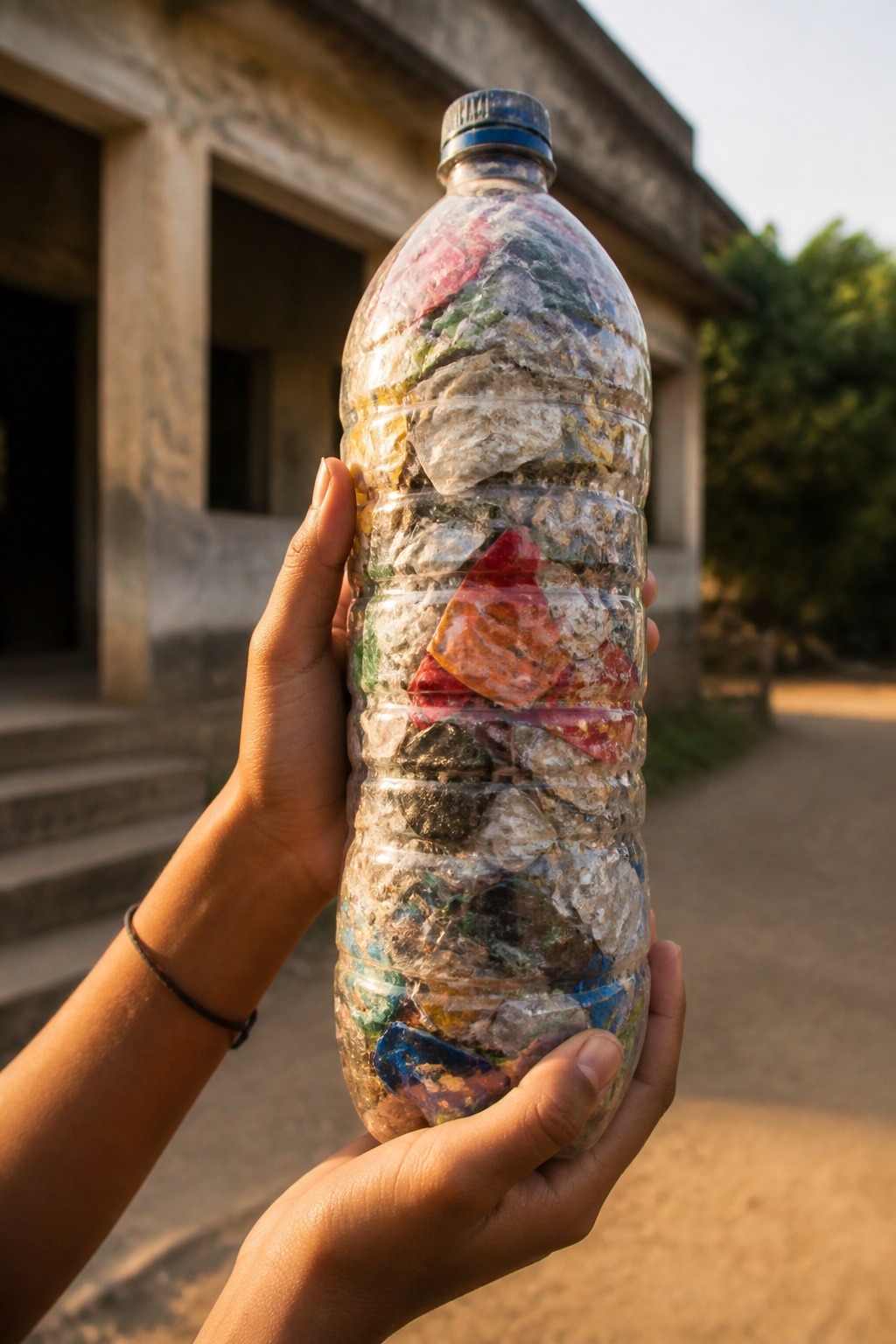
- Where it began: Akshar Forum School, Pamohi, Assam, India — founded 2016 by Parmita Sarma and Mazin Mukhtar.
- The “fee”: roughly 20–25 plastic items per student, brought from home each week.
- Indonesia’s twist: GRADASI (Gerakan Sedekah Sampah Indonesia, “the waste-charity movement”), launched 2021 — waste is donated at mosques, sold, and the cash pays tuition.
- Scale in Indonesia: ~1.3 million participants; 98 schools in Malang; 92 Islamic boarding schools (pesantren) in Jombang.
- What the plastic becomes: eco-bricks for low-cost building, or rupiah for uniforms and school fees.
Key Facts
- Akshar Forum School in Pamohi, Assam, India, was founded in 2016 by Parmita Sarma and Mazin Mukhtar; the plastic-fee rule was added in 2019.
- Students bring roughly 20 to 25 plastic items each week as a condition of enrolment.
- Indonesia’s GRADASI (Gerakan Sedekah Sampah Indonesia), a waste-as-charity movement, launched in 2021 and has about 1.3 million participants.
- GRADASI supports 98 schools in Malang and 92 pesantren (Islamic boarding schools) in Jombang.
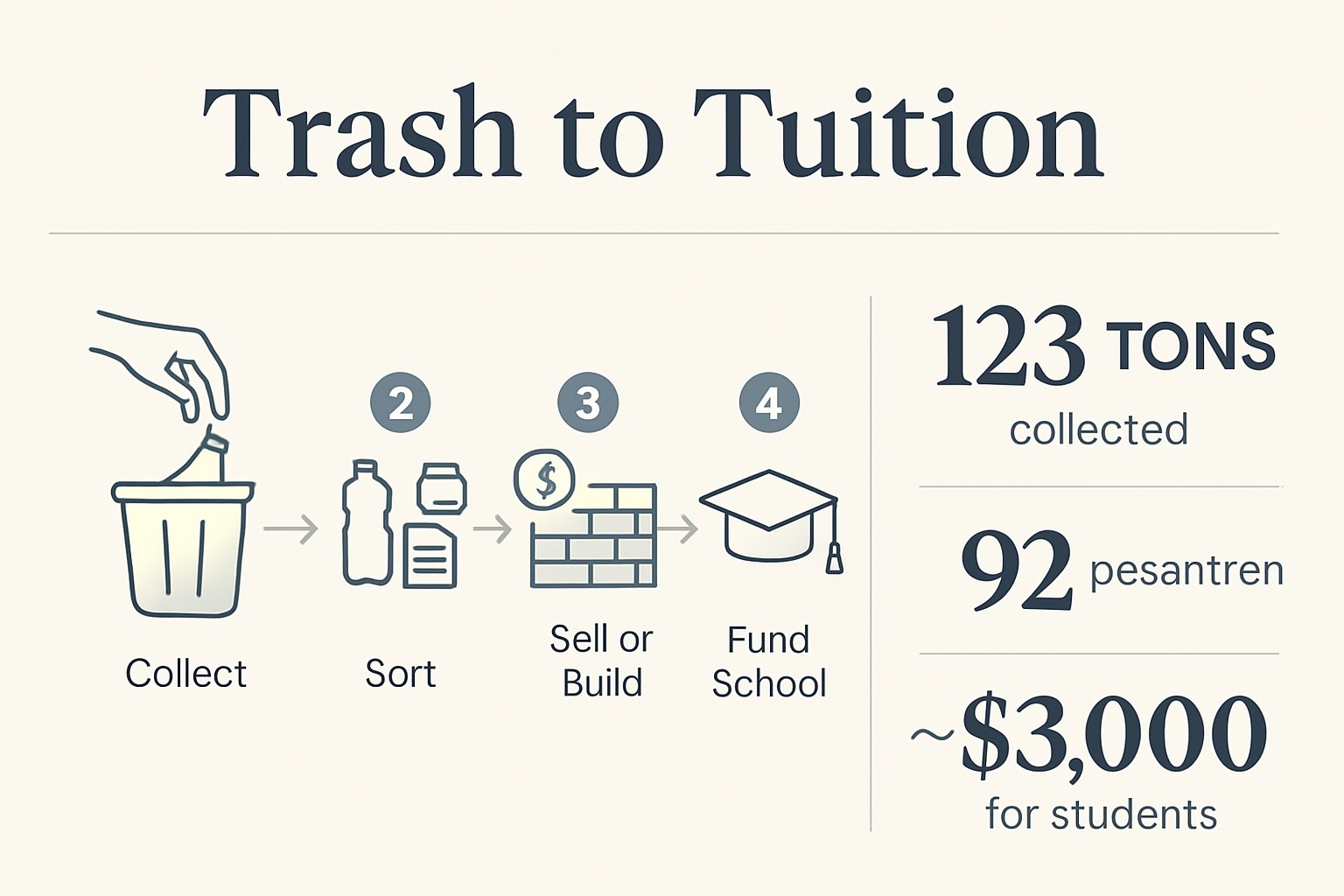
- By March 2023 the network had logged 123 tons of waste from 34 mosques (38 tons plastic), raising about IDR 45 million (~US$3,000) for student support.
In short: At Akshar Forum School in Assam, India, children pay fees not in cash but in about 20 to 25 pieces of plastic waste a week, a nudge to stop families burning it. Indonesia’s GRADASI movement scales the idea through mosques, where donated waste is sold to fund tuition for around 1.3 million participants.
The school where kids pay fees with plastic waste, not rupees
Before the plastic scheme, Akshar Forum was free — and struggling. Parmita Sarma and Mazin Mukhtar, the couple who started it in 2016 (she from Assam, he from New York), kept hitting the same wall: parents in the neighbourhood burned their household plastic, and the classrooms filled with the acrid smell of it. Asking families nicely to stop went nowhere.
So in 2019 they changed the rules. Every child would bring plastic waste each week as a condition of enrolment — reported at the time as around 20 to 25 items per student. It was never really about the money the trash was worth. It was a behavioural nudge dressed as a fee: if the classroom door only opens for a bag of collected plastic, the burning stops, the streets get cleaner, and the lesson about waste is taught before the first bell.
Here’s the part the viral 2019 headlines rarely followed up on: the fee also broke a quieter cycle. Older students at Akshar earn small “toy money” for tutoring younger ones, which nudged some families away from sending children out to low-wage work. The plastic was the hook. The education was the point.
From doorstep trash to a brick in the wall
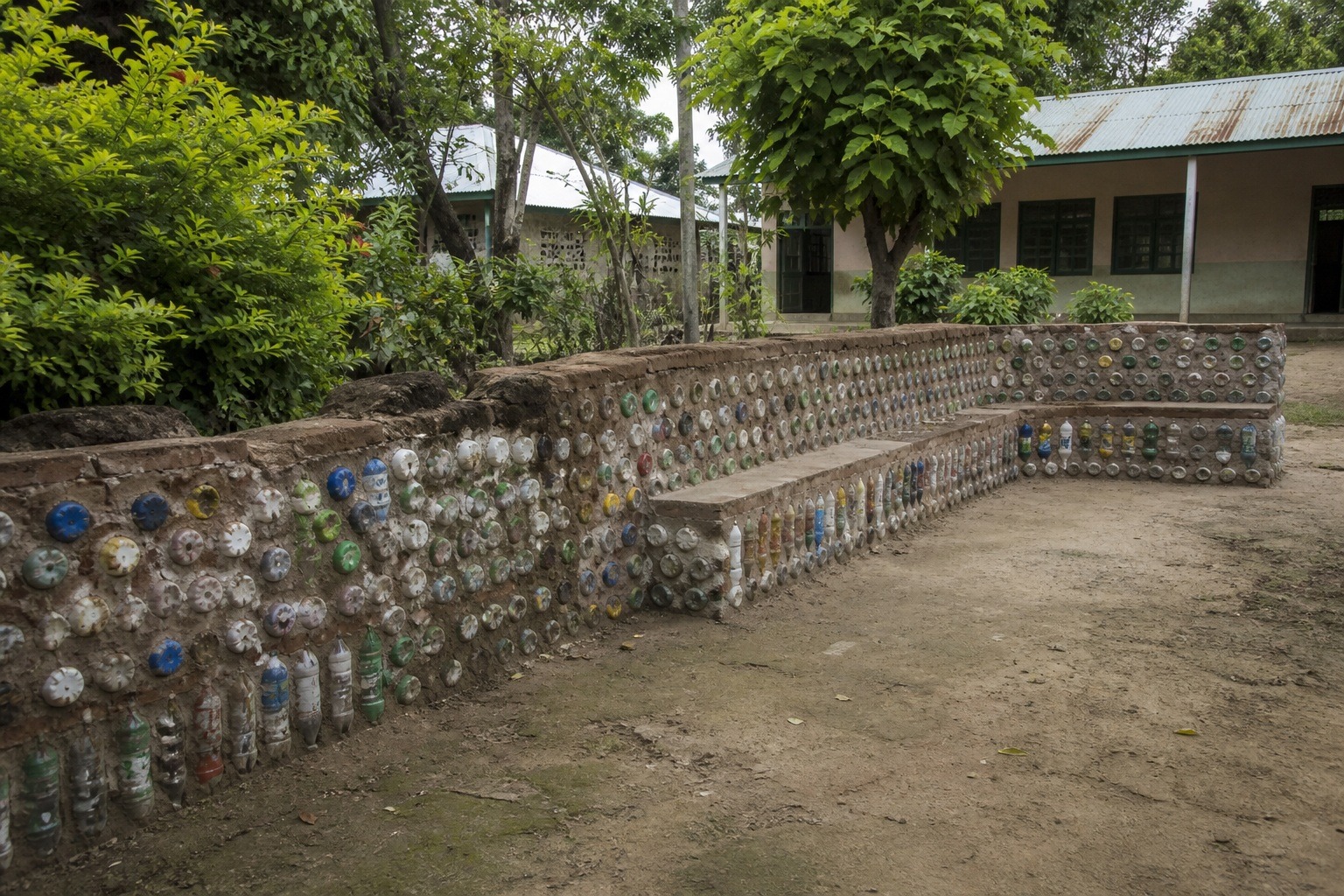
What happens to all that plastic? It doesn’t vanish into a recycling plant — most of it can’t be conventionally recycled at all. Instead, much of it becomes an eco-brick: a plastic bottle packed tight with clean, dry, non-recyclable plastic until it’s dense and rigid enough to behave like a building block.
The mechanics are deliberately low-tech. Students and volunteers wash and dry the film plastic — the wrappers, sachets and bags that no municipal system wants — then stuff it into a bottle with a stick, compressing it layer by layer. By the Global Ecobrick Alliance’s own packing guidance, a single ordinary bottle can swallow the equivalent of dozens of snack wrappers, locking that plastic into a solid form instead of letting it shred into rivers. String hundreds of finished bottles together with cob, cement or a frame, and you have a bench, a raised garden bed, a wall.
{IMAGE_2}
It is genuinely clever, and it is also where the honesty has to start. If you want the deeper engineering side of plastic-as-construction — where waste is actually melted and cast into blocks tested for load-bearing strength — that is a different technology altogether, one being pushed hardest in parts of Africa. An eco-brick is not that. It’s storage.
Indonesia’s quieter twist: paying tuition through the mosque
Most articles stop at Assam. The more surprising story is in Indonesia, and it works nothing like the Indian model. There, the plastic rarely goes into the school building at all — it goes through the mosque.
The movement is called GRADASI, short for Gerakan Sedekah Sampah Indonesia: literally, the movement of “giving alms” in the form of waste. It grew out of a genuinely local idea — sedekah sampah, waste-as-charity — and was formalised in 2021 by an unusually broad coalition: Indonesia’s Coordinating Ministry for Maritime Affairs and Investment, the Ministry of Environment and Forestry, the United Nations Development Programme in Indonesia, and the Indonesian Ulema Council, the country’s top Islamic clerical body.
The loop is elegant. Congregations bring their household waste to the mosque the way they might bring a donation. Volunteers weigh and sort it — plastic, metal, paper — and sell it to recyclers and scrap buyers. The proceeds become a fund. In Malang, East Java, that fund reaches 98 schools; in nearby Jombang, it supports santri — students at 92 pesantren, or Islamic boarding schools — who otherwise couldn’t afford uniforms, supplies or tuition. Hayu Prabowo, who chairs the environment body of the Indonesian Ulema Council, has framed it as faith and ecology pulling in the same direction: caring for creation as a religious duty, funded by the very waste the community produces.
What one community’s plastic is actually worth
Numbers are where this story earns trust, and Indonesia’s are rarely published in English. According to reporting by Climate Tracker Asia and LiCAS.news drawing on GRADASI’s own monitoring, here is what the mosque network had logged by March 2023.
- 123 tons of waste collected from 34 reporting mosques
- 38 tons of that total was plastic
- IDR 45 million (~US$3,000) — combined profit from selling plastic, metal and paper, channelled into student support
- IDR 7 million (~US$450) — plastic sales at a single mosque, Baitul Makmur in Bekasi
- ~1.3 million participants nationwide; roughly 100 mosques now taking part, up from just 6 at launch
Set that beside Akshar’s arithmetic — about 110 students each bringing 20-odd plastic items a week — and the two models come into focus. India’s is small, local and physical: the plastic literally becomes furniture and walls on campus. Indonesia’s is a financial machine: the plastic is converted to cash that quietly removes the cost barrier keeping poor children out of class. Same premise, two completely different engines.
A note on precision, because it matters: Indonesia produced roughly 19 million tons of waste in 2022, of which about 18 percent was plastic. Against that, 123 tons is a rounding error. GRADASI’s designers know this. The point was never to out-muscle the national waste stream — it was to change behaviour and pay a few thousand school bills while doing it.
From a 2016 headline to a living 2025 movement
The reason this topic feels frozen in time online is simple: the viral wave crested in 2019 around Akshar, and most coverage never moved on. It kept re-telling one Indian school, five and six years out of date.
The waste-for-education idea, though, kept spreading — especially through Indonesia’s pesantren network, where it has become a hands-on environmental curriculum rather than a one-off stunt. Academic community-service reports from 2025 document eco-brick training run with pesantren students in places like Bekasi and Tangerang Selatan on the outskirts of Jakarta, where small groups of santri were taught to pack bottles and assemble them into demonstration walls. These are modest, local efforts — a few dozen students at a time, measured in single walls, not tonnage — and it would be dishonest to inflate them into a national construction programme. But they show the idea is alive and being taught to the next cohort, not embalmed in a 2019 news cycle.
Does it really work, or just hide the plastic?
Now the question the feel-good coverage skips. An eco-brick does not recycle plastic. It contains it. The wrappers inside that bottle are still plastic; they’ve simply been immobilised, kept out of the river and the cooking fire, and given a second job holding up a bench. That’s a real benefit — smoke not inhaled, waterways not clogged — but it is sequestration, not a cure.
Strip away the warm framing and the honest verdict is narrower than the headlines suggest: this is brilliant social design and, at best, mediocre waste management — and pretending otherwise does the idea no favours.
Critics raise fair points. Eco-brick structures can degrade if left in direct sun; the plastic hasn’t been destroyed, only parked, and someday still has to be dealt with; and the model doesn’t scale to the tens of millions of tons a country actually generates. All true. But that critique measures the wrong thing. Judge Akshar and GRADASI as recycling plants and they fail. Judge them as what they are — a way to make waste visible, valuable and educational, and to put children in classrooms who weren’t there before — and they clearly work. The plastic outcome is the bonus. The kids are the win.
That framing matters beyond South Asia: schools everywhere are increasingly treating environmental responsibility as something you do, not just study, an approach seen in classrooms as far away as Latin America.
Quick answers
Which school first let kids pay fees with plastic waste? Akshar Forum School in Pamohi, Assam, India. It was founded in 2016 and introduced the plastic-waste “fee” in 2019, asking each student for roughly 20–25 items a week.
How does the Indonesia version pay for tuition? Through GRADASI. Households donate waste at mosques; volunteers sort and sell it; the proceeds fund uniforms, supplies and tuition for students who can’t afford them — about IDR 45 million raised across the reporting network by early 2023.
What is an eco-brick? A plastic bottle packed tightly with clean, dry, non-recyclable plastic until it’s solid enough to use as a building block for benches, garden beds and low-cost walls.
Is it actually recycling? Not really. Eco-bricks store and immobilise plastic rather than reprocessing it. The environmental win is keeping plastic out of fires and rivers; the bigger win is the education it funds.
Sources and notes
- Climate Tracker Asia / LiCAS.news — reporting on GRADASI and mosque-based waste charity in Indonesia (2023), including collection tonnage and funding figures
- Gerakan Sedekah Sampah Indonesia (GRADASI) — program background and participating institutions
- TIME — “This Indian School Takes Plastic Waste as Tuition” (2019)
- World Economic Forum and The Week — coverage of Akshar Forum School, Assam
- Global Ecobrick Alliance — eco-brick definition and packing guidance
- Indonesian government waste-generation statistics (Ministry of Environment and Forestry, 2022)
The most honest thing to say about a school where kids pay fees with plastic waste is that it solved the smaller problem beautifully and left the bigger one open. The burning stopped; the children came; the bottles hold up a wall. But the plastic is still there, waiting inside those bricks for a future that knows what to do with it. Which leaves the real question these schools quietly ask the rest of us: if a bag of trash can buy a child an education, what else are we throwing away?
Frequently Asked Questions
Q: How does the school where kids pay with plastic work?
Akshar Forum School in Pamohi, Assam, requires each child to bring roughly 20 to 25 plastic items a week as a condition of enrolment, a rule added in 2019. It was never really about the trash’s cash value but a behavioural nudge: if the classroom door only opens for a bag of collected plastic, families stop burning it and the streets get cleaner.
Q: What happens to the collected plastic?
Much of it becomes an eco-brick, a plastic bottle packed tight with clean, dry, non-recyclable film plastic until it is rigid enough to act like a building block. Students wash, dry and stuff wrappers into bottles, which are combined with cob or cement into benches, garden beds or walls. An eco-brick is storage, not conventional recycling of the plastic.
Q: What is Indonesia’s version of the scheme?
It is GRADASI, short for Gerakan Sedekah Sampah Indonesia, the waste-charity movement, formalised in 2021 by a coalition including government ministries, the UNDP and the Indonesian Ulema Council. Congregations bring household waste to the mosque like a donation; volunteers weigh, sort and sell it, and the proceeds fund tuition, uniforms and supplies for students.
Q: How much money does the waste raise?
By March 2023, GRADASI had logged 123 tons of waste from 34 reporting mosques, 38 tons of it plastic, generating about IDR 45 million (~US$3,000) in combined profit channelled into student support. One mosque, Baitul Makmur in Bekasi, made IDR 7 million (~US$450) from plastic sales alone. The network had grown to around 1.3 million participants nationwide.
Illustrations are AI-generated. Article fact-checked and human-edited. Our editorial standards.