How Costa Rica Pays Farmers to Protect Forests
Costa Rica pays farmers to protect forests — not to plant them, not to log them carefully, but simply to leave the trees standing and be paid for it, year after year. Put that way it sounds almost lazy. It is, in fact, one of the most quietly radical ideas in modern conservation: the country decided that a living forest does real work — storing carbon, cleaning water, sheltering wildlife, holding beauty — and that the people who own that forest deserve a paycheck for keeping it alive. Then it did something almost no nation has managed. It reversed its own deforestation.

- The turnaround: forest cover crashed to roughly 25–40% by the 1980s, then climbed back to about 60% today — the first tropical country to reverse deforestation.
- The program: Payments for Environmental Services (PES), launched in 1997 — the world’s first country-wide scheme of its kind.
- The money: around $64 per hectare per year for basic protection; over $524 million paid out; 18,000+ families; 1.3 million+ hectares under contract.
- The engine: funded largely by a 3.5% tax on fossil fuels, plus a water tariff.
- The 2026 proof: a University of Zurich soundscape study found regenerated forests now sound up to four times more like mature forest than pasture.
Key Facts
- Costa Rica reversed its deforestation, with forest cover climbing from roughly 25-40% in the 1980s back to about 60% today
- The Payments for Environmental Services (PES) program launched in 1997, the world’s first country-wide scheme of its kind
- The program pays around $64 per hectare per year for basic protection, has paid out over $524 million, and covers more than 1.3 million hectares under contract with over 18,000 families
- PES is funded largely by a 3.5% tax on fossil fuels plus a water tariff, routed through the national fund FONAFIFO
- A June 2026 University of Zurich bioacoustics study recorded 16,658 hours of soundscape across 119 sites, finding regenerated forests now sound up to four times more like mature forest than pasture
In short: Costa Rica pays landowners to keep forests standing through its 1997 Payments for Environmental Services program, funded by a fossil-fuel tax and water tariff via FONAFIFO. Forest cover rebounded from around 25-40% to about 60%. A 2026 University of Zurich soundscape study confirmed regenerated forests sound genuinely alive.
From 25% to 60%: the forest that came back
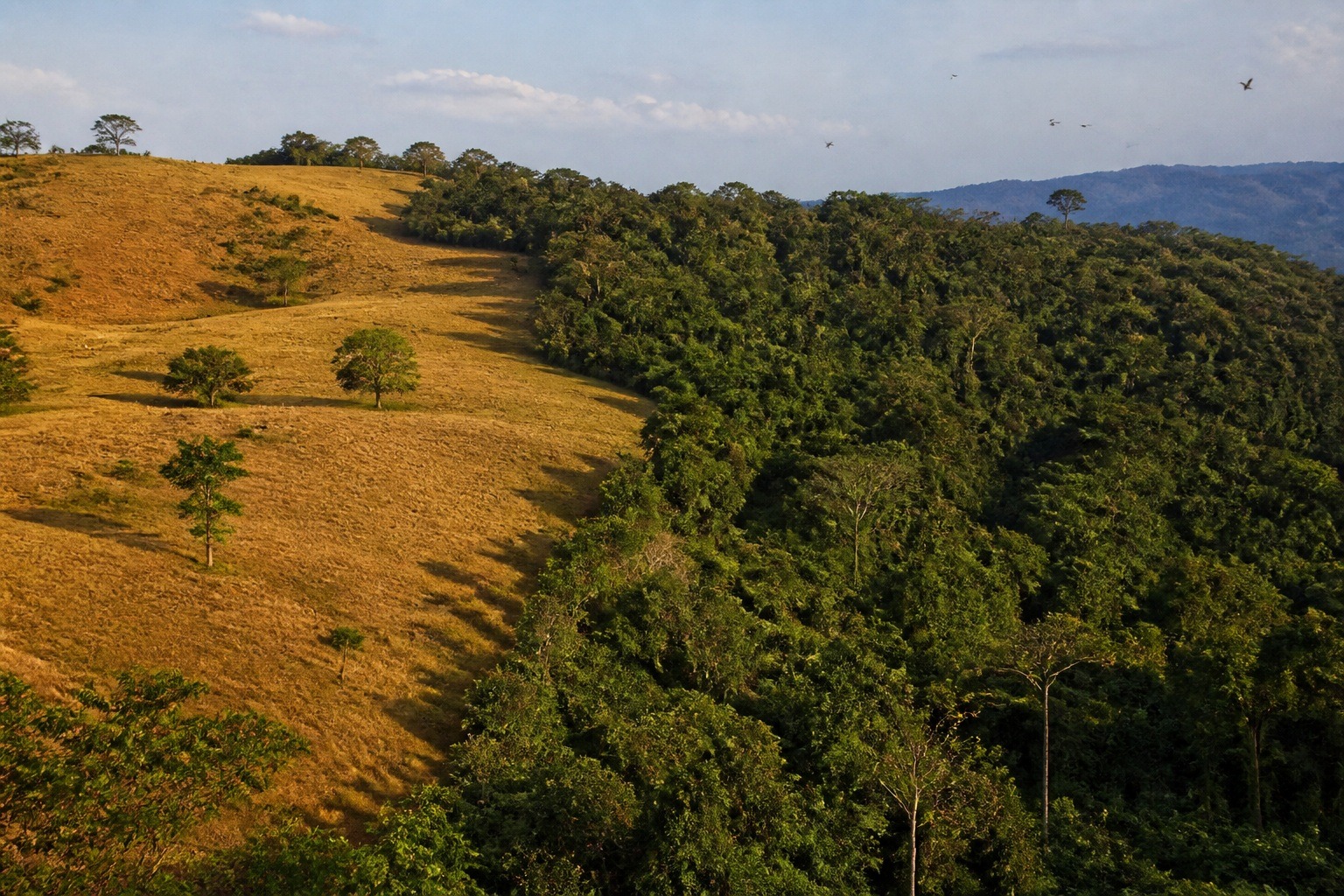
Rewind to the 1980s. Costa Rica was clearing land at one of the fastest rates on Earth, mostly for cattle. Hillsides that had held cloud forest a generation earlier were open pasture, cracking in the dry season. By the low point, depending on how you count and which year you pick, tree cover had fallen to somewhere between a quarter and two-fifths of the country. The green postcard nation was, on paper, going bald.
Then the line on the graph did something graphs of tropical forest almost never do. It turned around. Today roughly 60% of Costa Rica is forest again. That single reversal is why the country keeps showing up in climate talks and won the Earthshot Prize in 2021 — it is living proof that the trend is not a law of nature.
Here’s the thing worth pausing on, though. A recovered forest is not automatically a living one. Trees can return while the animals, the insects, the whole humming machinery of a real ecosystem stay gone. Whether Costa Rica bought back a forest or just a green backdrop is a question that sat unanswered for years — and we’ll get to who finally answered it.
The one fund: how Costa Rica pays farmers to protect forests
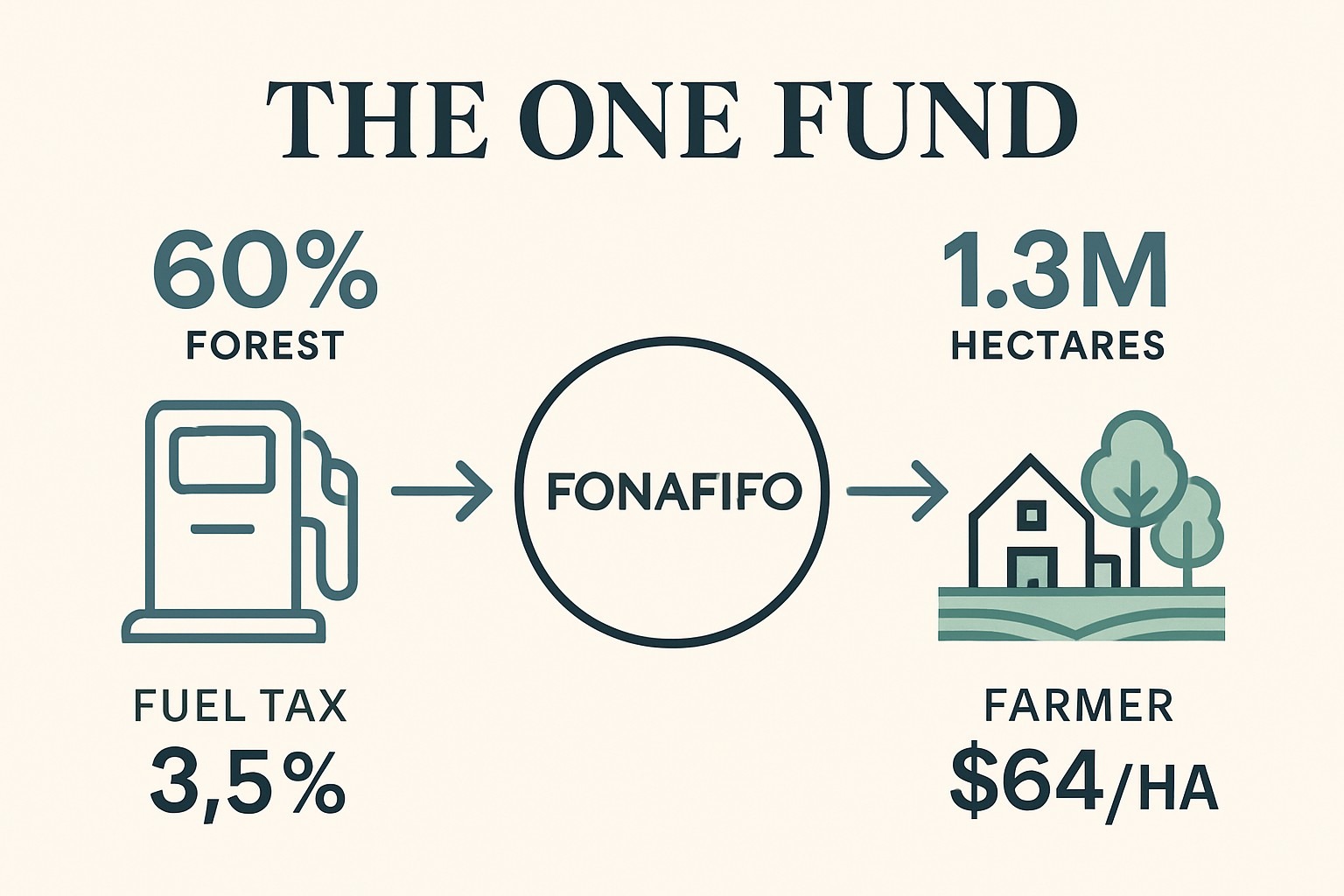
The mechanism is simpler than most people assume, and cleverer. It runs through a single national pot of money called FONAFIFO — the National Forestry Financing Fund. Nearly every competitor article says “farmers get paid” and stops there. The interesting part is the plumbing.
Follow one colón. A driver fills up in San José. A slice of the fuel tax — the law earmarks 3.5% of fossil-fuel revenue — flows into FONAFIFO. Hydroelectric and bottling companies that depend on clean rivers pay a water tariff into the same fund. So the money arriving in the forest is, in effect, a tax on the very things that damage it: burning fuel and drawing down watersheds. FONAFIFO then signs a contract directly with a landowner and pays them to keep a specific patch of forest intact.
{IMAGE_2}
That’s the whole trick, and it’s an elegant one: a tax on harm becomes a wage for care, routed through one accountable fund. The country isn’t buying trees. It’s buying four bundled “environmental services” that a standing forest performs — carbon storage, water regulation, biodiversity habitat, and scenic beauty — and paying the landowner as the service provider.
What $64 a hectare actually buys — inside a FONAFIFO contract
So what does a farmer actually sign? For basic forest protection, the headline rate has sat around $64 per hectare per year. It is not a fortune. On a modest plot it might cover the property tax and a little more — but crucially, it can tip the math against the chainsaw. When keeping the forest pays something and clearing it pays a one-time cattle windfall, a steady annual check changes the arithmetic of a hard decision.
Contracts typically run 5 to 16 years, depending on whether the goal is protecting existing forest, regenerating cleared land, or sustainable management. In exchange for the payments, the landowner agrees to conserve — no clearing, no unpermitted logging — and the state gains the carbon and watershed benefits. Across the program’s life, that arrangement has moved more than $524 million to over 18,000 families and put upward of 1.3 million hectares under contract.
Imagine a smallholder on the Nicoya Peninsula with twenty hectares of recovering forest. The cattle buyer offers a lump sum to clear it. FONAFIFO offers a modest annual payment to keep it. One is a bird in the hand; the other is a slow, dependable trickle — plus a forest that keeps the springs running through the dry season. Multiply that single choice across thousands of farms and you get a national forest coming back one contract at a time.
The 2026 sound test: proof the life returned, not just the leaves
This is where the story gets genuinely new — and where every other article on the subject stops short. For decades the evidence for Costa Rica’s success was aerial: satellite images showing green where there had been brown. Tree cover. But cover is the easy part to fake. Does a regrown forest actually sound alive?
In June 2026, biologist G. Delgado and colleagues at the University of Zurich’s Institute of Integrative Biology published an answer in the journal Global Change Biology. Their team ran a bioacoustics study on the Nicoya Peninsula — recording 16,658 hours of soundscape across 119 sites, from open pasture to forest that had regrown under PES to old mature forest. Then they compared the acoustic fingerprints: the dawn and dusk choruses, the layered calls of birds, frogs, and insects that a healthy forest generates and a pasture cannot.
The finding is striking. Forests that regenerated under the payment program had come to sound up to four times more like mature forest than like the pasture they replaced, with dusk-chorus overlap exceeding 0.90 against old-growth reference sites. In plain terms: the life came back, not just the leaves. It is, as far as anyone has published, the first acoustic proof that PES restored biodiversity and not merely canopy — the single most important thing to know about the program, and it is barely a season old.
The uncomfortable question: did we pay for forests that were already safe?
A good story deserves a hard question, and this one has a real one. Economists call it “additionality.” If you pay a farmer to protect a forest that no one was ever going to cut — a steep, remote plot with no road and no buyer — you have spent public money and changed nothing. The forest would have survived anyway. You bought a result you already had.
Research led by Arturo Sánchez-Azofeifa and others, along with efficiency analyses from the agricultural research center CIRAD, has pressed exactly this point in the peer-reviewed literature. A meaningful share of early PES payments, the critics argue, may have flowed to land that faced little real deforestation threat. There’s a second, thornier issue: access. Signing a FONAFIFO contract requires a formal land title and the paperwork to apply, which quietly favored wealthier, titled landowners over the smallholders and Indigenous communities who often needed the income most.
None of this erases the forest that came back — the satellite record and now the soundscape are real. But a country that only tells the flattering half of its own story is selling a brochure, not reporting a result. The honest verdict is that PES worked and was imperfect, and Costa Rica’s own agencies have spent years tightening targeting toward the places and people where a payment actually changes the outcome.
Could your country copy this? The hidden preconditions
This is the question viewers ask first and articles answer last: can anyone just do what Costa Rica did? Copy the fuel tax, set up a fund, cut the checks?
Partly. But the mechanism sat on top of preconditions that are easy to miss. Costa Rica abolished its standing army in 1948 — and money that many nations pour into defense could instead flow toward things like schools, health, and eventually the environment. It had a stable, continuous democracy, so a program begun in 1997 could survive across governments rather than dying with the next administration. And critically, a fuel tax was already in place to skim from. You cannot earmark 3.5% of a revenue stream that doesn’t exist.
So the payment scheme is exportable; the foundation under it is harder to ship. A country without secure land titles, durable institutions, or a pre-existing revenue base to tap can adopt the FONAFIFO blueprint and still watch it stall. That, more than the payment rate, is the real lesson — and the reason “just pay farmers” has proven far easier to admire than to repeat.
What’s next: PES 2.0 and the fossil-fuel paradox
There is a paradox baked into the machine. The program that grows Costa Rica’s forests is funded, in large part, by taxing the fossil fuels the country is trying to move away from. As the nation decarbonizes — as fewer liters of gasoline move through the pumps — the very revenue stream that pays farmers to keep the trees begins to shrink. Success, followed far enough, starves its own funding.
That tension is driving current debate around what’s often called “PES 2.0” and proposals for a broader Natural Capital Trust — ways to diversify the fund beyond a declining fuel tax, drawing on carbon markets and new financing so the payments outlast the pump. In 2022 the World Bank noted the program’s payoff and Costa Rica received its first results-based payment through the Forest Carbon Partnership Facility, a hint of where the money of the future might come from. How a green program keeps paying for itself once the dirty fuel it taxed is gone is a question Costa Rica hasn’t fully solved — and one every country hoping to copy it will eventually have to.
Frequently asked questions
How much do Costa Rican farmers get paid to protect forests?
For basic protection the rate has been about $64 per hectare per year, paid through the FONAFIFO fund under contracts that typically run 5 to 16 years. Rates vary by activity — protection, reforestation, or sustainable management — and the program has paid out more than $524 million overall.
How is the program funded?
Mainly by a 3.5% tax on fossil fuels, topped up by a water tariff on users like hydroelectric and bottling companies. The money pools into one national fund, FONAFIFO, which then contracts directly with landowners — a tax on environmental harm converted into payments for environmental care.
Did Costa Rica really reverse its deforestation?
Yes. Forest cover fell to roughly 25–40% by the 1980s and has recovered to about 60% today, making Costa Rica the first tropical nation to reverse the trend. A 2026 University of Zurich soundscape study went further, showing the regenerated forests now sound close to mature forest — evidence that wildlife, not just tree cover, returned.
Can other countries copy the PES program?
The payment mechanism is copyable, but it relied on preconditions many nations lack: secure land titles, a stable long-running democracy, and a pre-existing fuel tax to draw revenue from. Without those foundations, the blueprint alone tends to stall.
Sources and notes
- Delgado, G. et al., Institute of Integrative Biology, University of Zurich — bioacoustics study of PES forest restoration, Global Change Biology (2026), 119 sites and 16,658 hours of recordings on the Nicoya Peninsula.
- FONAFIFO (National Forestry Financing Fund) and UNFCCC Momentum for Change — Costa Rica’s Payments for Environmental Services program figures.
- The World Bank (2022) — reporting on Costa Rica’s forest conservation results and its first Forest Carbon Partnership Facility payment.
- Peer-reviewed additionality and access critiques, including work led by Arturo Sánchez-Azofeifa and efficiency analyses from CIRAD, in the ecological-economics literature.
- Earthshot Prize (2021) — recognition of Costa Rica’s forest-restoration achievement.
Costa Rica’s answer to a burning planet turned out to be almost gentle: decide that a standing forest is worth paying for, then actually pay. The forests came back, and in 2026 we finally heard them do it. The question the country hasn’t answered — the one it’s now racing to solve — is how you keep paying for the trees once the fuel tax that funded them fades away.
Illustrations are AI-generated. Article fact-checked and human-edited. Our editorial standards.