Lycurgus Cup: Colour Changing Roman Glass Explained
In Room 41 of the British Museum sits the Lycurgus Cup — colour changing Roman glass, cut by hand roughly seventeen centuries ago — and under gallery lighting it looks like almost nothing: a flat, mossy jade green. Stand right in front of it and, honestly, you would not look twice. Nearly opaque. The sort of green you could walk past on your way to the Sutton Hoo helmet. Move a light source behind the vessel, though, and the same glass turns a deep translucent red, the colour of claret held up to a window. Same cup. Same glass. Nothing added, nothing swapped.
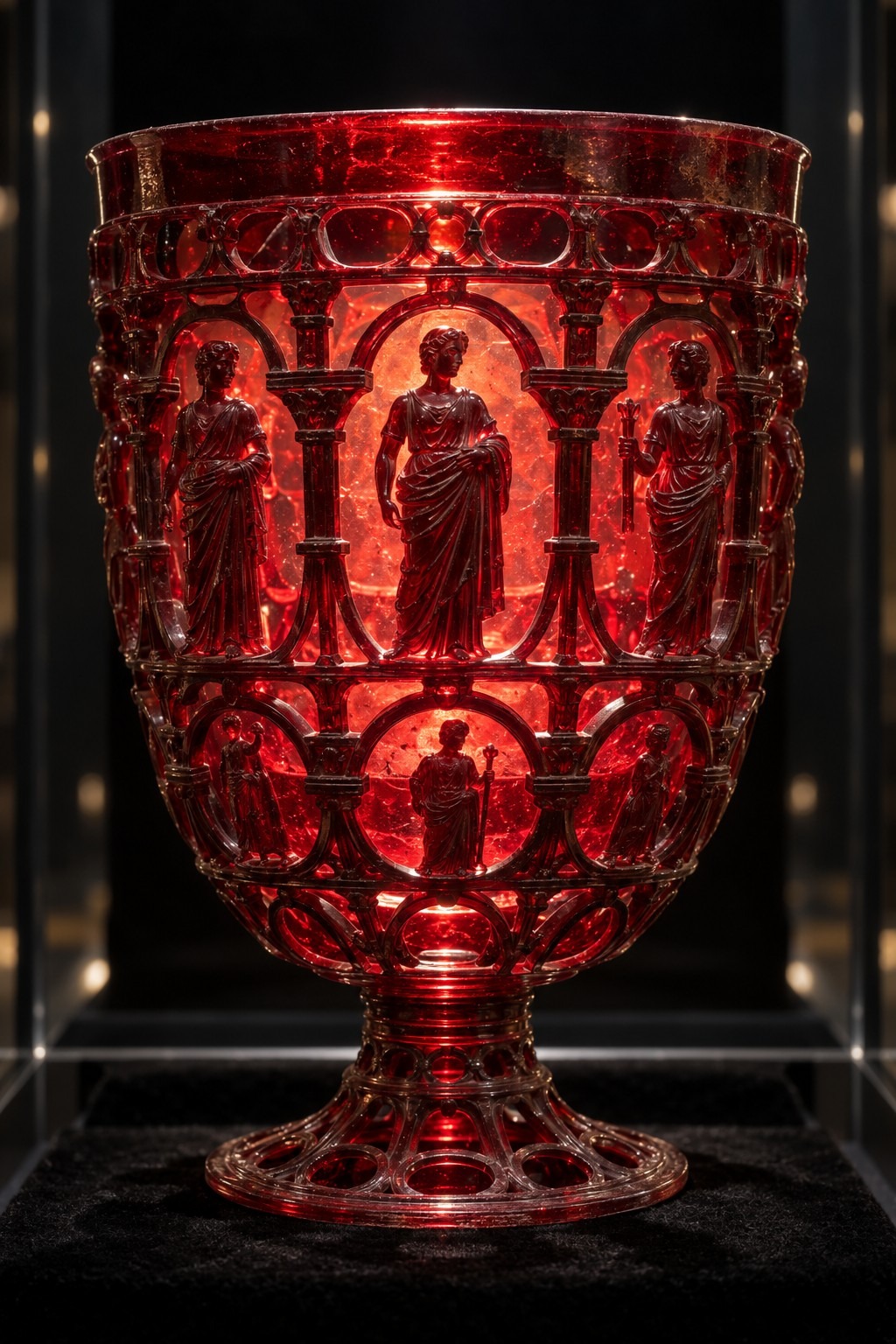
It is the only complete Roman vessel made from this kind of dichroic glass. Fewer than ten dichroic Roman glass objects are known at all, and every single other one is a fragment. The effect comes from metal particles a few dozen nanometres across, scattered through the glass body in amounts so tiny you could never weigh them out by hand: around 330 parts per million of silver and 40 of gold. Which leads straight to the question archaeologists have been arguing over for seventy years. Did the Romans mean to do this?
Key Facts
- The Lycurgus Cup dates to the 4th century AD, probably c. 290-325, likely made in Rome or Alexandria.
- It measures 15.9 cm high and 13.2 cm wide (excluding its 19th-century gilt-bronze mounts) and is the only complete Roman vessel made from this dichroic glass.
- The glass contains about 330 parts per million of silver and 40 parts per million of gold, in particles averaging roughly 70 nanometres (50-100 nm range, about 66% silver, 31% gold, 3% copper).
- In 1990, physicist D. J. Barber and archaeologist Ian Freestone identified the colour-change mechanism in the journal Archaeometry as surface plasmon resonance in colloidal metal nanoparticles.
- The British Museum purchased the cup in 1958 for 20,000 British pounds.
In short: The Lycurgus Cup, a 4th-century Roman glass vessel at the British Museum, looks jade green in reflected light but turns deep red when light shines through it. The effect comes from tiny silver and gold nanoparticles suspended in the glass, identified by researchers in 1990 as surface plasmon resonance.
Green in the gallery, red when the light comes from behind
At 15.9 cm high and about 13.2 cm across, it is a chunky, heavy thing — closer in proportion to a bucket than to a wine glass. Around its outside runs a carved scene in high relief: King Lycurgus of Thrace, bound and throttled by a vine, with a satyr winding up to hurl a rock at him, Pan at his feet, a panther mid-leap, and Dionysus himself standing back, levelling his thyrsus at the king in triumph. The figures stand almost free of the body, joined to it by hidden bridges of glass.
Its green-to-red shift is called dichroism, and it depends entirely on where the light sits relative to the glass. In practice most published photographs of the cup are two separate shots under two separate lighting rigs, which is why the object confuses people who have only seen it online.
One detail trips up a lot of readers: the gilt-bronze rim and foot are not Roman. They were added in the nineteenth century, long after the cup resurfaced, and they change its proportions considerably. Strip them away mentally and you are left with a vessel that flares outward and has no stable base of its own — a point that matters later.
- Date: 4th century AD, probably c. 290–325, made in Rome or Alexandria
- Size: 15.9 cm high, 13.2 cm wide (excluding the 19th-century mounts)
- Silver content: about 330 parts per million
- Gold content: about 40 parts per million
- Particle size: roughly 50–100 nanometres, averaging near 70 nm
- Particle alloy: approximately 66% silver, 31% gold, 3% copper
- Surviving Roman cage cups: around 50, mostly fragments
- Complete dichroic Roman vessels: one — this one
- Price paid by the British Museum in 1958: £20,000
The physics behind the Lycurgus Cup colour changing Roman glass
So why green one way and red the other? Because the particles in the glass are sitting in an awkward size range where they do two different jobs at once. In 1990, physicist D. J. Barber and archaeological materials specialist Ian Freestone put samples of the cup under an analytical transmission electron microscope and reported the answer in Archaeometry: the glass is full of crystalline particles of colloidal silver, gold and copper, averaging somewhere between 50 and 100 nanometres.
Particles that big are coarse enough to scatter light backwards at you. Scattering strength climbs roughly with the fourth power of particle radius, so the larger silver particles throw back the greenish part of the spectrum hard — hence the jade appearance in reflected light. When light instead travels through the glass, the same particles absorb and scatter the blue end of the spectrum far more effectively than the red end, and gold nanoparticles in particular soak up light at around 520 nanometres. What survives the journey through the wall is red.
| Lighting | What you see | What the particles are doing |
|---|---|---|
| Light in front (reflected) | Jade / olive green, nearly opaque | Larger silver-rich particles backscatter green light toward the viewer |
| Light behind or inside (transmitted) | Deep translucent wine red | Gold absorbs near 520 nm and blue wavelengths scatter away; red passes through |
Modern physics calls the underlying mechanism surface plasmon resonance — electrons on the surface of a metal nanoparticle oscillating in step with incoming light, at a frequency that depends on how big the particle is. Size is the whole trick — and nobody can say how Roman workers achieved such an even distribution of particles through a thick glass blank. Barber and Freestone were blunt about it in 1990, and the position has not really moved: the process is unknown, and its difficulty is probably why dichroic Roman glass is so vanishingly rare.
Carved, not blown: months of work on a single blank
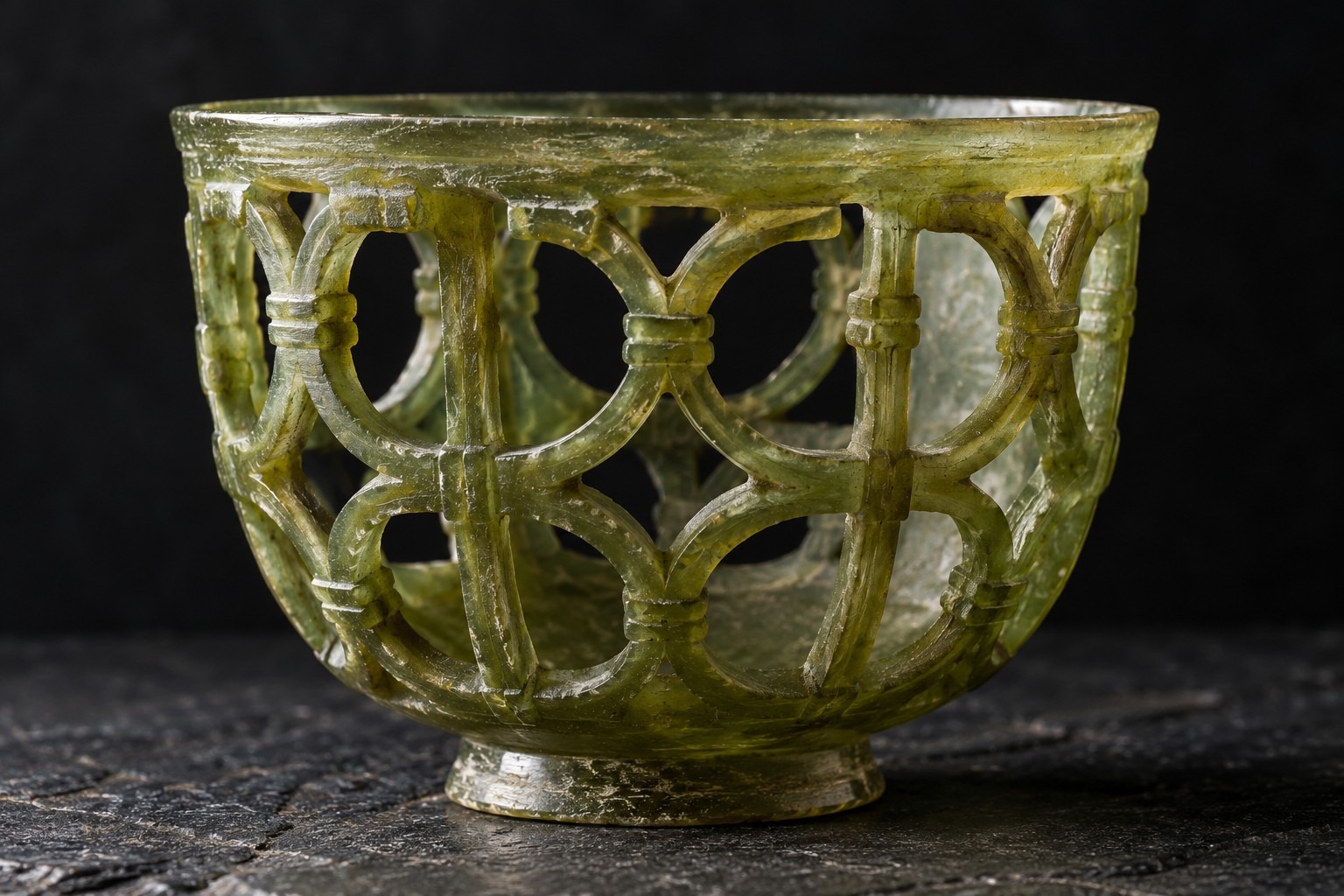
Glass historians file it under a class of late Roman luxury ware known as cage cups, or vasa diatreta. About fifty survive, almost all in pieces, dating from the mid-third to the mid-fourth century and clustering around the Rhineland workshops near Trier and Cologne. Only one, the Trivulzio Cup in Milan, has come down to us undamaged.
{IMAGE_2}
Since the first scholarly publication on the subject in 1680, the accepted view has been that a cage cup starts as a thick-walled blown blank. Cutters — the diatretarii — then grind and undercut the surplus glass away, leaving a thin inner beaker inside an outer openwork shell, the two joined by bridges thin enough to look structurally impossible. An alternative theory holds that cage and beaker were made separately and fused, pointing at suspiciously smooth joins on some examples. The debate has not closed.
Either way, the labour involved was enormous. Several months of expert work for a single vessel is the usual estimate, and that work was not done by one romantic genius at a bench. Hallie Meredith, an art historian and glassblower at Washington State University, examined cage-cup fragments in 2023 and argued in two 2025 papers — in the Journal of Glass Studies and in World Archaeology — that the small diamonds, leaves and cross-like figures previously brushed off as decorative “stop-marks” are actually workshop signatures: a deliberate visual shorthand used to coordinate teams of cutters, polishers and apprentices. (She was looking at a private collection housed at the Metropolitan Museum of Art when the pattern clicked.) Cage cups, on that reading, are industrial products of a very high order.
A king throttled by a vine, and the emperor it may flatter
Lycurgus is not a comfortable subject for a party. In the myth, the Thracian king attacks Dionysus and his followers, and is punished — in the version carved here, entangled and strangled by a vine that springs from the ground, while the god looks on. For a drinking vessel, the message is pointed: respect the god, or the god consumes you.
D. B. Harden and Jocelyn Toynbee, publishing the cup in Archaeologia in 1959 while it was still in Rothschild hands, proposed a sharper political reading. Constantine defeated his co-emperor Licinius in Thrace in AD 324. Licinius — a persecutor of Christians according to Constantine’s own subsequent letters — maps neatly onto the doomed king; Constantine onto the avenging god. If that is right, the cup is not a mythological ornament but a piece of imperial propaganda you could hand to a guest.
Maja Miziur-Moździoch of the Institute of Archaeology and Ethnology at the Polish Academy of Sciences revisited the iconography in Archaeologia Polona in 2017, comparing the frieze with other ancient renderings of the same episode on pottery and floor mosaics. Her conclusion is appropriately careful: how you read the symbolism depends almost entirely on what the object was actually for — a drinking cup, a libation bowl, a lamp, or a political statement. We do not know which.
The accident-or-intent argument, weighed honestly
Here is where popular accounts tend to pick a side and sound confident. The evidence does not really allow that.
On the accident side stands Freestone himself, now emeritus professor of archaeological materials at University College London, who with Nigel Meeks, Margaret Sax and Catherine Higgitt published “The Lycurgus Cup — A Roman Nanotechnology” in Gold Bulletin in 2007. Their reading is cautious: the process was probably neither well understood nor controlled by the people doing it, and may well have begun as contamination of a batch with finely ground precious metal. At 40 parts per million, the glassmakers may not have known gold was in there at all.
On the intent side stands a simple fact: other Roman glass fragments have turned up with essentially the same composition. A one-off could be a happy accident. A recurring recipe, with precious metals in a consistent ratio, looks much more like a recipe. Someone was reproducing something, even if they described it in terms of ingredients and furnace behaviour rather than particle size.
Both can be true at once.
Most likely, a Roman workshop knew that a certain batch treated a certain way sometimes came out of the furnace doing something extraordinary, and kept trying to hit it — succeeding rarely, which is exactly what a survival rate of fewer than ten dichroic objects would predict. Calling that “Roman nanotechnology” is fair as shorthand for the material achievement. Calling it Roman nanoscience is not; there was no concept of a nanoparticle to work with.
The lamp theory that would explain the red
Now the awkward detail about that flaring body and missing original foot. Since 1986, when a diatreta bowl was found with copper-alloy fittings for hanging, scholars have broadly accepted that open bowl-form cage cups were suspended lamps rather than drinking vessels. The argument has since been extended to some beaker-shaped examples, including this one: hang it, put a flame inside, and the light is coming from within the glass wall.
Which is precisely the condition under which the glass glows red.
Of the three readings on offer, the lamp is the one that earns the glass: it is the only scenario in which the red stops being a laboratory curiosity and becomes the entire design intent, visible to every guest in a dim late-Roman dining room. A green cup that turns red only when a modern curator shines a torch through it is a puzzle. A green vessel that becomes a hanging ember of wine-red light the moment you light it is an object someone commissioned on purpose. Nothing proves the Lycurgus Cup was used that way — no hanging fittings survive on it — but the physics and the form point in the same direction.
From a Roman workshop to a nanoplasmonic sensor
Turns out the cup has had a strange second career as a design brief. In 2013, a team led by Gang Logan Liu at the University of Illinois at Urbana-Champaign published work in Advanced Optical Materials on what they called nano Lycurgus cup arrays: dense fields of tiny plasmonic cups that shift colour in response to what fills them. Their device was reported as around a hundred times more sensitive than previous nanoplasmonic sensors, and — the genuinely useful part — sensitive enough that you read the result as a colour change by eye, with no spectrometer.
Seven years later a group at the Laboratory of BioNanoTechnology at Wageningen University, working with Germany’s Bundesanstalt für Materialforschung und -prüfung, went the other way and tried to rebuild the thing. Writing in the Beilstein Journal of Nanotechnology in 2020, Lars Kool, Vittorio Saggiomo and colleagues embedded silver and gold nanoparticles in polyvinyl alcohol at a 90:10 silver-to-gold ratio and 3D-printed a cup that performs the same green-to-red flip. Not glass, not Roman, but the same optics — and a reminder of how finely balanced the original recipe must have been.
Newest of all is a purely computational attack on the problem. A paper by Emre Burak Ertuş in Applied Physics A in 2026 built a nine-parameter physical model of the cup’s glass — plasmonic absorption, iron-oxide absorption, scattering from phase-separated silica droplets, layered structure — then trained a gradient-boosting emulator on 2,000 Monte Carlo simulations to predict spectra in milliseconds instead of minutes. That let the study sweep more than 215,000 candidate compositions looking for ones that reproduce the cup’s measured colours. It is an odd and rather lovely inversion: software searching the space of recipes that a fourth-century furnace stumbled into.
Seeing the colour change for yourself
The cup lives in Room 41 at the British Museum, the Sir Paul and Lady Ruddock Gallery, which covers Europe between AD 300 and 1100 — the same room as the Sutton Hoo finds. Admission is free; gallery access is worth checking before you travel.
Set your expectations, though. Under normal display lighting you will see the green state, and the green state alone; the red requires light passing through the glass wall, which a static case does not usually provide. Visitors who arrive hoping to watch a cup change colour in front of them generally leave slightly deflated. Go instead to look at the carving — the undercut vine, the bridges holding Dionysus off the surface — and to register how small and how heavy the thing is. The colour trick you can study in photographs. The craftsmanship you cannot.
Its modern history is short and well documented: first recorded in a French account in 1845, in the hands of Lionel de Rothschild by 1857, sold to the British Museum by Victor, Lord Rothschild in 1958 for £20,000. Where it spent the previous fourteen centuries, nobody knows.
Frequently Asked Questions
Why does the Lycurgus Cup change colour? Because the glass contains metal nanoparticles sized in the range where they both backscatter and selectively absorb light. Larger silver-rich particles bounce green light back at a viewer lit from the front; when light instead passes through the wall, blue wavelengths scatter away and gold absorbs strongly near 520 nm, so red comes through.
Is there really gold in the glass? Yes, but barely — about 40 parts per million, alongside roughly 330 parts per million of silver and a trace of copper. The total precious metal content is so small that the Roman glassworkers may not have known gold was involved.
Did the Romans invent nanotechnology? They made a nanostructured material, which is not the same thing. There was no theory of nanoparticles, no way to measure them, and the result was reproduced only rarely.
Was the Lycurgus Cup a drinking cup or a lamp? Genuinely unresolved. Its form, the absence of an original foot, and the 1986 discovery of a diatreta bowl with hanging fittings all support the lamp reading, which would also explain why the glass was engineered to glow red from within. No hanging hardware survives on this particular vessel, so the question stays open.
Sources and Notes
- Archaeometry — D. J. Barber and I. C. Freestone, “An Investigation of the Origin of the Colour of the Lycurgus Cup by Analytical Transmission Electron Microscopy” (1990)
- Gold Bulletin — I. Freestone, N. Meeks, M. Sax and C. Higgitt, “The Lycurgus Cup — A Roman Nanotechnology” (2007)
- Archaeologia Polona — Maja Miziur-Moździoch, “The Symbolism of the Lycurgus Cup” (2017); and D. B. Harden and J. M. C. Toynbee in Archaeologia (1959)
- Beilstein Journal of Nanotechnology — Kool, Saggiomo and colleagues, Wageningen University, on a 3D-printed dichroic nanocomposite (2020)
- Journal of Glass Studies and World Archaeology — Hallie Meredith, Washington State University, on cage-cup workshop marks (2025); Advanced Optical Materials (2013) and Applied Physics A (2026) for the modern optics
What makes the Lycurgus Cup worth an hour of anyone’s attention is not that the Romans were secretly modern. They were not. It is that a workshop with no instruments, no theory and no vocabulary for what it was doing still managed to control matter at a scale we only learned to see with electron microscopes. They could not explain it. They could not reliably repeat it. They did it anyway, once, well enough that the object still works after seventeen hundred years. That is a quieter and better story than the one about ancient nanotechnology, and it leaves you looking at the glass differently.
Illustrations are AI-generated. Article fact-checked and human-edited. Our editorial standards.