Unsinkable Sam Ship Cat: What the Evidence Shows
Every retelling of the Unsinkable Sam ship cat story runs the same way: a black-and-white tomcat sails with the Bismarck, is fished from the Atlantic by a British destroyer, outlives that destroyer too, then walks off a sinking aircraft carrier six months later — three warships, three sinkings, one unbothered cat. It is one of the best-loved animal stories of the Second World War. The stranger truth is that the legend can be watched assembling itself in real time, in the newspapers of late 1941, and one of its three ships only joins the story three weeks after the fact.
Key Facts
- Bismarck sank on 27 May 1941; of roughly 2,200 crew only about 114 survived.
- HMS Ark Royal was torpedoed by U-81 under Friedrich Guggenberger on 13 November 1941 and capsized early on 14 November, about thirty miles from Gibraltar.
- Only one man died when Ark Royal sank: Able Seaman Edward Mitchell, 44, out of roughly 1,500 aboard.
- HMS Cossack was torpedoed west of Gibraltar and lost with 159 of her crew, five months after Bismarck.
- The earliest press report, a Reuters wire dated 18 November 1941, said the cat had “lost two of his nine lives” — the third-ship claim first appeared on 9 December 1941, in the Belfast Telegraph and Londonderry Sentinel.
In short: The Unsinkable Sam legend claims a cat survived the sinkings of the Bismarck, HMS Cossack, and HMS Ark Royal in 1941. Contemporary records show no rescue by Cossack, and the earliest 1941 press reports credited the cat with only two narrow escapes — the third sinking was added to the story three weeks later, in December 1941.
The claim: three ships, six months, one cat
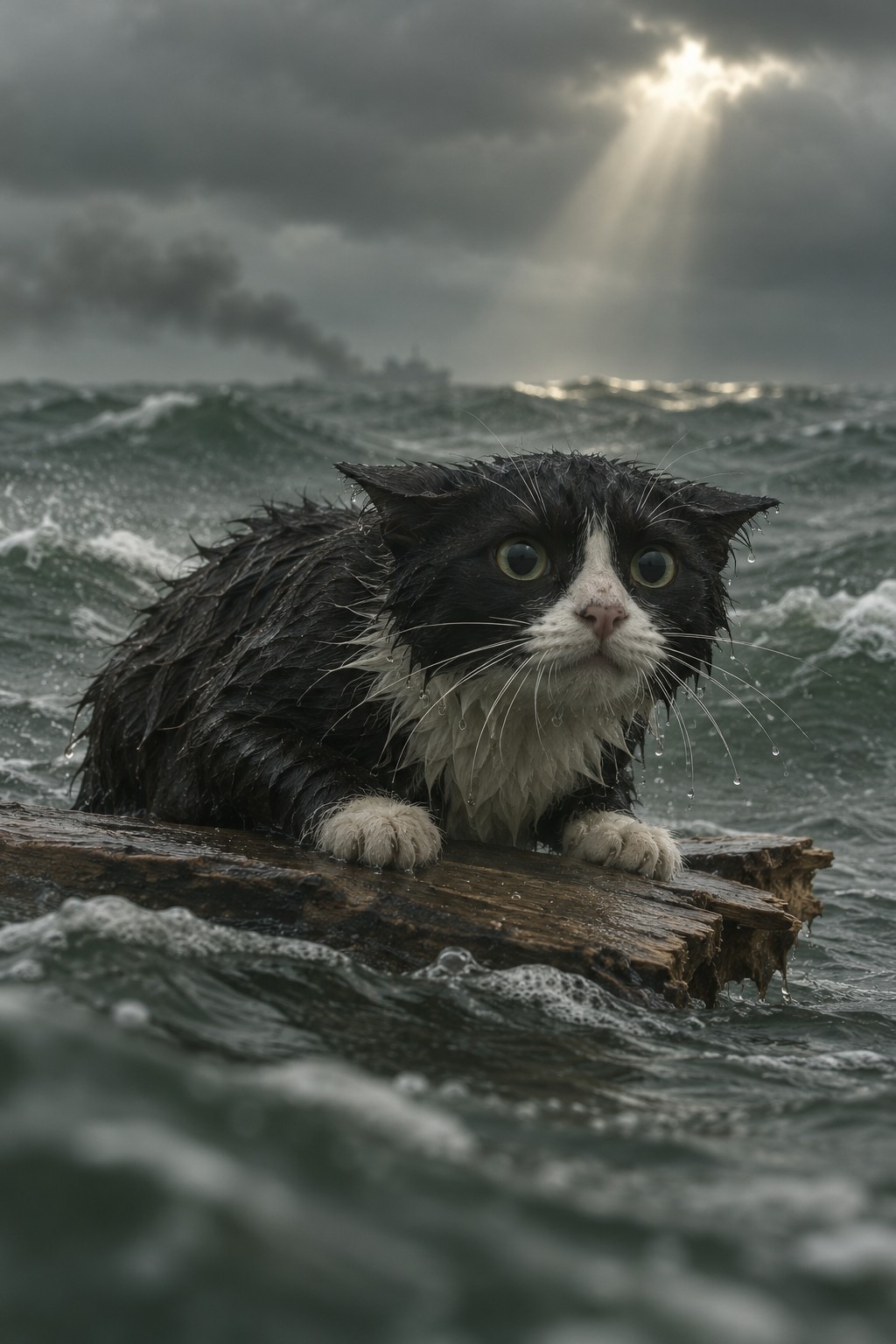
Here is the version almost every source tells. A German sailor smuggles a tuxedo cat aboard the battleship Bismarck before she sails from the Baltic in May 1941. On 27 May, after a running battle across the North Atlantic, Bismarck goes down. Of roughly 2,200 men aboard, only about 114 live — and among the debris, British sailors spot a cat on a floating plank and haul him in.
They name him Oscar, from the signal flag for the letter O: man overboard. The ship that saves him, the story says, is the Tribal-class destroyer HMS Cossack. Five months later Cossack is torpedoed west of Gibraltar and lost with 159 of her crew. Oscar survives again. Transferred to the carrier HMS Ark Royal, he is in the water a third time on 13 November 1941, found “angry but quite unharmed” on another plank, and renamed Unsinkable Sam.
Retired from the sea, he ends his days in a seamen’s home in Belfast and dies in 1955. A pastel portrait of a black-and-white cat perched on wreckage hangs in the National Maritime Museum in Greenwich, catalogued as Oscar, cat from the German battleship Bismarck.
Lovely. Now let us test it piece by piece.
Did HMS Cossack really pluck him from the Bismarck’s wreckage?
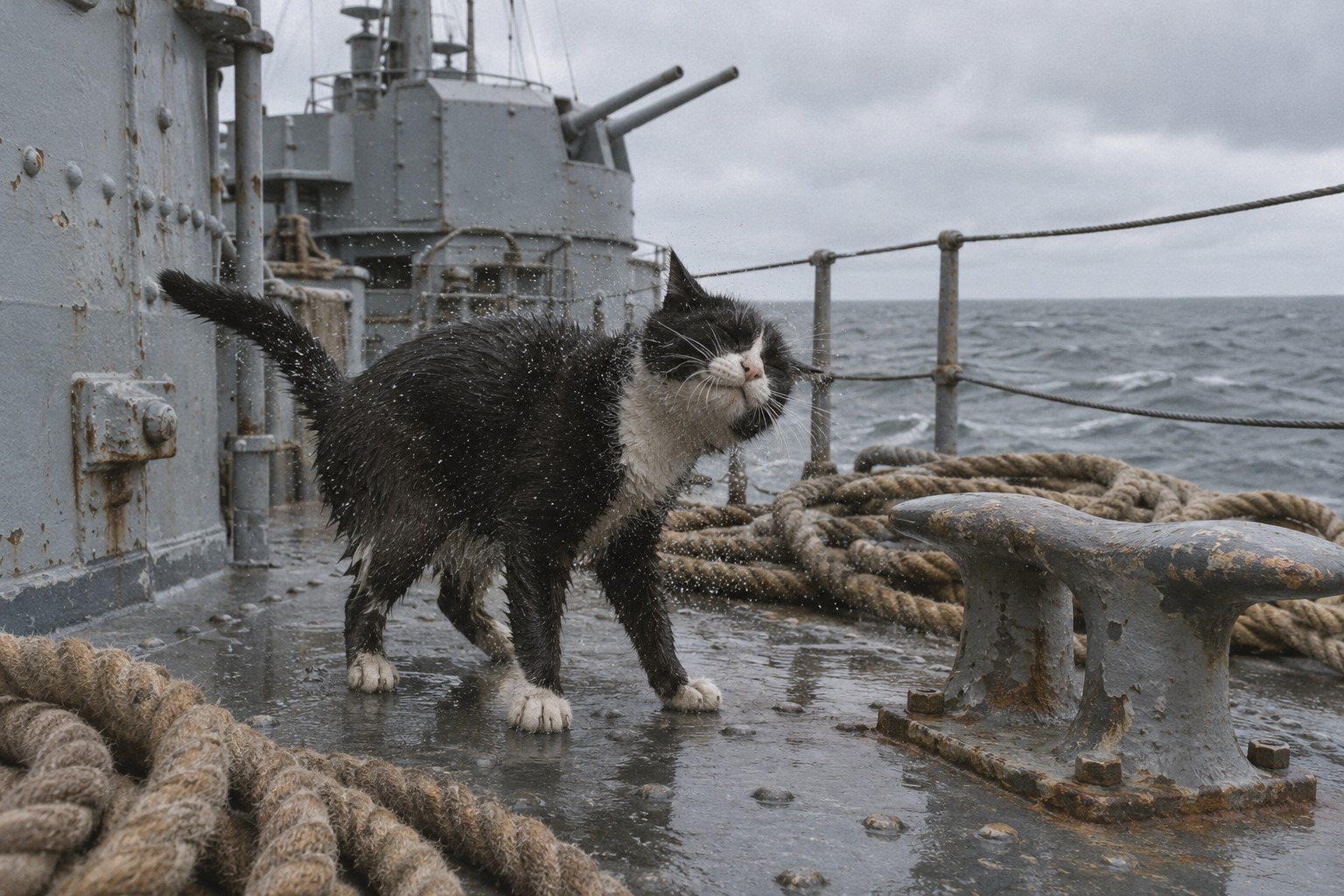
This is where the story meets the operational record and loses. On the night of 26–27 May 1941, Cossack was one of five destroyers under Captain Philip Vian that broke away from a troop convoy to shadow Bismarck. Her war was torpedo attacks in heavy seas through the dark — none of them hit, though they denied the German gunners any sleep. One of Bismarck‘s shells sheared the antenna clean off her.
When Bismarck finally sank the next morning, the ships picking men out of the water were the heavy cruiser HMS Dorsetshire, which took aboard roughly 85 survivors, and the destroyer HMS Maori, which took about 25. Both broke off abruptly on a submarine alarm and left hundreds of men behind — a decision that still haunts accounts of the action. Three more Germans were later found by U-74 and two by the weather ship Sachsenwald.
{IMAGE_2}
Cossack is not recorded as having rescued anyone. Strip away the photographs and the retellings, and the Cossack leg of this story is the weakest link by a wide margin — the one chapter with neither a rescue in the operational record nor a contemporary report to support it.
There is a second problem, and it belongs to the Bismarck end. Ludovic Kennedy, the Scottish journalist and broadcaster, was aboard HMS Tartar during the pursuit — the same destroyer flotilla, the same freezing night — and his 1974 book Pursuit remains one of the standard English accounts, built on interviews with survivors. It contains no cat. Royal Museums Greenwich, which owns the painting, says the quiet part out loud in its own catalogue: doubt hangs over Oscar’s Bismarck origins both because no survivor account places him there, and because two contradictory photographs of “Oscar” exist.
What the 1941 newspapers actually said — and when
Here is the thing nobody else lays out: the press trail, read in order, is the most useful evidence we have. Set the reports side by side and the legend stops looking like a single event and starts looking like a story being added to.
| Date, 1941–42 | Report | What it claims |
|---|---|---|
| 18 Nov 1941 | Reuters wire from Gibraltar | A black cat, “Oscar”, found on a plank after Ark Royal sank; formerly a pet aboard Bismarck; rescued by Cossack; had “lost two of his nine lives” |
| 25 Nov 1941 | Yorkshire Post and Leeds Mercury | A petty officer says “both the ship’s cats” were saved — Oscar, “previously the pet of the Bismarck‘s crew”, and one called Parry |
| 9 Dec 1941 | Belfast Telegraph; Londonderry Sentinel | Oscar handed to the Derry Sailor’s Rest — and, newly, said to have been aboard Cossack when she was sunk |
| 5 Feb 1942 | Londonderry Sentinel | Margaret Hill, the Rest’s manager, plans to take Oscar to America after the war |
| 10 Mar 1942 | Londonderry Sentinel | Oscar is put on Armed Forces Radio from Derry and “made himself heard to millions” |
Read the first row again. In the earliest wire report, Cossack is the rescuer, not a victim — and the tally is two lives lost, not three. The third sinking appears for the first time on 9 December, in local Northern Irish papers, three weeks after the carrier went down and six weeks after Cossack herself was lost.
Three weeks. That is all it took for the legend to grow a third ship.
So why does the three-ship version dominate every modern retelling? Because it completes the shape of a good story. Two sinkings is luck; three is destiny, and destiny is what gets reprinted.
Ark Royal: the one leg that holds up
Strange as it sounds, the most famous part of the tale is also the best evidenced. HMS Ark Royal was returning from Operation Perpetual, a run to fly aircraft into Malta, when U-81 under Friedrich Guggenberger put a single torpedo into her starboard side on the afternoon of 13 November 1941. She listed, was taken in tow, and capsized in the early hours of 14 November some thirty miles from Gibraltar.
Of the roughly 1,500 men aboard, exactly one died: Able Seaman Edward Mitchell, 44, killed in the explosion. Everyone else came off. In the days that followed, sailors in Gibraltar talked to reporters about a cat named Oscar who had come out of the water with them, and they said — themselves, at the time — that he had been the Bismarck‘s cat.
That is the honest core of the whole business. What is documented is not that a German battleship’s cat survived three sinkings; it is that in November 1941, British sailors who had just lost their carrier believed the cat sharing their rescue boat had come from the Bismarck. Those are very different claims, and conflating them is how a wardroom yarn became a historical fact.
The Derry chapter nobody tells
Turns out the best-documented stretch of this entire saga happens on dry land. Most articles jump from Gibraltar straight to “a seamen’s home in Belfast, died 1955,” and skip the only chapter with a dated paper trail.
In early December 1941 Oscar was taken to the Derry Sailor’s Rest — Londonderry was then a vital Western Approaches escort base, crowded with Royal Navy and Canadian crews — and handed to its manager, Margaret Hill, originally from Enniscorthy. By February 1942 the Londonderry Sentinel was reporting that Hill, newly married to an American technician, intended to take the cat to America once the war ended. In March he was carried into a studio and broadcast on Armed Forces Radio from Derry.
A cat with a radio appearance. Whatever else is shaky, Oscar was a real animal with a real address and a documented celebrity — and that, not the Bismarck, is the part of the story a historian can actually stand on.
What happened next is thin. The America plan evidently came to nothing; the record resumes with a cat living out his retirement in a Belfast home for sailors and dying in 1955, which would make him fifteen or more. The thirteen years between are, so far as published sources go, a blank. Better to say it plainly than paper over it: nobody has produced a continuous chain of custody from the Derry Sailor’s Rest to that Belfast deathbed.
Two cats, one legend: the photograph problem
Search for Unsinkable Sam and you will meet a photograph of a tidy black-and-white cat being held by a sailor. It is almost always Simon — a different cat entirely, and a genuinely decorated one.
Simon served aboard the Royal Navy sloop HMS Amethyst from 1947. When the ship was shelled on the Yangtze in April 1949 and pinned down for 101 days, Simon took four pieces of shrapnel, recovered in the sick bay, went back to killing the rats that were threatening the trapped crew’s rations, and became the ship’s morale. He was awarded the PDSA’s Dickin Medal — still the only cat ever to receive it — and died of complications from his wounds on 28 November 1949, before the medal could be presented. He is buried with honours at Ilford Animal Cemetery in east London.
There is a third image in circulation too, said to show Sam aboard a warship, in which the cat is a tabby — which contradicts essentially every written description of a black-and-white tomcat with a white muzzle and a white chest patch. One of the two photographs labelled “Oscar” must be wrong, and the museum’s own catalogue entry concedes it (which is more than most retellings manage).
Myths vs facts
Four claims, and what the evidence actually supports.
Myth: HMS Cossack rescued the cat from the Bismarck‘s wreckage.
Evidence: Cossack spent that night making unsuccessful torpedo attacks and is not recorded as recovering survivors. The men pulled from the water were taken aboard Dorsetshire and Maori, who then withdrew on a submarine alarm.
Myth: He survived three sinkings — Bismarck, Cossack, Ark Royal.
Evidence: The earliest report, a Reuters wire of 18 November 1941, credits him with losing two of his nine lives. The Cossack sinking is attached to him for the first time on 9 December 1941.
Myth: The famous photo of a sailor cradling the cat shows Unsinkable Sam.
Evidence: It almost always shows Simon of HMS Amethyst, a Dickin Medal recipient from 1949 — a different cat, a different war, a different ocean.
Myth: The whole thing is an invention.
Evidence: No. A cat called Oscar is in the Gibraltar press within days of Ark Royal‘s loss, is named alongside a second ship’s cat by a petty officer in the Yorkshire Post, is handed to a named manager at a named Derry institution, and is on the radio by March 1942. He existed. It is his résumé that inflated.
So did the Unsinkable Sam ship cat really exist?
Yes — and that answer is more interesting than either the legend or the debunking. A real animal came out of the Atlantic with the survivors of HMS Ark Royal in November 1941, was called Oscar by sailors who believed he had once belonged to the Bismarck‘s crew, and was still alive and locally famous in Northern Ireland months later. Every element of that is in print at the time.
What cannot be verified is the part that made him famous. No Bismarck survivor describes him. No muster roll lists him. Cossack‘s own loss was welded onto his biography weeks after the event by newspapers hundreds of miles from Gibraltar. The likeliest explanation is not a hoax but something far more ordinary: warships carried cats as a matter of course, sailors told stories about them, and a good story travelling by wire picks up cargo at every port.
The tradition itself did not last much longer than Sam did. The Royal Navy removed cats and other pets from its seagoing ships in 1975 on hygiene grounds, closing a practice thousands of years old — which is why no modern equivalent of Oscar will ever be rescued off a plank.
Bottom line: Oscar was real, his Ark Royal rescue is supported by contemporary press reports, and his life in wartime Derry is the best-documented chapter of all. The three-sinkings version, by contrast, is an accumulation — the Cossack leg appears only three weeks after the fact, and the Bismarck connection rests on what sailors said rather than on any record of the cat being there.
Sources and notes
- Royal Museums Greenwich / National Maritime Museum — pastel portrait of Oscar by Georgina Shaw-Baker, with the museum’s own caveat on his Bismarck origins
- Ludovic Kennedy, Pursuit: The Chase and Sinking of the Bismarck (1974) — the standard English account of the action, written by a participant
- Contemporary press, 1941–42: Reuters (Gibraltar), Yorkshire Post and Leeds Mercury, Belfast Telegraph, Londonderry Sentinel
- Val Lewis, Ships’ Cats in War and Peace — a copy of which is held in the Imperial War Museum’s collection
- Royal Navy operational records for HMS Cossack, HMS Ark Royal and the last battle of Bismarck; PDSA records for Simon’s Dickin Medal
Somewhere in the Greenwich collection, a black-and-white cat sits on a plank in pastel, labelled with a certainty the museum itself no longer claims. That is the real shape of Unsinkable Sam: not a fraud, not a miracle, but an ordinary ship’s cat who walked out of one catastrophe and into a story that kept growing without him.
Frequently Asked Questions
Q: Did HMS Cossack really rescue the cat from the Bismarck wreckage?
No operational record shows Cossack rescuing anyone from Bismarck’s survivors. The ships that picked men from the water were HMS Dorsetshire (about 85 survivors) and HMS Maori (about 25), both of which broke off on a submarine alarm. Cossack is not recorded as having rescued anyone, making this the weakest link in the three-ship legend.
Q: How many people survived the sinking of the Bismarck?
Of roughly 2,200 men aboard the Bismarck, only about 114 survived when the ship sank on 27 May 1941 after a battle across the North Atlantic. Most of the crew went down with the ship or died in the water after rescue efforts were cut short by a submarine alarm.
Q: When did the third-ship version of the story first appear in print?
The claim that the cat had also been aboard HMS Cossack when it sank first appeared on 9 December 1941, in the Belfast Telegraph and the Londonderry Sentinel — three weeks after Ark Royal sank and six weeks after Cossack herself was lost, according to the contemporary press record.
Q: What happened to HMS Ark Royal, and how many people died?
HMS Ark Royal was torpedoed by the German submarine U-81, commanded by Friedrich Guggenberger, on the afternoon of 13 November 1941 and capsized early the next day about thirty miles from Gibraltar. Of roughly 1,500 men aboard, only one died: Able Seaman Edward Mitchell, 44, killed in the initial explosion.
Illustrations are AI-generated. Article fact-checked and human-edited. Our editorial standards.