Uffington White Horse Age: What the Science Says
Everything we actually know about the Uffington White Horse age comes out of a hole roughly a metre deep, cut through the figure’s chalk lines in 1990 by Simon Palmer and David Miles of the Oxford Archaeological Unit. They were not looking for the horse. They were looking for dirt — the fine silt that had washed and blown into the bottom of the trench the horse was carved into, and had sat there in the dark ever since. That dirt is the clock. Everything else written about this animal’s age, for three hundred years before 1990, was guesswork.
Key Facts
- In 1990 Simon Palmer and David Miles of the Oxford Archaeological Unit cut a trench about a metre deep through the Uffington White Horse
- Three OSL (optically stimulated luminescence) samples dated the trench silt to 1240 ± 360 BC, 1030 ± 360 BC, and 900 ± 340 BC
- English Heritage quotes a 95%-confidence range of 1740–210 BC, while Oxford Archaeology quotes 1380–210 BC
- Joshua Pollard’s 2017 paper in Antiquity gives a 68%-confidence range of 1380–550 BC from the same three samples
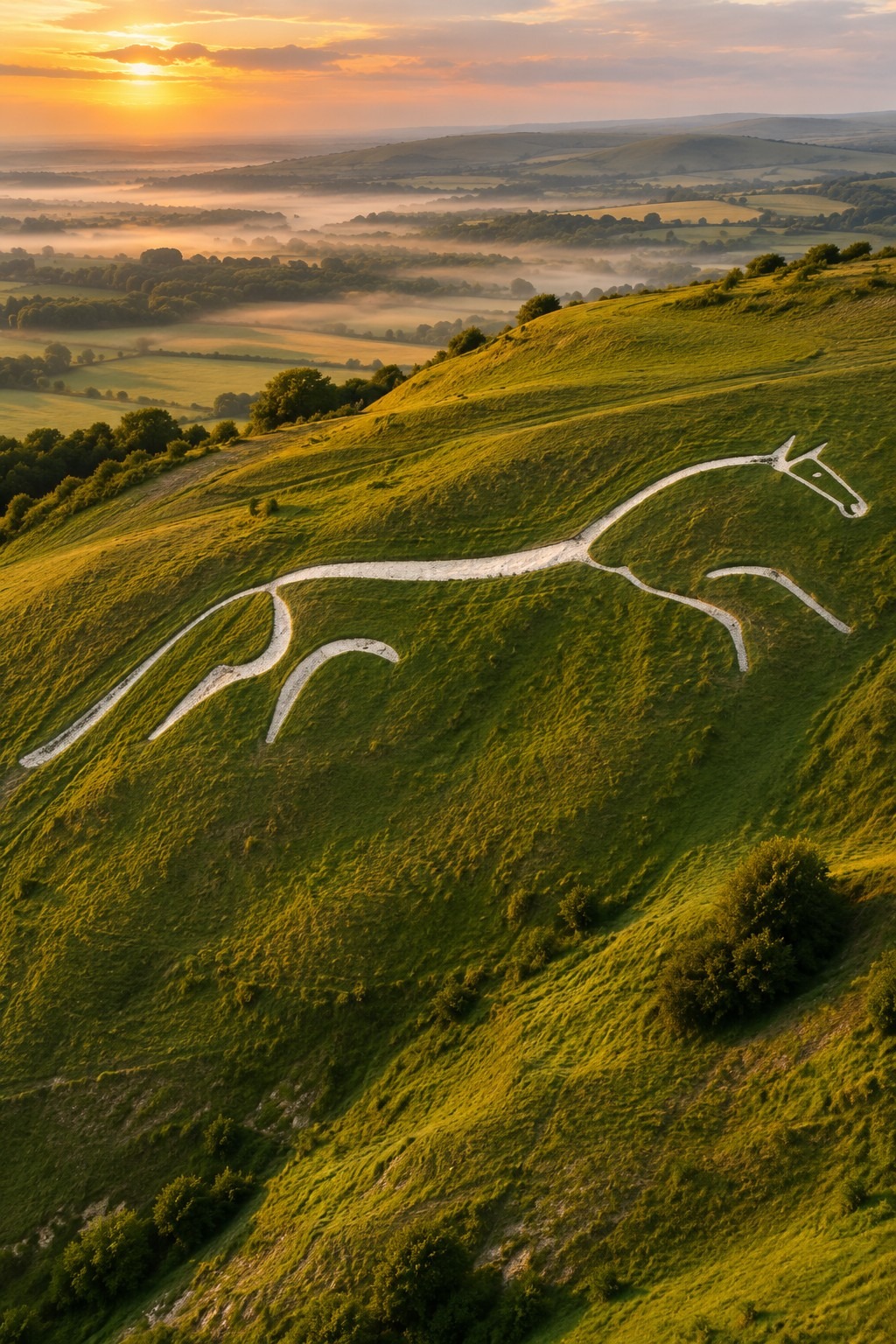
- White Horse Hill, the highest point in Oxfordshire (Berkshire until the 1974 boundary change), carries a horse figure about 110 metres (360 feet) long
In short: The Uffington White Horse was dated in 1990 when Oxford Archaeological Unit excavators used optically stimulated luminescence on trench silt, yielding three samples from roughly 1240 to 900 BC. Depending on the confidence level used, published ranges vary from English Heritage’s 1740–210 BC to Antiquity’s tighter 1380–550 BC, all derived from the same three measurements.
Summer 1990: a metre down through the chalk
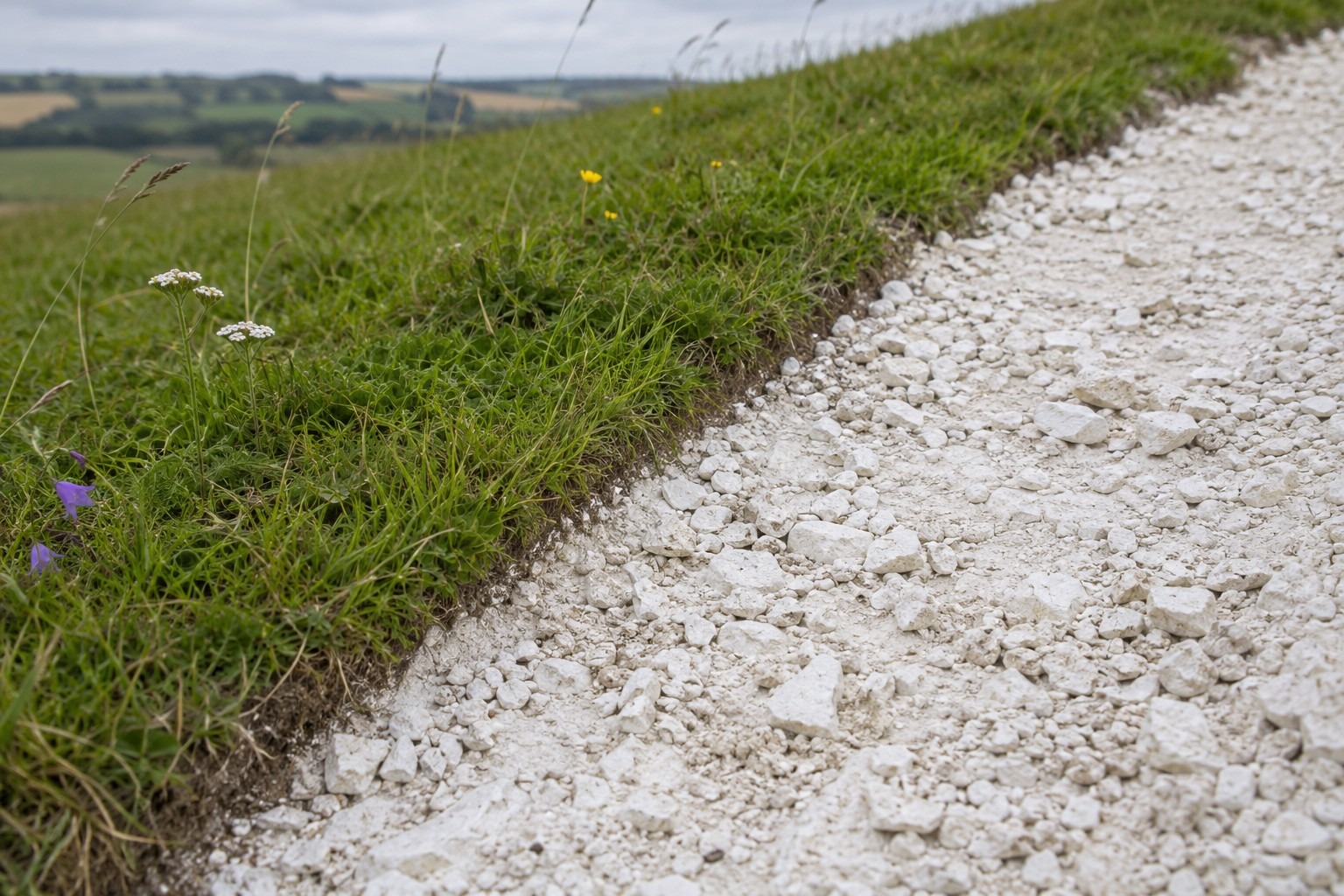
What the section revealed was not what most visitors assume. The horse is not turf scraped away to expose the natural chalk beneath. Underneath its white lines Palmer and Miles found successive packed layers of crushed chalk, laid one on top of another — evidence that a horse-shaped trench had been dug into the hillside, probably with bronze or iron tools, the spoil carried off in baskets, and fresh chalk rammed into the void.
That matters for dating, because a scraped outline leaves nothing to date. A deep trench, slowly silting up between re-chalkings, leaves a sealed archive.
White Horse Hill, the highest point in Oxfordshire — Berkshire, until the county boundaries moved in 1974 — carries about 110 metres (360 feet) of horse across its upper slope. It had been sectioned once before, after the Second World War, by the archaeologist W. F. Grimes, who also found deep chalk-packed trenches; his results went unpublished for decades. The 1990 team added something Grimes could not: a date. They also noticed that the plane of the horse’s body had originally sat at a steeper angle, tilted more towards the vale below, and that the strange beaked head was an original feature, not a modern misunderstanding.
What luminescence dating actually measures
Optically stimulated luminescence, or OSL, does not date chalk, and it does not date the moment someone first swung a pick into the hillside. It dates burial. Grains of quartz and feldspar sitting in soil absorb a trickle of natural background radiation and park the energy in crystal defects. Sunlight empties that store. Bury the grain, and the charge begins rebuilding; measure how much has accumulated in the laboratory, and you get the time since those grains last saw daylight.
Uffington’s samples were, as far as the published record goes, the first OSL dates ever obtained from a British archaeological site, run by Oxford’s Research Laboratory for Archaeology and the History of Art. A genuine methodological first — which is also why the result carries wide error bars. Oxford Archaeology’s own account of the work concedes plainly that the dates are not very precise.
Here’s the thing most pages skip: because the silt accumulated inside an existing trench, the measurement brackets a horse that was already there. It is a date for the monument’s early life, not a birth certificate. The real cutting could be a little older than any of the numbers below.
Why the Uffington White Horse age is quoted three different ways
Read three authorities and you will get three answers. Oxford Archaeology’s project pages give 1380–210 BC. English Heritage gives 1740–210 BC. The archaeological literature — including Joshua Pollard’s 2017 paper in Antiquity — gives 1380–550 BC at 68% confidence. Readers reasonably conclude that somebody is wrong, or that new work has overturned old work. Neither is true.
All three come from the same three measurements, published with the White Horse Hill excavation report: 1240 ± 360 BC, 1030 ± 360 BC and 900 ± 340 BC. Take the two younger samples at one standard deviation and the envelope runs roughly 1390–560 BC — essentially the quoted 1380–550 BC. Take the same two at two standard deviations, the 95% band, and it opens to roughly 1750–220 BC — essentially English Heritage’s 1740–210 BC. The oldest of the three samples reaches back further still, which is why some summaries stretch the early end. So the “disagreement” is a reporting convention: one body quotes the 68% range, the other the cautious 95% range, and a third mixes the two ends.
English Heritage’s wide 1740–210 BC is the honest figure to quote, and the round “3,000 years old” you see on signage and in headlines is journalism rather than measurement — convenient, roughly right, and considerably more confident than the data.
{IMAGE_2}
Three centuries of confident wrong answers
Before OSL, the horse was a blank screen. In the 17th century John Aubrey attributed it to the Saxon leaders Hengist and Horsa, though he also noted — shrewdly — that it resembled horses on Iron Age Celtic coins. In 1736 Francis Wise declared it a monument to Alfred the Great’s victory at Edington, an idea that stuck locally for two centuries largely because Alfred was born a few miles away at Wantage.
Then the specialists arrived and narrowed it the wrong way. Stuart Piggott, in 1931, read the figure’s stylised, disjointed body as Iron Age coin art and proposed around 100 BC. Morris Marples argued for a Bronze Age date in 1949 on stylistic grounds, comparing the design to European and North African parallels, and Ann Ross revisited the Celtic-coin comparison in 1967.
So was Piggott simply wrong? Not entirely — the resemblance to Iron Age coinage is real. What the 1990 dates showed is that the influence probably ran the other way: the horse was already old when those coins were struck, and the coin-makers were drawing on a visual language the hillside had been broadcasting for centuries.
From an abbey ledger to a seven-year festival
Here is the strangest part of the chronology. If the figure was cut in the later Bronze Age, roughly two thousand years pass before anyone writes it down. The earliest surviving reference is indirect: a cartulary from Abingdon Abbey, compiled in the 1070s or early 1080s, refers to mons albi equi — the hill of the white horse. The horse itself is described in the Welsh Llyfr Coch Hergest (Red Book of Hergest), written between about 1375 and 1425: “Near to the town of Abinton there is a mountain with a figure of a stallion upon it, and it is white.”
Twenty centuries of silence, and then a monk’s property list. The silence is not evidence of absence — it is evidence that nobody in the Bronze Age, Iron Age or Roman period left us a document that happened to mention a hillside.
What kept it alive through all of that was maintenance. Chalk grassland heals fast; an uncleaned figure vanishes under turf within a human lifetime. Uffington survived because the surrounding community kept scouring it — scraping back the grass, smashing fresh chalk into the lines. English Heritage dates recorded scouring festivals from at least 1677, and for generations the event was held roughly every seven years, with a fair inside the adjacent hillfort: cheese-rolling, wrestling, backsword play. Thomas Hughes, of Tom Brown’s School Days, attended the 1857 scouring and turned it into a book, The Scouring of the White Horse, in 1859. That 1857 festival was the last of the septennial ones.
- c. 1740–210 BC — the chalk trench is cut and silt begins to accumulate (OSL range, 95% confidence)
- 8th–7th century BC — Uffington Castle hillfort is built on the hill above it
- 1070s–1080s AD — Abingdon Abbey records mons albi equi, the first written trace
- c. 1375–1425 — the Red Book of Hergest describes the white stallion on the hill
- 1677 — earliest recorded scouring festival
- 1857 — the last seven-yearly scouring; Thomas Hughes publishes his account in 1859
- 1939 — turfed over and camouflaged so Luftwaffe crews cannot use it to navigate
- 1979 — David Astor gives the surrounding land to the National Trust
- 1990 — OSL samples give Britain’s oldest chalk figure its first scientific date
- 2024 — the figure is restored and resampled for re-dating
The only prehistoric figure in a field of modern imitations
Britain has dozens of chalk hill figures, and almost all of them are young. Westbury, the oldest of Wiltshire’s eight white horses, has no documented existence before 1742 and the animal visible today was cut in 1778 over a cruder earlier one. The rest of the Wiltshire horses are 18th- and 19th-century creations, several of them deliberate copies of Uffington.
The Cerne Abbas Giant is the instructive comparison, because it was long assumed to be prehistoric too. In 2021 a National Trust study — funded with the University of Gloucestershire, Allen Environmental Archaeology and the Pratt Bequest — applied OSL to sediment a metre down in the giant’s outline and returned AD 700–1100. National Trust archaeologist Martin Papworth has suggested the late Saxon figure was then neglected and grassed over, which would explain its absence from abbey records and Tudor surveys. Microscopic snail shells in the soil pointed the same way: medieval, not ancient.
Put those numbers side by side and Uffington stops being “one of Britain’s ancient hill figures” and becomes something sharper: the lone survivor. Roughly two millennia separate it from the next-oldest dated figure in the country. Pollard’s reading at Southampton adds a reason that would fit a Bronze Age origin — he argues the horse is a sun-horse, oriented and positioned so that from nearby Dragon Hill the midwinter sun appears to rise behind it and roll across its back, echoing a solar-horse symbolism found widely in Bronze Age Europe, as in the Trundholm sun chariot from Denmark. He also notes something sobering for photographers: on a 30–40° slope the image is badly foreshortened from the ground. It was never built for the view we want from it.
2022–2026: a shrinking horse and a sharper date
In 2022 Oxford Archaeology flew a drone over the figure and compared the photogrammetry against aerial surveys stretching back a century. The horse was disappearing. Its chalk lines had narrowed by up to 40% in about forty years, the head and neck to less than half their original width, as downhill soil creep and advancing turf quietly ate the edges. Trial trenches in 2023 confirmed it: the locals who said the horse looked thinner were right.
Restoration followed in 2024, run by Oxford Archaeology with the National Trust and English Heritage: encroaching turf was cut back and chalk redistributed to return the figure towards its 1980s proportions. “The figure is hugely important but also intriguing as we don’t know for certain its original purpose,” said National Trust archaeologist Adrian Cox during the work. Mark Dodd of Oxford Archaeology managed the project; Andy Foley and Adrian Cox represented the National Trust on the hill.
The quieter half of that project is the one that will change the number at the top of this article. While the trenches were open, fresh samples were taken from the lowest silts for re-dating by Jean-Luc Schwenninger’s team at Oxford’s Research Laboratory for Archaeology and the History of Art — the same technique as 1990, but with more than thirty years of refinement behind it. The hope is to narrow that broad Bronze Age window to something much tighter. As of November 2026 no new dates have been published, so the honest answer remains the old one: late Bronze Age to early Iron Age, most likely somewhere between about 1400 and 600 BC, with the wider 1740–210 BC band as the cautious bracket.
Quick Answers
So how old is the Uffington White Horse, in one sentence? Roughly 3,000 years old: scientific dating places its creation between about 1740 and 210 BC, with the most-quoted narrower estimate running 1380–550 BC — late Bronze Age to early Iron Age.
Is it definitely the oldest hill figure in Britain? It is the oldest dated one by a margin of around two thousand years, and no other British chalk figure has produced a prehistoric date. An undated figure somewhere could in principle be older; on current evidence, nothing comes close.
Sources and Notes
- Oxford Archaeology — White Horse Hill excavation reports and the Uffington White Horse Project (dating results, 1990 and 2022–24 fieldwork)
- English Heritage — Uffington Castle, White Horse and Dragon Hill: history and project pages
- Joshua Pollard, “The Uffington White Horse geoglyph as sun-horse”, Antiquity 91 (2017), University of Southampton
- The National Trust — Cerne Abbas Giant dating study (2021) and White Horse Hill conservation
- Thomas Hughes, The Scouring of the White Horse (1859), for the 1857 festival
There is a pleasing symmetry in how this figure has been kept. The Bronze Age community that cut it could not have imagined drones, luminescence laboratories or the National Trust, but they built something that only survives if each generation chooses to kneel on the slope and hammer chalk into the grass. Three thousand years of that choice, almost unbroken, is a stranger monument than the horse itself — and the next refinement of its age will arrive not from a new theory, but from a bucket of silt that has been waiting in the dark since the Bronze Age for someone to ask it the right question.
Frequently Asked Questions
Q: How was the Uffington White Horse actually dated?
In 1990, Oxford Archaeological Unit archaeologists Simon Palmer and David Miles cut a trench about a metre deep through the chalk figure and used optically stimulated luminescence (OSL) to measure sediment that had silted into the carved trench over time. OSL does not date the carving itself but dates burial, measuring how long quartz and feldspar grains have been shielded from sunlight, so the results bracket the monument’s early life rather than the exact moment it was cut.
Q: Why do different sources give different ages for the horse?
Oxford Archaeology, English Heritage, and the archaeologist Joshua Pollard all cite the same three 1990 OSL measurements — 1240±360 BC, 1030±360 BC, and 900±340 BC — but report them at different confidence levels. English Heritage’s 1740–210 BC reflects the wider 95% confidence band, while the 1380–550 BC figure used in Pollard’s 2017 Antiquity paper reflects the narrower 68% band. The apparent disagreement is a reporting convention, not new evidence overturning old evidence.
Q: What did people believe about the horse’s age before 1990?
Before scientific dating existed, interpretations relied purely on style and legend. John Aubrey linked it to the Saxon leaders Hengist and Horsa in the 17th century, while Francis Wise attributed it to Alfred the Great in 1736. In the 20th century, Stuart Piggott proposed around 100 BC in 1931 based on Iron Age coin art, Morris Marples argued for a Bronze Age date in 1949, and Ann Ross revisited the Celtic-coin comparison in 1967 — all without excavation evidence.
Q: When was the Uffington White Horse first written down in historical records?
The earliest surviving written reference is indirect: a cartulary compiled at Abingdon Abbey in the 1070s or early 1080s mentions “mons albi equi,” meaning the hill of the white horse. This written mention comes roughly two thousand years after the likely Bronze Age carving date suggested by the 1990 OSL results, leaving a long gap during which the figure’s origin was passed on only through local tradition rather than documentation.
Illustrations are AI-generated. Article fact-checked and human-edited. Our editorial standards.