Why Making Your Bed Every Morning Is a Mistake
Nobody warned you about the part where making your bed every morning is actually the problem. The sheets look clean. That’s the whole issue.
There’s this deeply satisfying ritual that happens in bedrooms across the world every morning — pull up the duvet, smooth the creases, step back and feel like a functional adult. It gets drilled into you early. Tidy bed, tidy mind. But researchers at Kingston University looked at exactly what happens underneath that neatly made surface, and what they found has a way of sticking with you.
Key Facts
- Dr. Stephen Pretlove at Kingston University published 2005 research showing dust mites depend on warmth, darkness, and moisture, and that unmade beds dry out faster.
- Up to 2 million dust mites can inhabit a single mattress at any one time, per findings cited by the American College of Allergy, Asthma and Immunology.
- The human body releases up to a liter of sweat into bedding every night, the moisture source dust mites depend on.
- Around 80% of asthmatic children are triggered by dust mite allergens, based on research in the Journal of Allergy and Clinical Immunology.
- A wash temperature of 60 degrees Celsius (140 Fahrenheit) kills dust mites, but most people wash bedding at 40 degrees Celsius.
In short: The dust mites in mattress fabric thrive on warmth, darkness, and the moisture your body releases nightly, which is why Dr. Stephen Pretlove’s 2005 Kingston University research found that making your bed traps a humid microclimate. Up to 2 million mites can live in one mattress, and leaving the bed unmade helps it dry out and disrupts them.
What Dust Mites in Mattress Actually Need
House dust mites are arachnids — eight-legged, spider-adjacent, completely invisible without a microscope. Dr. Stephen Pretlove at Kingston University published research back in 2005 mapping the precise conditions these creatures depend on. The findings weren’t complicated. Warmth. Darkness. And moisture above everything else.
The moisture source? That’s you.
Every night, the human body releases up to a liter of sweat into the mattress, sheets, and surrounding fabric. You don’t notice it happening. But the mites notice. They’ve engineered their entire biology around that nightly output, and your bed — warm, dark, damp, consistently 37 degrees of radiated body heat — is, by accident of design, close to a perfect habitat. A mattress isn’t furniture to them. It’s infrastructure.
Your Morning Habit Turns Your Bed Into a Greenhouse
The moment you pull the duvet up and tuck in the sheets, here’s what’s actually happening: the warmth your body spent eight hours generating is still radiating outward, the moisture from a night of breathing and sweating is sealed beneath the surface, and you’ve just created a warm, dark, humid chamber with nowhere for any of it to go. Everything a dust mite population needs, locked in and held there until you climb back in tonight.
They feed, while they’re in there, on the shed skin cells you’ve left behind.
The contrast with an unmade bed is the whole point of Pretlove’s research. Leave the duvet folded back, let light reach the fabric, let air move across the surface — and the microclimate changes. Not dramatically. Not immediately. But measurably. The moisture that was sustaining a colony of dust mites in mattress fabric starts to dissipate instead of accumulating. For more on the strange ways our bodies interact with the invisible world around us, this-amazing-world.com covers stories most people never think to ask about.
The Kingston University Study Nobody Talked About Enough
Pretlove’s team used computer modeling to simulate how mite populations respond when bed conditions change. An unmade bed — sheets folded back, exposed to the ambient air of a room — dries out significantly faster than a made one. As humidity drops, so does the stability of the mite-friendly environment. It doesn’t eliminate dust mites in mattress fabric entirely. Nothing short of industrial-scale intervention does that. But it disrupts the conditions they need to maintain large, stable, multigenerational populations.
The study got a brief wave of media attention in 2005. Then it disappeared.
Probably because “leave your bed unmade” isn’t something anyone can package and sell you.
Twenty-Six Years Is a Long Time to Share a Bed
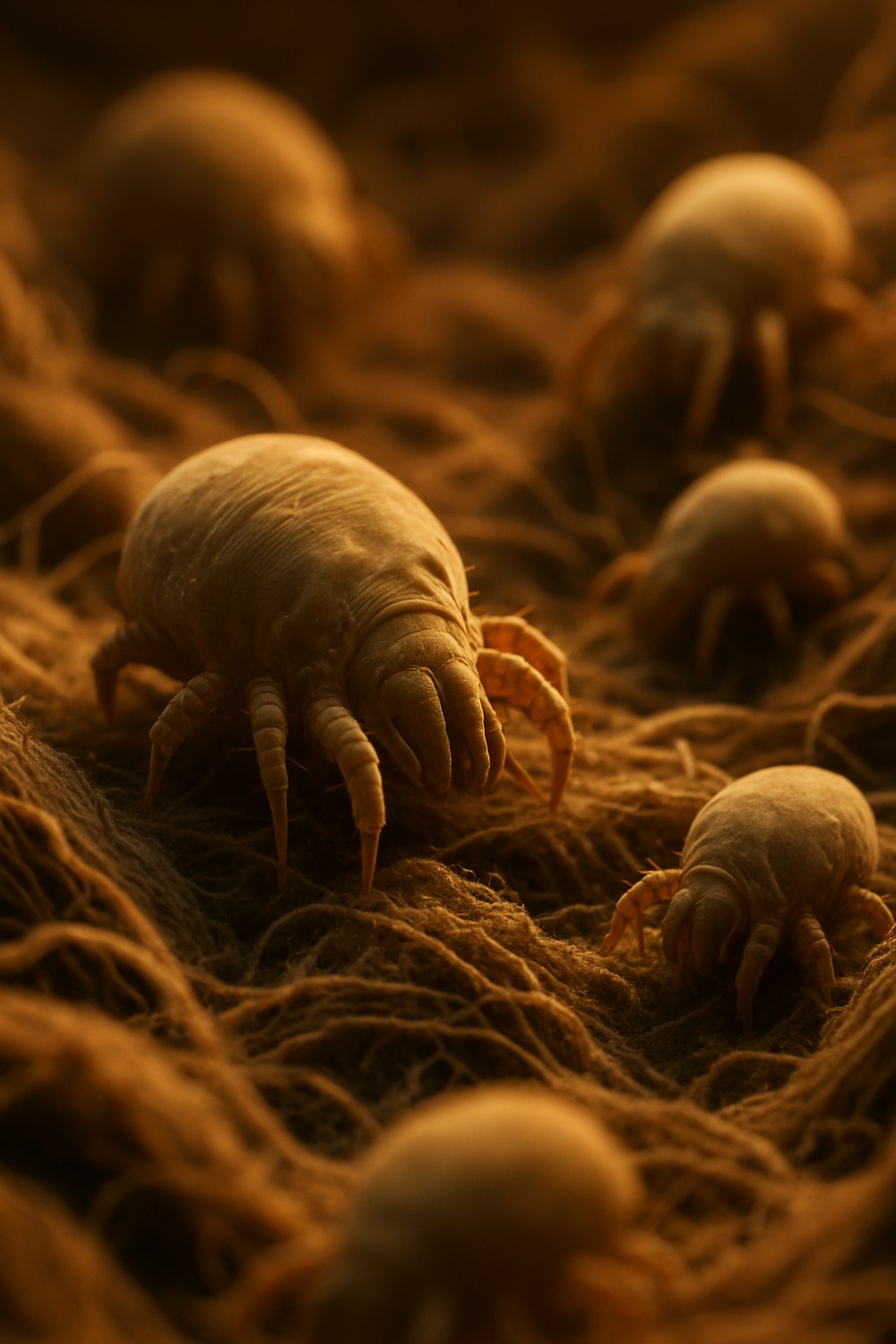
The average person spends roughly 26 years of their life asleep — not a rough guess, but a figure derived from standard sleep duration data across a lifetime. That means you’ll spend more time in your bed than in almost any other physical space on earth. The dust mites in mattress sharing that space with you are not passive occupants. They’re feeding continuously on dead skin cells, which humans shed at a rate of around 30,000 to 40,000 per hour, and their waste products are what actually triggers problems for allergy and asthma sufferers.
Most people with allergies aren’t reacting to the mites themselves.
They’re reacting to mite feces. Tiny, airborne, and landing directly on the surface you press your face against for eight hours every night. That last fact kept me reading about this for another hour. It reframes what “clean bedding” actually means in a way that’s hard to unfocus on.
It’s Not Just About Allergies
The reach of the mite problem goes further than most people assume. Researchers studying asthma triggers have consistently found that dust mite allergens rank among the most common environmental factors in asthma attacks, particularly in children. The World Health Organization estimates around 300 million people worldwide live with asthma. A significant portion of them are sleeping in conditions that actively worsen it — night after night, without ever understanding why their symptoms won’t fully clear.
The connection between sleep environment and respiratory health is something most doctors still don’t raise during routine appointments. You might leave with a prescription. You might get a referral. But nobody asks whether you make your bed in the morning.
Which is a strange gap, when you think about it.
By the Numbers
- Up to 2 million dust mites can inhabit a single mattress at any one time, according to findings cited by the American College of Allergy, Asthma and Immunology — the entire population sustained by shed human skin cells and absorbed moisture.
- Around 80% of asthmatic children are triggered by dust mite allergens, based on research in the Journal of Allergy and Clinical Immunology.
- The average mattress doubles in weight over ten years — dead skin, mite waste, mite bodies, moisture absorbed into foam and fiber over thousands of nights. That statistic has circulated since the early 2000s and it still lands the same way every time.
- A human sheds roughly 1.5 grams of skin per day. Enough, according to entomologists studying household arthropod populations, to feed roughly one million dust mites for a full 24 hours.
Field Notes
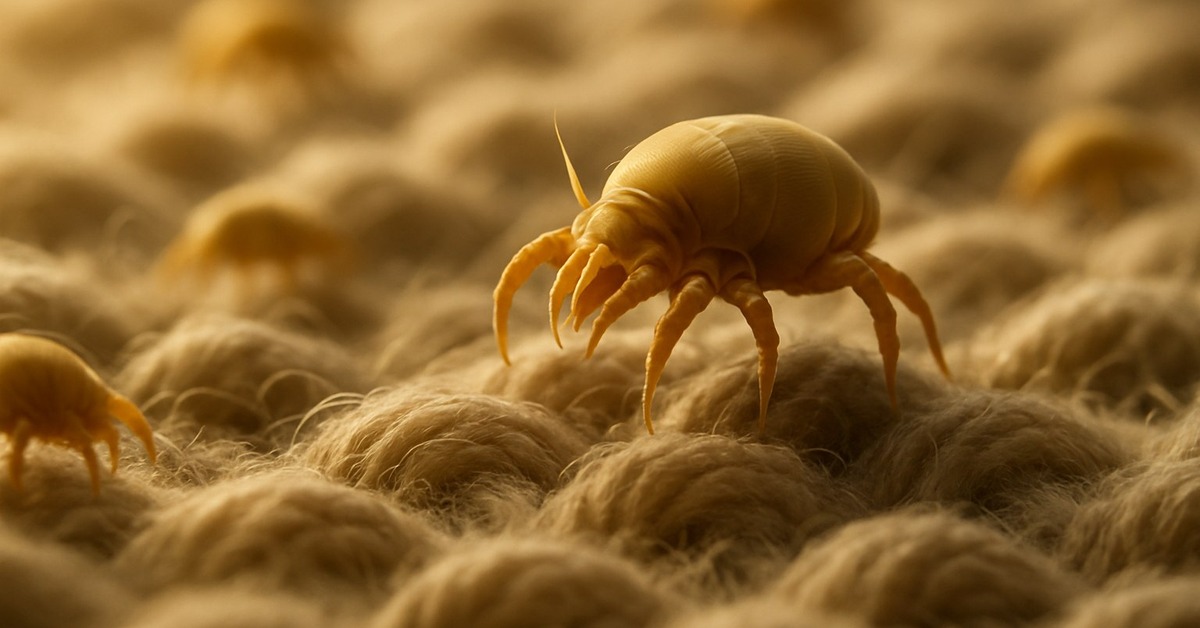
- Dust mites don’t drink water. They absorb moisture directly from the air through specialized glands near their front legs — which is why humidity control works better than most chemical sprays as a long-term population strategy.
- 60°C (140°F) is the wash temperature that kills them. Most people wash at 40°C. Warm enough to feel thorough. Not warm enough to do meaningful damage to colonies living deep in fabric fibers.
- Peak mite season: late summer and autumn.
- So those allergy symptoms that appear in September “out of nowhere” — the ones that don’t match the pollen calendar — might not be about the air outside at all. They might be about your bed.
What You Can Actually Do Starting Tonight
The fix costs nothing. Leave your bed unmade in the morning, or at minimum fold the duvet to the foot of the bed and let the sheets sit exposed for a few hours before you tidy up. Open a window if you can. Pair that with hot washes for your bedding — actually hot, not warm — and you’ve meaningfully changed the daily conditions for the dust mites in mattress fabric beneath you without spending anything. It won’t eliminate them completely. But it makes your bed considerably less hospitable, and that’s the goal.
It’s one of those cases where the science points directly at a habit most of us formed without ever interrogating. We make our beds because it looks better. Because someone told us to. Because it signals control over at least one corner of the world. But the thing that looks clean is quietly working against you every single night.
The tidiest-looking beds are often the warmest, dampest, most mite-friendly environments in the house. Leave it unmade. Open a window. Wash your sheets at a temperature that actually does something. The counterintuitive choice is sometimes the right one, and in this case the science is unambiguous. If this kind of story keeps you up at night, there’s more at this-amazing-world.com — and the next one is stranger still.
Frequently Asked Questions
Q: How does making your bed help dust mites in mattress fabric?
The moment you pull up the duvet and tuck in the sheets, you seal in the warmth your body generated over eight hours and the moisture from breathing and sweating, creating a warm, dark, humid chamber with nowhere for it to escape. Dr. Stephen Pretlove’s 2005 Kingston University research used computer modeling to show that an unmade bed dries out significantly faster, lowering the humidity dust mites need to maintain large, stable populations.
Q: How many dust mites live in a typical mattress?
Up to 2 million dust mites can inhabit a single mattress at any one time, according to findings cited by the American College of Allergy, Asthma and Immunology. They feed on shed human skin cells, which people lose at a rate of around 30,000 to 40,000 per hour. A human sheds roughly 1.5 grams of skin per day, enough to feed about one million dust mites for a full 24 hours.
Q: Why do dust mites trigger asthma and allergies?
Most people with allergies are not reacting to the mites themselves but to mite feces, which are tiny, airborne, and land on the surface you press your face against for eight hours each night. Researchers have found dust mite allergens rank among the most common asthma triggers, and around 80% of asthmatic children are triggered by them, based on research in the Journal of Allergy and Clinical Immunology. The WHO estimates around 300 million people live with asthma.
Q: What can you actually do to reduce dust mites in mattress fabric?
The fix costs nothing. Leave your bed unmade, or fold the duvet to the foot of the bed and let the sheets sit exposed for a few hours, and open a window if you can, so moisture dissipates instead of accumulating. Pair that with genuinely hot washes: 60 degrees Celsius (140 Fahrenheit) kills mites, but most people wash at only 40 degrees Celsius, too cool to damage colonies deep in the fibers.
Illustrations are AI-generated. Article fact-checked and human-edited. Our editorial standards.