Little Spotted Kiwi Returns After 47 Years of Silence
Here’s the thing about extinction: it rarely announces itself. The little spotted kiwi didn’t vanish from mainland New Zealand in a single catastrophic event — it just stopped being seen. For 47 years, no footprints, no feathers, no confirmation of anything alive beyond a single offshore island. Researchers were still publishing papers. Conservation teams were still working. But the mainland had gone quiet in a way that made hope feel almost irresponsible. Then a ranger in the dark found one.
New Zealand’s smallest kiwi, Apteryx owenii, had contracted so completely from its original range that the species existed in the wild only on Kapiti Island — a 1,965-hectare predator-cleared reserve off the North Island’s southwestern coast. Conservation teams worked without headlines, without guarantees. The confirmed return of a wild individual to the mainland didn’t just make news. It reopened a question scientists had nearly stopped asking: how far back from the edge can a species actually come?
Key Facts
- The little spotted kiwi (Apteryx owenii) had no confirmed wild mainland sighting for 47 years until a 2024 confirmation.
- By the early 1990s, fewer than 1,000 survived globally, all confined to Kapiti Island (Department of Conservation, NZ).
- In 1983, 8 founding birds were translocated to Tiritiri Matangi Island; that population now exceeds 40 individuals.
- Zealandia ecosanctuary in Wellington is enclosed by an 8.6 kilometre predator-proof fence and opened in 2000.
- The little spotted kiwi egg has an incubation period of around 70 days, one of the longest among birds relative to body size.
In short: The little spotted kiwi (Apteryx owenii), New Zealand’s smallest kiwi, returned to the mainland after a 47-year silence when a ranger confirmed a wild individual in 2024. Reduced to fewer than 1,000 birds on Kapiti Island by the 1990s, decades of translocation to sites like Tiritiri Matangi and Zealandia rebuilt the species into five-plus populations now dispersing into the wild.
The Kiwi That Shouldn’t Still Exist
To understand what this return means, you have to understand how close the little spotted kiwi came to being nothing but a museum specimen. By the late 20th century, mainland New Zealand had been ecologically dismantled — forests cleared, wetlands drained, and a parade of introduced predators unleashed that the country’s birds had no evolutionary framework to resist. Stoats, rats, and feral cats didn’t just hunt kiwi. They hunted them efficiently, systematically, and without pause. The little spotted kiwi, once distributed across both main islands, contracted to a single refuge: Kapiti Island, where the Department of Conservation had cleared predators in a painstaking operation completed through the 1980s. By the time anyone took a formal census, fewer than 1,000 individuals remained on Kapiti — and essentially zero survived anywhere else.
That number sounds manageable until you understand what it represents genetically. A population of 1,000 birds, all descended from a handful of founders, all confined to a single island — that’s not a safety net. That’s a single point of failure. One disease event, one biosecurity breach, one catastrophic storm surge, and the species disappears not over decades but in a season.
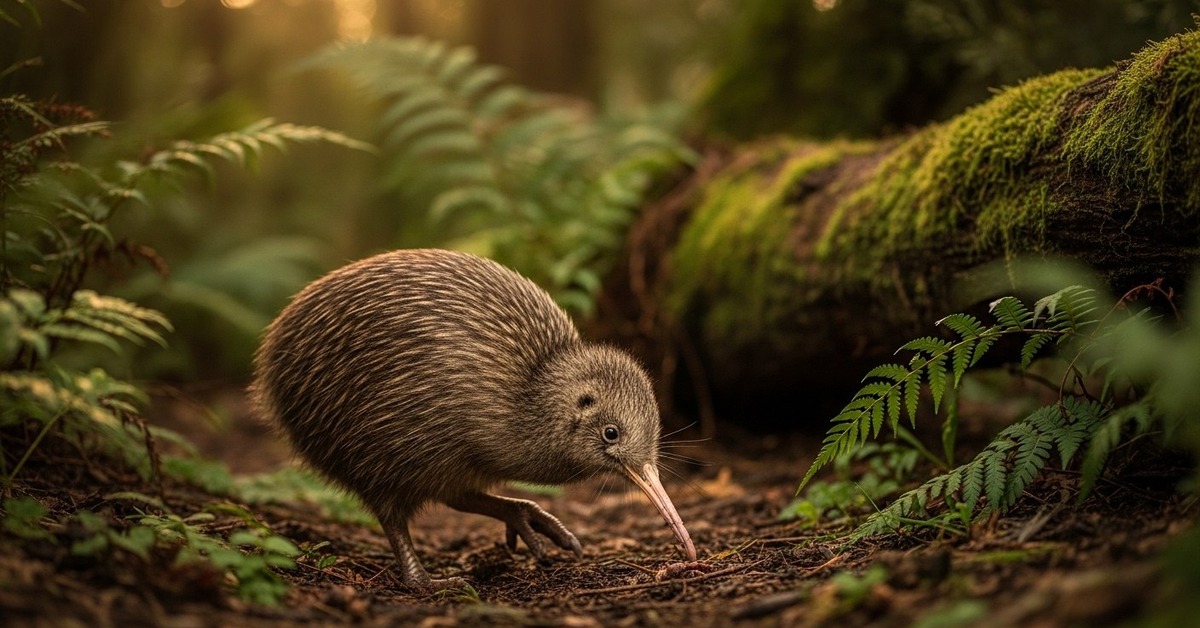
Department of Conservation teams recognized this by the early 1990s, and what followed was a slow, unglamorous campaign: carefully moving birds to new predator-free sanctuaries, breeding them up, monitoring survival with radio telemetry, and then waiting. Mostly waiting. Kiwi breed slowly — one egg per season, sometimes two, with an incubation period of around 70 days. Population growth, even under ideal conditions, is measured in years, not months. There’s no rushing a kiwi. You either commit to the timeline or you walk away.
An Island Fortress, Then Something More
What conservation teams built around the little spotted kiwi over four decades deserves more attention than it typically gets. When a species collapses to a single population, the instinct is to protect that population at all costs — to pour resources into the one place the animal still exists. That instinct is understandable. It’s also, on its own, insufficient.
Because if your entire strategy is a single island, you haven’t solved the problem. You’ve just paused it. New Zealand’s Department of Conservation, working alongside iwi (Māori tribal authorities) and private conservation groups like Zealandia — the ecosanctuary in Wellington that opened in 2000 — recognized this and began thinking in terms of networks: multiple sites, redundant populations, insurance against the unpredictable. The results mirror what happened with Mexico’s jaguar recovery effort, where coordinated corridor strategies across multiple reserves proved far more effective than protecting a single stronghold in isolation.
By 2005, little spotted kiwi had been successfully established at four additional sites beyond Kapiti Island, including Tiritiri Matangi Island in the Hauraki Gulf and the Zealandia sanctuary in Wellington. Population estimates at Kapiti climbed past 1,200. At Tiritiri Matangi, a population seeded with just 8 birds in 1983 had grown to more than 40 individuals by 2015. By 2010, Zealandia reported breeding pairs producing viable chicks within an urban environment — something that would have seemed almost absurd twenty years earlier. These weren’t dramatic numbers. But in kiwi conservation, they were extraordinary.
Inside a predator-proof fence running 8.6 kilometers around a Wellington valley, little spotted kiwi have not only survived — they’ve begun dispersing. Birds fitted with transmitters have been detected outside the fence boundary, moving through suburban Wellington under cover of darkness. The city, of all places, was becoming habitat again.
What a 47-Year Silence Actually Tells Scientists
Ecologists have a term for what the little spotted kiwi experienced on mainland New Zealand before its recovery: local extinction, or extirpation. The species didn’t die out globally — it died out in a place. But the practical difference, for those on the ground, can feel negligible. When no confirmed wild sightings exist for 47 years, you’re not managing a population. You’re managing a memory.
Why does this matter? Because the methodology that declared the mainland silent was itself flawed from the start.
What the silence reveals is how poorly equipped standard ecological survey methods are for detecting cryptic nocturnal species. The little spotted kiwi doesn’t appear on camera traps reliably. It doesn’t sing at dawn like a songbird. It moves through dense undergrowth on pathways that don’t intersect with most monitoring grids. The absence of data was never clean evidence of absence — it was evidence of methodology. Researchers at Victoria University of Wellington have been developing acoustic monitoring tools tuned to kiwi calls, combined with eDNA sampling from soil and water sources, to detect presence without requiring direct observation (and this matters more than it sounds — it changes what “confirmed absence” can even mean). According to a 2019 review in Smithsonian Magazine, New Zealand has become the global benchmark for island-based conservation — not because its problems were smaller than elsewhere, but because its response was more systematic, more sustained, and more willing to operate on biological rather than political timescales.
The confirmed sighting, when it came, didn’t arrive through new technology. It came through a ranger on foot, in the dark, in the right forest, at the right hour. Sometimes the most sophisticated instrument is still a person paying attention.
What the Little Spotted Kiwi’s Return Means for Conservation
Forty years of quiet, unglamorous work brought this species back — and it is worth saying plainly that most conservation failures aren’t failures of science but failures of institutional patience, of funding cycles that end before biology catches up.
Returning a confirmed wild little spotted kiwi individual to mainland New Zealand isn’t just a milestone for one species. It’s a data point in a much larger argument about what conservation actually requires and how long you have to wait to know whether it’s working. IUCN currently lists Apteryx owenii as Near Threatened — a classification that shifted from the far grimmer assessments of the 1980s, when the species was considered critically imperilled across its entire range. That shift didn’t happen because of a single intervention or breakthrough. Predator control operations maintained over decades, translocation programs run with quiet precision, and sustained funding commitments — including New Zealand’s Wildlife Act 1953 and its successive amendments, which gave conservation agencies legal teeth that many international counterparts lack — all compounded slowly into something that now resembles recovery.
Sit with these numbers. When translocation to Tiritiri Matangi began in 1983, the founding population was 8 birds. Forty years later, that island population alone exceeds 40 individuals, and birds from it have seeded new sites. Zealandia’s Wellington population, established in 2000, is now large enough that kiwi are dispersing beyond the sanctuary fence into suburban habitat — monitoring data from 2018 confirmed this was not incidental but systematic. Each dispersing bird represents a viable, territorial adult that survived its first year outside managed sanctuary conditions. The attrition is real. Survival rates are not perfect. But the trend line is moving in only one direction.
Rangers and ecologists are now asking a question they didn’t dare ask twenty years ago: not whether the little spotted kiwi can survive on the mainland, but where to put the next population.
That shift in the question is everything.
How It Unfolded
- 1982 — Little spotted kiwi is assessed as surviving only on Kapiti Island, with mainland populations considered functionally extinct following decades of predator pressure and habitat loss.
- 1983 — Department of Conservation initiates the first translocation program, moving 8 birds to Tiritiri Matangi Island in the Hauraki Gulf to establish a second insurance population.
- 2000 — Zealandia ecosanctuary opens in Wellington, becoming the first urban predator-proof sanctuary in New Zealand and a key breeding site for mainland little spotted kiwi recovery.
- 2018 — Acoustic monitoring and radio-telemetry data confirm little spotted kiwi are dispersing beyond the Zealandia fence boundary into suburban Wellington — the first verified urban-wild movement on record.
- 2024 — A confirmed wild sighting outside managed sanctuary conditions marks the first in 47 years, signalling that mainland re-establishment has crossed from managed survival to self-sustaining presence.
By the Numbers
- Fewer than 1,000 little spotted kiwi survived globally by the early 1990s, all confined to Kapiti Island (Department of Conservation, NZ).
- 8 — the number of founding birds translocated to Tiritiri Matangi in 1983; that population now exceeds 40 individuals.
- 8.6 kilometres — the length of the predator-proof fence enclosing Zealandia ecosanctuary in Wellington, one of the primary urban recovery sites.
- 70 days — average incubation period for a little spotted kiwi egg, one of the longest among birds relative to body size, making population growth inherently slow.
- 5+ — the number of separate, established populations now existing across predator-free islands and mainland sanctuaries, compared to 1 population in 1982.
Field Notes
- Nostrils positioned at the tip of the bill rather than the base — an anatomical trait unique among birds — allow the little spotted kiwi to probe soil and detect earthworms, grubs, and fallen fruit by smell before making contact. Researchers at Massey University confirmed this olfactory hunting behaviour through controlled feeding trials in 2011, making it one of the very few birds documented to actively hunt by scent rather than sight.
- And unlike other kiwi species, the little spotted kiwi is the only one in which the male incubates the egg almost exclusively — losing up to 20% of his body weight during the 70-day incubation period without leaving the burrow to feed.
- Zealandia’s dispersal data reframes urban green corridors as genuine kiwi habitat: radio-tagged birds moved through Wellington parks and gardens at night, using suburban vegetation as functional wildlife corridors in ways that urban ecology models hadn’t predicted at the project’s inception.
- Researchers still cannot definitively explain why some translocated kiwi populations on similar islands thrive while others plateau — survival rates, territory establishment, and breeding success vary between sites in ways that predator density and habitat quality alone don’t fully account for. Whether founder genetics, individual behaviour, or subtle site differences drive this variance is an open question that current monitoring data hasn’t resolved.
Frequently Asked Questions
Q: Why did the little spotted kiwi disappear from the mainland in the first place?
Introduced predators were the primary driver — stoats, rats, and feral cats brought to New Zealand by European settlers from the 18th century onward. Kiwi evolved in a predator-free environment and have no defensive behaviours against mammalian hunters. Adult birds are vulnerable, but chicks, hatched fully feathered but largely helpless for the first few weeks, face near-certain predation without active pest control. Habitat clearance compounded the pressure, eliminating the forest cover kiwi depend on for foraging and nesting.
Q: Is the little spotted kiwi now safe from extinction?
Not unconditionally. IUCN currently lists Apteryx owenii as Near Threatened — an improvement from previous assessments, but not a clean bill of health. With multiple established populations now existing across several predator-free islands and mainland sanctuaries, the risk of a single catastrophic event wiping out the entire species has been meaningfully reduced. Every population, though, still requires sustained predator management. Without active trapping and biosecurity protocols, stoat and rat reinvasion could collapse individual sites within a single breeding season.
Q: What’s the difference between the little spotted kiwi and other kiwi species?
New Zealand has five recognised kiwi species, and the little spotted kiwi is the smallest — roughly the size of a domestic chicken, weighing around 0.9 to 1.9 kilograms, compared to the great spotted kiwi which can reach 3.3 kilograms. Turns out it’s also the only kiwi species in which the male undertakes almost all incubation duties, and the only one whose wild population was, until recently, entirely restricted to offshore islands — which is precisely what makes its confirmed mainland return genuinely significant rather than routine.
Editor’s Take — Alex Morgan
What strikes me about this story isn’t the confirmed sighting itself — it’s the 47 years of work that made it possible when nobody was watching and nobody was celebrating. Conservation operates on timescales that are almost incompatible with how we fund things, cover things, or pay attention to things. The little spotted kiwi didn’t come back because of a moment of inspiration. It came back because a series of institutions committed to a biological timeline and didn’t quit when the results took decades to arrive. That’s the harder, more important lesson here — and it applies to nearly every species currently standing at the edge.
Wellington’s forest floor doesn’t look like the front line of anything. But somewhere in the dark, a bird the size of a chicken is moving through leaf litter on a scent trail, doing what its species has done for millions of years — surviving, quietly, on its own terms. The question that haunts every ecologist working in predator management, translocation, and the slow arithmetic of population recovery is the same one this story raises without resolving: how many other species are out there right now, holding on in the silence, waiting for someone to build the fence, pull the trap line, and give them 47 years to prove they’re still here?
Illustrations are AI-generated. Article fact-checked and human-edited. Our editorial standards.