They Forged Knives From a Meteor Centuries Before Contact
Nobody was looking for it. That’s the part that keeps getting lost in the retelling — the Inuit of northwest Greenland weren’t searching for metal. They found a meteorite, figured out how to hammer it into tools with nothing but stone, and built an entire supply chain around it. All of this happened centuries before any European knew Greenland existed.
It is 1897. A Danish-American explorer named Robert Peary arrives in Greenland and finds something the Inuit have known about for a thousand years: fragments of a meteorite scattered across the ice. Within months, he loads the three largest pieces onto a ship and sails them back to New York to sell them. The Inuit watch their celestial iron disappear.
But here’s what matters: before Peary arrived, before Europeans had any claim to Arctic exploration, Inuit families were already working this iron. Not smelted from ore. Not traded from distant smiths. Cold-hammered from fragments of a rock that had fallen from space, shaped into harpoon tips and blade edges that fed entire communities across a thousand kilometers of frozen coastline. The tools they made hunted seals. The tools hunted whales. The tools kept children alive through Arctic winters.
Key Facts
- The Cape York meteorite weighs roughly 58 tons across its scattered fragments and struck what is now northwest Greenland thousands of years before written history.
- Archaeologist Vagn Fabritius Buchwald traced Inuit meteorite iron tools across more than 1,000 kilometers of Greenland’s coastline to this single impact source.
- The Inuit cold-hammered the iron using quartzite stone tools, with no furnace, fire, or smelting, into harpoon tips and blade edges.
- The largest fragment, Ahnighito (the tent), weighs about 31 tons and is the largest iron meteorite on public display in the world.
- In 1897, explorer Robert Peary loaded the three major fragments onto a ship and sold them to the American Museum of Natural History for $40,000, roughly $1.4 million today, with no compensation to the Inuit.
In short: For centuries before Europeans arrived, the Inuit meteorite iron tools of northwest Greenland were cold-hammered from fragments of the 58-ton Cape York meteorite with stone, no smelting required. Chemical fingerprints trace these tools across 1,000 kilometers. In 1897 Robert Peary shipped the fragments to New York and sold them for $40,000, with nothing to the Inuit.
How a Rock From Space Became an Industry
The Cape York meteorite is massive — roughly 58 tons across its scattered fragments. When it struck what is now northwest Greenland thousands of years before written history, it shattered on impact.
Archaeologist Vagn Fabritius Buchwald spent decades analyzing iron artifacts recovered from Inuit settlements. His chemical analysis kept returning the same fingerprint: nickel-iron composition, the distinctive Widmanstätten pattern (a crystalline structure that takes a million years to form in space), the unmistakable signature of Cape York. Again and again. Hundreds of miles apart. Always the same source.
So how did fragments end up scattered across so much territory?
Turns out, the Inuit knew exactly where the pieces lay. They returned to them deliberately. Generation after generation, families walked to the meteorite fragments, used stone tools to chip flakes of iron loose, and carried those flakes back home to work into cutting edges. It wasn’t scavenging. It wasn’t luck. It was supply chain management operating in one of the harshest environments on Earth.
Stone Hammers Against Iron From Space
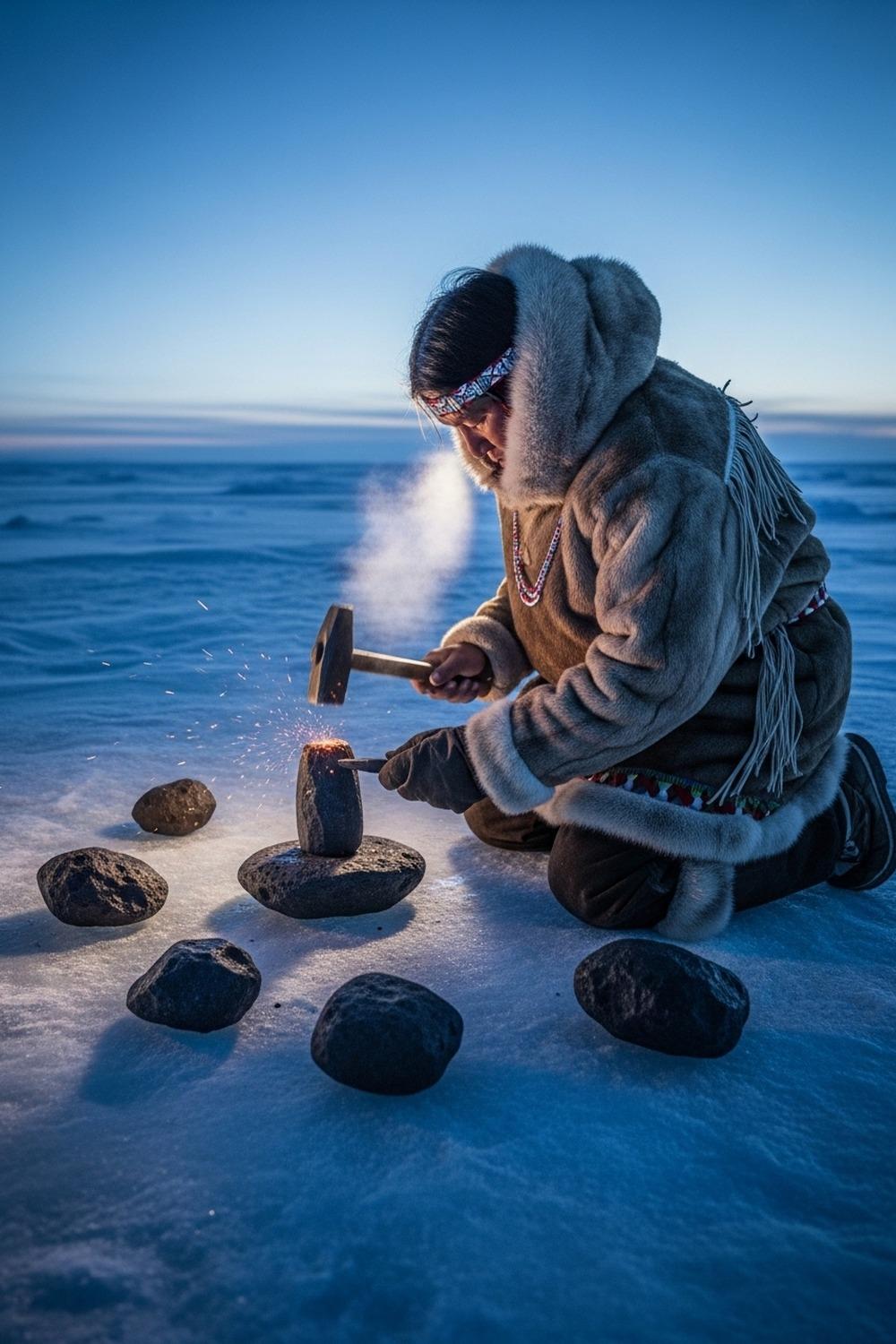
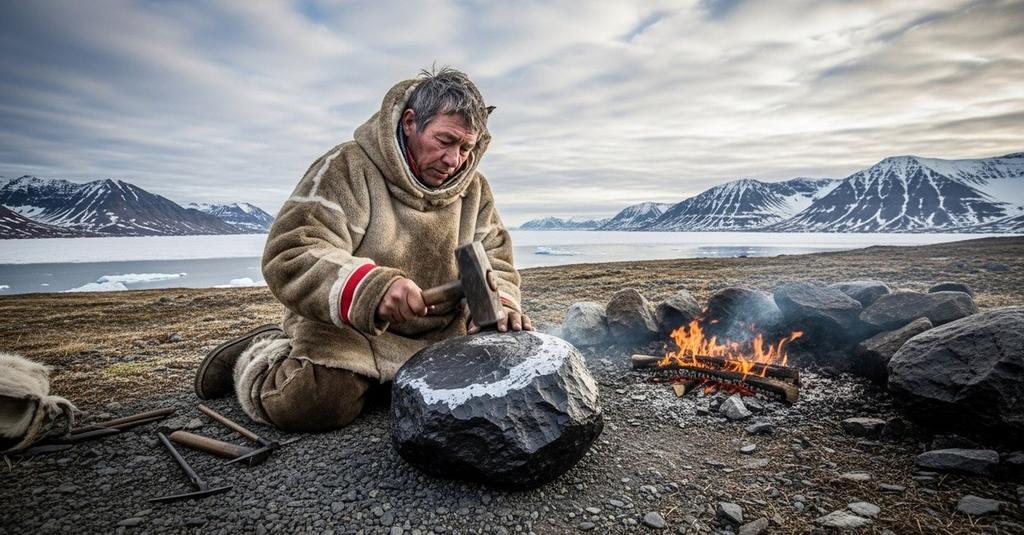
Here’s what actually stunned me when I kept reading about this: meteoritic iron is extraordinarily hard. The Inuit weren’t working soft copper. They were attacking a space rock with quartzite hammers, using a technique called cold-hammering — chipping tiny fragments loose and then shaping those fragments into blade edges through percussive force alone. No furnace. No fire. No smelting.
Painstaking work.
But the payoff changed everything. A meteoritic iron harpoon tip is sharper than bone. Sharper than stone. In the Arctic, that edge means the difference between a clean kill and a miss. A clean kill means food. A miss means your children don’t eat.
Think about what that mathematics means when you’re living through a winter where temperatures drop to minus forty degrees. The iron didn’t just represent technological cleverness — it represented survival. It represented the difference between a thriving settlement and starvation.
The Fingerprint That Told Everything
When Buchwald’s team traced the chemical signatures of Inuit meteorite iron tools across Greenland’s settlements, they weren’t finding random curiosities scattered by chance. They were uncovering evidence of deliberate, sustained resource management.
The same isotopic composition appeared in knife blades from sites hundreds of miles from the impact zone. The same Widmanstätten pattern — that million-year crystalline signature — showed up again and again. Proof these tools weren’t smelted from terrestrial ore. Proof they all came from one source. One specific rock that fell from the sky.
But here’s the thing that kept me reading for another hour: the consistency of the chemical signature also tells you something about Inuit society itself. This wasn’t random scavenging by different communities. This was knowledge. Knowledge of where the fragments were buried. Knowledge of how to work them. Knowledge of how to carry meteoritic iron across enormous distances through terrain that would kill most people in a week.
That knowledge was precious. It was protected. It was passed down.
A 58-Ton Rock With Names
The Cape York meteorite didn’t arrive as a single piece. Impact fragmented it. Three major fragments embedded themselves in the ice and rock of Melville Bay, and the Inuit communities nearby gave them names.
Ahnighito — “the tent.” The Woman. The Dog.
Ahnighito alone weighs about 31 tons. It’s one of the largest iron meteorites ever found on Earth. For centuries it served as a source of Inuit meteorite iron tools used across the entire Arctic. Families knew where it was. Families knew how to reach it. Families knew how to take what they needed.
And then, in the 1890s, everything changed.
Peary Took Them
Robert Peary didn’t discover the Cape York meteorite. The Inuit guided him there. They’d known about it for centuries.
In 1897, Peary loaded all three major fragments onto a ship. He sailed them to New York and sold them to the American Museum of Natural History for $40,000 (roughly $1.4 million in today’s money). The Inuit communities who had relied on those fragments for generations weren’t consulted. They weren’t compensated. Historical records describe how local Inuit viewed Peary’s removal as a profound loss.
The meteorite fragments had been part of Inuit life for so long that oral traditions described them as gifts from the sky — placed there specifically for their use. That’s not disconnected mythology. That’s a perfectly reasonable way to describe what these objects had meant to their communities for hundreds of years. The tools those fragments made had fed real people. The removal wasn’t just extraction of iron. It was extraction of a resource that an entire culture had built itself around.
And the Inuit never got paid for it.
By the Numbers
- Ahnighito weighs 31 tons — the largest iron meteorite on public display anywhere in the world.
- Chemical analysis traced Inuit meteorite iron tools across more than 1,000 kilometers of Greenland’s coastline. All from one impact site.
- The Widmanstätten pattern in meteoritic iron requires an estimated 1 million years of slow cooling in space to form — meaning those knife blades had been traveling through the solar system longer than modern humans have existed on Earth.
- Peary sold the three Cape York fragments for $40,000 in 1897 — none of which went to the Inuit communities who had protected these meteorites for centuries before he arrived.
Field Notes
- The name Ahnighito — “the tent” — suggests the fragment was seen as a sheltering presence, not just raw material.
- Cold-hammering meteoritic iron requires no furnace, no smelting, no fire. Just stone. Just force. Just the exact right technique, developed independently, without any knowledge of Old World ironworking traditions happening thousands of miles away.
- Nickel-iron meteorites are extraordinarily rare on Earth’s surface because terrestrial iron oxidizes quickly in wet environments. In Greenland’s cold, dry conditions, these fragments survived largely intact for thousands of years, making the region uniquely suited to preserving them.
Why This Gets Treated Like a Footnote
The standard narrative of human metalworking runs through the Middle East, through bronze and iron ages, through smelting and trade routes and the march of civilization. Inuit meteorite iron tools don’t fit that timeline neatly. For a long time, they were treated as an interesting curiosity rather than serious metallurgical history.
But what happened in northwest Greenland was sophisticated. It was sustained. It was deliberate.
A community observed a rock from space. Figured out how to extract value from it using nothing but stone tools. Built an inter-community resource network that lasted for centuries. That’s metallurgy. That’s not a footnote — it’s an entire chapter in human technological development that’s been overlooked because it doesn’t fit the standard story.
And it happened without cross-cultural exchange, without written instruction, without the benefit of existing metalworking traditions. Just observation, experimentation, and knowledge passed down through generations of people living in one of the coldest places on Earth.
A meteor fell thousands of years ago. Families found it. They learned to shape it. For centuries, a rock from the sky fed people who had no other metal to work with. The story of Cape York isn’t just about iron or archaeology — it’s about human ingenuity operating at absolute limits. It’s about knowledge that mattered so much it was worth preserving through generations. And it’s about how that knowledge was taken, sold, and forgotten by people who didn’t understand what they were taking.
“
Frequently Asked Questions
Q: What are Inuit meteorite iron tools?
Inuit meteorite iron tools are harpoon tips, knife blades, and cutting edges that the Inuit of northwest Greenland made from fragments of the Cape York meteorite. Rather than smelting iron from ore, they cold-hammered flakes chipped from the meteorite with quartzite stone tools, using percussive force alone. A meteoritic iron edge is sharper than bone or stone, which in Arctic hunting meant the difference between a clean kill and starvation.
Q: How did the Inuit work meteorite iron without a furnace?
They used a technique called cold-hammering. Meteoritic iron is extraordinarily hard, but the Inuit attacked it with quartzite hammers, chipping tiny fragments loose and shaping those flakes into blade edges through repeated percussive force, with no furnace, fire, or smelting. This metalworking method was developed independently, without any knowledge of Old World ironworking traditions happening thousands of miles away.
Q: How do scientists know the tools came from one meteorite?
Archaeologist Vagn Fabritius Buchwald spent decades analyzing iron artifacts from Inuit settlements. His chemical analysis kept returning the same fingerprint: nickel-iron composition and the distinctive Widmanstatten pattern, a crystalline structure that takes about a million years to form in space. The same signature appeared in tools found more than 1,000 kilometers apart, proving they all came from the single Cape York impact source.
Q: What happened to the Cape York meteorite fragments?
In 1897, Danish-American explorer Robert Peary, guided to the site by the Inuit who had known it for centuries, loaded the three major fragments, named Ahnighito, the Woman, and the Dog, onto a ship. He sailed them to New York and sold them to the American Museum of Natural History for $40,000, roughly $1.4 million today. The Inuit communities who had relied on the iron for generations were neither consulted nor compensated.
Illustrations are AI-generated. Article fact-checked and human-edited. Our editorial standards.