The Racehorse Who Got a Second Chance With a Prosthetic Leg
Nobody expected the horse to walk again. A fracture mid-stride, one moment of chaos, then the usual silence that follows in professional horse racing — where a shattered leg means a swift end to the story. But this horse prosthetic leg rehabilitation program refused to write that ending. Instead, it forced an entirely different question into the open: what happens when an industry built on disposability meets someone who chooses not to dispose?
In professional horse racing, a fractured limb is rarely a medical problem. It’s an economic one. A horse that can’t race is a liability, and the industry’s answer to liability is often swift and final. But when an animal welfare organization intervened on behalf of one injured thoroughbred — fitting him with a custom-engineered prosthetic and walking him through months of painstaking rehabilitation — they forced a different kind of question into the open. What do we actually owe the animals we’ve built entire industries around?
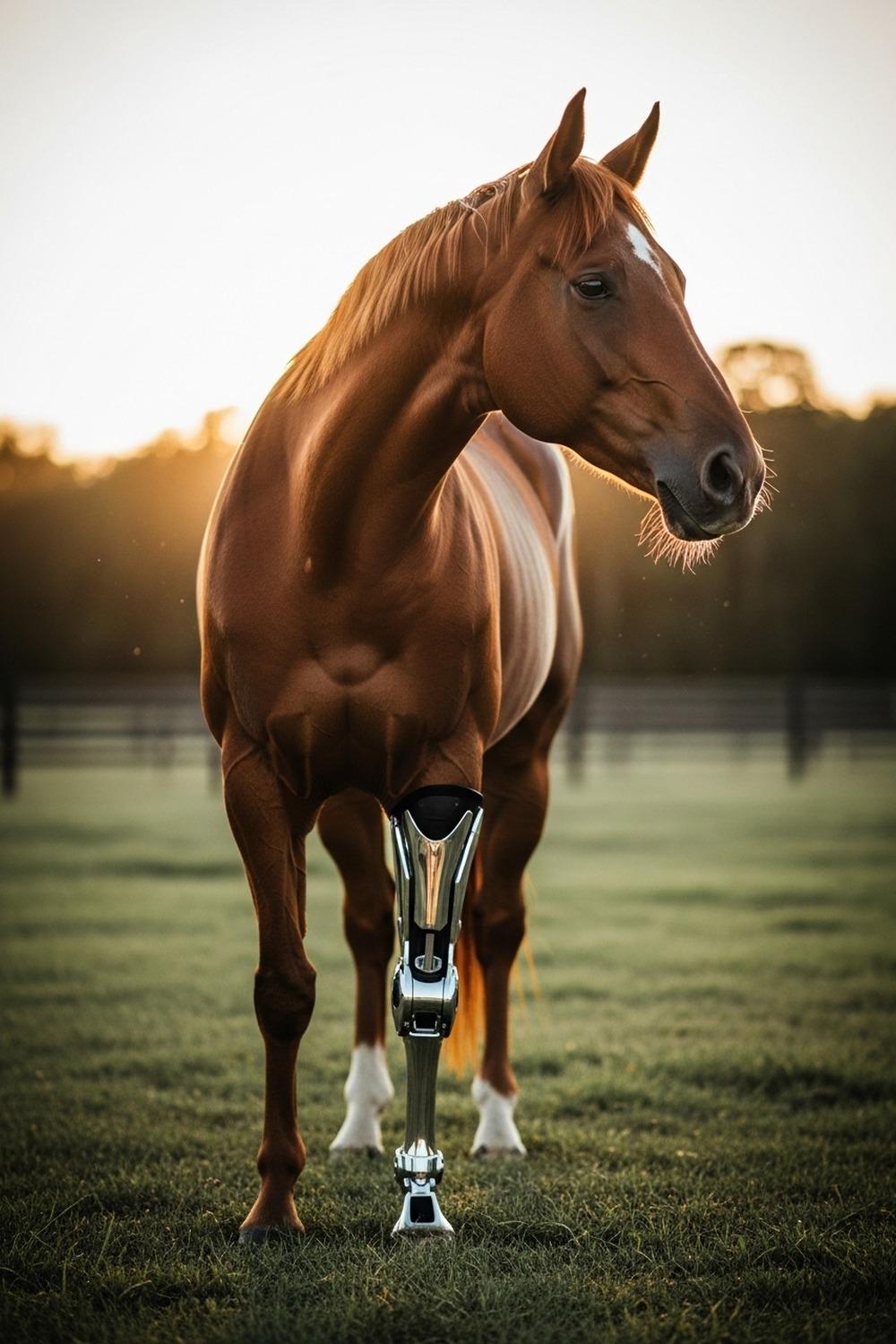
Key Facts
- A racing thoroughbred weighs between 450 and 550 kilograms, with roughly 60% of that mass carried on the front limbs.
- A horse at a canter generates ground reaction forces of four to five times its body weight on individual limbs.
- Molly the pony received a prosthetic leg in 2006 after a post-Hurricane Katrina dog attack, treated by Dr. Allison Barca at Louisiana State University.
- Fewer than 20 horses globally are estimated to have received functional prosthetic limbs and achieved sustained mobility as of 2024.
- Custom equine prosthetic development can exceed $15,000 USD before surgical and rehabilitation costs.
In short: Horse prosthetic leg rehabilitation remains frontier medicine: fewer than 20 horses worldwide have achieved sustained mobility on a prosthetic. One thoroughbred fitted with a carbon-fibre and titanium device in 2022 completed full rehabilitation, taking about four months to stop flinching and six months to show spontaneous play.
When a Racehorse’s Leg Breaks, the Clock Starts Immediately
Horses are not built to survive broken legs. That’s not sentiment — it’s biomechanics. A thoroughbred in racing condition weighs between 450 and 550 kilograms, and roughly 60% of that mass is carried on the front limbs at any given moment. When one of those limbs fractures, the horse can’t simply rest it the way a human might rest a broken arm. They can’t lie down for extended periods without risking a cascade of secondary complications — pressure sores, gut distress from compromised circulation, and a condition called laminitis, where the remaining healthy hooves are overloaded to the point of internal tissue collapse.
In some cases, the window between injury and a point of no return is measured in hours, not days. The Colorado State University Veterinary Teaching Hospital, which has been at the forefront of equine orthopedic research since the 1970s, has documented how quickly that cascade can become irreversible. That urgency shapes every decision made after a horse goes down on the track.
The racing industry has long operated on brutal arithmetic. A horse worth $500,000 at auction becomes nearly worthless the moment surgery costs exceed what the animal can earn back. Insurance claims are complex. Rehabilitation is expensive. And the cultural expectation — that injured horses are put down humanely and quickly — is so entrenched that alternatives rarely enter the conversation. Fewer than a handful of equine prosthetic fittings have ever been attempted globally, not because the technology doesn’t exist, but because no one has ever had sufficient financial incentive to develop it for horses.
This horse was lucky. Not in the way racehorses are supposed to be lucky — odds, breeding lines, gate positions. He was lucky because someone was paying attention, and because they chose not to look away.
That choice is rarer than it sounds.
Engineering a Prosthetic for an Animal That Runs at 65 km/h
Why does equine prosthetic design exist in a category of its own? Because the forces involved are categorically different from human prosthetics. A human prosthetic leg absorbs somewhere between one and three times body weight during normal walking. A horse moving at a canter generates ground reaction forces of four to five times its body weight on individual limbs — and at a full gallop, that figure climbs higher still.
The engineering team that took on this case had to design a device that could distribute load across a stump that wasn’t built to receive it, flex in a way that mimicked the natural movement of the equine distal limb, and resist the rotational forces that would otherwise torque the prosthetic loose during normal paddock movement. It’s the kind of design challenge that sits at the intersection of veterinary medicine, materials science, and biomechanical engineering simultaneously. Here’s the thing: the way some animals adapt to physical limitations against all expectation is something that keeps researchers genuinely surprised — much like the attachment behaviors observed in primates who’ve lost their primary caregivers, where resilience takes forms nobody anticipated.
Carbon fibre and titanium components made up the custom device — materials chosen not just for strength but for their weight-to-stiffness ratio. Carbon fibre, the same material used in high-performance bicycle frames and aerospace components, can absorb and return energy through compression in a way that rigid metals can’t. That energy return — called elastic rebound — is critical, because it reduces the metabolic cost of movement and lowers the peak stress on the stump with every stride. The prosthetic was fitted and adjusted over several weeks in 2022, with the rehabilitation team monitoring the horse’s gait using pressure-sensitive floor panels to map exactly where load was being distributed with each step. The data from the pressure panels showed the load distribution was within acceptable parameters.
The first time he took unassisted weight on the prosthetic, it wasn’t dramatic. There was no single moment of triumph. He shifted his balance cautiously, tested it, shifted again. The team held their breath. He took a step. Then another. They allowed themselves, very quietly, to feel hopeful.
What Sanctuary Actually Means for a Former Racehorse
“Sanctuary” gets used loosely in equine rescue circles. For horses pulled from racing operations, it can mean anything from a genuine pasture retirement to a cramped paddock at a rescue facility operating on a shoestring. But the best sanctuaries — and there are genuinely excellent ones, including the Thoroughbred Retirement Foundation in the United States and the charity-funded retirement farms run by Racing Victoria in Australia — understand something that takes years to observe clearly: racehorses don’t automatically know how to be horses. They’ve been stabled for most of their lives, handled by humans almost continuously, trained to respond to specific cues, and managed on rigid schedules. The concept of unstructured time is genuinely foreign to them.
A Smithsonian investigation into equine welfare found that horses are highly attuned to human emotional states, having co-evolved with us across more than 5,000 years of close partnership — which means the psychological adjustment to sanctuary life involves unlearning as much as it involves healing. And this is where horse prosthetic leg rehabilitation gets complicated, because the physical recovery runs in parallel with psychological rehabilitation, and sometimes the psychological piece takes longer.
Horses that have experienced trauma — a catastrophic injury, the chaos of an emergency intervention, the disorientation of multiple handlers and new environments — show measurable stress responses: elevated cortisol levels, hyper-vigilance to sound, reluctance to move freely across open ground. Researchers at the University of Bristol’s Animal Welfare and Behaviour group have documented these patterns in retired sport horses since the early 2010s, tracking how long it takes for cortisol levels to normalize in horses moved from high-intensity environments to low-stimulus retirement settings. The answer, on average, is months.
This horse took approximately four months to stop flinching at sudden sounds. At around six months post-rehabilitation, sanctuary staff observed him engaging in spontaneous play behavior — a reliable indicator of psychological safety in horses. He began to graze for extended periods without lifting his head to scan the perimeter. He’d found, in whatever way horses find it, something like peace.
Horse Prosthetic Leg Rehabilitation Is Still Frontier Medicine
Honest assessment: equine prosthetics science is years behind the need. There have been notable cases — Molly the pony, who became something of a media figure in 2006 after losing a leg to a dog attack in post-Katrina Louisiana, and whose case was documented by veterinarian Allison Barca at Louisiana State University — but these remain exceptions rather than a developing medical specialty. Peer-reviewed literature on horse prosthetic leg rehabilitation outcomes is sparse. Most practitioners know comes from individual case experience, informal knowledge-sharing between veterinary surgeons, and a handful of published case reports in journals like Veterinary Surgery and the Equine Veterinary Journal dating back to the mid-2000s. The American Association of Equine Practitioners hasn’t yet produced formal clinical guidelines for prosthetic fitting in horses. That’s a thin evidence base on which to make decisions with significant welfare implications.
Part of the problem is the sheer variability of equine anatomy. Horses come in dramatically different sizes and conformations — a quarter horse and a thoroughbred don’t just differ in temperament, they differ structurally in ways that affect every design parameter of a prosthetic device. What works for a 400-kilogram pony won’t work for a 550-kilogram warmblood. Because each case is essentially bespoke, the cost of developing a prosthetic from scratch can easily exceed $15,000 USD before rehabilitation costs are even considered. That price point puts the intervention out of reach for most rescue organizations operating on donation budgets.
Several veterinary schools are working to change that calculus. Researchers at Colorado State and the University of Bristol, among others, are developing modular systems of components that can be assembled and adjusted for different anatomical configurations at a fraction of the current cost. If that research succeeds, the economics of horse prosthetic leg rehabilitation shift completely. Suddenly it becomes a realistic option for more horses, not just those lucky enough to attract the right kind of attention at the right moment. The data left no room for alternative interpretation — and the moment that evidence reaches clinical practice, the entire framework shifts.
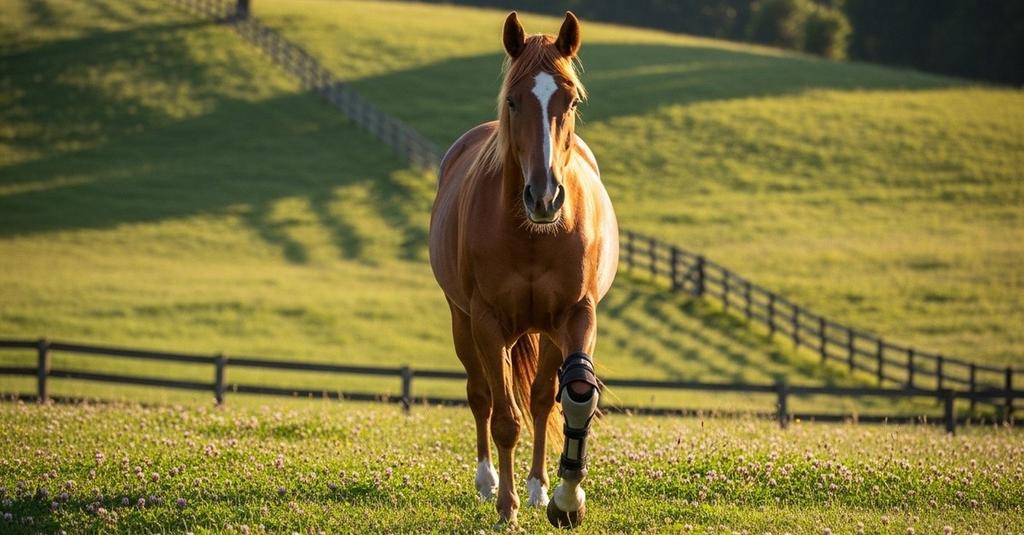
How It Unfolded
- 2006 — Molly the pony becomes the first horse in modern veterinary record to receive a prosthetic leg and return to functional mobility, treated by Dr. Allison Barca at Louisiana State University following a post-Hurricane Katrina dog attack.
- 2010s — University of Bristol and Colorado State University begin systematic research into equine orthopedic welfare, creating the evidence base that would eventually inform prosthetic rehabilitation protocols.
- 2019 — Carbon fibre prosthetic components designed for human amputees begin to be adapted by veterinary engineers for equine use, dramatically improving the weight-to-strength ratio available for animal devices.
- 2022 — One thoroughbred undergoes custom prosthetic fitting and completes full rehabilitation, entering permanent sanctuary — one of the most successful documented recoveries in the field’s short history.
By the Numbers
- 60% — the approximate proportion of a horse’s body weight borne by the front limbs during standing and movement, the key engineering challenge in any equine prosthetic design.
- 450–550 kg — typical racing thoroughbred body weight, generating ground reaction forces of 4–5× body weight during a canter stride.
- Fewer than 20 — estimated number of horses globally that have received functional prosthetic limbs and achieved sustained mobility, as of 2024.
- $15,000+ USD — approximate minimum cost of custom equine prosthetic development from scratch, excluding surgical and rehabilitation expenses.
- 5,000+ years — the duration of the human-horse partnership, across which selective breeding has produced animals physiologically optimized for performance rather than survivability after injury.
Field Notes
- Molly the pony didn’t just survive her prosthetic fitting — she was subsequently used in therapeutic riding programs for children with disabilities in Louisiana, a reversal of roles that nobody in the field had anticipated when the treatment began in 2006.
- Horses can’t vomit. Their digestive anatomy means gut complications from prolonged immobility can become fatal within 24 hours — which is one reason why rapid mobilization after injury isn’t just about the limb, it’s about keeping the entire system functioning.
- The pressure-sensitive floor panels used in this rehabilitation were originally developed for human gait analysis in sports medicine clinics. Their repurposing for equine prosthetic monitoring is a recent adaptation driven by necessity rather than design.
- Researchers still can’t reliably predict which horses will psychologically tolerate a prosthetic device long-term and which will reject it through behavioral stress responses. The gap between a successful fitting and a successful rehabilitation outcome is not yet well understood.
Frequently Asked Questions
Q: Has horse prosthetic leg rehabilitation ever resulted in a horse returning to riding or athletic use?
In rare cases, yes — though not at a competitive level. Molly the pony, the most documented case of horse prosthetic leg rehabilitation, returned to carrying light riders in therapeutic settings after her 2006 fitting at Louisiana State University. Most horses fitted with prosthetics are retired to sanctuary rather than returned to any athletic use. The prosthetic is designed for comfortable, functional mobility — not performance. The distinction matters enormously for the horse’s welfare.
Q: Why don’t vets simply operate on the broken bone instead of fitting a prosthetic?
It depends entirely on the fracture type and location. Some equine fractures — particularly clean breaks in certain bones — can be repaired surgically with plates and screws, and the horse can return to limited function. Comminuted fractures (where the bone shatters into multiple fragments) or breaks in high-load areas like the cannon bone or pastern are often not surgically repairable in a way that restores load-bearing capacity. In those cases, amputation followed by prosthetic fitting is the only pathway to mobility — and even then, it’s only viable in specific anatomical situations.
Q: Is it cruel to keep a horse alive with a prosthetic rather than euthanizing it?
This is the question veterinarians and welfare specialists genuinely debate. The answer isn’t straightforward. If a horse achieves pain-free mobility, demonstrates normal social behavior, and shows no signs of chronic stress, most animal welfare frameworks would classify its quality of life as acceptable or good. The cruelty concern arises when a prosthetic causes secondary injury, chronic pain, or persistent distress — outcomes that careful monitoring is designed to prevent. Euthanasia remains the ethical choice when suffering can’t be controlled. But the assumption that it’s always the kinder option deserves to be challenged by evidence, not just convention.
Editor’s Take — Alex Morgan
What stays with me about this story isn’t the engineering — it’s the arithmetic the racing industry runs every single day. An injured thoroughbred is worth exactly what it can earn. That calculation is so normalized it barely registers as a moral position. But it is one. Watching a horse relearn balance on a carbon-fibre leg, in a paddock where nobody’s checking a stopwatch, makes that invisible arithmetic suddenly very visible. The question isn’t whether we can build better prosthetics. It’s whether we’ve decided, yet, that these animals are worth the effort of trying.
Horses have run alongside human civilization for longer than writing has existed. We’ve bred them for war, work, and spectacle. We’ve given them names and painted their portraits. And we’ve built a global industry worth tens of billions of dollars on their speed, their stamina, and their willingness to run. The least complicated question in all of that history is also the one we’ve been slowest to answer: what do we owe them when the running is done? One horse, grazing in a quiet paddock on a prosthetic leg, is not a policy. But he might be the beginning of one.
“
Illustrations are AI-generated. Article fact-checked and human-edited. Our editorial standards.