Scientists Made Light Behave Like a Crystal in Italy
Italian physicists just trapped light inside a crystal made of itself. It held its shape. Flowed like water. Didn’t lose a single photon in the process.
What you’re about to read is the kind of experiment that makes physicists look at each other in silence for a very long time. Not because anyone doubted it was theoretically possible — the math checked out years ago — but because the gap between “theoretically possible” and “actually did it” is vast enough to swallow careers.
In a lab in Pisa, researchers took photons (massless particles that have spent the entire history of the universe refusing to sit still) and forced them into a crystalline lattice. A solid made of pure light. Except it also flowed. Like a superfluid. At the same time. In the same place.
Key Facts
- Italian physicists in Pisa forced photons into a crystalline lattice that also flowed like a superfluid, a photonic supersolid.
- Researchers used a microcavity sandwiched between two mirrors to create quasiparticles called polaritons, part light and part matter.
- Supersolids were first theoretically predicted in 1957.
- Experimental evidence of supersolid behavior first emerged in helium-4 around 2004.
- Microcavity structures are typically just a few micrometers thick, thinner than a human red blood cell.
In short: Italian physicists in Pisa created a photonic supersolid light state, forcing massless photons into a crystalline lattice that simultaneously flowed like a frictionless superfluid. Using a microcavity between two mirrors to produce polaritons, the team achieved a state first theorized in 1957, with applications in quantum networks and ultra-sensitive sensors.
What Is a Photonic Supersolid Light Structure?
A supersolid is one of physics’ most paradoxical states of matter: a substance that maintains rigid crystalline order while simultaneously flowing like a frictionless liquid.
The concept was first theorized in the 1950s. Physicists spent half a century chasing it in helium-4, finally getting tantalizing experimental hints in 2004 — work that sparked enormous controversy and years of follow-up debate. But those experiments involved atoms. Cold, slow, heavy atoms. Doing this with light particles is an entirely different category of strange.
Photons don’t have mass. They don’t interact with each other under normal conditions. Getting them to form any kind of structure — let alone a stable crystalline lattice with superfluid properties — requires building an environment so precisely controlled it barely resembles anything in nature.
So here’s the obvious question: how?
How Italian Physicists Built Light a Skeleton
The researchers used a microcavity — an incredibly thin optical trap sandwiched between two mirrors — to force photons into coupling with electronic excitations in a semiconductor material. Think of it like creating a house so small that light can’t help but interact with the walls. The result is a quasiparticle called a polariton: part light, part matter, and strange enough to behave in ways neither parent particle would on its own.
By carefully tuning the density and confinement of these polaritons, the team coaxed them into a state where spatial periodicity and frictionless flow existed at the same time.
What makes this genuinely remarkable isn’t just the result. It’s that they engineered it deliberately. They built the conditions, tuned the parameters, and then watched light do something it had never done in recorded history. No accident. No luck. Pure control.
You can read more about related quantum breakthroughs in surprising materials over at this-amazing-world.com.
Why This Matters Beyond the Physics Lab
The photonic supersolid light phenomenon isn’t just a trophy on a physicist’s shelf. When light can hold a structured pattern without losing energy — without degrading, scattering, or collapsing — it becomes something engineers can actually use.
Optical circuits built around this principle would be dramatically more stable than anything we have today. Information encoded in quantum states could survive longer, travel farther, and arrive intact in ways that current quantum communication systems can’t guarantee.
There’s also sensor technology. Supersolid light structures respond to disturbances with extraordinary sensitivity. A system that can detect infinitesimally small vibrations, gravitational shifts, or electromagnetic fluctuations — at scales current instruments can’t reach — changes what’s measurable.
And what’s measurable changes everything.
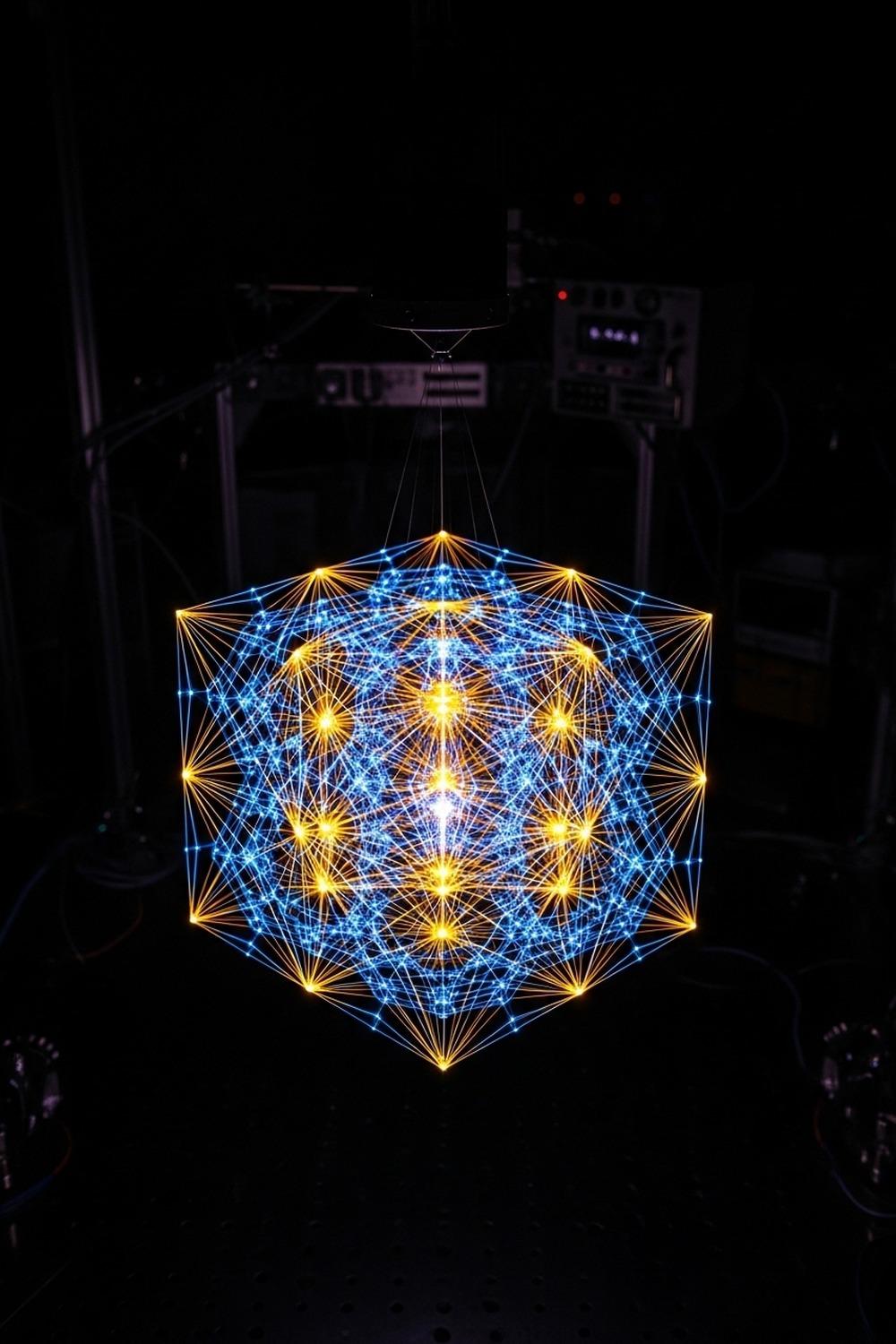
The Part Nobody Saw Coming About Light
We’ve been living with light for the entire span of human existence. Every civilization, every experiment, every equation. And we thought we understood what light could and couldn’t do. It travels. It reflects. It bends. It carries energy.
It doesn’t stop. It doesn’t stack. It certainly doesn’t form a rigid repeating pattern while simultaneously being frictionless.
Turns out that last part was just a limit of our imagination — and our technology. That last fact kept me reading for another hour.
The photonic supersolid challenges something deeper than a single physics fact. It challenges the assumption that light is fully characterized. That we’ve catalogued its properties and closed the book. The Italian experiment suggests the book was never close to finished.
If light has been hiding a trick this significant, it’s fair to ask what else we’ve been confidently misunderstanding about the most fundamental forces we interact with every single day.
By the Numbers
- Supersolids were first theoretically predicted in 1957. It took nearly five decades before experimental evidence emerged in helium-4 around 2004, and decades more before anyone attempted it with light.
- Polaritons travel fast.
- The quasiparticles at the heart of this experiment can travel at speeds approaching a significant fraction of the speed of light inside the microcavity — making them among the fastest information-carrying quasiparticles in quantum materials research.
- Microcavity structures are typically just a few micrometers thick — thinner than a human red blood cell — yet capable of sustaining quantum coherence across the entire sample.
- Quantum information stored in superfluid-like photonic systems degrades exponentially slower than in conventional optical systems. For the quantum networks currently in development across Europe, China, and the United States, this factor could prove decisive.
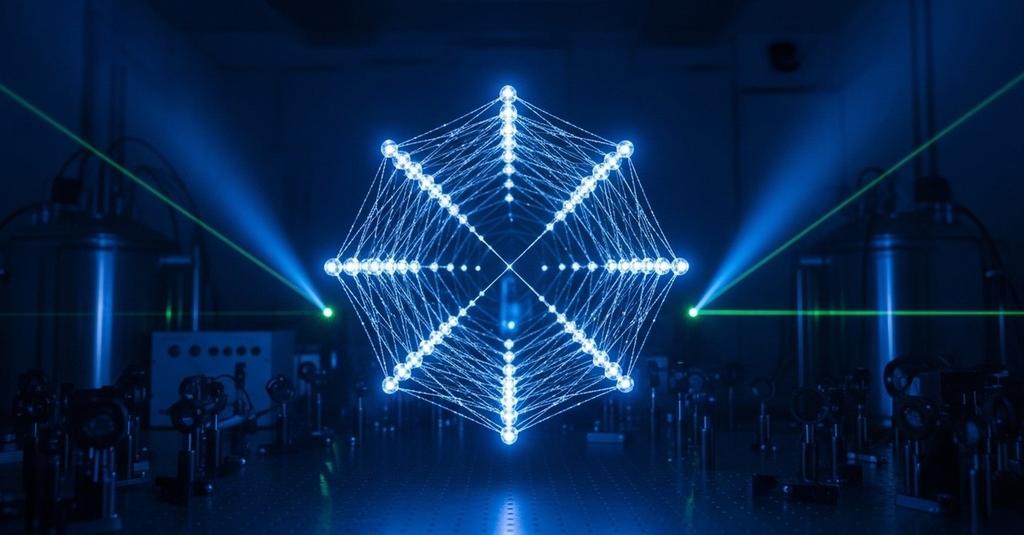
Field Notes
- The spontaneous breaking of translational symmetry is the technical name for what happens when light “decides” to arrange itself into a crystal pattern. It’s the same mathematical mechanism behind ordinary solid crystals, snowflakes, and some biological structures. The physics doesn’t care what the substance is.
- Macroscopic quantum effects. Most people assume quantum weirdness only shows up at the scale of single particles, but supersolid behavior is visible at scales large enough to interact with directly.
- The Italian research builds on decades of European investment in polariton physics, with key groups in Pisa, Trento, and Rome contributing foundational theory that made this experimental leap possible.
What This Discovery Means for Our Future
The creation of a photonic supersolid light state is the kind of result that starts appearing in engineering textbooks about fifteen years after it first appears in a physics journal. Right now it lives in the realm of the extraordinary. But the trajectory is clear.
Stable optical circuits. Quantum networks that don’t lose coherence over distance. Sensors sensitive enough to detect things we currently have no instrument capable of measuring. The researchers haven’t just demonstrated a curiosity — they’ve handed future engineers a material specification for something that didn’t exist before.
The philosophical implications sit alongside the practical ones. Every generation of scientists inherits a map of what’s possible. This experiment quietly tears a corner off ours. If light can crystallize without freezing and flow without losing structure, then the categories we use to describe physical reality are less settled than physics textbooks suggest.
That’s not unsettling.
It’s genuinely exciting.
We’ve spent millennia assuming light was a thing we understood. Turns out it’s been waiting for us to ask better questions.
Science doesn’t always announce its revolutions. Sometimes they arrive quietly, in a thin sliver of semiconductor between two mirrors, in a lab in Italy, while most of the world is looking somewhere else entirely. The photonic supersolid exists now. The rules got a little stranger. And the next experiment is already running.
“
Frequently Asked Questions
Q: What is a photonic supersolid light state?
A supersolid is a paradoxical state of matter that maintains rigid crystalline order while simultaneously flowing like a frictionless liquid. A photonic supersolid achieves this using light particles instead of atoms. Italian physicists in Pisa forced photons into a crystalline lattice that also flowed like a superfluid, in the same place at the same time. They did it by creating polaritons, hybrid quasiparticles that are part light and part matter, inside a microcavity. The concept was first theorized in 1957.
Q: How did the physicists make light behave like a solid?
The researchers used a microcavity, an extremely thin optical trap sandwiched between two mirrors, to force photons into coupling with electronic excitations in a semiconductor. This produces a quasiparticle called a polariton, part light and part matter. By carefully tuning the density and confinement of these polaritons, the team coaxed them into a state where spatial periodicity and frictionless flow existed simultaneously. Microcavity structures are typically just a few micrometers thick, thinner than a human red blood cell, yet sustain quantum coherence across the whole sample.
Q: Why does the photonic supersolid discovery matter?
When light holds a structured pattern without losing energy, it becomes useful for engineering. Optical circuits built on this principle would be far more stable than current technology, and quantum information could survive longer and travel farther. Supersolid light structures also respond to disturbances with extraordinary sensitivity, enabling sensors that detect vibrations or electromagnetic fluctuations beyond today’s instruments. Supersolids were first predicted in 1957 and demonstrated in helium-4 around 2004, but doing it with light opens entirely new applications.
Illustrations are AI-generated. Article fact-checked and human-edited. Our editorial standards.