Ligers: The World’s Largest Cat Breaks Every Rule
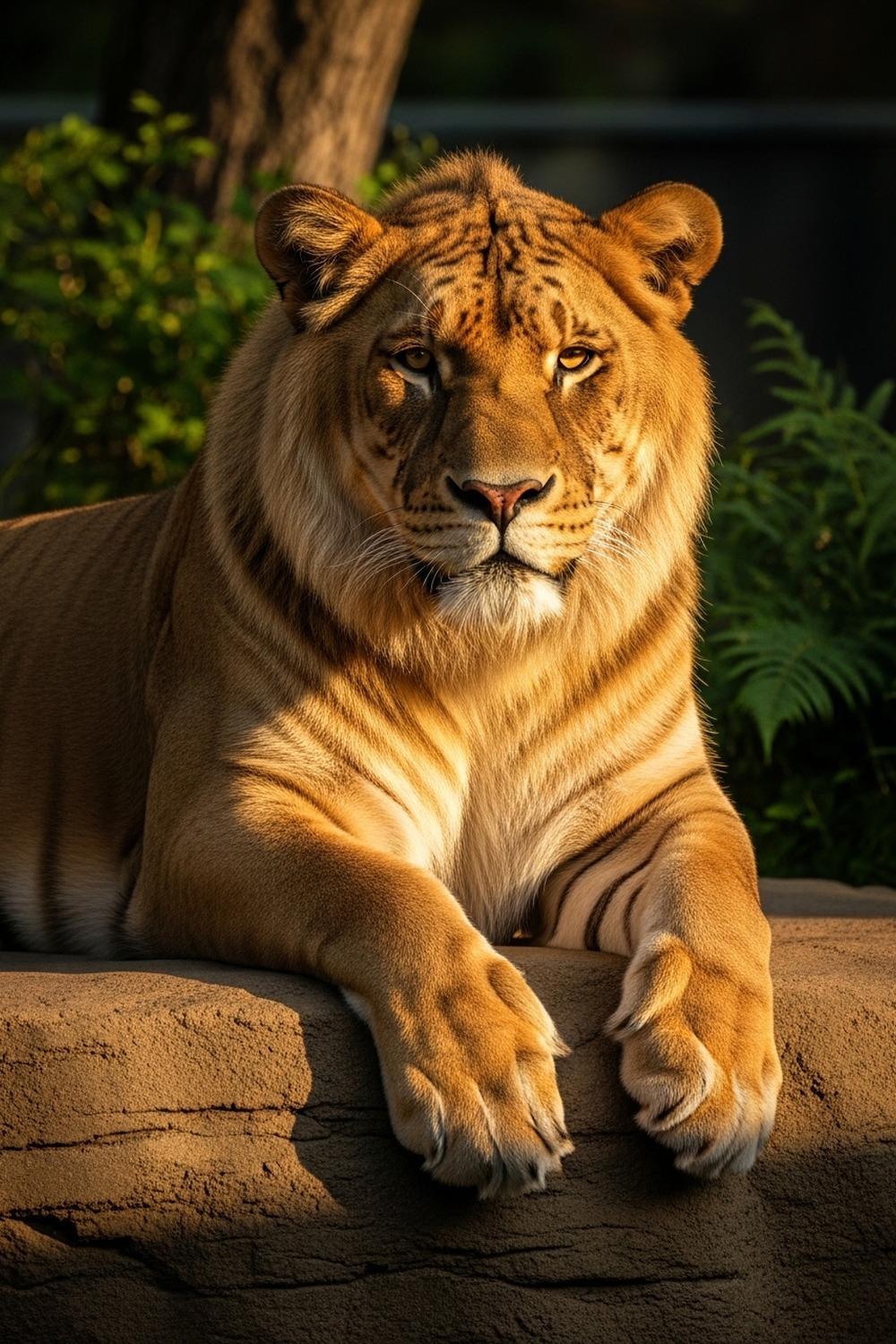
What if two apex predators collided in a way nature never intended, and instead of canceling each other out, they created something that obliterated both? The liger — clocking in as the world’s largest cat by every measurable standard — is that collision made flesh. Not a compromise between lion and tiger. Not a midpoint. An overshoot, swimming in South Carolina, apparently dabbling in painting, defying the entire architecture of what a cat should be.
Born only when a male lion and a female tiger mate in captivity, ligers occupy a biological category that evolution itself never designed for. They’re an accidental experiment in what happens when two incompatible genetic instruction sets collide and the regulatory system simply fails to engage. The scientific explanation is stranger than watching it happen. And the spectacle, by any measure, is already extraordinary.
Key Facts
- The liger is born only when a male lion mates with a female tiger in captivity.
- In 2012, University of Edinburgh researchers published analysis showing genomic imprinting drives the liger’s unchecked growth.
- Hercules, a liger at Myrtle Beach Safari in South Carolina, was recorded by Guinness World Records at a peak weight of 922 pounds in 2014.
- Hercules measures 11 feet 2 inches from nose to tail and can consume up to 30 pounds of meat in a single feeding.
- Zero ligers have ever been documented in the wild; approximately 100 are estimated to exist worldwide, mostly in the U.S., Russia, and China.
In short: The liger, the world’s largest cat, is born only when a male lion mates with a female tiger in captivity. Genomic imprinting, confirmed by 2012 University of Edinburgh research, removes the growth brake, producing animals like the 922-pound Hercules at Myrtle Beach Safari, exceeding both parent species.
How the World’s Largest Cat Defies Basic Biology
Genomic imprinting — that’s the mechanism. Both lions and tigers carry it, a process where certain genes silence themselves depending on which parent they came from. In 2012, researchers at the University of Edinburgh published the detailed analysis proving it. In lions, the father’s growth-promoting genes dominate, but the mother’s growth-suppressing genes keep them in check. Tigers work in reverse. When two species combine in a liger, that regulatory conversation breaks down completely. The father lion’s growth signals arrive without the tiger maternal suppressors to counterbalance them.
The result is an animal that never receives the biological instruction to stop growing.
It keeps going. And going. Until you’ve got an 11-foot-long cat that weighs the better part of half a ton. That’s not metaphor — it’s genetics without a ceiling, confirmed by genomic imprinting studies across a decade of research.
A normal male lion tops out at around 420 pounds in the wild. A Siberian tiger — the largest wild cat species on Earth — can reach 660 pounds in exceptional cases. Ligers routinely exceed both. They don’t split the difference; they transcend it entirely. This growth pattern is technically hybrid vigor, or heterosis, though in ligers the effect is so pronounced it’s almost in a category of its own. Most hybrid animals are smaller and less fertile than their parents. Ligers went the other direction.
What’s almost embarrassing is the consistency. Nearly every liger recorded grows well beyond both parent species. This isn’t a fluke of one exceptional animal — it’s the predictable outcome, every time. The biology is reliable about producing something that looks designed for a different planet.
Swimming Lions and Sociable Solitudes
Here’s the thing: behavioral traits cut across the species divide as cleanly as physical ones. Lions are famously water-averse. They’ll wade when necessary, but they don’t seek it out. Tigers are the opposite — enthusiastic swimmers, capable of crossing rivers several kilometers wide, cooling off and hunting in water without hesitation. The liger inherited the tiger’s relationship with water completely.
They swim. Readily. This reveals how lion and tiger evolution diverged more than years of field observation might. In some ways, a liger’s behavioral inheritance tells us more than we expected to learn — much like the Sunda flying lemur, which glides impossibly far for a mammal that technically can’t fly, the liger does things its category says it shouldn’t.
Socially, ligers tend to carry the lion’s gregariousness forward into a life that has no real social structure to belong to. Lions are deeply social creatures — prides, cooperation, constant communication. Tigers are solitary. Put those two instincts together and you get an animal that seems to want company, that interacts with keepers and other animals with more openness than a tiger typically would. But it has no actual pride to fall back on. It’s sociability without a social world.
Hercules, the record-holding liger at Myrtle Beach Safari in South Carolina — recognized by Guinness World Records as the largest living cat on Earth as recently as 2023 — is described by his keepers as affectionate. He reportedly enjoys painting. His canvases, apparently, sell. There’s something quietly melancholy about sociability without a social world, even as the animal itself seems, by all accounts, unbothered.
That detail shouldn’t be funny, but it is. An animal that defies the biological architecture of two apex predators, and in his spare time produces abstract art.
Hercules and the Record That Keeps Growing
Myrtle Beach Safari in South Carolina — that’s where Hercules lives. His statistics read like a misprint. Over 11 feet long from nose to tail. Approaching 1,000 pounds. Capable of consuming 30 pounds of meat in a single sitting. His Guinness World Records certification has been renewed multiple times, and as of 2023, he still holds the title. The Smithsonian’s National Zoo and other research institutions have noted the liger’s unusual growth profile in broader discussions of hybrid biology. Hercules himself has become something of a cultural landmark — a creature so far outside the expected parameters of big cat biology that he functions as a living proof-of-concept for what genomic imprinting can do when it’s allowed to run unchecked.
Why does this matter? Because Smithsonian Magazine’s science coverage has examined how hybrid animals challenge our assumptions about species boundaries — and few hybrids make that case as dramatically as a liger standing next to a full-grown lion and making it look modest.
What’s striking isn’t just the raw numbers — it’s that no wild liger has ever existed to challenge them. Every measurement comes from captivity. There’s no baseline for what a liger might become in a different environment, with different diet and movement and stress. The animals we’re measuring are, by definition, a captive artifact. Lions and tigers haven’t shared natural territory for thousands of years, their ranges having separated as climates shifted and human expansion compressed their habitats on different continents. Whether a wild liger would grow differently is a question we can never answer.
This captive-only existence shapes every conclusion we draw. The swimming, the sociability, the size — all observed under conditions that no wild felid ever experiences. We’re documenting an animal through a very particular window, and what we might be missing is anyone’s guess.
The Ethics Behind the World’s Largest Cat’s Existence
Ligers don’t happen by accident. Lions and tigers don’t encounter each other in the wild. A liger requires deliberate human facilitation: a captive setting, a male lion, a female tiger, and a keeper willing to allow or arrange the pairing. That decision has become increasingly controversial. In 2020, the World Wildlife Fund and several large zoological associations formally reiterated their opposition to deliberate breeding of hybrid big cats, arguing that it serves no conservation purpose — ligers can’t be released into any wild habitat, they don’t represent any endangered population worth preserving, and the practice prioritizes spectacle over science.
The Zoological Society of London echoed similar concerns in educational materials updated in 2021, emphasizing that ethical captive breeding focuses on species preservation, not novelty. A liger, however astonishing, is not a conservation tool. It’s a consequence of captivity with nowhere further to go.
But the harder questions involve the animal itself. Ligers are prone to certain health issues — some research suggests accelerated aging in some individuals, and the sheer mechanical demands of carrying 900-plus pounds on a felid skeletal structure creates chronic joint stress over time. Female tigers used for breeding carry enormous cubs relative to their frame, making pregnancies genuinely dangerous. This isn’t hypothetical welfare concern. It’s documented veterinary reality. Watching a species deliberately produced for spectacle while carrying costs nobody talks about — you start asking if wonder and harm can coexist quite so peacefully.
None of this makes Hercules less remarkable. He exists, he’s healthy by most accounts, and he apparently paints. But the conditions that produced him are worth holding alongside the wonder. The two things can be true simultaneously.
Where to See This
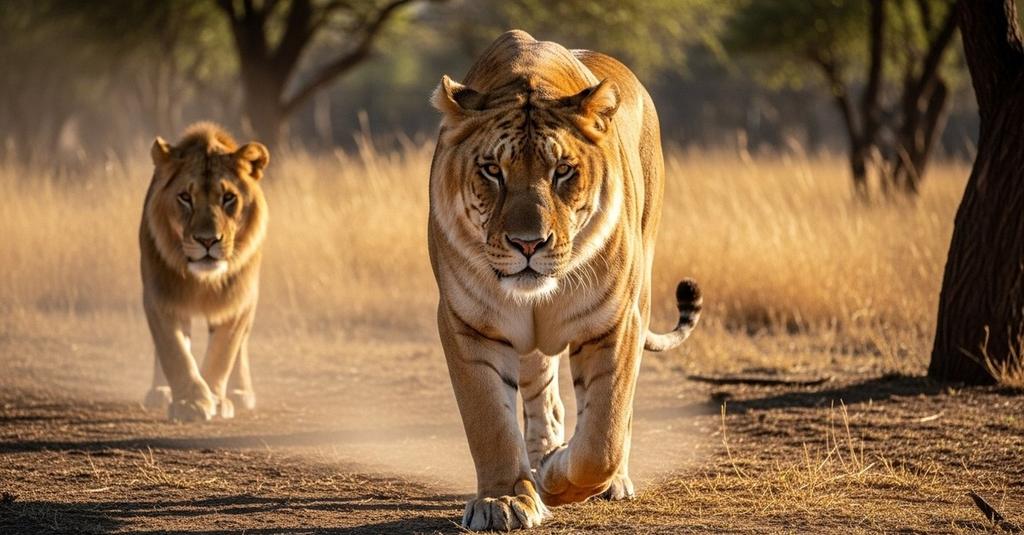
- Myrtle Beach Safari, South Carolina, USA — home to Hercules, the Guinness-certified world’s largest living cat; visits are by private tour reservation only and available year-round, though spring and autumn offer cooler conditions for the animals.
- Carolina Tiger Rescue and other accredited facilities offer educational programming around hybrid big cats and big cat conservation. The Big Cat Rescue sanctuary in Tampa, Florida is also transitioning operations with similar focus.
- For background reading, the Smithsonian Magazine’s science section and the Guinness World Records official website both carry detailed profiles on Hercules; the 2012 University of Edinburgh genomic imprinting research is accessible through open-access academic databases.
By the Numbers
- 922 pounds — the peak recorded weight of Hercules, the world’s largest liger, as verified by Guinness World Records in 2014.
- 11 feet, 2 inches — Hercules’s recorded length from nose to tail, longer than many small cars.
- Up to 30 pounds of meat consumed in a single feeding session by a full-grown liger — roughly equivalent to what a wild lion eats every 3–4 days.
- 0 — the number of ligers ever documented in the wild; every liger in recorded history has been born in captivity.
- Approximately 100 ligers are estimated to exist worldwide at any given time, spread across private facilities and accredited zoos, predominantly in the United States, Russia, and China.
Field Notes
- A liger named Hobbs at the Valley of the Kings Animal Sanctuary in Wisconsin was documented in 2008 swimming voluntarily in a pool for extended periods — something keepers initially found surprising before they learned to factor the tiger behavioral inheritance into daily enrichment planning.
- Ligers retain the lion’s distinctive roar rather than the tiger’s chuffing vocalisation — so despite their tiger-inherited love of water, they sound unmistakably like their father’s side.
- The reverse cross — a male tiger bred with a female lion — produces a different hybrid called a tigon, which tends to be significantly smaller than either parent, the opposite of the liger growth pattern, because the paternal growth-promoting imprinting works differently in tigers than in lions.
- Researchers still can’t fully explain why the genomic imprinting mismatch in ligers produces such consistent and extreme size overshoot rather than chaotic or variable results; the predictability of the effect is itself scientifically puzzling and hasn’t been replicated to the same degree in any other known large mammal hybrid.
Frequently Asked Questions
Q: Is the liger really the world’s largest cat, bigger than any wild species?
Yes — the liger holds the confirmed title of world’s largest cat, surpassing even the Siberian tiger, which is the largest wild cat species. Guinness World Records has certified Hercules, a liger at Myrtle Beach Safari in South Carolina, at over 900 pounds and more than 11 feet long. No wild cat species comes close to those dimensions. The size is a consistent feature of the hybrid, not an anomaly of one exceptional individual.
Q: Can ligers reproduce, and do they have health problems?
Female ligers are occasionally fertile — there are documented cases of female ligers producing offspring when mated back to a lion or tiger, creating second-generation hybrids. Male ligers, however, are almost universally sterile, which is typical of most interspecies hybrids. Health-wise, ligers can suffer from joint and skeletal stress related to their extreme weight, and some individuals show signs of accelerated aging. The pregnancies that produce them also carry risks for the tiger mother, given the size of liger cubs relative to a tiger’s frame.
Q: Are ligers legal, and is it ethical to breed them?
Legality varies by country and state — in the United States, liger breeding isn’t federally prohibited, though several states restrict or ban it. The 2003 Big Cats and Public Safety Protection Act, and its 2022 successor the Big Cat Public Safety Act, introduced new federal restrictions on private ownership and public contact with big cats, which has indirect implications for hybrid breeding. Most major conservation organisations, including the WWF and Zoological Society of London, oppose deliberate liger breeding on the grounds that it serves no conservation purpose and prioritises novelty over animal welfare.
Editor’s Take — Sarah Blake
What unsettles me about the liger isn’t the size — it’s the tidiness of the biology. A genetic brake fails, and an animal the weight of a grand piano emerges, reliably, every time. We didn’t engineer this. We just removed the obstacle of geography. That’s a quieter kind of power than it sounds, and it points at something worth sitting with: there are likely dozens of biological combinations that don’t exist simply because two species never meet. We’ve barely started asking what that means.
The liger exists because humans brought two worlds into the same enclosure. That’s it. No grand design, no scientific program — just proximity doing what proximity does. And from that accident emerged the largest cat on Earth, one that swims like a tiger, roars like a lion, and paints like neither. What that says about the rigidity of species boundaries — about what “natural” actually means when you start moving the fences — is a question that outlasts any single animal. Even one that weighs half a ton and has a gallery of canvases to his name.
Illustrations are AI-generated. Article fact-checked and human-edited. Our editorial standards.