The Black Bat Flower Looks Like a Villain. It Kind of Is.
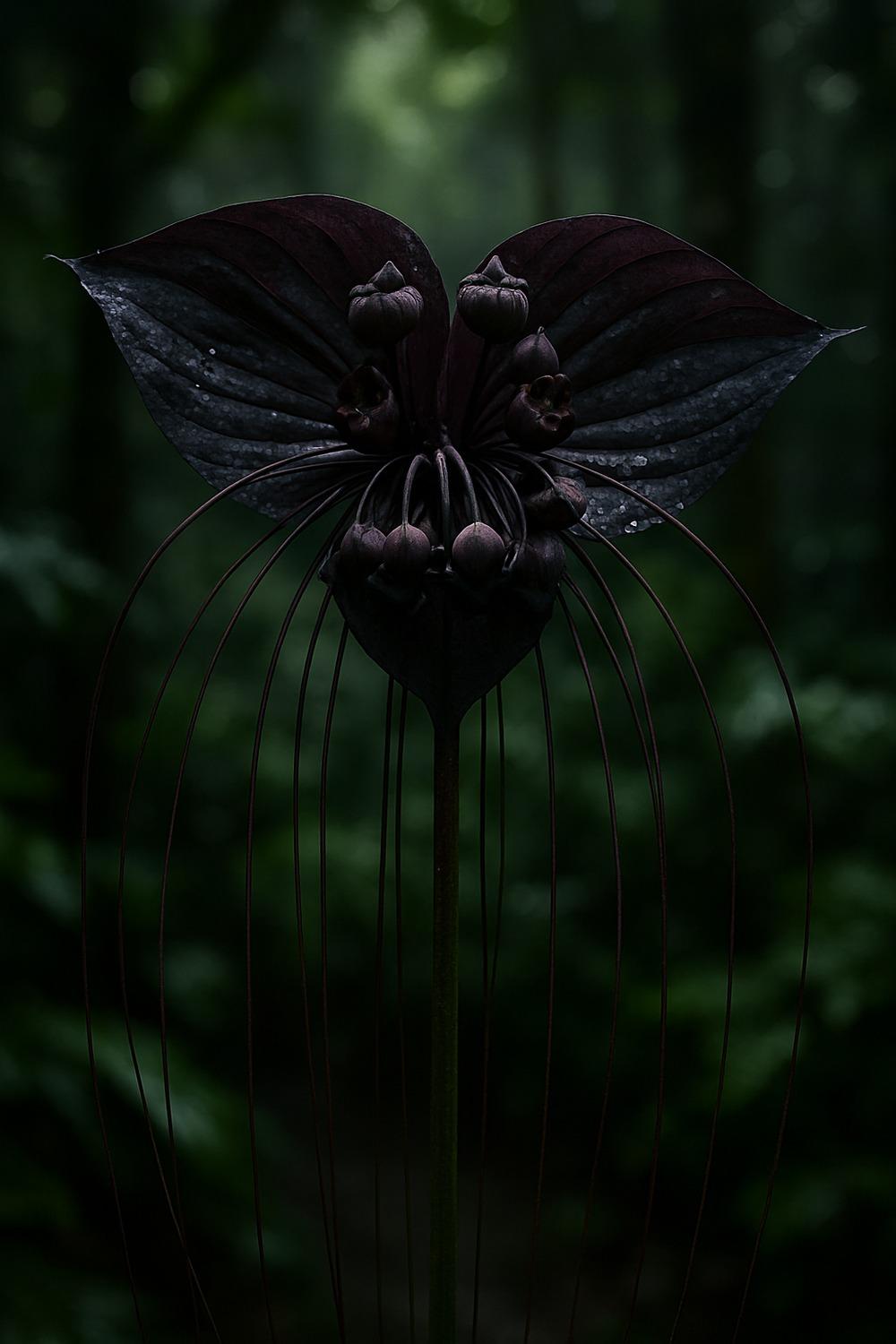
There’s a flower in Southeast Asian rainforests that looks like it’s planning something. The black bat flower grows whiskers nearly thirty inches long — and it uses them to trick insects into doing work they’ll never get paid for.
Deep in the shadowed understory where light arrives already exhausted, a plant has spent millions of years perfecting a con. Dark as a bruise. Wide as an outstretched hand. Trailing long filament threads that drift in humid air like something alive and hunting. It doesn’t attract butterflies or smell sweet. It’s pulling off a deception so complete that nobody was really sure how it worked until recently.
Key Facts
- The black bat flower (Tacca chantrieri) grows trailing filaments that can reach 70 centimeters, roughly 28 inches, the maximum recorded length
- The plant belongs to the yam family Dioscoreaceae, making it distantly related to sweet potatoes after genetic analysis folded the former Taccaceae family into it
- Western botanists first documented it in the mid-1800s, with botanist Andre Chantreau helping bring attention to it
- Roughly 7,500 flowering plant species worldwide use deceptive pollination, offering no reward to pollinators
- The genus Tacca contains roughly 10 recognized species and grows from sea level to 1,500 meters in its native Southeast Asian habitat
In short: The black bat flower (Tacca chantrieri) of Southeast Asian rainforests grows whiskers nearly 30 inches long and mimics rotting flesh to trick flies and gnats into pollinating it for no reward. Part of the yam family, this dark understory plant is one of roughly 7,500 species using deceptive pollination.
The Thing About a Flower That Looks Like Death
The black bat flower — Tacca chantrieri — belongs to the yam family Dioscoreaceae. Which is wild. That means it’s distantly related to sweet potatoes. Nobody expects that family tree.
Western botanists first documented it in the mid-1800s, though communities across Thailand, Malaysia, and southern China had known it for generations before some European showed up and decided to name it. Botanist André Chantreau helped bring attention to it in the 1800s. The obvious question — why does a plant related to yams look so aggressively hostile? — nobody’s fully answered yet.
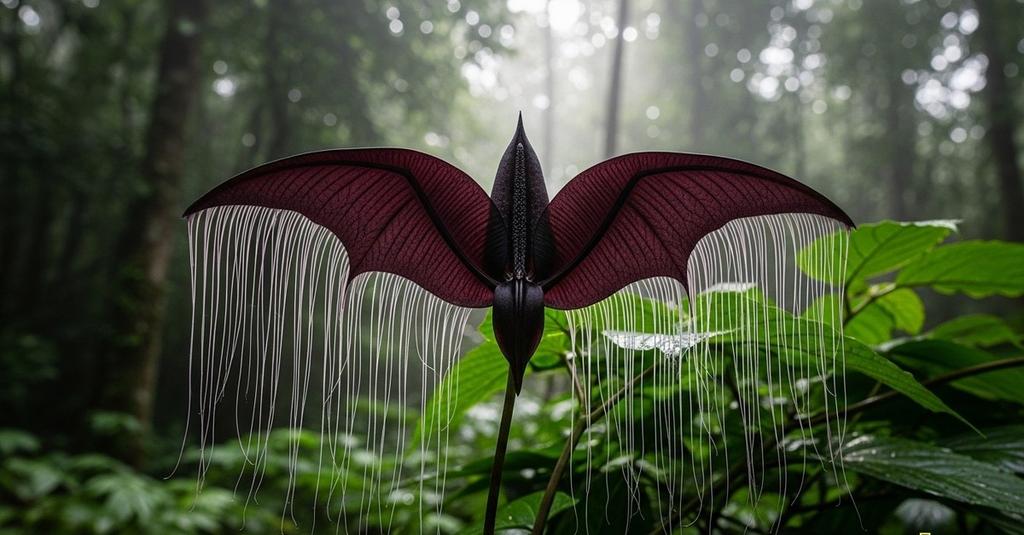
Those dark, wing-shaped bracts framing the bloom aren’t petals. They’re modified leaves doing something deliberate. The whole structure is performance art. And the audience is insects.
How a Flower Lies to Flies
Here’s the mechanism: the dark coloration and faintly unpleasant scent mimic rotting organic matter. Flies, fungus gnats, insects that lay eggs in decaying material — they get fooled completely. They think they’ve found the perfect nursery. According to research documented on Wikipedia’s Tacca chantrieri entry, the flower provides zero nectar reward whatsoever.
The insects do all the pollination work and get absolutely nothing.
That’s not symbiosis. That’s theft with a biological signature. And it’s not rare — roughly 7,500 flowering plant species worldwide pull off deceptive pollination. But most don’t commit to the theater the way this one does. The bat flower doesn’t hint at death. It shows up dressed for a funeral.
Those Filaments Are Precision Tools
The trailing threads can reach 70 centimeters — 28 inches of dangling, impossible length. They hang from the flower’s base like the legs of something you’d find under a log. They kept me reading about pollination mechanics for another hour, because scientists still aren’t entirely certain what they’re optimizing for, but the leading theory is that they guide confused insects toward the central reproductive structures. Funneling. Manipulation. Precise manipulation.
Stand next to one in bloom and it doesn’t read as plant. It reads as something that’s made a decision about you.
You can read about other plants that bend nature’s rules on this-amazing-world.com, and the bat flower would fit perfectly into that company.
The Habitat Problem
The black bat flower doesn’t grow in open meadows. It prefers the deep, humid understory of tropical forests — that zone where light arrives secondhand, filtered through canopy layers until it’s barely light at all. Warm. Consistent. Humid. Low air circulation. These aren’t conditions most gardens can replicate. It’s picky in the way that only something shaped by millions of years of one very specific rainforest gets to be picky.
Nurseries across North America, Europe, and Australia sell it as an ornamental houseplant now. Most buyers discover quickly that it sulks.
Then it dies.
That’s not the plant being dramatic. It genuinely needs conditions most homes can’t sustain.
The Taxonomic Mess
Here’s something weird — the bat flower’s scientific family got reshuffled. For a long time, Tacca species had their own family, Taccaceae. Then genetic analysis came along and folded them into Dioscoreaceae, the yam family. Which means this gothic, velvet-dark, insect-deceiving flower is technically in the same family as sweet potatoes. The evolutionary distance between them is enormous. But the shared ancestry is real.
What that actually tells us: evolution doesn’t care what things look like to humans. It only cares what works. The bat flower looks like a villain because in the deep shade of a Southeast Asian forest, looking like a villain is exactly what works.
The Numbers
- 70 cm (28 inches) — maximum recorded filament length
- Approximately 7,500 flowering plant species worldwide use deceptive pollination without offering any reward to pollinators. The estimates vary wildly depending on which botanical literature you’re reading, but the lower bound is still staggering.
- The genus Tacca contains roughly 10 recognized species, and several share the same dark appearance, but chantrieri remains the most studied
- Sea level to 1,500 meters in its native habitat — a wider range than its finicky reputation would suggest
Field Notes
- The scent is real, faint, and described variously as musty, slightly sweet, vaguely fungal — which makes perfect sense when you’re trying to convince flies they’ve found decomposing matter.
- Despite being nearly impossible to grow outside the tropics, hobbyists in Florida, Hawaii, and Singapore have managed sustained cultivation by obsessively controlling humidity and essentially building a microclimate around a single pot.
- The white variety — Tacca integrifolia — pulls off the same deceptive trick in ghostly white, and it’s somehow even more striking for being unexpected.
Why This Matters
The black bat flower is easy to dismiss — a botanical curiosity, a thing to photograph and share, nature’s oddity for the obsessed. But it’s actually a window into something bigger. Deceptive pollination without reward is energetically expensive. For a plant to pull it off successfully, generation after generation, means the deception has to be good enough to keep working. That tells us something remarkable about how sophisticated the arms race between species gets — and how much of it happens invisibly in forests we barely study.
The bat flower only thrives in intact, humid forest understory. When those forests disappear — and they are disappearing — the entire web goes with it. The fly that gets fooled. The shade that never quite becomes darkness. The humidity that stays just slightly too high for comfort.
There are an estimated 400,000 flowering plant species on Earth. We’ve formally described maybe 300,000. The black bat flower has been known to Western science for over a century and we still don’t fully understand its pollination mechanics. That’s not a gap in knowledge. That’s a door. Some of what’s still out there makes this flower look ordinary. More stories like this at this-amazing-world.com — and the next one is even stranger.
“
Frequently Asked Questions
Q: What is the black bat flower and where does it grow?
The black bat flower (Tacca chantrieri) is a dark, wing-shaped bloom native to the humid understory of Southeast Asian tropical forests across Thailand, Malaysia, and southern China. It belongs to the yam family Dioscoreaceae, making it distantly related to sweet potatoes. It grows from sea level up to 1,500 meters in elevation and was first documented by Western botanists in the mid-1800s, though local communities had known it for generations before.
Q: How does the black bat flower trick insects?
The black bat flower uses deceptive pollination. Its dark coloration and faintly unpleasant, musty scent mimic rotting organic matter, fooling flies and fungus gnats that lay eggs in decaying material into thinking they have found a nursery. The flower provides zero nectar reward, so insects perform all the pollination work and get nothing. It is one of roughly 7,500 flowering plant species worldwide that pollinate this way without offering any reward.
Q: Why are the black bat flower’s long filaments so unusual?
The trailing threads of the black bat flower can reach 70 centimeters, about 28 inches, the maximum recorded filament length. They hang from the flower’s base and drift in humid air. Scientists are not entirely certain what the filaments optimize for, but the leading theory is that they guide confused insects toward the central reproductive structures. The pollination mechanics remain incompletely understood despite over a century of Western scientific attention.
Q: Can you grow a black bat flower as a houseplant?
Nurseries across North America, Europe, and Australia sell the black bat flower as an ornamental houseplant, but most buyers find it extremely difficult to keep alive. It requires the warm, consistently humid, low-circulation conditions of deep tropical forest understory, which most homes cannot sustain. Dedicated hobbyists in Florida, Hawaii, and Singapore have managed sustained cultivation only by obsessively controlling humidity and building a microclimate around a single pot.
Illustrations are AI-generated. Article fact-checked and human-edited. Our editorial standards.