The Ant Death Spiral: When Instinct Becomes a Trap
Nobody planned it. That’s the part that keeps nagging at you — there’s no confusion, no panic, no malfunction. Just hundreds of thousands of ants, walking in a perfect circle, dying because they’re doing exactly what they’re supposed to do.
In 1921, William Beebe was watching a mass of army ants move across a Guiana rainforest floor when something stopped him. They looked purposeful. Organized, even. It took him a while — longer than he probably wanted to admit — to realize the ants weren’t going anywhere. They were rotating. Had been for days, apparently. Most of them would keep rotating until they collapsed.
Key Facts
- William Beebe first documented an army ant death spiral on a Guiana rainforest floor in 1921
- Beebe measured a spiral with a circumference of roughly 365 meters that took the ants about two and a half hours to complete one lap
- An Eciton burchellii colony can contain up to 700,000 individual workers
- Some recorded death spirals have persisted for more than 24 consecutive hours
- Army ants travel at up to 20 meters per hour during normal foraging and are functionally blind, navigating entirely by pheromone trails
In short: An army ant death spiral, or ant mill, forms when Eciton burchellii workers lose the main pheromone trail and the lead ants curve back into their own tail. Each ant follows and reinforces the trail, creating a self-feeding loop. William Beebe documented a 365-meter spiral in 1921; colonies of up to 700,000 ants can be trapped, sometimes for days.
How the Army Ant Death Spiral Actually Forms
Army ants of the species Eciton burchellii navigate entirely by pheromone trails. Each ant follows the chemical signal left by the ant ahead of it, and reinforces that same trail as it walks. Across a colony of up to 700,000 individuals, this creates something almost miraculous — a self-correcting, living navigation system that researcher T.C. Schneirla spent decades documenting through mid-20th century fieldwork. He described the swarm as functioning like a single adaptive organism. It usually is.
But what happens when the front of the column loses contact with the main trail?
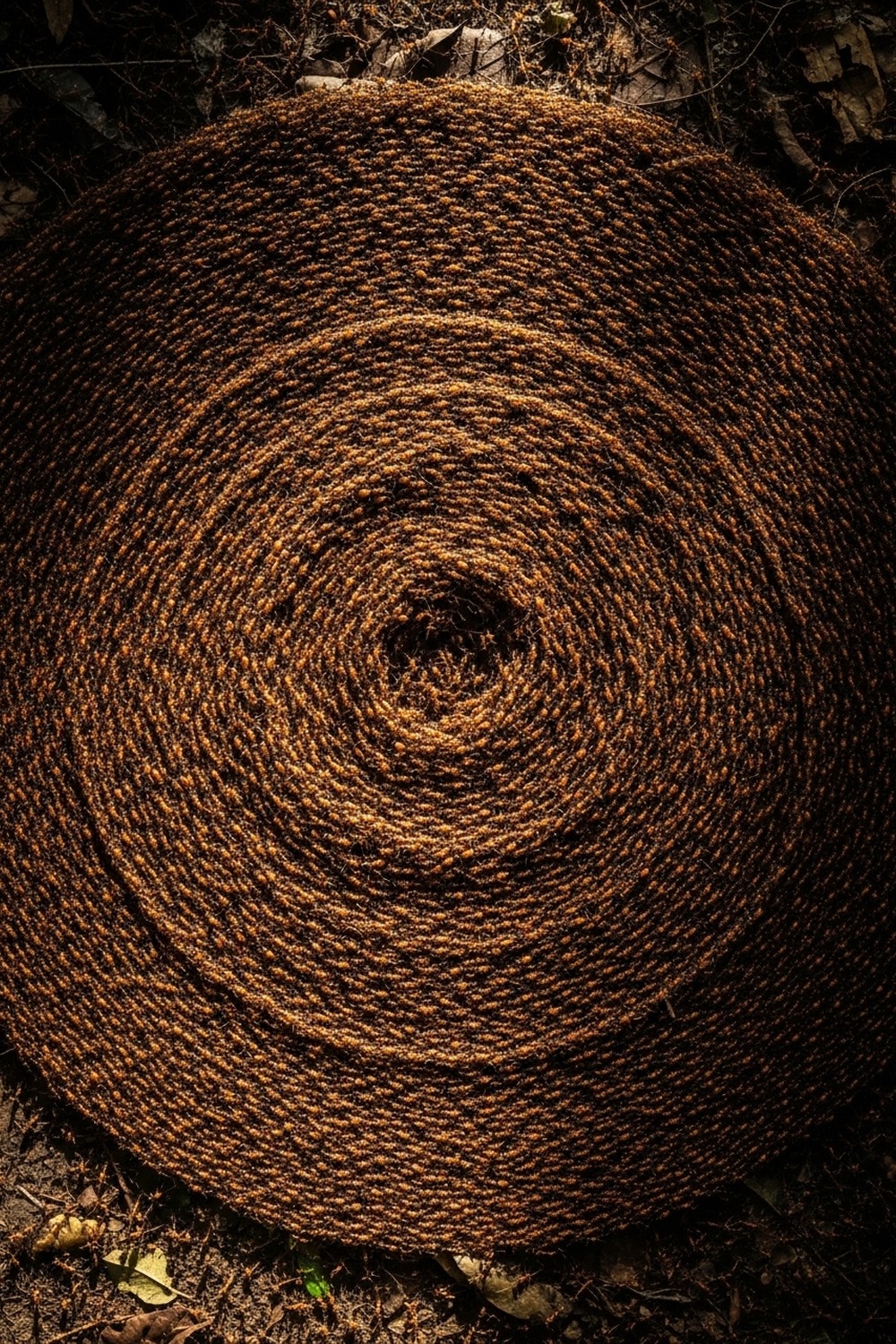
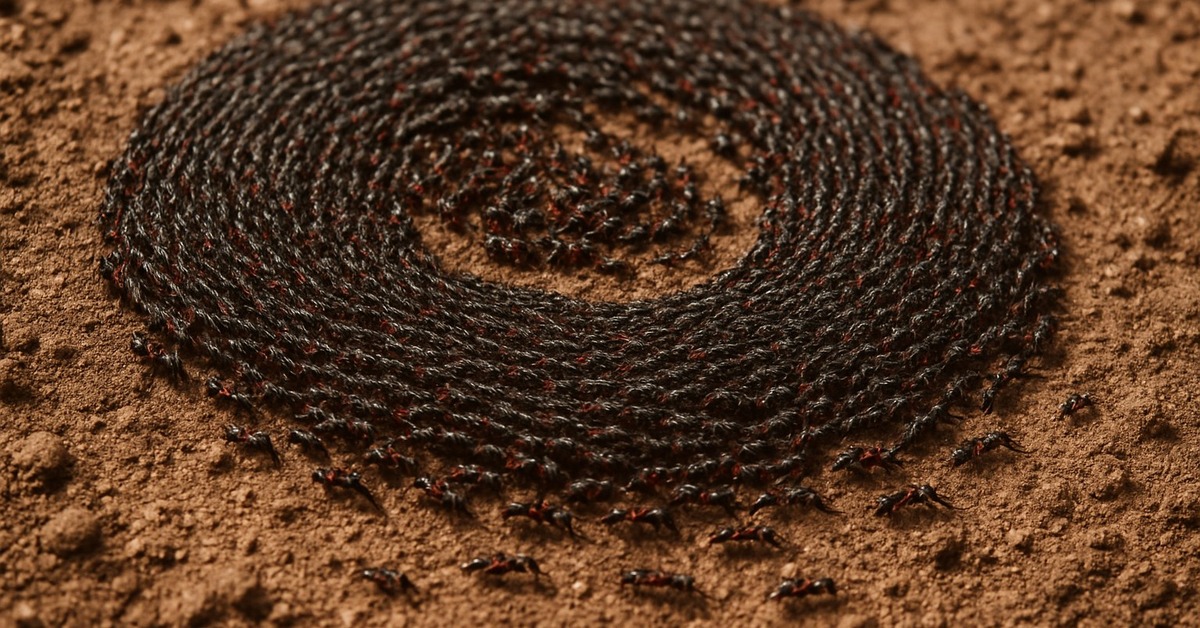
The lead ant curves. Slightly at first. The ants behind follow, because following is the rule. The curve tightens. And eventually — and this is the part that’s hard to sit with — the head of the column walks directly into its own tail and the loop closes. Now every ant is following another ant that’s following another ant, all the way around a circle that has no start and no finish. The pheromone signal gets stronger with every pass. This is called an ant mill, and it is one of the most unsettling things in nature.
The Cruelest Part: The Ants Are Doing Everything Right
There’s no malfunction here. No sick ants, no panicking ants, no ants making bad decisions. They’re executing their behavioral code with complete fidelity — follow the pheromone, reinforce the trail, keep moving. Every single ant in that circle is doing exactly what it’s supposed to do.
The result is a collective death sentence.
Beebe measured one of these spirals himself. Circumference: roughly 365 meters. The ants took two and a half hours to complete a single lap. They’d been circling for days before he arrived, and most would keep circling until exhaustion killed them mid-stride. Swarm intelligence at this-amazing-world.com explores how group behavior creates both brilliance and catastrophe in the animal kingdom — and the army ant death spiral is one of the starkest examples of that second category.
That last detail kept me reading for another hour. Days. They’d been at it for days.
The Size of These Spirals Will Catch You Off Guard
Most people picture a small, confused cluster. Reality is considerably worse.
Documented army ant death spirals have pulled in hundreds of thousands of individuals, forming slow-rotating discs that stretch across significant patches of forest floor. The spiral doesn’t stay at the edges of the colony — it can consume the entire foraging force, leaving the queen and her brood with no workers returning, no food coming in. And the mechanism feeds itself: the pheromone trail grows stronger with every lap, not weaker. The longer it runs, the harder it becomes to escape.
Some spirals have persisted for over 24 hours. Ants dying mid-loop, being walked over by the ants behind them, the circle barely breaking stride. The pheromone of the dead adds to the trail of the living. The spiral compounds.
The Escape Clause That Almost Never Triggers
There actually is a way out. Occasionally, random variation in individual ant behavior introduces just enough noise to crack the loop — an ant drifts slightly off the inner edge, a gap opens, and the column, given a fraction of an exit, begins to unravel. Researchers studying swarm dynamics have found that the same randomness that sometimes causes the spiral can, rarely, also dissolve it.
It’s not intelligence. It’s statistical luck.
In most documented cases, that luck doesn’t arrive. The pheromone signal becomes so dense that no individual deviation is strong enough to break the feedback loop. What started as a small navigation error becomes, effectively, a chemical prison — walls too thick for any single ant to notice, let alone climb.
By the Numbers
- Beebe’s 1921 spiral: 365 meters around, two and a half hours per lap.
- A single Eciton burchellii colony can contain up to 700,000 workers — meaning a death spiral can trap a significant fraction of an entire colony’s foraging force simultaneously, with no workers returning to the queen and brood.
- Some spirals have persisted more than 24 consecutive hours.
- Army ants travel at up to 20 meters per hour during normal foraging; inside a spiral, that same speed becomes the mechanism of confinement — all movement, no direction, the energy of navigation turned inward on itself.
Field Notes
- Army ants are functionally blind. Most species have heavily reduced eyes or none at all — the entire navigational system that creates death spirals runs on chemical signals, not sight. They can’t see the circle they’re trapped in.
- Pheromone trails are species-specific, so two colonies won’t accidentally redirect each other. But that also means there’s no external chemical signal capable of interrupting a death spiral once it’s established. Nothing from outside can break in.
- Computer models have reproduced ant mill dynamics using surprisingly simple rule sets — just a few behavioral parameters and the right feedback conditions. No complexity required. Catastrophic collective failure turns out to need very little to get started.
What an Ant Spiral Tells Us About Ourselves
The army ant death spiral has become a genuine reference point in complexity science — not because ants are dramatic, but because the mechanism is so stripped down and so weirdly universal. Locally rational behavior producing globally catastrophic outcomes. Turns out that dynamic isn’t unique to insects.
Traffic jams work on a version of it. So do financial panics, social media feedback loops, certain kinds of organizational collapse. Everyone following the rules. Nobody doing anything wrong. The system eating itself anyway.
Which raises the obvious question — if no one’s making an error, how do you stop it? And the honest answer, at least for the ants, is: mostly you don’t. The spiral forms because no individual ant can see the whole circle. You’d need a vantage point above the loop to know you’re in one. The ants don’t have that.
Sometimes neither do we.
That’s what makes this story stick around after you’ve closed the tab. It’s not really about ants. It’s about what happens when a system is working perfectly and that’s exactly the problem. There’s more at this-amazing-world.com — and the next one is stranger than this.
Frequently Asked Questions
Q: What causes an ant death spiral to form?
Army ants of Eciton burchellii navigate by following pheromone trails left by the ant ahead and reinforcing them as they walk. When the front of a column loses contact with the main trail, the lead ant begins to curve. The ants behind follow because following is the rule, the curve tightens, and the head of the column eventually walks into its own tail. The pheromone signal then strengthens with every lap, locking the loop in place.
Q: Can the ants escape a death spiral?
Occasionally, yes. Random variation in individual ant behavior sometimes introduces enough noise to crack the loop — a single ant drifts off the inner edge, a gap opens, and the column unravels. Researchers studying swarm dynamics have shown that the same randomness that creates spirals can also rarely dissolve them. In most documented cases, however, the pheromone trail becomes so dense that no individual deviation is strong enough to break the feedback loop before exhaustion kills the workers.
Q: How long can a death spiral last?
Some documented spirals have persisted for more than 24 consecutive hours. William Beebe’s 1921 spiral in Guiana had been rotating for days before he arrived. Ants die mid-stride from exhaustion, are walked over by the ants behind them, and the pheromone of the dead adds to the trail of the living, compounding the signal. The cruelest part, as researchers note, is that every individual ant is executing its behavioral program with complete fidelity until it collapses.
Q: Why can’t outside ants or signals break the spiral?
Pheromone trails are species-specific, so two ant colonies will not accidentally redirect each other, but that same specificity means no external chemical signal can interrupt a spiral once it is established. Eciton burchellii are also functionally blind — most species have heavily reduced eyes or none at all — so they cannot see the circle they are trapped in. The entire navigational system runs on chemistry, and nothing outside that chemistry can intervene.
Illustrations are AI-generated. Article fact-checked and human-edited. Our editorial standards.