A New Island Rose From the Pacific in Just 11 Hours
Eleven hours. That’s how long it took for Home Reef to go from invisible to undeniable — from a seamount lurking 150 kilometers northeast of Tonga to an actual island, one acre of brand-new earth rising through the Pacific on September 10, 2022. The Home Reef volcanic island Tonga 2022 eruption didn’t simmer. It didn’t announce itself. Geology doesn’t wait for permission, and neither did this.
What made this particular moment extraordinary was the documentation. Before Home Reef, before the satellites got good enough and the network tight enough, volcanologists watched islands emerge through reports that arrived days late — ship logs, aerial surveys, second-hand accounts. This time, Planet Labs satellites were overhead within hours. NASA’s Operational Land Imager caught the plume. Tonga Geological Services detected the seismic signature almost instantly. The volcano was performing, and the world was watching in real-time.
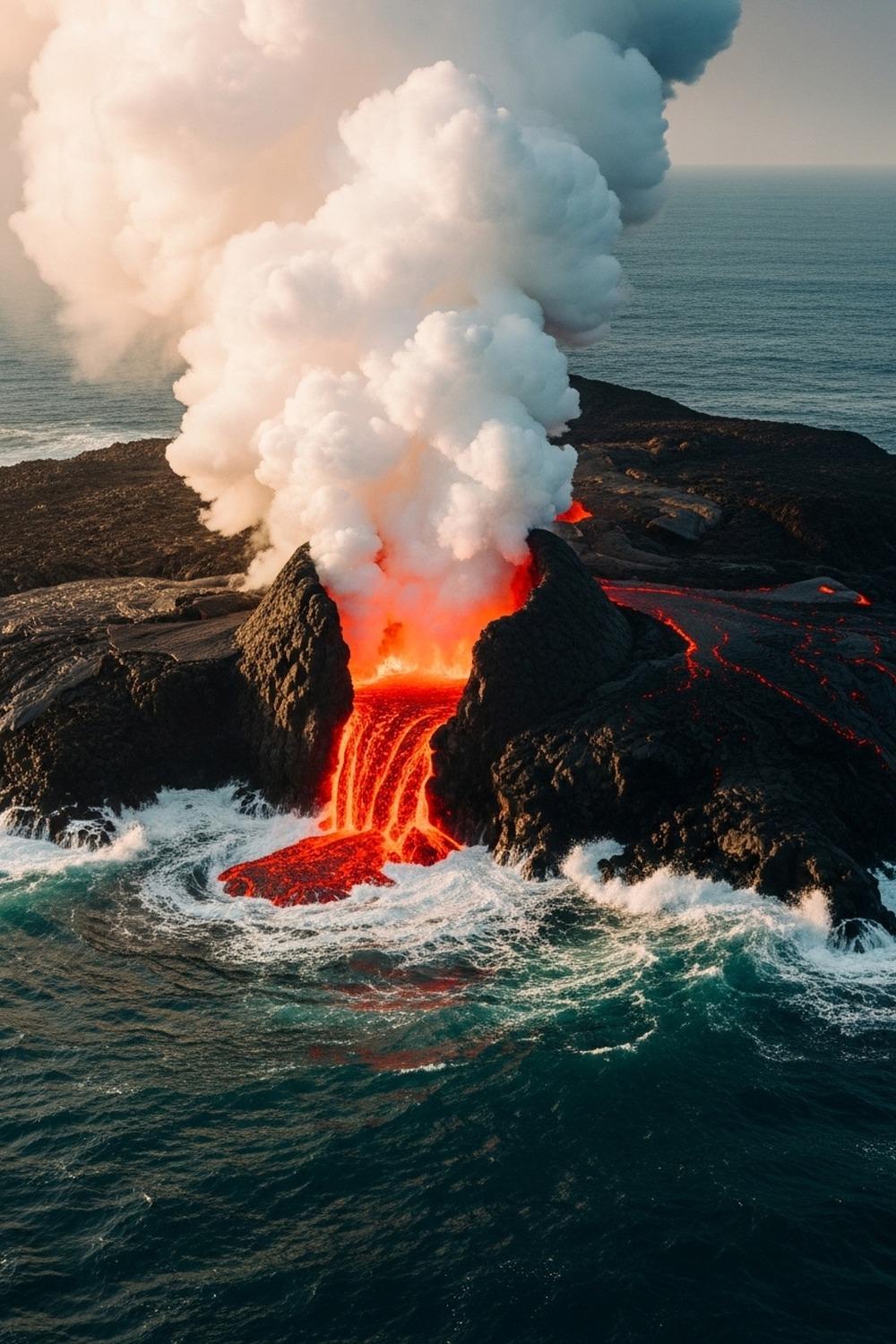
The island measured roughly one acre at birth.
Within days, it was pushing past eight. Scientists staring at satellite feeds couldn’t quite believe what the data was showing them. What, exactly, does a brand-new piece of Earth look like from the inside?
Key Facts
- Home Reef erupted on September 10, 2022, forming an island in roughly 11 hours northeast of Tonga
- The island measured about one acre at birth and grew past 8 acres within a week
- Home Reef sits on the Tonga-Kermadec subduction zone, where the Pacific Plate subducts at about 24 centimeters per year
- The 2022 island reached an estimated maximum elevation of about 10 meters above sea level
- Home Reef previously erupted in 1984 and 2006, each time producing a temporary island that eroded away
In short: The Home Reef volcanic island emerged near Tonga in roughly 11 hours on September 10, 2022, growing from one acre to over 8 acres within a week. Captured in unprecedented daily detail by Planet Labs satellites, it offered scientists a real-time view of how a new island is born and eroded.
How Home Reef Island Erupted Into Existence
Sitting along the Tonga-Kermadec subduction zone, about 150 kilometers northeast of the Ha’apai island group, Home Reef has erupted multiple times in recorded history — 1984, 2006, and now 2022. Each eruption produced a temporary island. Each time, the ocean took it back. The subduction zone itself is one of the most geologically violent corridors on the planet. Here, the Pacific Plate dives beneath the Australian Plate at a rate of roughly 24 centimeters per year — fast by tectonic standards — generating earthquakes, spawning deep-ocean trenches, and feeding a chain of undersea volcanoes. The Tonga-Kermadec subduction zone stretches more than 2,500 kilometers and hosts some of the deepest trenches on Earth.
When Home Reef lit up again on September 10, 2022, the mechanism was straightforward in principle — lava erupts from a vent, cools against seawater, and builds up layer by layer until the accumulated pile breaks the surface. But the speed here was extraordinary. Most seafloor volcanic features spend months or years making that same climb. Home Reef’s vent was prolific enough to compress the timeline into a single working day. Tonga Geological Services detected the activity almost immediately.
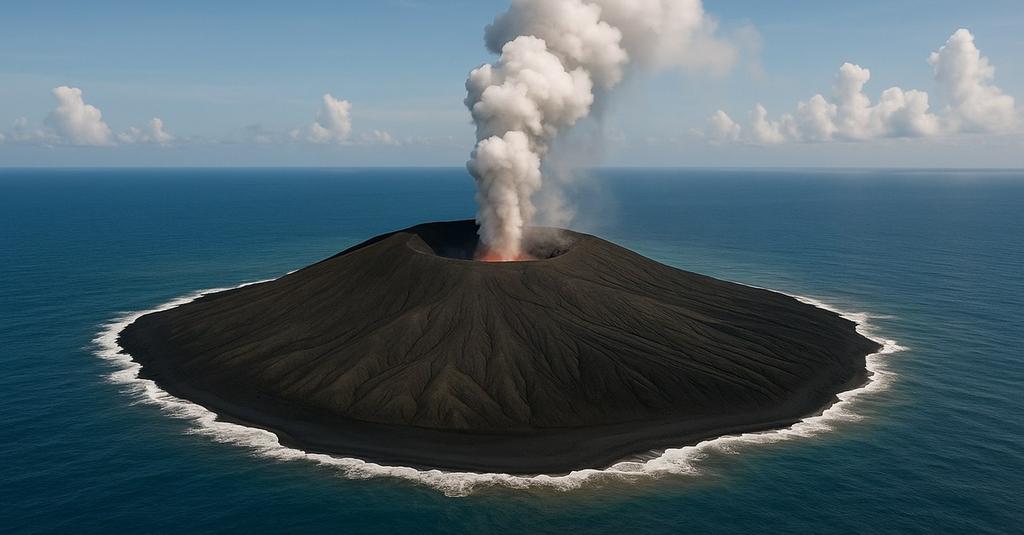
Early satellite measurements put the initial landmass at approximately one acre. Within a week, continued eruptions had expanded it to more than eight acres, with elevation reaching nearly ten meters at its highest point. The water surrounding the newborn island turned a vivid turquoise-yellow from sulfur and volcanic minerals leaching into the sea. Pumice rafts — floating islands of porous volcanic rock — spread across the surrounding ocean, some thick enough to slow passing boats. It’s the kind of detail that makes plate tectonics suddenly, viscerally concrete.
What Happens When a New Island Is Born
A newborn volcanic island is essentially geology caught performing in public. Sharp lava rubble. Hot ash compacted into fragile layers. Surfaces so unstable that the ocean immediately begins the work of dismantling what the volcano just built. There’s no crust weathered smooth by time, no soil laid down over millennia. Scientists at the Smithsonian Institution’s Global Volcanism Program describe these emergent islands as among the most dynamic landforms on Earth — not because they’re growing, but because they’re simultaneously growing and eroding from the moment they appear.
It’s a race.
And watching a species of landform disappear at this speed, you stop calling it an anomaly — you start asking what it tells us about how Earth actually works, not how we imagine it should.
The erosion process begins immediately and works from every direction at once. Wave action attacks the island’s flanks. Storm surges overtop the lowest sections. Rain, paradoxically, accelerates breakdown by saturating the loosely compacted ash layers until they slump. Researchers watching via satellite noted something else: the island’s shape changed almost daily in its early weeks. Lobes of fresh lava extended seaward, then retreated as wave action undercut them. It wasn’t a stable landform. It was a negotiation — between volcanic output and oceanic force — playing out in public.
The Smithsonian’s Global Volcanism Program documented this pattern in detail after Home Reef’s 2006 eruption produced an island that reached its peak size within two weeks before shrinking steadily for months. By 2008, it had largely vanished below the waterline. The 2022 island appeared to follow a similar initial growth curve — satellites tracked its expansion in near-real-time — though its longer-term fate depended heavily on whether eruptions continued feeding material faster than erosion could strip it away.
The Long History of Islands That Appear and Vanish
Home Reef isn’t an anomaly. The Pacific’s volcanic arcs have been producing temporary islands for as long as anyone has been paying attention — and probably for millions of years before that. Most famous among recent examples: Hunga Tonga-Hunga Ha’apai, another Tongan volcano that erupted in 2014 and 2015 to produce an island that volcanologists initially expected would disappear within months. It didn’t. By 2017, geologists from NASA’s Jet Propulsion Laboratory were calling it one of the most stable young volcanic islands ever documented outside of Hawaii, with a consolidated tuff cone structure that suggested it might persist for decades. Then, in January 2022 — just months before Home Reef’s eruption — Hunga Tonga-Hunga Ha’apai exploded in one of the most powerful volcanic events in recorded history, erasing the island almost entirely and sending a tsunami across the Pacific. National Geographic’s coverage of that eruption documented how dramatically a young island’s story can reverse in a matter of hours.
Why does the Home Reef volcanic island Tonga 2022 case matter so much beyond its spectacle? Because here’s the thing: it’s the opportunity it offers. Each new island in this arc is a slightly different experiment — different vent depth, different lava composition, different wave exposure, different rate of eruption. By comparing how each one evolves, researchers build models of island longevity that simply couldn’t exist without repeated natural trials. The 2022 eruption gave the Global Volcanism Program a fresh data set to set alongside 1984, 2006, and everything in between.
There’s a counterintuitive implication buried in all of this. The temporary islands of the Tonga arc aren’t failures. They’re contributions — each one depositing material on the seafloor, raising the seamount’s cumulative elevation slightly, incrementally improving conditions for the next eruption to last a little longer. The ocean wins most individual rounds. But the volcano is playing a longer game.
What the Home Reef Volcanic Island Reveals About Earth’s Edge
Complete documentation changed everything about how we understand this eruption. Planet Labs, a commercial satellite operator that maintains a constellation of small Earth-imaging satellites, captured daily imagery of Home Reef’s emergence and early growth at a resolution that simply wasn’t available during previous eruptions in 1984 or 2006. The University of Auckland’s School of Environment was able to combine those satellite images with seismic data to reconstruct the eruption timeline in granular detail. Researchers could watch individual lava flow lobes extend and retract in near-real-time — something that had previously required expensive ship deployments or aerial surveys that often arrived after the most dramatic changes had already occurred.
Rather than building uniformly, Home Reef’s 2022 island grew in distinct pulses. Those pulses correlated with heightened seismic activity detected by monitoring stations in Tonga and Fiji, suggesting that the vent’s output wasn’t continuous but episodic, fed by discrete surges of magma from depth. The data revealed a pattern that wasn’t obvious from earlier eruptions — periods of rapid expansion, sometimes adding measurable area within a single 24-hour window, followed by relative pauses. When the surges came hard, the island grew. When they eased, erosion gained ground. The final size of the island was a function of how many surges arrived and how well the accumulated material held together under wave stress.
Tonga Geological Services scientists worked with satellite operators to prioritize imaging passes over the site during peak activity. That coordination — between a small Pacific island nation’s geological authority and a commercial satellite company — produced a monitoring record that researchers will be analyzing for years, and it changed how real-time volcanic island monitoring is likely to be handled going forward.
Survival Odds and What Comes After
Of the temporary islands that have emerged here over the past two centuries along the Tonga-Kermadec arc, the vast majority vanished within one to three years. Home Reef’s 1984 island lasted slightly longer before erosion claimed it. The 1995 eruption of Metis Shoal, another vent on the same arc, produced an island that peaked at roughly 200 meters in length before disappearing within months. Only a handful of islands generated by subduction-zone eruptions globally have ever consolidated into permanent landmasses — and most of those required either exceptional lava volume, a protected position from dominant wave directions, or both. The historical record isn’t encouraging when you’re trying to predict longevity.
By late 2022 and into 2023, satellite monitoring showed the Home Reef volcanic island Tonga 2022 landmass had already begun shrinking from its peak. The eruption’s main feeding pulse appeared to have subsided, and without fresh lava replenishing the flanks, wave erosion was steadily reducing the island’s footprint. This isn’t surprising. It’s the default outcome.
But it doesn’t mean the event is scientifically over. Underwater, the material deposited during the eruption remains — raising the seamount’s summit slightly closer to the surface than it was before September 10, 2022. Each eruption is a down payment on the next one. Biologists are tracking something unexpected alongside the geology. Within weeks of the 2022 island’s emergence, seabirds were landing on it — using fresh lava rock as a resting platform, leaving behind organic material that represents the very earliest stage of island colonization. A barren rock, steam still rising from its flanks. A bird lands. The biology clock starts. It’s a process that normally plays out over decades on older islands. Here, researchers could watch it begin from day one.
How It Unfolded
- 1984 — Home Reef seamount erupted and produced a temporary island along the Tonga-Kermadec arc, one of the first documented modern emergences at this site.
- 2006 — A second major eruption generated a new island at Home Reef that reached peak size within two weeks before wave erosion steadily dismantled it over the following two years.
- January 2022 — The nearby Hunga Tonga-Hunga Ha’apai volcano erupted catastrophically, one of the most powerful atmospheric events in recorded history, destroying an island that had been considered surprisingly stable since 2015.
- September 10, 2022 — Home Reef erupted again, producing a new island in approximately 11 hours, with Planet Labs satellites capturing its growth at daily resolution for the first time in the site’s recorded eruption history.
By the Numbers
- 11 hours — the approximate time between eruption onset and confirmed island emergence above sea level on September 10, 2022 (Tonga Geological Services / NASA imaging data)
- 8+ acres — the island’s peak estimated surface area, reached within approximately one week of the initial eruption
- 2,500+ kilometers — the length of the Tonga-Kermadec volcanic arc, one of Earth’s most seismically active subduction zones
- 24 centimeters per year — the rate at which the Pacific Plate subducts beneath the Australian Plate along this arc, roughly 3× faster than the global average for major subduction zones
- ~10 meters — the estimated maximum elevation the 2022 Home Reef island reached at its highest point above sea level during peak eruption activity
Field Notes
- Pumice rafts generated by the 2022 eruption were thick enough to measurably slow maritime vessel speeds in surrounding waters — some individual rafts extended hundreds of meters in length and were tracked drifting westward by satellite for weeks after the eruption subsided.
- The seawater surrounding the island turned a striking turquoise-yellow within hours of emergence — a color signature of sulfur dioxide and iron compounds leaching from fresh volcanic material, visible clearly in NASA’s Operational Land Imager satellite imagery.
- Seabirds were documented landing on the new island’s surface within days of its appearance — representing one of the most rapid colonization events ever directly observed on a volcanically emergent landmass, with researchers able to track this via satellite before any ship reached the site.
- Scientists still can’t reliably predict how long any individual Tonga-Kermadec emergent island will survive. The factors that determined Hunga Tonga-Hunga Ha’apai’s unusual durability between 2015 and 2022 remain only partially understood — and its destruction in January 2022 happened faster than any model had suggested was likely.
Frequently Asked Questions
Q: What caused the Home Reef volcanic island Tonga 2022 to form so quickly?
Speed came down to eruption intensity. Home Reef’s September 2022 eruption produced an unusually high-volume pulse of lava and fragmented volcanic material from a vent that sits in relatively shallow water — close enough to the surface that material didn’t have far to travel before accumulating above the waterline. Eleven hours is extraordinarily fast even by volcanic island standards, and it reflects how prolific the initial eruptive phase was before any significant slowdown occurred.
Q: Is the Home Reef island still there?
As of monitoring data extending into 2023, the island had shrunk considerably from its peak size following the subsidence of the main eruption pulse. Wave erosion works quickly on ash-and-lava landforms that haven’t had time to consolidate. The seamount itself remains beneath the surface and will almost certainly erupt again — it’s done so repeatedly over recorded history. Whether any surface landmass persists long-term depends entirely on whether future eruptive activity resumes before erosion finishes the job.
Q: Do volcanic islands like this one ever become permanent?
Most don’t — but some do. The Hawaiian Islands began exactly this way, built over millions of years by repeated eruptions over a stationary hotspot beneath the Pacific Plate. Along subduction zones like the Tonga-Kermadec arc, permanent island formation is far rarer because eruptions tend to be explosive rather than effusive, producing loosely consolidated material that erodes quickly. True permanence requires either enormous lava volume, a sheltered position from wave attack, or decades of repeated eruptions that progressively harden and raise the underlying structure.
Editor’s Take — Alex Morgan
What strikes me most about the Home Reef story isn’t the eleven hours — it’s the seabirds. Within days of that island’s existence, something landed on it. Organic material hit bare volcanic rock. A biological process that normally takes decades on an established island began from a standing start, in real time, watched by satellites. We tend to think of colonization as something that happens slowly, in the background, invisible. Home Reef 2022 showed it happening on a Tuesday. That’s the part I can’t stop thinking about.
Every few years, the Pacific reminds us that the planet’s surface isn’t finished — that new geography can appear between breakfast and dinner on an otherwise unremarkable September morning. Home Reef will likely disappear again, swallowed back by the same ocean that tried to stop it from rising. But the seamount beneath it will be fractionally taller for the effort, fractionally closer to the surface, fractionally more ready for the next attempt. How many times has this exact scenario played out, unseen, in the deep ocean before anyone had a satellite overhead to notice?
“
Illustrations are AI-generated. Article fact-checked and human-edited. Our editorial standards.