He Took the Impact So She Wouldn’t: Andre’s Miracle
A ten-year-old boy in Philadelphia had maybe two seconds to decide whether his sister lived or died. He didn’t think about it. That’s what keeps neurologists up at night — not the surgery that followed, but the choice that came before.
Plane debris doesn’t announce itself. One moment Andre Howard and his little sister are standing in a residential neighborhood on an ordinary afternoon. The next moment there’s metal in the air and Andre’s doing the math in real time: his body or hers. He puts himself between her and whatever’s coming. The metal finds him instead. What happens in the first sixty minutes after that — and I mean the first sixty minutes — determines whether he ever has another ordinary afternoon again.
Key Facts
- Roughly 837,000 children visit U.S. emergency departments each year with traumatic brain injuries, the leading cause of pediatric ER visits (CDC, 2022).
- Severe pediatric TBI with a Glasgow Coma Scale of 8 or below carries a mortality rate between 10% and 30%.
- Neurosurgeons describe a 60-minute ‘platinum window’ in which reaching an operating room can shift survival odds by roughly 40%.
- Traumatic brain injury is the leading cause of death and disability in children under 14 (National Institute of Neurological Disorders and Stroke).
- The youngest recorded patient to undergo decompressive craniectomy and regain full cognitive function was 4 years old (Great Ormond Street Hospital, London, 2019 case study).
In short: Child traumatic brain injury survival often hinges on a 60-minute ‘platinum window’ that neurosurgeons say can shift outcomes by about 40%. When ten-year-old Andre Howard shielded his sister from plane debris, the metal struck him instead, and the speed of his care determined whether he would ever recover fully.
Child Traumatic Brain Injury Survival: The Window Nobody Talks About
Neurosurgeons call it the platinum window. Not hours. Sixty minutes. Get a kid with a severe head injury into an operating room inside that window and survival odds shift by forty percent. Miss it and the brain swelling does its own surgery — the kind that doesn’t end well.
When metal strikes a skull, the brain doesn’t just bruise. It swells. It bleeds. Pressure builds in a closed space with nowhere to go. According to the National Institute of Neurological Disorders and Stroke, traumatic brain injury is the leading cause of death and disability in kids under 14 — and pediatric brains respond to trauma in ways that still surprise the doctors who study them. Sometimes worse than adult brains. Sometimes with resilience that makes them stop taking notes and just stare. Dr. Ann-Christine Duhaime at Massachusetts General Hospital has spent decades documenting this. She knows the variables. But time? Time is the only one that matters when you’re counting minutes instead of hours.
The pressure cascade can become fatal faster than people realize.
What His Family Did in the Chaos
Andre’s family got him to care fast. That sentence sounds simple because we live in a world where things usually work out. But in a debris field — smoke, noise, panic, people running in different directions — someone kept their head. Scooped up a bleeding ten-year-old. Moved. Made a decision that took seconds but required the kind of clarity most people never find even when they have time to think.
Emergency surgeons opened his skull to relieve the pressure building inside. They didn’t know what they’d find on the other side of that procedure. One surgeon described it to a colleague later as “asking a question you won’t get the answer to until the patient wakes up.” If the patient wakes up.
That last part kept me reading for another hour.

The Numbers That Actually Matter
- Severe pediatric TBI — Glasgow Coma Scale of 8 or below — carries a mortality rate between 10% and 30% depending on injury type and how fast care arrives. Survival isn’t the whole story though.
- 837,000 children hit U.S. emergency departments each year with traumatic brain injuries (CDC, 2022). It’s the leading cause of pediatric ER visits.
- Cognitive outcomes. Motor function. Personality changes. Memory disruption. These follow even the kids who survive surgery.
- Children under 12 show measurably higher neuroplasticity than adults with identical injuries — undamaged regions sometimes take over lost functions, a phenomenon rarely seen after age 25.
- The youngest recorded patient to undergo decompressive craniectomy and regain full cognitive function was 4 years old (Great Ormond Street Hospital, London, 2019 case study).
His First Words
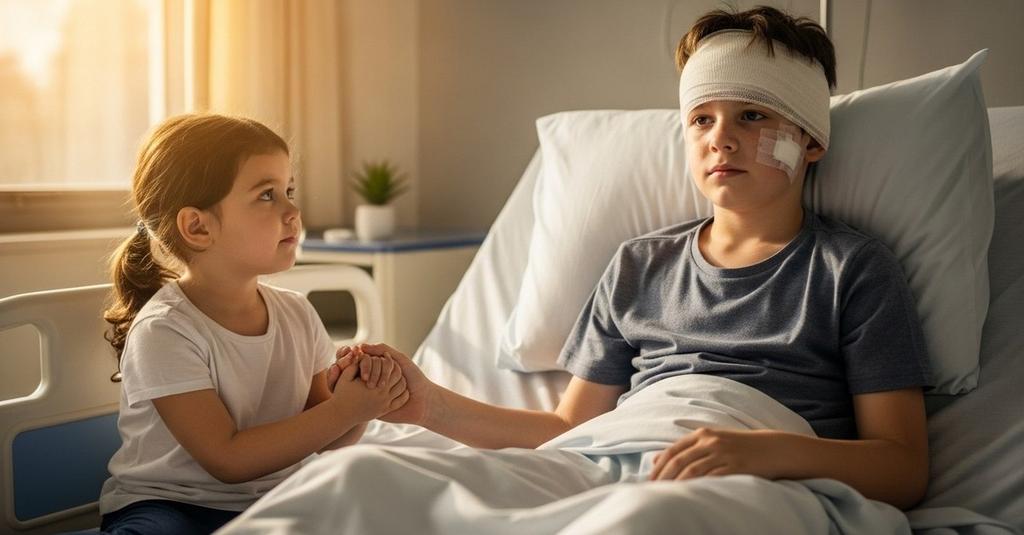
Here’s the thing about what Andre said when he woke up. He didn’t ask about pain. He didn’t fragment into the confused, disconnected language that sometimes comes after brain trauma. He asked if his sister was okay. Clear. Purposeful. Directed at someone else before he even oriented himself to where “he” was.
She was okay.
Because of him.
The medical staff present described his response as calm — like he’d been holding his breath waiting for that specific answer, and only then did he allow himself to rest. There’s clinical language for neurological recovery patterns. There’s no clinical language for that.
Field Notes
- Psychologists studying protective instinct in children found that kids as young as 7 will shield younger siblings during threat scenarios — even when it increases their own risk. The behavior activates before conscious reasoning, suggesting it’s wired deeper than decision-making.
- Something researchers call “social activation” — the presence of familiar voices and faces in hours after injury — dramatically influences the brain’s recovery ability. Hospitals with immediate family bedside access post-surgery document faster consciousness recovery than restricted visiting policies allow.
- Plane crash debris produces a specific injury profile. Metal fragments carry unpredictable combinations of blunt and penetrating force. The same piece of debris can glance off one person and fracture a skull on the next. Andre’s survival wasn’t just medicine. It was geometry.
Why This Story Doesn’t Fit the Pattern
Most child traumatic brain injury survival stories get told around the medicine — the surgery, the odds, the recovery timeline. The neuroscience gets the attention. And it should. But what makes Andre different isn’t what doctors did in an operating room. It’s that the injury happened because he chose it.
A ten-year-old made a calculation in less than a second: his sister’s safety was worth whatever came next. He didn’t know what was coming. He just knew she shouldn’t take it alone.
Researchers who study protective behavior in crisis situations struggle to explain why some people act and others freeze. Age matters. Training matters. Threat familiarity matters. Andre had none of those advantages. He had a little sister standing next to him and a fraction of a second. He decided.
The cost was enormous.
He paid it anyway.
Andre walked out of that platinum window — the one pediatric neurosurgeons say determines everything. His sister walked with him, unhurt. Some stories don’t need to be explained. A boy. A piece of metal. A choice that took less than a second and changed two lives permanently. If this kind of story stays with you, there’s more like it over at this-amazing-world.com. The next one is even stranger.
“
Frequently Asked Questions
Q: What is the ‘platinum window’ in child traumatic brain injury survival?
The platinum window is the first 60 minutes after a severe pediatric head injury. Neurosurgeons say getting a child into an operating room within that hour can shift survival odds by roughly 40%. After a skull is struck, the brain swells and bleeds inside a closed space, and pressure builds rapidly. Miss the window and that pressure cascade can become fatal faster than many people realize, which is why emergency response speed matters as much as surgical skill.
Q: How common are traumatic brain injuries in children?
Roughly 837,000 children visit U.S. emergency departments each year with traumatic brain injuries, according to CDC data from 2022, making TBI the leading cause of pediatric ER visits. It is also the leading cause of death and disability in children under 14, per the National Institute of Neurological Disorders and Stroke. Severe cases, defined by a Glasgow Coma Scale score of 8 or below, carry a mortality rate between 10% and 30% depending on injury type.
Q: Do children recover from severe brain injuries better than adults?
Children under 12 show measurably higher neuroplasticity than adults with identical injuries, meaning undamaged brain regions can sometimes take over functions lost to trauma, a phenomenon rarely seen after age 25. In one 2019 Great Ormond Street Hospital case study, the youngest recorded patient to undergo decompressive craniectomy and regain full cognitive function was just 4 years old. Recovery is never guaranteed, and outcomes still include risks to memory, motor function, and personality.
Q: Why does family presence matter after pediatric brain surgery?
Researchers describe a phenomenon called ‘social activation,’ where the presence of familiar voices and faces in the hours after injury measurably influences the brain’s recovery ability. Hospitals that allow immediate family bedside access after surgery document faster consciousness recovery than facilities with restricted visiting policies. This is why pediatric trauma teams increasingly prioritize getting parents and siblings to the bedside as soon as a child stabilizes following emergency neurosurgery.
Illustrations are AI-generated. Article fact-checked and human-edited. Our editorial standards.