Dolphins Make Bubble Rings — Then Critique Their Own Work
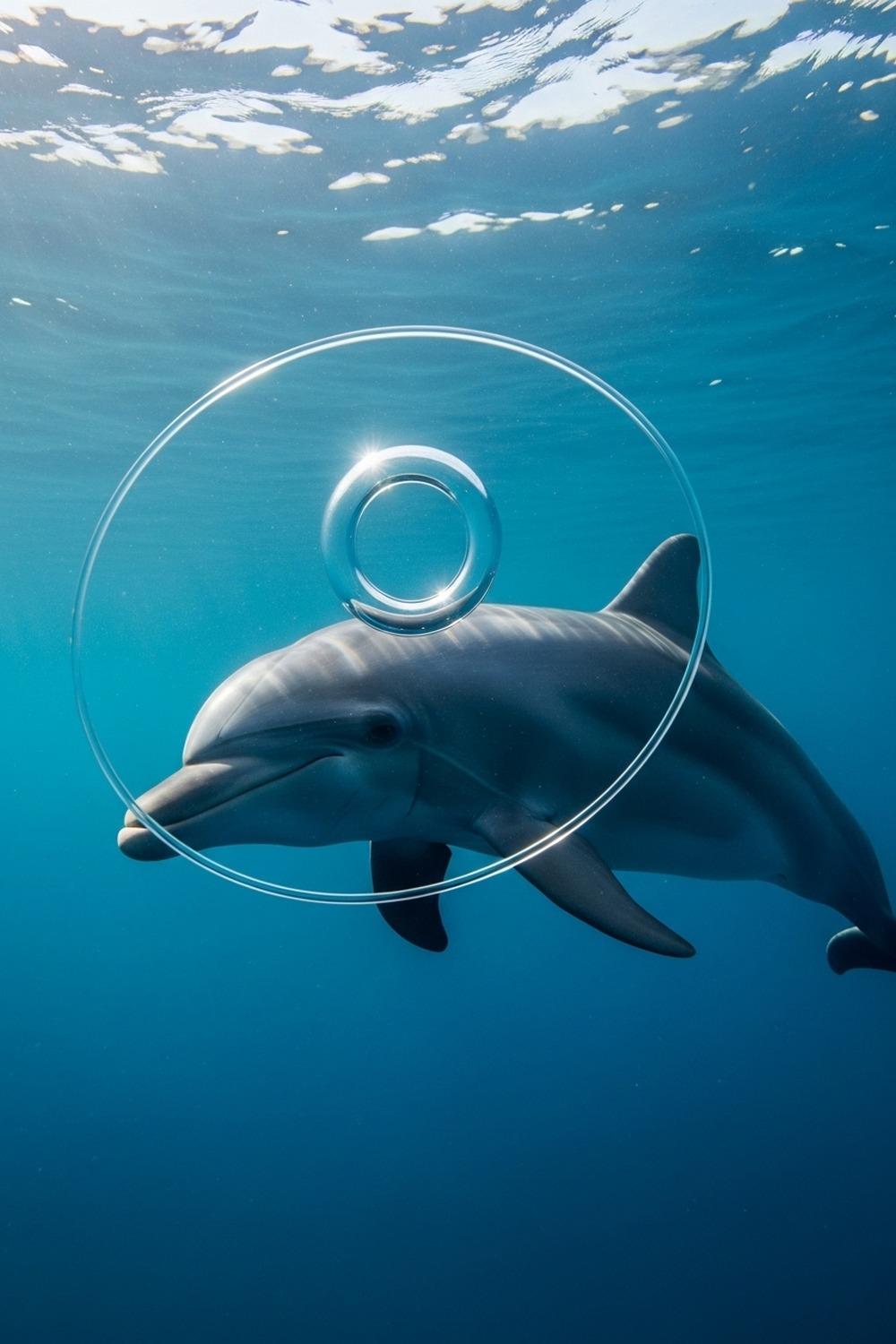
Here’s the thing: a dolphin produces a perfect torus of bubbles, circles it slowly, approaches from three different angles, and then — if the shape feels wrong — destroys it with a single calculated movement of its snout. That’s dolphins bubble rings behavior. Not reflex. Not accident. A marine animal, working against its own creation until the result satisfies something we can’t quite name.
The footage exists. Sea Life Park in Hawaii captured it in the late 1990s. The Dolphin Research Center in Grassy Key, Florida documented it systematically starting in 1995. Bottlenose dolphins in aquariums from Hawaii to the Mediterranean, and in open ocean off the Azores, have been filmed doing this for three decades. The behavior is voluntary. It’s playful. What unsettles marine biologists — what they’re still arguing about over field notes — is the self-correction. If a dolphin looks at a bubble ring and finds it unsatisfying, what exactly is it looking for?
Key Facts
- A dolphin-produced torus bubble ring can hover for up to 30 seconds before rising and breaking at the surface (Dolphin Research Center, 1995).
- The air burst must be released into the vortex within an estimated window of under 0.5 seconds for the ring to form correctly.
- UC Santa Cruz footage from 2003 captured a single dolphin executing 15 consecutive ring-splitting sequences at near-identical angles.
- Bottlenose dolphins are one of only 4 non-human species confirmed to pass the mirror self-recognition test, alongside chimpanzees, orangutans, and elephants (Reiss, 2001).
- The National Marine Mammal Foundation in San Diego began formal longitudinal correlations between bubble ring complexity and cognitive performance in 2015.
In short: Dolphins bubble rings behavior is the voluntary creation, inspection, and self-correction of toroidal air bubbles by bottlenose dolphins. They generate a water vortex, inject air within a sub-0.5-second window, then evaluate the result and dissolve rings that fall short, a self-monitoring pattern researchers have documented for over three decades.
How Dolphins Engineer Perfect Bubble Rings
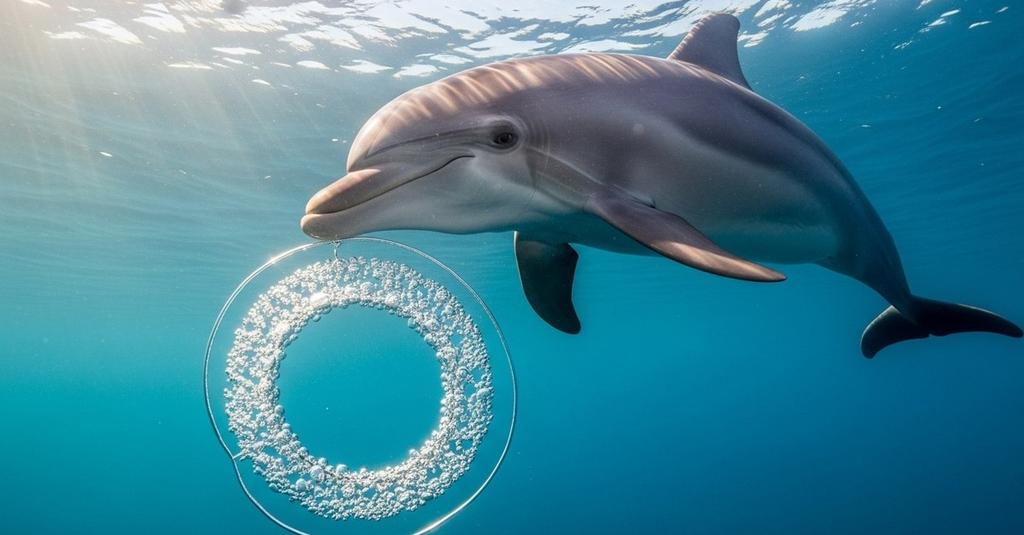
Start with the fin. A bottlenose dolphin drives its pectoral or dorsal fin in a tight spiral, generating a rotating column of water — a vortex ring — that persists in the surrounding fluid for several seconds. At precisely the right moment, the dolphin releases a controlled burst of air from its blowhole directly into the eye of that spinning column. The air doesn’t disperse. It wraps into the rotation and forms a torus — a donut-shaped bubble — that can hover in place for up to thirty seconds before slowly rising and breaking at the surface.
Researchers at the Dolphin Research Center in Grassy Key, Florida, began formally documenting dolphins bubble rings behavior in 1995, describing it as one of the most mechanically sophisticated spontaneous behaviors ever recorded in a cetacean outside of echolocation. What makes this genuinely strange is the precision required. The burst of air must hit the vortex column within a window that some estimates place at under half a second. Too early, and the bubbles scatter. Too late, and the rotation has dissipated.
The dolphins don’t appear to be taught this. Individuals in different facilities and different ocean basins have independently developed the same technique, which suggests they’re working out the physics themselves through play and iteration. Some individuals have also learned to inject air while swimming in a horizontal corkscrew, producing a silver helix instead of a torus. The shape lasts only a few seconds longer, but the dolphins return to it repeatedly — which suggests they notice the difference and prefer it.
The Critique: When a Ring Isn’t Good Enough
Here’s where the story gets genuinely uncomfortable for anyone who wants to keep a clean line between human cognition and animal behavior. Dolphins don’t just make bubble rings — they evaluate them. Trainers at Sea Life Park in Hawaii first documented this on video in the late 1990s: a dolphin would produce a ring, circle it slowly, approach from multiple angles, and then — if the shape was asymmetric or the torus was too thin — slice through it deliberately with its snout, dissolving it before starting over.
What changed in how we understood this behavior? Everything, starting around 2001.
The parallel to human creativity isn’t exact, and researchers are rightly cautious about over-interpreting it. But watching the footage is genuinely difficult to explain away. It rhymes, uncomfortably closely, with what happens when a sculptor crumples a failed sketch. It’s not entirely dissimilar to watching a golden retriever methodically sound out a word during a literacy session — both reveal a kind of focused, purposeful attention that our categories for animal intelligence struggle to contain. If you want to explore how non-human animals engage in surprisingly deliberate cognitive tasks, the research on dogs helping children read sits in the same territory — creatures applying sustained focus to achieve something that looks, from the outside, like it requires intent.
By angling its snout at a precise angle and striking the ring at the right moment in its rotation, a dolphin can divide a single large torus into two or three smaller, stable rings that then drift upward in formation. High-speed underwater camera footage from the University of California, Santa Cruz, captured in 2003, showed the same individual dolphin executing the split at near-identical angles across fifteen consecutive attempts — a repeatability that implies something closer to technique than chance. This isn’t random.
Not every dolphin develops this skill. Within a group, it tends to be held by a few individuals — and others have been documented watching those individuals, closely, before attempting their own versions weeks later. Social learning in cetaceans is well-established. But watching another animal to learn an aesthetic behavior is something different entirely.
What This Tells Us About Dolphin Cognition
Bubble ring play sits within a broader scientific conversation about animal self-awareness and executive function — and it keeps arriving at inconvenient conclusions. Diana Reiss, a cognitive psychologist at Hunter College in New York who has spent decades studying cetacean intelligence, published research in 2001 showing that bottlenose dolphins pass the mirror self-recognition test, recognizing their own reflections rather than treating the image as another animal. That finding placed dolphins in a very small group — chimpanzees, orangutans, elephants, and humans — capable of understanding that a reflection is themselves.
And what that meant for everything that came after was profound. The Smithsonian Magazine’s overview of dolphin intelligence research traces how that 2001 result changed the framing of subsequent studies, shifting emphasis from “can dolphins learn commands” to “do dolphins have an internal model of themselves.” The dolphins bubble rings behavior fits squarely into that second framework. A dolphin that evaluates its own output against an internal standard — and acts on that evaluation — is doing something that requires a self to refer back to.
The counterintuitive part is how casual it all looks. These aren’t behaviors elicited by reward systems or training protocols. Dolphins do this spontaneously, during what can only be described as leisure time. They’re not hungry. They’re not being observed in ways that would trigger anxiety or performance. The rings appear to be made for the pleasure of making them — and corrected because the result didn’t match whatever template the dolphin was working from. That template, wherever it lives in a dolphin’s brain, is one of the more mysterious objects in all of cognitive science. It also complicates the standard narrative about play in animals. Play is usually framed as practice — rehearsal for hunting, fighting, or social bonding.
But bubble ring behavior doesn’t obviously rehearse anything. It’s not a predation skill. It doesn’t clearly strengthen social bonds. It appears to exist for its own sake, which is a much harder category for evolutionary biology to explain. Watching a species devote cognitive resources to something functionally useless, you stop calling it instinct.
Dolphins Bubble Rings Behavior: What Researchers Still Don’t Know
The honest answer is that the neural mechanism behind this remains almost entirely opaque. A 2019 study from the University of Chicago’s comparative neuroscience group examined MRI data from bottlenose dolphin brains — specifically the anterior insular cortex, which in humans is associated with aesthetic experience and self-monitoring — and found a level of cellular complexity and folding comparable to great apes. The study stopped well short of claiming dolphins have aesthetic experience in any human sense, but it noted that the architecture for that kind of processing appears to be present. What researchers can’t yet establish is whether bubble ring evaluation and reconstruction activates those regions, because inserting dolphins into fMRI machines while they’re playing in water remains, for obvious logistical reasons, beyond current capability.
Individual variation adds another layer of complexity. Not all bottlenose dolphins develop bubble ring creation, and among those that do, skill levels vary enormously. In a 2007 observational study conducted at Marineland Antibes in France, researchers noted that one female dolphin produced rings with a consistency and precision far exceeding the others in her group — and that younger dolphins spent significantly more time in proximity to her than to the males who also produced rings, but less reliably. This suggests taste, or at least preference, operates within the group. Some rings are recognized as better. Some makers are worth watching. The researchers conducting these observations reported finding something unexpected: the younger dolphins weren’t just watching. They were studying technique.
Since 2015, researchers at the National Marine Mammal Foundation in San Diego have been attempting to correlate bubble ring complexity with other cognitive measures — problem-solving speed, mirror test performance, tool use — and the preliminary correlations are positive but not yet statistically robust enough to publish. The work continues. In the meantime, the dolphins keep making rings, studying them, and dissolving the ones that don’t pass whatever internal test they’re running.
Where to See This
- Hawaii Institute of Marine Biology, Kāneʻohe Bay, Oʻahu — one of the longest-running facilities documenting spontaneous dolphin play behavior, including bubble ring formation, best observed during non-public research sessions open to registered educators and scientists (year-round access, contact HIMB directly).
- The Dolphin Research Center in Grassy Key, Florida, USA, offers structured observation programs and has permitted academic researchers to film bubble ring behavior since the mid-1990s — their website at dolphins.org includes research access inquiries.
- For the deepest available footage without travel, the Cetacean Society International’s video archive and the BBC Earth YouTube channel both hold high-resolution underwater sequences showing the torus formation, splitting, and self-correction behavior in real time.
How It Unfolded
- 1990: Trainers at Sea Life Park in Hawaii first notice bottlenose dolphins producing bubble rings spontaneously during unsupervised pool time — not in response to any training cue.
- 1995: The Dolphin Research Center in Grassy Key begins systematic video documentation, capturing the vortex-injection technique on underwater camera for the first time.
- 2001: Diana Reiss publishes mirror self-recognition results for bottlenose dolphins, reframing bubble ring behavior as potential evidence of self-monitoring rather than simple play.
- 2019: University of Chicago comparative neuroscience study identifies high-complexity folding in the bottlenose dolphin insular cortex — the region associated in humans with self-evaluation and aesthetic response — without yet linking it directly to bubble behavior.
By the Numbers
- Up to 30 seconds — the maximum documented hang time of a dolphin-produced torus bubble ring before it rises and breaks at the surface (Dolphin Research Center, 1995).
- Under 0.5 seconds — the estimated window within which the air burst must be released into the vortex for the ring to form correctly.
- 15 consecutive attempts — the number of ring-splitting sequences captured at near-identical angles from a single dolphin in UC Santa Cruz footage from 2003, implying repeatable technique rather than random behavior.
- 4 species — the number of non-human species confirmed to pass the mirror self-recognition test, placing dolphins alongside chimpanzees, orangutans, and elephants (Reiss, 2001).
- 2015 — the year the National Marine Mammal Foundation in San Diego began formal longitudinal correlations between bubble ring complexity and individual cognitive performance scores, with results still pending publication.
Field Notes
- In 2007 at Marineland Antibes, France, researchers documented a female bottlenose dolphin whose bubble rings were consistently more uniform and longer-lasting than those produced by any other individual in the group — and younger dolphins preferentially clustered near her during play sessions, watching before attempting their own rings.
- Dolphins have been observed producing bubble rings in the wild, not just in captivity — including documented cases off the Azores, where wild bottlenose individuals were filmed creating and interacting with rings in open ocean, far from any human structure or feeding stimulus.
- The same vortex-ring physics exploited by dolphins appears in humpback whale bubble-net feeding — but in that context it’s used to corral prey, not to create a persistent structure for inspection. Two species, same fluid mechanics, completely different apparent purpose.
- Researchers still can’t determine whether the internal standard dolphins seem to apply when evaluating their rings is fixed or improves over time — whether a dolphin’s “good ring” at age five looks the same as their standard at age fifteen. Longitudinal data exist for only a handful of individuals, and the question of whether aesthetic criteria in dolphins develop with age remains genuinely open.
Frequently Asked Questions
Q: How do dolphins create bubble rings, and how is the behavior first documented?
Dolphins produce bubble rings by first generating a rotating water vortex with a tight fin movement, then releasing a controlled air burst from the blowhole into the spinning column — the rotation wraps the air into a stable torus shape. The dolphins bubble rings behavior was first formally documented on video at Sea Life Park in Hawaii around 1990, during unsupervised pool time when no trainers were present. The Dolphin Research Center in Grassy Key, Florida, began systematic study by 1995.
Q: Do all dolphins make bubble rings, or just certain individuals?
Not all bottlenose dolphins develop this skill, even within groups where others practice it regularly. The behavior appears to spread through social observation rather than independent discovery in every individual — younger dolphins have been documented watching skilled ring-makers closely before attempting their own versions. Within a group, certain individuals are consistently better at it, producing more uniform and longer-lasting rings. This individual variation is itself a significant finding, because it suggests the skill isn’t hard-wired but learned and refined.
Q: Does dolphins bubble rings behavior prove dolphins are self-aware or have aesthetic preferences?
Researchers are careful not to overclaim here — and that caution is worth respecting. What the evidence does show is that dolphins evaluate their own output against some internal reference and act on that evaluation, which is a functional component of self-monitoring. Whether that constitutes “aesthetic preference” in any philosophically meaningful sense is genuinely contested. Diana Reiss’s 2001 mirror recognition work established that the cognitive architecture for self-reference exists in bottlenose dolphins — bubble ring self-correction is consistent with that architecture being active during play.
Editor’s Take — Alex Morgan
What stays with me about this research isn’t the bubble rings themselves — it’s the dissolving. A dolphin that simply made rings would be impressive. A dolphin that destroys its own work because it doesn’t meet standard is something else entirely. We spend a lot of time searching for signs of complex cognition in other species, usually looking for tool use or language analogs. Meanwhile, off the coast of the Azores, bottlenose dolphins have been quietly running quality control on their own creative output for decades. We just weren’t asking the right questions.
The deeper discomfort this research creates isn’t about dolphins — it’s about categories. We’ve built a lot of intellectual infrastructure around the idea that self-evaluation, aesthetic judgment, and the desire to improve one’s own work are distinctly human traits. Bubble ring behavior doesn’t demolish that idea, but it puts a crack in it that researchers are going to be widening for years. Somewhere in the blue water off the Azores right now, a dolphin is probably studying a ring, finding it inadequate, and starting over. What it’s looking for, we still genuinely don’t know.
Illustrations are AI-generated. Article fact-checked and human-edited. Our editorial standards.