Oxford Cursed a Man for 563 Years — Then Forgot Why
In 1827, Oxford University finally crossed out a name from its graduation oath. The name had been there since 1264. Nobody could explain why anymore.
It’s 1264. A royal pardon lands on the desk of Oxford’s administrators like a bomb. Henry Symeonis — a wealthy townsman implicated in murdering a student, already fined and banished — has just been forgiven by the king himself. And the university’s response? They didn’t accept it. They didn’t move on. Instead, they embedded his name into every single graduation ceremony, forcing every new Master of Arts to swear, by name, that they would never be reconciled with him. Not metaphorically. His actual name. Repeated aloud, over and over, for 563 years straight.
This is what happens when bureaucracy outlasts memory.
Key Facts
- Oxford forced every new Master of Arts to swear eternal enmity against Henry Symeonis for about 563 years, from roughly 1264 to 1827
- Symeonis was implicated in a student’s death in 1242 and later pardoned by King Henry III in March 1264
- Henry III’s pardon came during the Second Barons’ War as his political position was collapsing
- A formal attempt to delete the oath in 1651 failed, leaving 176 years before its removal in 1827
- Oxford University was founded around 1096, meaning the oath was active for more than half its history
In short: The Oxford University Symeonis oath forced every new Master of Arts to swear eternal enmity, by name, against Henry Symeonis for roughly 563 years. It began after King Henry III pardoned Symeonis in 1264 for a student’s death, and survived a failed 1651 removal attempt before a statute review finally struck it in 1827.
The Oxford University forgotten oath that started with blood
In 1242, a student died. Town-gown violence in medieval Oxford wasn’t unusual — it was a genuine crisis. Historians of Oxford’s medieval period have documented it: students and townspeople clashing constantly in streets that both groups claimed. Symeonis got implicated, fined, banished. That should have been the end of it.
Then March 1264 happened.
Henry III issued the pardon. But the timing was catastrophic — England was lurching toward civil war. The Second Barons’ War was tearing the kingdom apart. Simon de Montfort was challenging the king’s authority. And in the middle of all that chaos, the monarch decides to officially forgive the man Oxford had already punished for a student’s death.
The university lost it.
A pardon that lit a five-century fuse
Here’s what makes this strange: Oxford didn’t just lodge a complaint. They didn’t send an angry letter to the king and move on. Instead, they did something far more creative and far more vindictive. They institutionalized their rage.
Every Bachelor advancing to Master of Arts had to swear it. By name. His name. Eternal enmity against Henry Symeonis, encoded into the university’s most sacred ritual.
Think about what that actually means for a second. At some point — the 1400s, the 1500s, the 1700s — professors and graduates were reciting the name of a man none of them had ever met, swearing personal vengeance against someone whose crime they couldn’t have described if asked. The oath became ritual. And ritual, it turns out, is almost impossible to kill.
I kept reading about this for hours because I couldn’t understand how nobody just… fixed it.
In 1651, someone tried. A formal attempt to delete the oath from Oxford’s statutes. It should have worked. It went nowhere. The bureaucratic inertia was too powerful. Whatever administrator pushed for removal apparently didn’t push hard enough, because the oath just stayed there, mumbling along in the background like a curse that nobody believed in anymore.

And then another 176 years passed.
When institutions stop thinking
This is the terrifying part: Oxford didn’t keep the Symeonis oath alive because anyone was passionate about it. They kept it alive because nobody was passionate enough about removing it. The university wasn’t malicious. It was just busy. Too busy, for five and a half centuries, to clean up one weird clause buried in the graduation statutes.
Institutions don’t need to understand something to keep doing it.
Finally, in 1827, a systematic review of Oxford’s accumulated statutes surfaced the oath. A university commission went through centuries of rules, found one swearing eternal enmity against a man nobody remembered, and decided that was probably enough. Symeonis was officially forgiven. Posthumously. By approximately 580 years.
By the numbers
- 563 years from approximately 1264 until 1827 — the length of time the oath persisted
- 1242: the year of the original murder. The grudge outlasted the crime by over five centuries.
- 1651 to 1827 — that’s 176 years between the first failed attempt to remove the oath and when someone finally finished the job
- Oxford University was founded around 1096. The Symeonis oath was active for more than half of the university’s entire history.
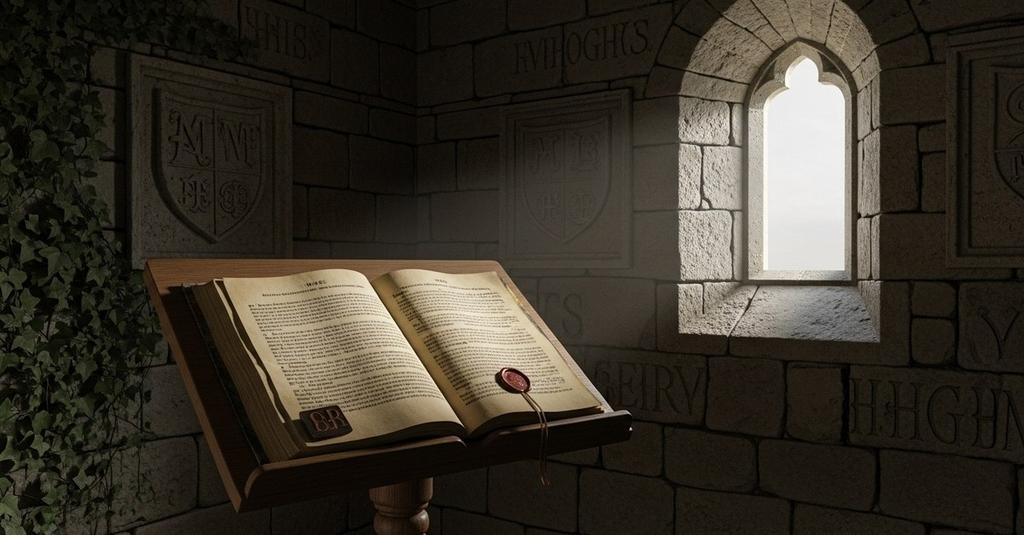
What actually happened
- Town-gown violence at Oxford was so severe in the 13th century that students abandoned the university multiple times. One migration in 1209 helped found Cambridge.
- Henry III’s 1264 pardon came during the Second Barons’ War, when his political position was so unstable he may have been buying loyalty from powerful townspeople — regardless of consequences for the university.
- Most medieval statutes accumulated bizarre clauses over centuries. The Symeonis oath was unusual because it targeted one specific person instead of a category of behavior.
The thing about institutional grudges
On the surface, this is funny. A 563-year grudge against a man nobody remembered — it sounds like a Monty Python sketch. Administrators dutifully maintaining an oath they couldn’t explain. Generations of students swearing vengeance against someone long dead.
But underneath it, there’s something worth sitting with. Every institution carries its own version of the Symeonis oath. Rules. Procedures. Assumptions that made sense once and now persist purely through momentum. The difference is that most of them aren’t funny. Most don’t have a name attached. They’re just the way things are done.
What makes the Symeonis case so rare is the paper trail.
We know the name, the year, the specific royal pardon that lit the fuse. We can trace the original injury. Most institutional grudges don’t come with that kind of documentation. They just calcify silently, generation by generation, until someone finally asks the most disruptive question an organization can hear: why are we still doing this?
Symeonis never got to hear that question.
But 176 years after someone first tried to ask it, the answer finally came: we don’t know. And we should probably stop.
Henry Symeonis was a man caught up in medieval violence, pardoned by a king, and then cursed by a university for more than five centuries after his death. He never knew his name would echo through Oxford’s graduation halls long after England had transformed beyond recognition. That’s the thing about grudges — they outlast the people who hold them. And sometimes, they outlast the reason entirely. There’s more at this-amazing-world.com — and the next one is even stranger.
“
Frequently Asked Questions
Q: What was the Oxford University Symeonis oath?
It was a clause in Oxford’s graduation statutes requiring every Bachelor advancing to Master of Arts to swear eternal enmity, by name, against Henry Symeonis. Symeonis had been implicated in a student’s death in 1242, fined, and banished. After King Henry III pardoned him in 1264, the university institutionalized its anger by embedding his name into the graduation oath, where it persisted for about 563 years until 1827.
Q: Why did Oxford keep the Symeonis oath for over 500 years?
Oxford maintained the oath not from passion but from bureaucratic inertia: nobody was motivated enough to remove it. A formal attempt to delete it in 1651 failed, and another 176 years passed before action was taken. The oath became ritual, recited by generations who never knew who Symeonis was. It finally ended in 1827 when a systematic review of accumulated statutes surfaced the forgotten clause.
Q: When was the Symeonis oath finally removed?
The oath was removed in 1827, roughly 563 years after it began around 1264. A university commission reviewing centuries of accumulated statutes discovered the clause swearing eternal enmity against a man nobody remembered and struck it. Symeonis was, in effect, posthumously forgiven by approximately 580 years. The first failed removal attempt had occurred in 1651, leaving a 176-year gap before the matter was finally settled.
Q: What did Henry Symeonis actually do?
Henry Symeonis was a wealthy Oxford townsman implicated in the killing of a student in 1242, during an era of severe town-gown violence in medieval Oxford. He was fined and banished. In March 1264, King Henry III issued a royal pardon, likely tied to political instability during the Second Barons’ War. Oxford rejected the pardon and instead encoded eternal enmity against him into its graduation ceremony for centuries.
Illustrations are AI-generated. Article fact-checked and human-edited. Our editorial standards.