A Stray Cat Kept a Frozen Baby Alive All Night
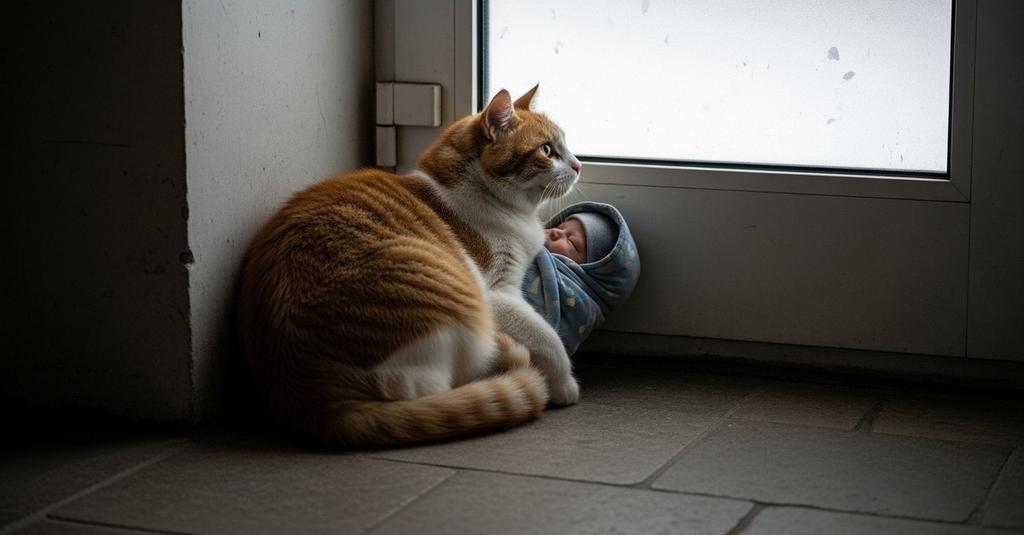
It was -15°C that January night in Obninsk, Russia. A newborn lay abandoned in an apartment building entryway, and nobody knew he was there except a stray cat named Masha — who decided to stay.
The baby had been left with nothing. No blanket. No note. Just cold steps and colder air. And Masha, a tabby that had spent years using those same steps as her territory, made a choice that kept him alive until morning.
Key Facts
- The overnight temperature in Obninsk, Russia, dropped to -15C in January 2015, when the rescue occurred.
- An unprotected newborn develops severe hypothermia within 30 to 60 minutes in such cold, with irreversible organ damage occurring around a core temperature of 32C.
- Domestic cats maintain a body temperature between 38.1C and 39.2C, making a cat pressed against skin a viable heat source.
- Newborns lose heat roughly 4 times faster than adults relative to body mass due to their high surface-area-to-volume ratio.
- Over 300 cases of infant abandonment in public spaces were recorded in Russia during 2015.
In short: When a stray cat saves baby stories surface, few are as documented as Masha’s: a tabby in Obninsk, Russia, who curled around an abandoned newborn through a -15C January night in 2015, then cried out to alert a passerby. Her 38C body heat held the infant above the lethal hypothermia threshold until help arrived.
What happens to a newborn in -15°C
Here’s the thing — an unprotected newborn develops severe hypothermia within 30 to 60 minutes in that kind of cold. Core body temperature starts dropping almost immediately. Organs shut down. It’s not gradual.
Neonates can’t shiver to generate heat the way adults do. They’re stuck depending on whatever warmth touches their skin. According to research on hypothermia, that threshold where organ damage becomes irreversible sits around 32°C. Below that, you’re looking at permanent injury or death.
So when pediatric specialists talk about “survival margins,” they’re talking about degrees. Fractions of degrees.
And Masha was a cat weighing maybe four kilograms, with a body temperature of roughly 38.5°C. No training. No instinct humans had bred into her. Just a small, warm body that chose to press against a smaller, colder one.
What Masha did that night
She didn’t just curl up next to him. Neighbors described what they pieced together later — she circled when he stirred. Repositioned. Maintained contact through what turned out to be one of the coldest nights that winter. And she didn’t leave.
Cats aren’t pack animals. They don’t have the instinct to protect human infants the way a dog might. They’re solitary. They’re governed by territory and comfort and self-preservation.
Masha had been a fixture on those apartment steps for years. Residents knew her. Fed her scraps. She was gentle, unhurried, the kind of animal that didn’t startle easily. But nobody had ever seen her do anything like this.
That last fact kept me reading for another hour.
Morning came
The baby was alive. But he needed more than body heat now. He needed a hospital. So Masha did the only thing left.
She cried out.
Not the casual meowing neighbors had heard before. This was insistent. Urgent. The kind of sound that made Irina Lavrova stop on her way down the stairs and actually look, really look, at what was happening in the entryway. Lavrova later told reporters she’d never heard Masha make noise like that.
A stray cat saves baby stories don’t happen without that moment. Without someone stopping. Without Masha refusing to stay silent.
Lavrova called emergency services. The baby was rushed to the hospital. Doctors confirmed early-stage hypothermia. Cold, but alive. The margin between those two things was a cat that had spent the night pressing warmth into skin.

The medical part
What Masha provided wasn’t symbolic. It was measurable. Quantifiable. The baby’s core temperature had dropped into dangerous territory, but not so far that organ damage became irreversible. Medical staff who treated him said his body had been kept just above that threshold.
Think about what that means: a cat’s body heat, approximately 38 to 39 degrees Celsius, had held the line against a Russian January. That’s not metaphor. That’s physics.
The math works out. The survival works out. Everything that happened after — Masha following the paramedics to the entrance, watching the ambulance pull away, one medic reportedly turning back to look at her — none of it would have been possible if she’d done something else that night.
By the Numbers
- -15°C overnight in Obninsk, January 2015. Fatal hypothermia in unprotected newborns occurs within 30 to 60 minutes (Russian Meteorological Service records)
- Newborns lose heat roughly 4 times faster than adults relative to body mass — their high surface-area-to-volume ratio means they need external warmth immediately and continuously
- Domestic cats maintain a body temperature between 38.1°C and 39.2°C. In a sheltered space pressed against skin, that’s a viable heat source
- Over 300 cases of infant abandonment in public spaces were recorded in Russia during 2015. Most went undiscovered until it was too late
The stranger details
Behaviorists call what Masha did “alloparenting” — caring for young that aren’t your own. It’s documented in cats, particularly ones that have formed stable social bonds with a human community. Masha’s years on those apartment steps may have been more socially formative than anyone realized.
The vocalization she used to alert Lavrova? That’s something feline behavior researchers, including Dr. Karen McComb at the University of Sussex, have studied in cats. Turns out some cats manipulate human responses by embedding a cry-like frequency inside a purr or meow. A distress call pattern that triggers urgency in the listener.
After the story went public, Masha was formally adopted by the residents of the building. They gave her a food bowl. A blanket. A named spot in the entryway — the same spot where she’d spent the night keeping a baby alive.
For more on animals making choices that seem to cross the line between instinct and something harder to name, there’s a whole thread worth pulling at this-amazing-world.com.
Why we keep coming back to this
It’s easy to file this under “feel-good animal story” and move on. But a stray cat saves baby — and this is real, documented, medically confirmed — keeps asking something bigger of us. It asks what empathy actually is. What care means. Who or what is capable of recognizing another creature’s need and choosing to meet it, without reward, without language, without any guarantee that morning will come.
The baby recovered fully. He was placed with a family. He’ll grow up never knowing what held him through the night when the cold was winning.
She’ll never know what she did.
He’ll never know who she was.
Some stories don’t resolve into a lesson. They just sit open, like a door in January. A cat on cold steps. A baby breathing. A neighbor who almost didn’t look. Every piece mattered. None of it was guaranteed. If this kind of story keeps you asking questions, there’s more at this-amazing-world.com.
Frequently Asked Questions
Q: How did a stray cat save an abandoned baby in Russia?
In January 2015 in Obninsk, Russia, a stray tabby named Masha found a newborn abandoned in an apartment entryway during a -15C night. She curled around the infant, repositioning herself when he stirred, and maintained body contact for hours. Her body temperature of roughly 38.5C kept the baby above the lethal hypothermia threshold. In the morning she cried out insistently, alerting resident Irina Lavrova, who called emergency services. Doctors confirmed early-stage hypothermia but the baby survived.
Q: How quickly does a newborn develop hypothermia in extreme cold?
An unprotected newborn can develop severe hypothermia within 30 to 60 minutes in temperatures around -15C, according to the article. Core body temperature begins dropping almost immediately because neonates cannot shiver to generate heat the way adults do. Irreversible organ damage typically begins around a core temperature of 32C. Newborns also lose heat roughly four times faster than adults relative to body mass, owing to their high surface-area-to-volume ratio, which is why continuous external warmth is critical to survival.
Q: Why would a solitary cat protect a human infant?
Behaviorists call what Masha did ‘alloparenting,’ meaning caring for young that are not your own. It is documented in cats, particularly those that have formed stable social bonds with a human community. Masha had spent years on the apartment steps, fed by residents, which may have made her unusually socially attuned. Cats are normally solitary and governed by territory and self-preservation, so this protective behavior toward an unrelated human baby was striking even to the neighbors who knew her.
Q: Is there science behind the cat’s urgent cry for help?
Yes. Feline behavior researchers, including Dr. Karen McComb at the University of Sussex, have studied how some cats embed a cry-like frequency inside a purr or meow, producing a distress-call pattern that triggers urgency in human listeners. Masha’s vocalization that night was described as insistent and unlike her usual meowing, the kind of sound that made a passerby stop and actually look at the entryway, which proved decisive in getting the baby to a hospital in time.
Illustrations are AI-generated. Article fact-checked and human-edited. Our editorial standards.