Hong Kong Flushes Toilets With Seawater — And Has Since 1958
In 1958, Hong Kong made a choice that every coastal city on Earth should have copied by now: when the freshwater ran out, engineers didn’t import more water. They pumped the harbour straight into the pipes. Seawater — raw, unfiltered, direct from Victoria Harbour — now flushes toilets across a city of 7.5 million people. The Hong Kong seawater toilet flushing system has been doing this for sixty-seven years. Nobody else has scaled it. And that absence is the more remarkable fact than the system itself.
Most cities treat their harbours as scenery. Hong Kong, desperate and inventive, treats its harbour as infrastructure. The postwar population surge — from 600,000 in 1945 to over two million by the mid-1950s — had drained every freshwater source the islands possessed. Rationing became daily life. By 1963, water arrived from taps four hours every four days. Engineers faced an arithmetic problem with no comfortable solution: there wasn’t enough fresh water to drink, let alone flush. The ocean, though, was right there.
Key Facts
- Hong Kong launched the world’s first urban seawater toilet flushing pilot in 1958 in Kwun Tong, Kowloon.
- The system moves roughly 270 million cubic metres of seawater through dedicated pipes each year (Water Supplies Department, 2023).
- Seawater flushing serves approximately 85% of Hong Kong’s 7.5 million residents.
- The system saves an estimated 22% of the city’s total freshwater demand annually.
- During the 1963 drought, Hong Kong residents received tap water just four hours every four days, accelerating the network’s expansion.
In short: Hong Kong seawater flushing has pumped raw harbour water through a separate pipe network into toilets since 1958, now serving about 85% of 7.5 million residents. Moving 270 million cubic metres of seawater yearly, it saves an estimated 22% of the city’s freshwater demand, yet after 67 years no other city has replicated it at scale.
Two Invisible Networks Running Beneath the Streets
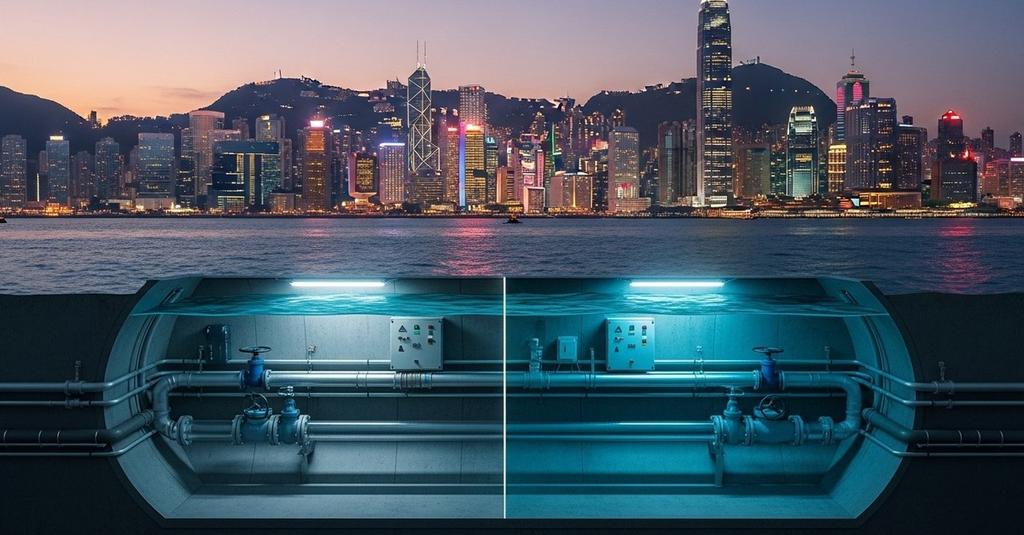
Imagine a city built twice over, one on top of the other — one carrying what you drink, one carrying what you flush. That’s Hong Kong. The Water Supplies Department operates dual pipe systems beneath every major street: potable freshwater in one network, raw seawater in another, never touching, colour-coded, pressurized separately. Intake stations positioned around Tolo Harbour and Victoria Harbour’s western approaches draw water where tidal exchange keeps salinity stable. Roughly 270 million cubic metres of seawater moves through these pipes annually.
Two hundred and seventy million cubic metres. That’s enough to fill over 100,000 Olympic swimming pools every single year, all diverted from the ocean, flushed once, treated, discharged — never consuming Hong Kong’s freshwater reserves at all. The city saves an estimated 22% of its total freshwater demand this way. In a place that historically relied on rationed supplies and emergency imports from mainland China, that percentage means survival versus crisis.
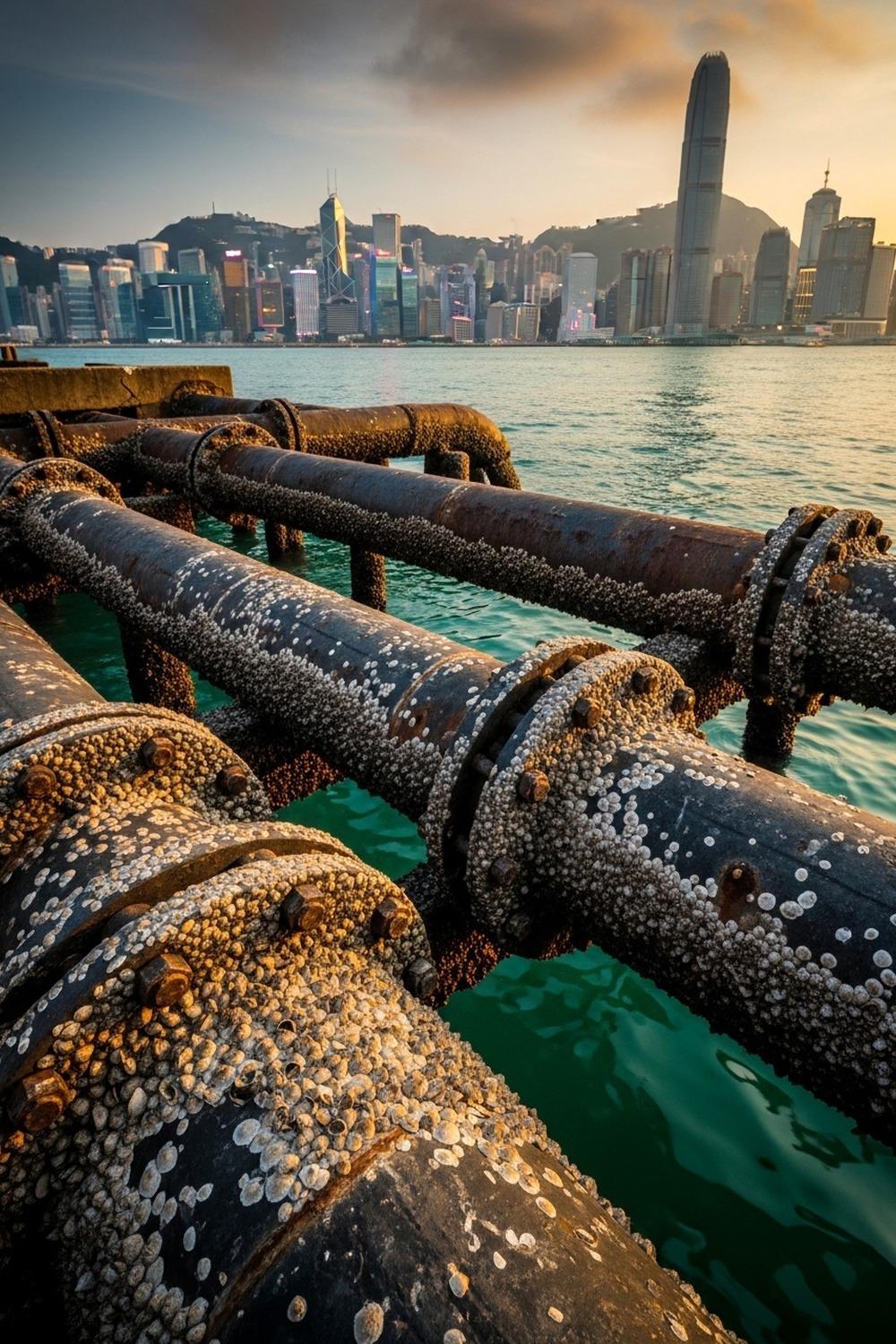
The engineering is almost invisible. Corrosion-resistant materials. Separate pressure systems. Salt corrodes what freshwater doesn’t. Those 1958 design choices had to survive decades of saltwater exposure, and largely they did. Coverage has grown from the original northwestern New Territories pilot to serve approximately 85% of the city today — a steady expansion that feels ordinary to residents who’ve never known anything else.
What changed the city’s arithmetic was pure resource desperation.
The Drought That Forced Brilliance
Consider how the ocean has always found ways to move water through constrained systems — a dynamic explored in the unexpected world of salmon runs that carry ocean nutrients deep into landlocked forests, organisms solving scarcity with what’s immediately available. Hong Kong’s engineers were doing something structurally identical: using what the harbour offered rather than importing what it lacked. The pilot scheme launched in 1958 in Kwun Tong, Kowloon — chosen for its industrial character and coastal position, where seawater intake infrastructure was relatively straightforward to build.
The Water Supplies Department monitored the pilot obsessively. Not just water savings. Infrastructure wear, pipe integrity, and — critically — how seawater affected sewage treatment. Chlorides from salt water change how wastewater behaves in treatment plants. Engineers had to adapt the entire downstream process accordingly.
By the 1970s, why does a city expand infrastructure that most planners still don’t trust? Because the savings were undeniable. Every year the network grew, the freshwater demand curve bent downward.
The expansion across Kowloon and Hong Kong Island wasn’t smooth. Some residential districts required complete parallel pipe installation in already-dense neighbourhoods — logistical puzzles that took years to solve. But watching a system save 22% of a city’s water supply while operating for seven decades, you stop calling it experimental.
Why Three Generations of Planners Have Ignored It
Globally, water stress is accelerating. Over two billion people currently live in countries experiencing high water stress, according to a landmark analysis from the UN Environment Programme, and that number climbs sharply toward 2050 as climate change alters precipitation patterns and shrinks mountain snowpacks feeding major river systems. Coastal cities — precisely the type with easiest access to seawater infrastructure — are most vulnerable. Rising seas threaten freshwater aquifers through saltwater intrusion even as demand increases. In this context, the Hong Kong seawater toilet flushing system looks less like historical footnote and more like a model that global planners have somehow failed to replicate at scale.
The honest answer is brutal: the Hong Kong seawater toilet flushing system costs an extraordinary amount to build from scratch in a city that doesn’t already have it. Here’s the thing — dual pipe networks require double the infrastructure investment, double the maintenance overhead, and retrofitting existing buildings is often prohibitively complex. Hong Kong’s system works partly because it was built into expansion rather than grafted onto completed districts. Areas developed after the network existed were designed to connect from the start. That sequential logic is almost impossible to replicate in a fully built city.
Singapore has explored versions of the concept. Parts of Tokyo use recycled greywater for toilet flushing in newer buildings. But no other city has built anything approaching Hong Kong’s scale, coverage, or longevity.
What the Salt Does to the Infrastructure
Seawater is corrosive, biologically active, and chemically complex in ways ordinary freshwater isn’t. A 2019 assessment by the Hong Kong Water Supplies Department found that sections of the original 1958-era infrastructure in Kwun Tong had required progressive replacement over two decades — not because the concept failed, but because 1950s materials weren’t engineered for sixty-plus years of salt exposure. Modern replacement pipes use high-density polyethylene and corrosion-resistant composites that should extend service life considerably.
Victoria Harbour has been heavily polluted for much of the twentieth century — industrial runoff, sewage discharge, shipping traffic. The seawater being pumped into toilet cisterns across the city isn’t pristine ocean. For decades, the Water Supplies Department operated with minimal pre-treatment of intake water, relying on the toilet-flushing function’s low hygiene requirements. But as harbour water quality improved — partly due to the Harbour Area Treatment Scheme launched in phases from the 1990s onward — so too has the quality of what enters the flushing network.
Chlorides from seawater flushing alter the chemistry of wastewater in ways that require treatment plants to use modified processes. Hong Kong’s facilities have adapted over decades, but those adaptations represent real engineering costs that any city considering replication needs to factor in honestly. The downstream ecological effects of treating sixty-seven years of salt-contaminated wastewater remain an open question in municipal engineering literature — researchers still can’t fully model the microbial interactions that occur, or predict long-term system behaviour.
The Harbour Is Changing Faster Than the System Was Built For
Climate change is rewriting the conditions that made the Hong Kong seawater toilet flushing system viable. Victoria Harbour’s water temperature has risen measurably over four decades — a documented warming trend that increases biological activity in intake water, raises biofouling risk in pipes, and changes the salinity gradients that intake stations were originally designed around. Hong Kong’s mean sea level has risen approximately 30 millimetres since 1954, according to the Hong Kong Observatory’s long-term tidal gauge data. That sounds modest until you consider what it means for intake infrastructure positioned at specific tidal elevations.
Rising seas change where and how efficiently the system can draw water. There’s an irony embedded here. The same fossil-fuel combustion driving global sea-level rise is the reason cities worldwide need water-saving systems like Hong Kong’s. The city’s solution to its own water scarcity is now operating inside a changing ocean it didn’t anticipate and can’t fully control. Infrastructure designed for one set of environmental parameters is being asked to perform in another.
The Water Supplies Department has begun modelling future intake scenarios, but the specifics remain an active engineering challenge rather than a solved one. Stand at Victoria Harbour’s edge on a clear morning, water running green-grey, container ships idle near Stonecutters Island. Somewhere beneath you, seawater is being drawn into pipes, directed under streets, flushed through millions of cisterns before returning — changed, treated, released. The harbour doesn’t notice. But the city absolutely depends on it.
How It Unfolded
- 1958 — Hong Kong’s Water Supplies Department launches the world’s first urban seawater toilet flushing pilot in Kwun Tong, Kowloon, as chronic freshwater shortages force a radical rethink of municipal water use.
- 1963 — A catastrophic drought leaves Hong Kong residents with just four hours of tap water every four days, accelerating political will to expand the seawater network citywide.
- 1970s–1980s — The dual-pipe network expands across urban Kowloon and Hong Kong Island, becoming standard infrastructure in all new residential and commercial developments.
- 2023 — The system serves approximately 85% of Hong Kong’s 7.5 million residents, processing around 270 million cubic metres of seawater annually and saving an estimated 22% of the city’s total freshwater demand.
By the Numbers
- 270 million m³ — seawater flushed through Hong Kong’s system annually (Water Supplies Department, 2023)
- 85% — proportion of Hong Kong’s 7.5 million residents currently served by the seawater flushing network
- 22% — estimated freshwater demand saved each year by the Hong Kong seawater toilet flushing system compared to a fully freshwater-flushed equivalent
- 65+ years — continuous operational lifespan of the original network, making it the longest-running urban seawater flushing system in the world
- 1990s — decade in which the Harbour Area Treatment Scheme began improving harbour water quality enough to reduce contamination entering the intake stations
Field Notes
- In 2007, engineers conducting routine maintenance in the Wan Chai district discovered sections of original 1958-era cast-iron seawater pipe still in service beneath one of Hong Kong’s busiest commercial corridors — a testament to original installation quality, and a reminder that some infrastructure has been quietly working for half a century without replacement.
- The seawater flushing network operates at lower pressure than the potable water system — a deliberate engineering choice that reduces cross-contamination risk and limits the corrosive force of saltwater moving through ageing pipe sections.
- Hong Kong’s system has inspired academic interest but almost zero direct replication — a 2021 review of global water reuse strategies by the International Water Association identified Hong Kong as a unique case study with no comparable municipal equivalent anywhere in the developed world.
- Researchers still can’t fully model how long-term seawater flushing affects the microbial communities in urban sewage treatment plants compared to freshwater-only systems (and this matters more than it sounds). The chloride interactions are understood in broad terms, but downstream ecological effects remain an open question in municipal engineering literature.
Frequently Asked Questions
Q: How does the Hong Kong seawater toilet flushing system prevent salt water from contaminating drinking water supplies?
Two completely separate pipe networks with no physical connection between them. The seawater pipes are clearly identified, run at different pressures, and are made from different materials than potable infrastructure. Regular inspections and pressure monitoring detect any cross-connection before contamination can occur. Since 1958, there have been no recorded incidents of seawater entering the potable network at scale, which speaks to the integrity of the dual-pipe design.
Q: Why don’t other coastal cities copy what Hong Kong does with seawater?
Cost and timing. Building a dual-pipe network into a city already fully developed requires tearing up streets, retrofitting buildings, and replacing existing single-pipe infrastructure — an investment often impossible to justify politically or financially. Hong Kong’s system works because it was built incrementally as the city expanded, allowing new developments to connect from day one. Cities that missed that window face steeper retrofitting challenges than any water-saving benefit can justify.
Q: Is seawater toilet flushing actually hygienic and safe?
Yes — and this is the misconception most people bring to the topic. Toilet flushing doesn’t require potable-standard water. Seawater entering cisterns never contacts food, drinking glasses, or human skin in meaningful ways. The Water Supplies Department applies basic screening to intake water, and the sewage treatment system downstream handles the chloride load. After sixty-seven years of operation across millions of households, there’s no documented public health concern linked to the seawater flushing system specifically.
Editor’s Take — Alex Morgan
Sixty-seven years of operational data. A system serving six million people. Water savings measured in hundreds of millions of cubic metres annually. And virtually no replication anywhere else on Earth. That gap between proof and adoption is the real story here — not the engineering, which is elegant but not mysterious. The world is watching water tables drop and reservoirs shrink, and the answer to at least part of that problem has been running under Hong Kong’s streets since the Eisenhower administration. The inertia required to ignore that is extraordinary.
Hong Kong’s seawater solution was born from desperation — a city running dry, engineers staring at a harbour full of water, asking an obvious question that somehow wasn’t obvious enough for anyone else to act on at scale. As freshwater stress tightens its grip on coastal megacities from Jakarta to Lagos to Miami, that question becomes harder to avoid. The ocean isn’t running out. The engineering exists. The data is sixty-seven years old. What, exactly, are the rest of us waiting for — and what will the arithmetic look like when we finally stop?
Illustrations are AI-generated. Article fact-checked and human-edited. Our editorial standards.