Eileen Gu Leads SF’s Chinese New Year Parade, Oldest in the West
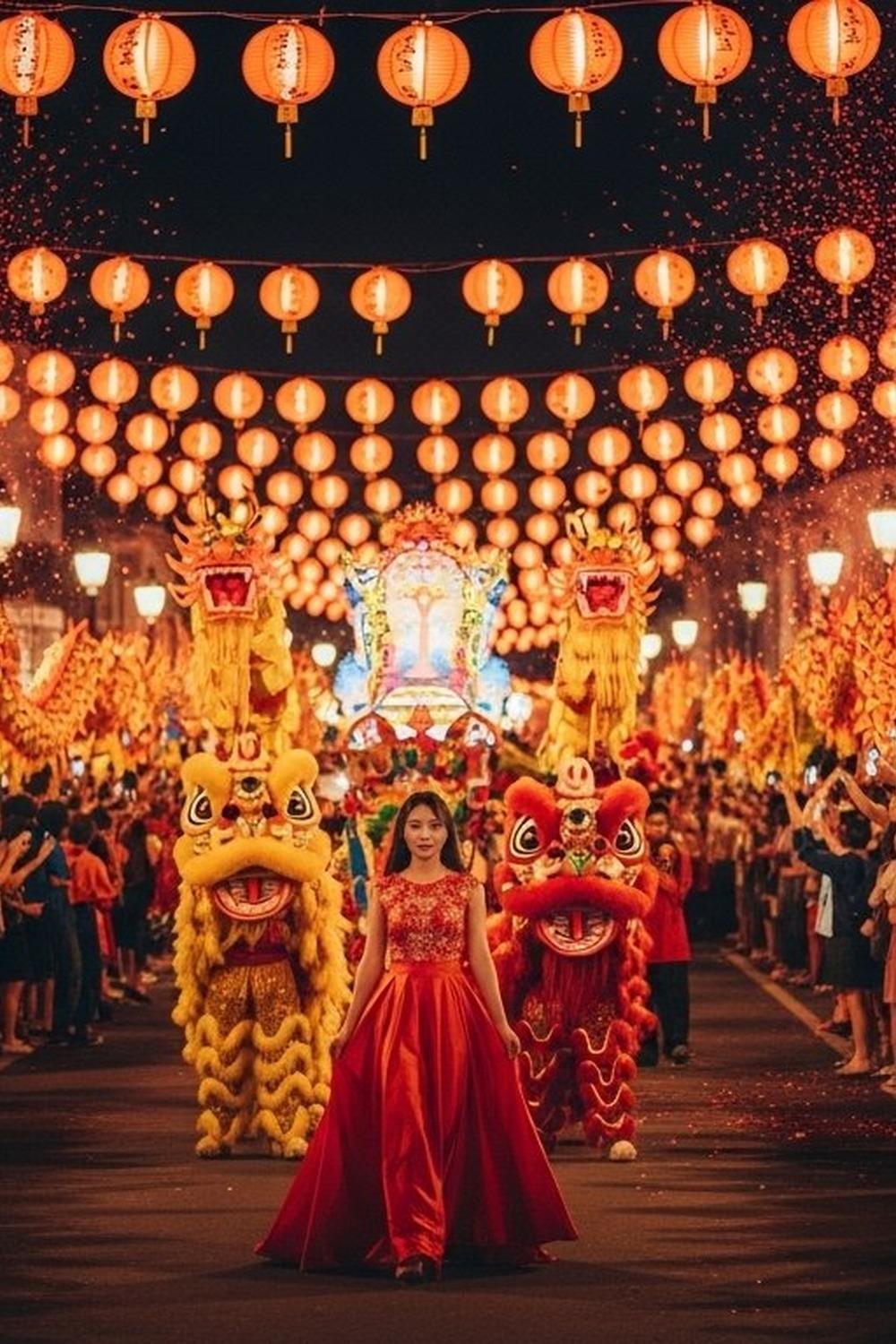
You could feel it before you saw it — the ground itself seemed to know something was coming. The roar, the shaking of Grant Avenue, the way the crowd’s attention snapped forward all at once. At the front of the San Francisco Chinese New Year Parade, arms raised, stood a 21-year-old Olympic champion who’d grown up belonging to two worlds at once, carrying both flags down streets that had been telling the same story since before electricity existed. Saturday night, February 24th, 2024, this city finally watched itself through her eyes.
Eileen Gu stepped into her role as grand marshal of an event that’s wound through these same Chinatown streets since 1860 — predating the lightbulb, predating the telephone, predating most things we now consider modern. More than 100,000 people lined the route that night. But the real question — the one worth sitting with — is what exactly they came to witness, and why this particular grand marshal mattered so much more than the title suggests.
Key Facts
- The San Francisco Chinese New Year Parade has run through Chinatown streets since 1860, making 2024 its 164th year of continuous celebration.
- The 2024 parade, held February 24th, drew over 100,000 spectators along a roughly three-mile route and named Eileen Gu grand marshal.
- Gum Lung, the Golden Dragon, stretches 268 feet and requires more than 100 trained bearers to carry it.
- The parade generates more than $30 million in annual economic impact for San Francisco (Chinese Chamber of Commerce).
- Eileen Gu won 3 medals at the 2022 Beijing Winter Olympics, the most ever by a freestyle skier at a single Winter Games.
In short: The San Francisco Chinese New Year Parade, running since 1860, is the largest celebration of its kind outside Asia. The 2024 edition on February 24th drew over 100,000 spectators and named Olympic champion Eileen Gu grand marshal, featuring the 268-foot Golden Dragon Gum Lung and generating over $30 million in economic impact.
The Oldest New Year Parade in the Western World
History, when it survives at all, usually does so quietly. Not here. The San Francisco Chinese New Year Parade doesn’t just have history — it is history, pressed into asphalt and lit with fire, marched through streets every single year by people who understand what it took to keep it alive.
Back in the early 1860s, Chinese immigrants — many of whom had arrived to work the gold mines and lay the transcontinental railroad — began organizing public celebrations to maintain cultural ties. The context matters: they were doing this while facing mounting anti-Chinese sentiment in California. According to the Wikipedia entry on the San Francisco Chinese New Year Parade, the event has grown into the largest celebration of its kind outside Asia, drawing over 100,000 spectators annually along a roughly three-mile route through the city’s Chinatown — itself the oldest in North America. By 2024, it had evolved into a full week of events, not just a single night’s procession.
Most parades that started in the 1860s don’t exist anymore. They got absorbed into civic indifference or rerouted into irrelevance. This one didn’t. It grew. It deepened. The floats got bigger, the firecrackers got louder, and the crowds kept coming back, generation after generation, to stand on the same corners their grandparents stood on.
That kind of continuity isn’t accidental. It’s protected, deliberately, by a community that understood from the start how fragile visibility can be. Walk Grant Avenue the morning after the parade and you’ll find the street still smells of gunpowder. Red paper scraps from firecrackers blanket the pavement like fallen leaves. The city doesn’t immediately sweep them away — in Chinese tradition, leaving the remnants overnight is considered good luck for the year ahead. Even the cleanup has ceremony baked into it.
Eileen Gu and the Weight of Two Flags
There are athletes who become symbols, and then there are athletes who become arguments.
Eileen Gu is firmly in the second category. Born in San Francisco in 2003 to a Chinese mother and an American father, she competed for China at the 2022 Beijing Winter Olympics — a decision that generated enormous commentary on both sides of the Pacific. The medals came next: gold in freeski big air, gold in halfpipe, bronze in slopestyle. She became the first athlete in history to win three freestyle skiing medals at a single Winter Games. Freestyle skiing at Olympic level demands not just physical power but a specific brand of controlled recklessness — the ability to commit fully to a trick mid-air, 50 feet above a halfpipe, while your brain is screaming at you to pull back.
That duality required in the sport — boldness and precision held in perfect tension — maps almost too neatly onto the duality of Gu’s public identity. And yet, there it is. Grand marshal of a parade that has always been about exactly that tension. Between two worlds, held in one body. In the same way that hidden complexity defines so much of the natural world — the way, say, a gliding mammal can cross 90 meters of air without technically flying — Gu’s story resists easy categorization.
The decision to compete for China was not without criticism. American commentators questioned her loyalty. Chinese state media embraced her as a symbol of national pride. Gu herself has largely declined to let others define the terms. In interviews before and after Beijing, she’s consistently maintained that her identity is additive, not a zero-sum contest. “I feel I can show people that you can have multiple identities,” she told the New York Times in 2022. Walking as grand marshal through San Francisco’s Chinatown in 2024 was, depending on how you read it, either a homecoming or a statement. Probably both.
When Gu passed through the parade route, the noise didn’t dip — it doubled. People had come specifically to see her. That’s not nothing in a parade that has featured governors, diplomats, and cultural icons for more than 160 years.
What 268 Feet of Dragon Actually Looks Like
The centerpiece of the San Francisco Chinese New Year Parade isn’t a float. It’s a creature. Gum Lung — the Golden Dragon — stretches 268 feet from head to tail and requires more than 100 trained bearers to carry it through the streets. According to the Smithsonian’s coverage of the parade’s cultural significance, the dragon tradition in Chinese New Year celebrations connects directly to ancient beliefs about dragons as bringers of good luck, rain, and prosperity — benevolent forces, not the fire-breathing destroyers of European mythology.
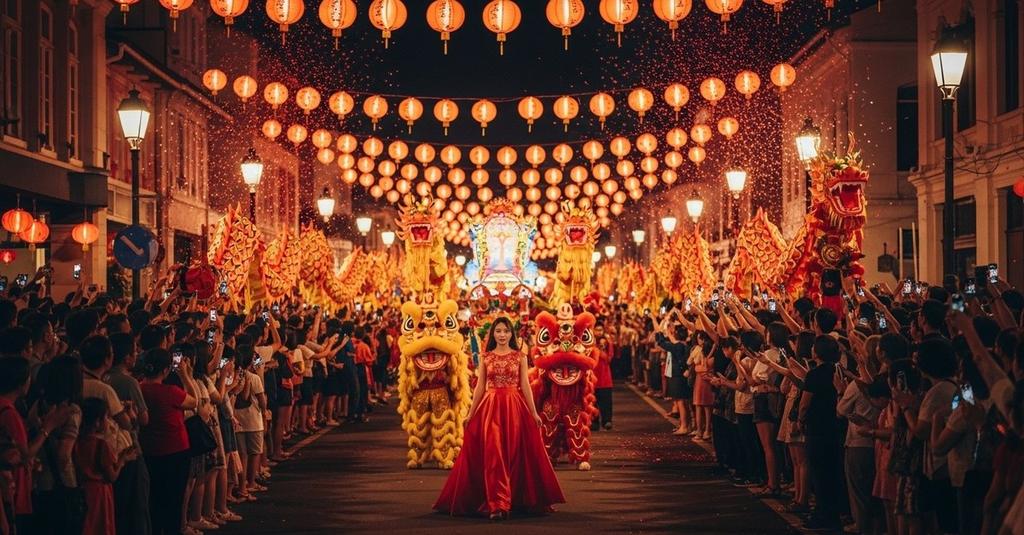
For decades now, Gum Lung has been the parade’s anchor, its shimmering scales catching the light of thousands of firecrackers as it winds through streets too narrow for its ambition. The effect, for a first-time viewer, is genuinely overwhelming. It’s not a prop. It moves with something that reads, viscerally, as alive.
Economic data: the San Francisco Chinese New Year Parade generates more than 30 million dollars in annual economic impact for the city, according to organizers from the Chinese Chamber of Commerce of San Francisco, which has produced the event since the post-World War II era. That figure covers hotels, restaurants, retail, and the vast informal economy of street vendors and photographers that springs up along the route each February. The parade isn’t just cultural preservation. It’s a significant piece of the city’s economic calendar — something the city’s tourism bureau has known and planned around for decades.
But here’s what the numbers don’t capture: the smell of incense from Chinatown’s doorways mixing with firecracker smoke. The way the drumbeats from competing lion dance troupes overlap and argue with each other from a block away. The grandmothers in folding chairs who’ve been watching from the same spot for forty years. Those things don’t show up in economic reports. But they’re the reason people keep coming back.
The San Francisco Chinese New Year Parade’s Living Record
The parade has outlasted earthquakes, pandemics, and waves of anti-immigrant legislation that tried, at various points in California’s history, to erase the community that created it. The Chinese Exclusion Act of 1882 passed by U.S. Congress, effectively barred Chinese laborers from entering the country and stripped many already here of the right to naturalize — the parade continued. The 1906 San Francisco earthquake destroyed much of Chinatown — the parade continued. The COVID-19 pandemic forced the cancellation of the in-person 2021 event, the first cancellation in decades, with organizers from the Chinese Chamber of Commerce pivoting to a virtual broadcast that still drew hundreds of thousands of viewers. By 2022, the parade was back in the streets. The 2024 edition was the fullest return yet, with all 100-plus parade units, the full three-mile route, and a grand marshal whose name recognition stretched from San Francisco to Beijing.
Why did this particular cultural tradition survive when so many others faded into footnotes? The University of California, Berkeley’s Ethnic Studies department has documented the parade’s history as part of its broader research into the Chinese American experience in California, noting that the parade functioned, particularly in the late 19th century, as both a cultural assertion and a calculated act of public diplomacy — a way of showing a hostile city something beautiful, and daring it to look away.
That framing — public beauty as resistance — shifts how you watch. The lion dances aren’t just entertainment. The firecrackers aren’t just spectacle. Each element carries freight from the years when Chinese San Franciscans had very few tools at their disposal to assert their presence and demand respect. This parade was one of them, and the accumulated weight of that defiance — generation after generation showing up in the same streets, refusing to be invisible — remains the real centerpiece, more than any float or dragon.
Attendance has diversified enormously since the 1980s, mirroring the city’s own demographic shifts and the broader mainstreaming of Lunar New Year observances across the United States. The parade units themselves tell a compressed history. Traditional martial arts schools founded in the 1920s march alongside tech company floats. High school drum corps from the Sunset District march next to delegations from the Republic of China. The parade doesn’t resolve those tensions. It holds them, year after year, in motion.
How It Unfolded
- 1860 — Chinese immigrants in San Francisco organize the earliest recorded public Chinese New Year celebrations in what is now Chinatown, establishing what would become the longest-running parade of its kind outside Asia.
- 1882 — The Chinese Exclusion Act passes, intensifying anti-Chinese hostility in California, but the Chinatown community continues its annual New Year celebrations as a form of cultural persistence.
- 1953 — The Chinese Chamber of Commerce of San Francisco takes formal control of the parade, transforming it into a large-scale civic event with international press attention and a nationally broadcast Miss Chinatown USA pageant.
- 2021 — The COVID-19 pandemic forces the first cancellation of the in-person parade in modern memory; organizers mount a virtual broadcast that reaches hundreds of thousands of viewers.
- 2024 — Olympic champion Eileen Gu serves as grand marshal, drawing record media coverage and reigniting global conversation about the parade’s cultural significance.
By the Numbers
- 268 feet — the length of Gum Lung, the Golden Dragon carried by more than 100 bearers through the parade route each year.
- 100,000+ spectators line the route annually, making it the largest Chinese New Year parade outside of Asia (Chinese Chamber of Commerce of San Francisco).
- $30 million+ in estimated annual economic impact generated by the parade weekend for the city of San Francisco.
- 3 Olympic medals won by Eileen Gu at the 2022 Beijing Winter Games — the most ever by a freestyle skier at a single Winter Olympics.
- 164 years of continuous celebration, making the San Francisco Chinese New Year Parade older than the Golden Gate Bridge, California’s statehood recognition of the holiday, and virtually every other public festival in the American West.
Field Notes
- The parade’s traditional firecracker sequence can involve tens of thousands of individual crackers strung into a single continuous chain — some chains historically ran over 600,000 crackers long, a number calculated to maximize the noise believed to ward off evil spirits. Modern safety regulations have shortened the chains, but the sound still carries twelve city blocks.
- Gum Lung, the Golden Dragon, is not the same dragon every year (researchers actually call this cultural continuity without physical preservation). The costume is periodically retired and replaced, but the name and the character carry forward — a distinction that mirrors how Chinese cultural traditions generally treat lineage: the identity persists even as the physical form changes.
- The Miss Chinatown USA pageant, which runs alongside the parade weekend, has been held since 1958 and is one of the longest-running Asian American scholarship competitions in the United States — a fact almost entirely absent from mainstream parade coverage.
- Researchers studying diaspora cultural events still can’t fully quantify what makes some ethnic parades survive for 160+ years while comparable celebrations in other cities fade within decades — the San Francisco parade’s specific mix of community governance, commercial partnership, and civic integration appears to be a factor, but no single institution has cracked the model for replication.
Frequently Asked Questions
Q: When and where does the San Francisco Chinese New Year Parade take place?
The parade typically happens on a Saturday evening in February, timed to coincide with the Lunar New Year calendar. The route runs approximately three miles through Chinatown and the downtown corridor, beginning near Market Street and winding north through Grant Avenue. In 2024, the parade was held on February 24th, drawing over 100,000 spectators along the route.
Q: Why is Eileen Gu significant as grand marshal?
She’s the first Olympic champion to serve as grand marshal of the San Francisco Chinese New Year Parade in recent memory. Her significance extends beyond her three medals at the 2022 Beijing Winter Olympics — she’s also a San Francisco native who competed for China, making her identity a living embodiment of the parade’s own dual heritage. Her selection resonated particularly strongly with younger Chinese American audiences who’ve followed her career closely since 2021.
Q: Is the San Francisco parade really the biggest Chinese New Year celebration outside Asia?
The organizers make this claim, and it’s broadly accepted, though “biggest” depends on the metric. By spectator count and parade unit size, San Francisco’s event ranks consistently among the top two or three Chinese New Year parades globally outside the Asian continent. London, Sydney, and Vancouver all host major celebrations, but San Francisco’s combination of historical depth, scale, and media visibility gives it a strong claim to the title. The Chinese Chamber of Commerce has used the “largest outside Asia” designation since at least the 1980s.
Editor’s Take — Sarah Blake
What strikes me most about this story isn’t Eileen Gu’s medals or even the parade’s staggering age. The real story is in the survival itself — this community didn’t just preserve a tradition, it kept expanding it through some of the most hostile conditions American history could produce. The parade is now larger than it was when the Chinese Exclusion Act passed. That’s not sentiment. That’s a measurable outcome. And it deserves more than a paragraph at the bottom of a celebrity grand marshal profile.
A parade that started in 1860 is, in the most literal sense, a form of argument that kept winning. Every year the firecrackers go off on Grant Avenue, that argument is renewed — not symbolically, but physically, by the hundred-plus people hoisting a 268-foot dragon through streets that once tried to contain them. Eileen Gu stood at the front of that procession and, for one Saturday night, the city she grew up in roared back at her. What does it take to build something so stubborn it outlasts everything the world throws at it?
Illustrations are AI-generated. Article fact-checked and human-edited. Our editorial standards.