Amsterdam’s Canals Were Killing Animals. A Staircase Fixed It.
Amsterdam’s canals are killing animals nobody’s counting. For decades, it just… happened. And then someone realized: a wooden staircase costs less than a used bicycle.
Every year, things fall into Amsterdam’s canals and vanish. Cats. Hedgehogs. Foxes. Even ducks sometimes. They slip in, scratch at walls that don’t care, and that’s it. Local animal welfare groups have been fielding these calls forever — usually at night, usually too late. The thing that kept me reading about this for hours wasn’t the problem itself. It was that the solution had been sitting in another Dutch city the whole time, waiting to be borrowed.
Key Facts
- Amsterdam’s canal ring spans over 100 kilometers of waterway lined almost entirely with vertical stone and brick walls that lack natural exit points (Amsterdam City Archive, 2023).
- Amsterdam is funding a citywide rollout of small wooden exit staircases with 100,000 euros from an existing biodiversity budget.
- The nearby city of Amersfoort, about 50 kilometers southeast, installed hundreds of animal exit ladders years earlier and reported reduced drowning incidents.
- Amsterdam’s canals contain an estimated 2,500 houseboats and attract roughly 20 million tourists per year, among Europe’s most densely trafficked waterways.
- The wooden staircases function as emergency egress for humans as well as animals, reframing them as public safety infrastructure.
In short: The Amsterdam canal animal rescue program installs small wooden exit staircases along over 100 kilometers of vertical-walled canals where cats, hedgehogs, and ducks drown unseen. Borrowed from nearby Amersfoort and funded with 100,000 euros from a biodiversity budget, the steps start at the waterline so exhausted animals, and even people, can climb out.
What’s actually happening in Amsterdam’s canals
The canal network stretches over 100 kilometers through the city. Almost all of it — the entire historic ring — is lined with vertical stone and brick walls that drop straight into the water with zero mercy.
Animal welfare organizations have documented dozens of cats alone lost to drowning. Just the reported cases. According to research compiled by the city of Amsterdam, the canal ring contains more than 1,500 bridges and countless unguarded wall sections. For anything smaller than a human, it’s a trap. Dr. Frederike van den Berg, a Dutch urban ecology researcher, has pointed out that the problem is structurally invisible — you don’t see the animals who fail.
The canals are stunning. Tourists photograph them constantly. But that’s the exact problem.
Beauty and danger have been sharing the same postcard this whole time. The walls look solid and permanent and historical. They’re also, for any creature smaller than a human, essentially a one-way drop into cold water with no way out.
Amersfoort solved this years ago
A smaller city about 50 kilometers southeast of Amsterdam figured it out first. Amersfoort started installing small wooden exit staircases on canal walls years ago. The results were significant enough that Amsterdam’s city council took notice. Now Amsterdam is deploying its own version citywide, funded by €100,000 from an existing biodiversity budget. That’s not a pilot. That’s real commitment.
The model works because it’s cheap, unobtrusive, and nearly invisible to humans. Most tourists never even notice them. A cat that’s been treading water for twenty minutes absolutely will. You can read about other cities making quiet changes for urban wildlife at this-amazing-world.com.
The design is almost embarrassingly simple
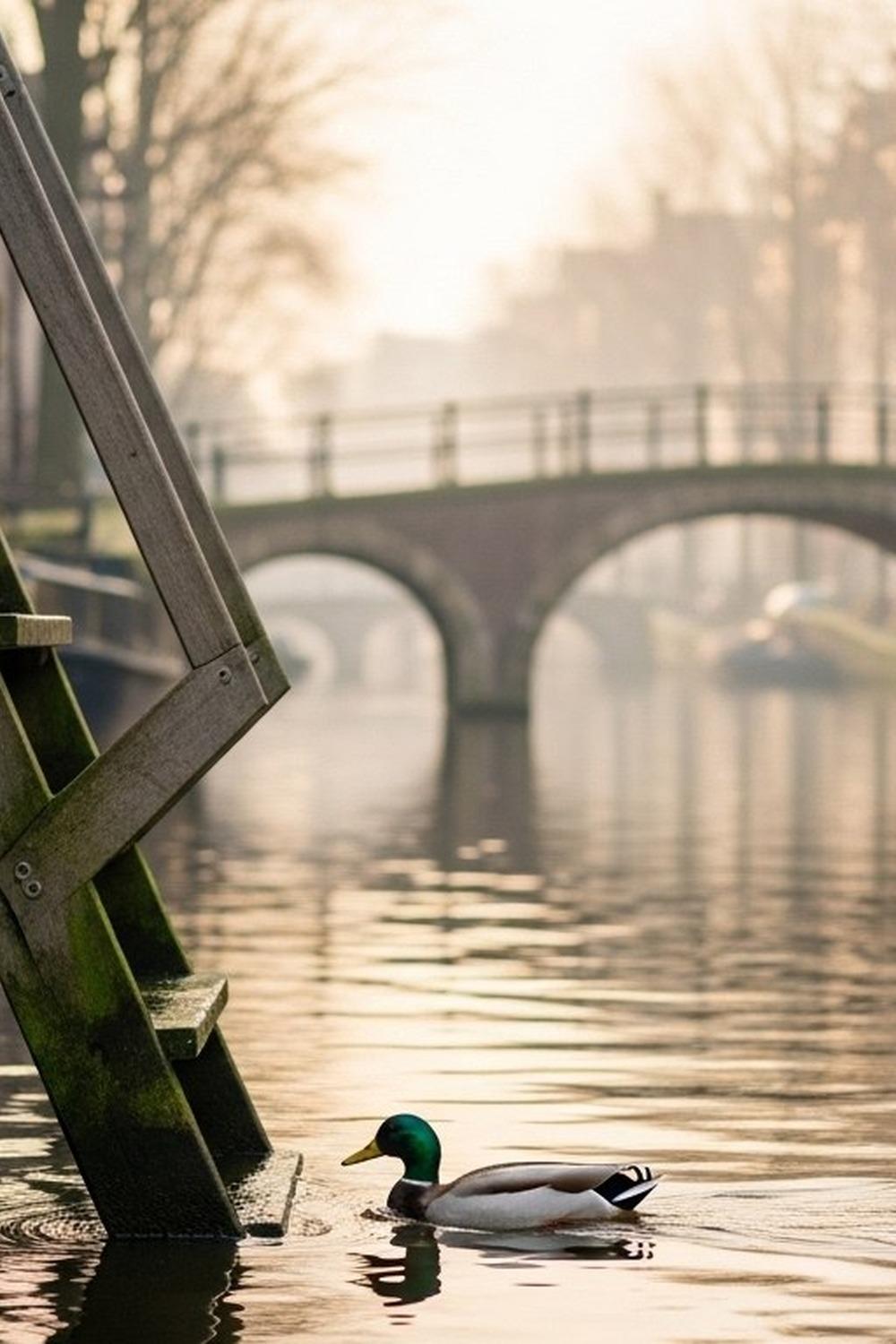
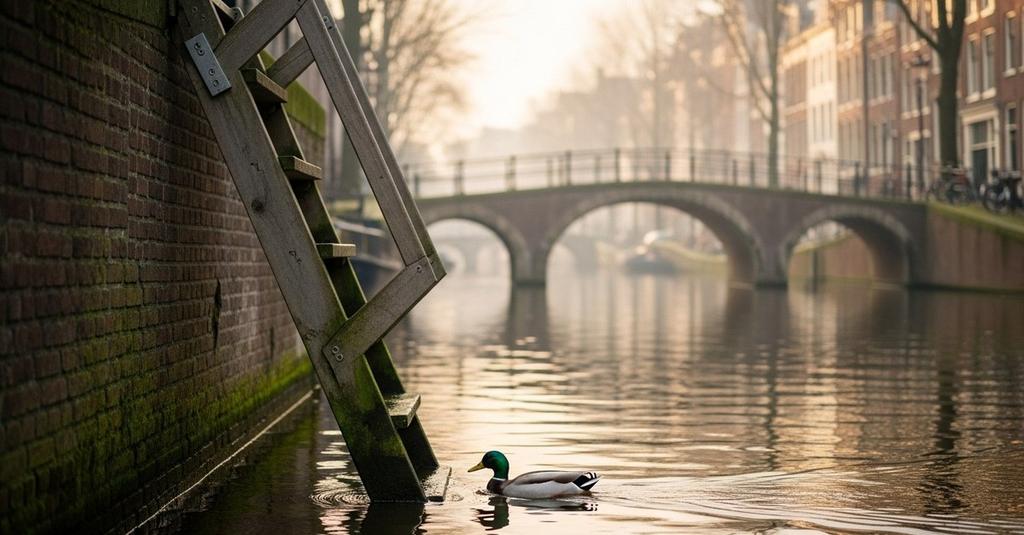
Small wooden structures. Bolted to canal walls at water level. Enough grip that an exhausted, wet animal can actually climb out. The key insight took a while to land on: the steps need to start at or below the waterline. An animal that’s drowning isn’t going to leap. It needs a ramp it can crawl onto when it’s barely conscious.
That detail separates a staircase that saves lives from one that just looks good in a press release.
Amsterdam canal animal rescue efforts had been mostly reactive before this. Someone would call. Volunteers would show up with nets. The city would apologize. Now they’re building something preventive into the structure itself.
The installations are going in at known trouble spots first — near parks, nature corridors, places where welfare volunteers have historically received the most distress calls. It’s targeted. It’s data-driven.
Here’s the part that changes everything
A person who falls into an Amsterdam canal faces nearly the same problem. Vertical walls. Slick surfaces. Panic. Amsterdam’s canals claim human lives every year — mostly late at night, mostly near areas with heavy foot traffic and alcohol involved.
The wooden staircases function as emergency egress for people too.
City council members have been careful to mention this in their public statements. It’s not a minor detail. It reframes the entire investment from “nice animal welfare gesture” to “functional urban safety infrastructure.” That shift in framing matters because it changes who supports the project. Animal welfare funding has limits. Public safety funding doesn’t face the same political friction. By solving both problems with one wooden staircase, Amsterdam’s planners found a way to make the case to people who wouldn’t have cared about the ducks.
By the numbers
- Amsterdam’s canal ring spans over 100 kilometers of waterway, with walls almost entirely lacking natural exit points for animals or people (Amsterdam City Archive, 2023)
- Amersfoort had installed hundreds of animal exit ladders across its canal network before Amsterdam’s program launched. Documented reductions in animal drowning incidents were reported by local welfare groups.
- €100,000 from existing biodiversity fund
- Amsterdam’s canals contain an estimated 2,500 houseboats and attract roughly 20 million tourists per year — some of the most densely trafficked urban waterways in Europe
Field notes
- Hedgehogs are surprisingly strong swimmers but can’t sustain it. They paddle for several minutes before exhaustion sets in. Without an exit point, that’s exactly long enough to drown. The staircases give them a window they wouldn’t otherwise have.
- The wooden staircase design was developed by animal welfare volunteers, not engineers. Placement data came entirely from rescue call logs.
- Ducks usually exit water easily. Not in Amsterdam’s narrow, wall-lined channels.
Why other cities are about to copy this
Canals, rivers, ornamental ponds, drainage channels — everywhere urban development meets water, you get the same vertical wall problem. Cities all over Europe have it. Most haven’t moved on it yet.
Amsterdam’s Amsterdam canal animal rescue initiative is drawing attention precisely because it’s so simple, so cheap, so easy to replicate. The €100,000 budget sounds significant until you do the math: spread across a city of 900,000 people, it’s negligible. Other cities watching this unfold are going to have a hard time explaining why they haven’t done the same thing.
Once you know this problem exists, you can’t unsee it. Every beautiful canal photo has a subtext now. Every stone wall is also a barrier. The staircases don’t change the aesthetic — they just quietly save whatever falls in.
That’s the story underneath the postcard.
Not a scandal. Not a disaster. Just a fixable problem that went unfixed for too long, and a small wooden staircase that turned out to be enough.
Amsterdam’s canals are still beautiful. They’re just becoming a little safer — for cats, hedgehogs, ducks, and anyone who stumbles too close to the edge at night. One city borrowed a good idea from a smaller neighbor and made it real. That’s how progress actually happens: quietly, practically, without much fanfare. If this keeps you reading late into the night, there’s more at this-amazing-world.com.
Frequently Asked Questions
Q: What is the Amsterdam canal animal rescue staircase program?
It is a citywide initiative installing small wooden exit staircases along Amsterdam’s canal walls so animals that fall in can climb out. The canal ring spans over 100 kilometers of vertical stone and brick walls with almost no natural exit points, trapping cats, hedgehogs, and ducks. Amsterdam funded the rollout with 100,000 euros from an existing biodiversity budget, placing staircases first at known trouble spots near parks and nature corridors identified from rescue call logs.
Q: Where did Amsterdam get the idea for the canal staircases?
Amsterdam borrowed the idea from Amersfoort, a smaller Dutch city about 50 kilometers to the southeast. Amersfoort installed hundreds of small wooden animal exit ladders across its canal network years earlier, and local welfare groups reported documented reductions in animal drowning incidents. The results were significant enough that Amsterdam’s city council took notice and launched its own version. The staircase design was actually developed by animal welfare volunteers rather than engineers.
Q: Do the canal staircases help people too, not just animals?
Yes. Amsterdam’s canals claim human lives every year, mostly late at night and often involving alcohol, because people face the same vertical, slick walls that trap animals. The wooden staircases function as emergency egress for humans as well. City council members have emphasized this in public statements, reframing the project from an animal welfare gesture into functional urban safety infrastructure, which broadens political and funding support beyond animal welfare budgets alone.
Q: Why is the design of the canal staircases so important?
The key insight is that the steps must start at or below the waterline. A drowning animal that has been treading water for twenty minutes will not leap onto a high ledge; it needs a ramp it can crawl onto while barely conscious. Hedgehogs, for example, are strong swimmers but can only paddle for several minutes before exhaustion, exactly long enough to drown without an exit. That waterline detail separates a staircase that saves lives from one that merely looks good.
Illustrations are AI-generated. Article fact-checked and human-edited. Our editorial standards.