The Blood-Red Bird That One Mosquito Bite Can Kill
The ʻIʻiwi shows up in Hawaiian legends, in royal cloaks woven from thousands of its feathers, in forests that used to glow red with flocks so dense they turned the canopy into living fire. Now a single mosquito bite can erase it.
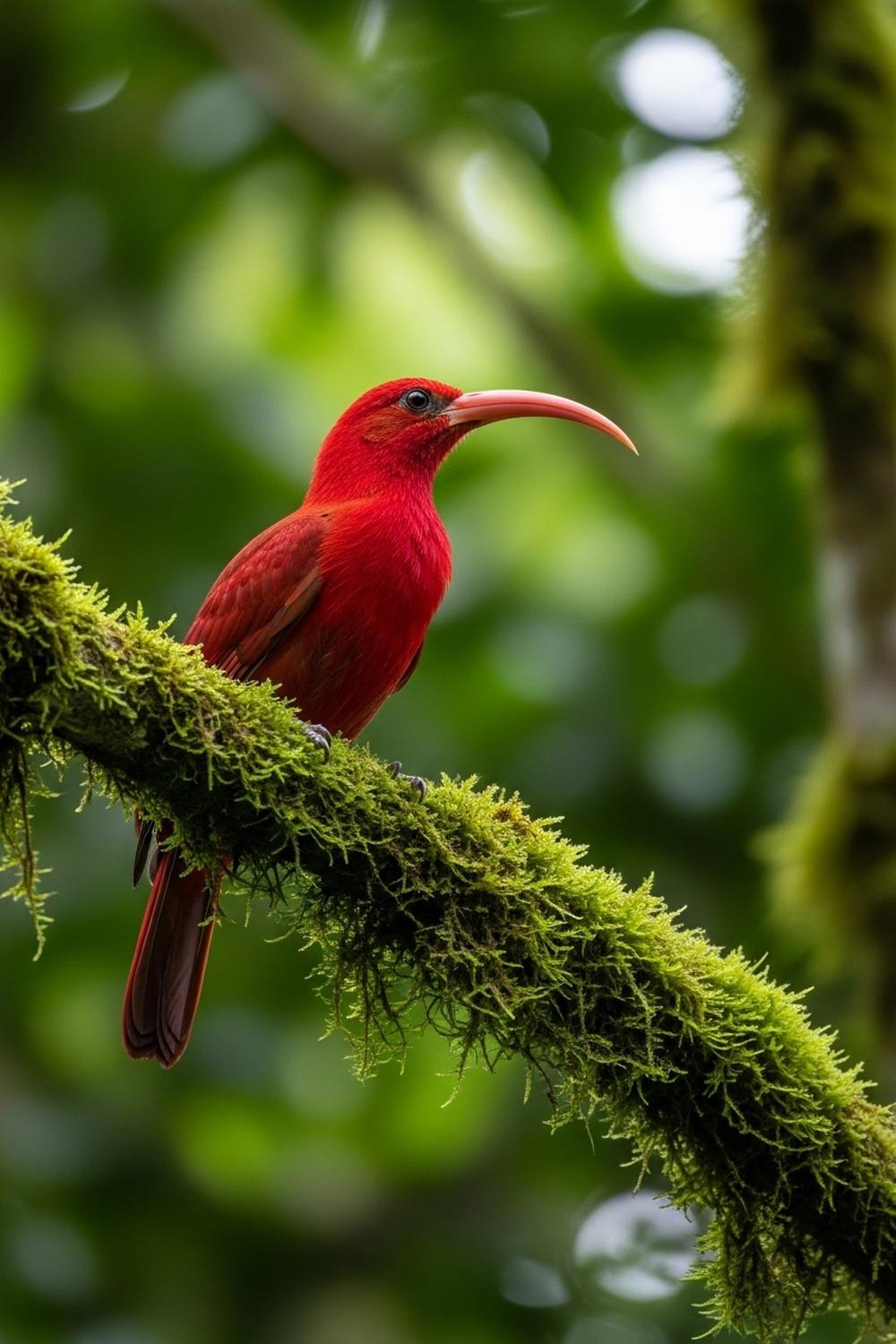
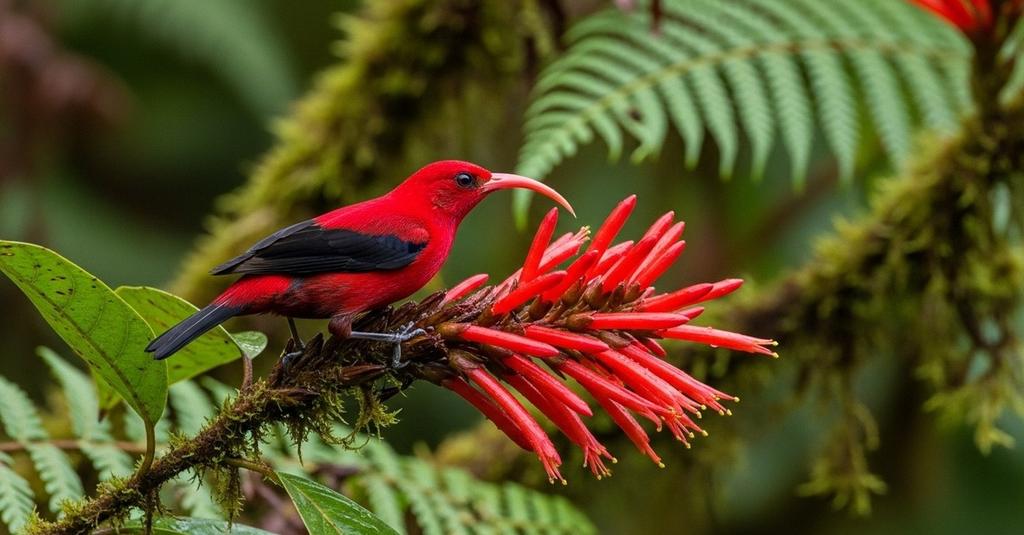
There’s something about how the ʻIʻiwi Hawaiian bird moves through the cloud forests that makes you understand why the early naturalists couldn’t stop writing about it. It’s not just the color — though that salmon-pink beak and scarlet plumage would stop you mid-hike if you saw it. It’s the way it belongs there, the way everything about its body has been shaped, over millions of years, to fit into this exact ecosystem on these exact islands. The curve of that beak isn’t decoration. It’s a conversation with specific flowers that nothing else on Earth can pollinate quite like it does.
And then the silence started.
Key Facts
- USGS monitoring data shows an estimated 72% decline in ʻIʻiwi populations on Maui between 1994 and 2018.
- Mosquitoes arrived in Hawaii around 1826, believed to have come in water casks aboard the ship Wellington.
- Avian malaria mortality in ʻIʻiwi after even minimal mosquito exposure can exceed 90%, compared to near-zero in mainland birds.
- Mosquitoes cannot survive in the cold air above roughly 4,500 feet, the altitude refuge that long protected the birds.
- Hawaiian honeycreepers have lost more than 50% of their historically recorded species; roughly 17 survive today out of over 50 once documented.
In short: The ʻIʻiwi Hawaiian bird, a scarlet honeycreeper, faces extinction from avian malaria spread by mosquitoes that arrived around 1826. Maui populations fell an estimated 72% between 1994 and 2018, and warming temperatures are erasing the high-altitude refuge above 4,500 feet that once kept this keystone pollinator safe.
The Beak That Built a Forest
Carter Atkinson from the U.S. Geological Survey has spent decades with the data on Hawaiian honeycreepers, and what he’s documented is wild — the ʻIʻiwi and the tube-shaped flowers of Hawaiian lobelioids co-evolved so tightly, so specifically, that they’re basically locked together. You can’t separate them without the whole ecosystem starting to unravel.
Early European naturalists saw flocks so large they literally turned the canopy red. Not metaphor. Entire forests shimmering with movement.
That doesn’t happen anymore.
One Bite. That’s All It Takes.
Here’s the thing: the ʻIʻiwi evolved with zero defenses against mosquitoes or avian malaria. None. Why would it? The islands had neither for millions of years. Then early 1800s happen. Ships arrive. Water barrels arrive. And inside those barrels — mosquito larvae.
Culex quinquefasciatus colonized the islands in a handful of generations.
The ʻIʻiwi had no answer.
The avian malaria parasite — Plasmodium relictum — moves through an infected bird’s system so fast that researchers watching this happen in labs describe it as almost clinical in its efficiency. One bite. One parasite load. Dead bird. Studies show infection rates in exposed populations hitting nearly 100%. Mortality follows rapidly. It’s not metaphor. It’s just what happens when a species meets a threat it never had time to evolve around.
Climate Change Is Rewriting the Map
For decades, the ʻIʻiwi had one thing working: altitude. Mosquitoes can’t survive in the cold, wet air above roughly 4,500 feet. So the birds climbed. The refugium held. It worked until it didn’t.
Warming temperatures are creeping up the mountain slopes.
The cool zones that protected these birds for generations? Shrinking. The ʻIʻiwi’s last stronghold is being compressed from below. On Oʻahu and Molokaʻi, populations haven’t just declined — they’ve effectively vanished. Maui used to be the stronghold. Now it’s down more than 75% in recent decades. That last fact kept me reading for another hour, cross-checking the numbers because they seemed too steep.
They weren’t.
You can explore how other island species are fighting similar battles at this-amazing-world.com, where the pattern starts to look terrifyingly consistent across different ecosystems.
What Happens When the Red Disappears
The ʻIʻiwi isn’t just a bird. It’s infrastructure. Keystone species — ecologists use that term for creatures whose presence props up everything around them. The ʻōhiʻa lehua flowers it pollinates depend on it. The entire native Hawaiian forest ecosystem was built, in part, around this relationship. When the ʻIʻiwi starts vanishing from an area, the flowers it pollinated begin to decline. When the flowers decline, the other species that depend on them follow. It’s a cascade.
Researchers walking through lower-elevation Hawaiian forests today describe something unsettling: an eerie quiet. No scarlet flash between the trees. No whistling call cutting through the mist. Just wind and the sound of something missing.
The Mosquito Solution Involves Mosquitoes
The most promising intervention being tested right now is almost paradoxical: fighting mosquitoes with mosquitoes. Researchers are releasing male mosquitoes carrying Wolbachia bacteria — naturally occurring, completely harmless to other species. When these males mate with wild females, the eggs don’t develop. No larvae. No next generation. In early trials, target populations have declined dramatically in test areas.
It won’t fix the climate.
But it might buy time. And time is what the ʻIʻiwi needs most right now. Conservationists are also working on captive breeding programs, exploring assisted evolution — essentially breeding for slightly higher malaria tolerance. The biology is genuinely hard. The timeline is harder. Every warm year means mosquitoes climb higher and the window narrows another notch.
By the Numbers
- An estimated 72% decline in ʻIʻiwi populations on Maui between 1994 and 2018 according to USGS monitoring data. One of the steepest recorded drops for any Hawaiian honeycreeper in that period.
- Mosquitoes arrived around 1826 — believed to have hitched a ride in water casks aboard the ship Wellington. Nearly 200 years of ecological damage from one accidental introduction.
- Avian malaria mortality in ʻIʻiwi after even minimal mosquito exposure can exceed 90%, compared to near-zero mortality in mainland bird species that evolved alongside the parasite.
- Hawaiian honeycreepers have lost more than 50% of their historically documented species since human arrival. Roughly 17 species survive today. Over 50 were recorded historically.
Field Notes
- The ʻIʻiwi’s song sounds like “a rusty gate hinge” — a gurgling, squeaky call that completely doesn’t match the bird’s appearance. Visitors who finally hear one in the wild often can’t believe that brilliant red creature is making that sound.
- ʻIʻiwi, pronounced roughly “ee-EE-vee,” appears extensively in traditional Hawaiian chants and poetry, where its red feathers were used in sacred royal cloaks called ʻahuʻula — each cloak required thousands of feathers and took generations to complete.
- The curved beak appears in the bird’s likely ancestral species too, but the modern curve is more pronounced. Evidence that co-evolution with tube flowers continued long after the ancestral split — flowers getting longer, beaks getting deeper to match them.
Why This Matters Everywhere Else
The ʻIʻiwi Hawaiian bird has become something like a canary in the coal mine. Except it’s real. Except it’s happening right now. Except the coal mine is the entire planet. What’s unfolding in the Hawaiian cloud forests is a compressed, visible version of what climate change does to isolated ecosystems everywhere: it shifts the boundaries. Safe zones shrink. Threats advance. Species that survived in narrow ecological niches for millions of years run out of altitude, latitude, luck. The ʻIʻiwi just happens to be doing it in one of the most beautiful places on Earth, which makes it impossible to ignore.
If we can protect the ʻIʻiwi, we’re not just saving one bird. We’re proving that intervention works before the last breeding pair disappears into a forest that’s already gone quiet.
The ʻIʻiwi survived volcanic eruptions, ice ages, millions of years of island isolation. What it couldn’t survive was a water barrel full of mosquito larvae and two centuries of warming temperatures. But the story isn’t finished. People are fighting for it right now — with science, with genuine urgency, with the stubborn belief that one red bird in a green forest is worth saving. If this keeps you up at night, there’s more at this-amazing-world.com. The next story is even stranger.
Frequently Asked Questions
Q: Why is the ʻIʻiwi Hawaiian bird endangered?
The ʻIʻiwi is endangered primarily because of avian malaria, spread by mosquitoes that arrived in Hawaii around 1826 aboard the ship Wellington. The bird evolved with no defenses against the parasite Plasmodium relictum, and mortality after even minimal mosquito exposure can exceed 90%. USGS data shows an estimated 72% decline on Maui between 1994 and 2018. Warming temperatures are now shrinking the cool high-altitude zones that once protected the birds.
Q: What role does altitude play in protecting the ʻIʻiwi?
Mosquitoes cannot survive in the cold, wet air above roughly 4,500 feet, so for decades the ʻIʻiwi found refuge by climbing to higher elevations where avian malaria could not reach them. This high-altitude zone acted as a critical disease-free stronghold. However, warming temperatures are pushing mosquitoes farther up the mountain slopes each year, compressing the birds’ last safe habitat from below and narrowing their survival window.
Q: Why does the ʻIʻiwi matter to the Hawaiian forest?
The ʻIʻiwi is a keystone species whose curved salmon-pink beak co-evolved to pollinate specific tube-shaped Hawaiian flowers, including ʻōhiʻa lehua and lobelioids, that few other animals can service. When the bird vanishes from an area, the flowers it pollinated decline, triggering a cascade through the native forest ecosystem. Its loss therefore threatens not just one species but the structure of entire Hawaiian cloud-forest communities.
Q: How are conservationists trying to save the ʻIʻiwi?
One leading intervention releases male mosquitoes carrying naturally occurring Wolbachia bacteria; when they mate with wild females, the eggs fail to develop, collapsing mosquito populations in test areas. This approach is harmless to other species and has cut target populations dramatically in early trials. Conservationists are also pursuing captive breeding and assisted evolution to breed for slightly higher malaria tolerance, buying time against the warming climate.
Illustrations are AI-generated. Article fact-checked and human-edited. Our editorial standards.