The Fake Doctors Who Made Nathan’s Famous a Legend
Nathan Handwerker started with a problem nobody wanted to solve: Americans in 1916 weren’t buying cheap hot dogs because cheap hot dogs meant something — they meant danger. A young immigrant with a cart on Coney Island was about to fix that with the strangest marketing move ever, and it didn’t involve lying once.
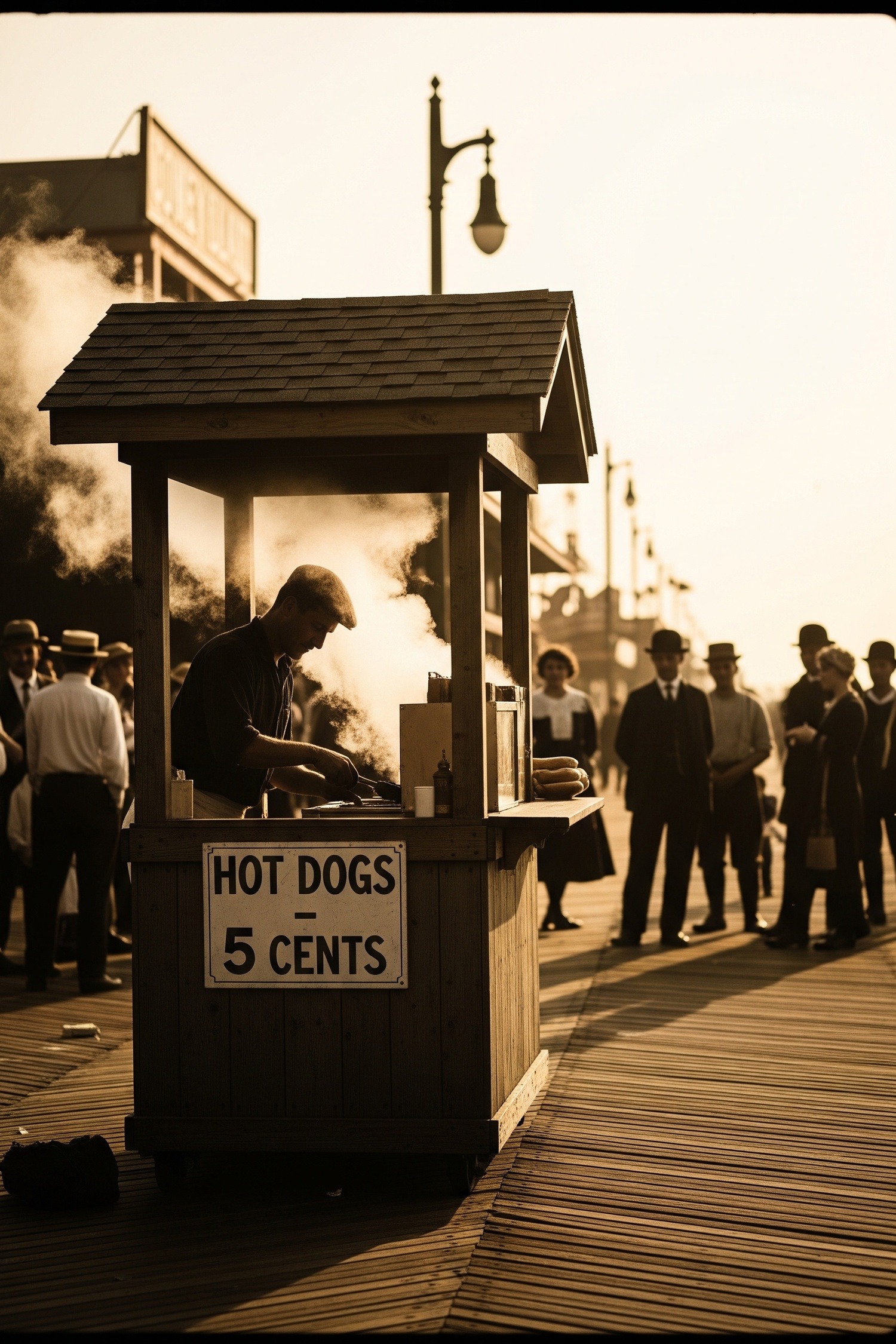
He was selling frankfurters for a nickel. His competitors charged ten. The math was simple. The psychology was impossible. People walked past his cart like it was invisible, even though he’d gotten the recipe right and the price was right and everything about it should have worked. The problem wasn’t the food. The problem was fear, baked into the American consciousness by a book published ten years earlier.
Key Facts
- Nathan Handwerker began selling frankfurters for five cents on Coney Island in 1916, half the ten cents competitors charged.
- Upton Sinclair’s 1906 novel The Jungle had made Americans fear cheap processed meat.
- Nathan paid men in white coats to eat his hot dogs, performing authority to signal safety.
- Robert Cialdini formally codified social proof in the 1980s — decades after Nathan exploited it.
- Joey Chestnut set the men’s hot dog eating record in 2021 with 76 hot dogs and buns in 10 minutes.
In short: In 1916 Nathan Handwerker sold five-cent hot dogs on Coney Island, but customers feared cheap meat after Upton Sinclair’s 1906 book The Jungle. He hired men in white coats to eat confidently at his cart, manufacturing trust through social proof decades before Robert Cialdini named it. Nathan’s Famous endured, spawning the 1972 eating contest.
The Book That Made America Terrified of Meat
The Jungle by Upton Sinclair came out in 1906. Graphic doesn’t cover it. Food historian Ann Vileisis has documented how the novel rewired American attitudes toward processed meat — and by 1916, a cheap hot dog didn’t just look like a bargain. It looked like a warning. People had been trained to distrust it.
Nathan couldn’t buy trust. He didn’t have the money.
What he had was sharper than that.
The White Coat Trick
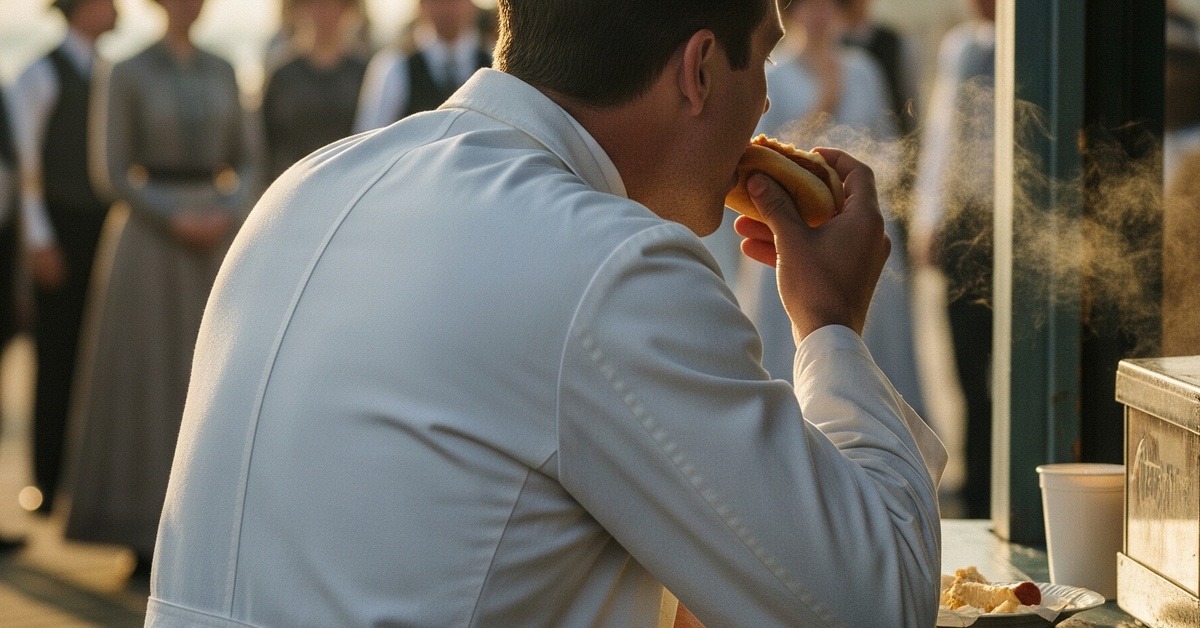
It is 1916. Nathan finds men — medical students, supposedly, though the records are vague and that vagueness might be intentional — and he pays them to stand near his cart in white coats. They eat his frankfurters slowly. Confidently. Like this is the most ordinary thing in the world. No signs. No sales pitch. No announcement. Just white coats. Just authority. Just the unmistakable visual code that says this is safe.
The crowd draws its own conclusions.
The crowd gets in line.
Within days, Nathan’s cart has the longest line on the boardwalk. The competitors — the ones charging twice as much — are watching him move product faster than they are. Trust hadn’t been earned. It had been performed. And it worked so completely that nobody even bothered to question whether those men were actually doctors. That last fact kept me reading for another hour.
What Nathan Figured Out Before Psychology Had a Name For It
Social proof didn’t get formally named until the 1980s, when Robert Cialdini codified it in his research on influence and persuasion. But Nathan was running the experiment on a Coney Island boardwalk in 1916, watching it work in real time. People look to others to figure out what’s safe, what’s correct, what’s desirable. A white coat is shorthand for authority. A confident person eating something is shorthand for safety. Nathan engineered both of those signals — and let human behavior do the heavy lifting.
He didn’t forge certificates. He didn’t lie about ingredients. He just understood that trust is mostly theater, and he performed it brilliantly.
From Five Cents to a Restaurant That Never Closed
The white coat moment was the spark. Everything after that was momentum.
Through the 1920s and 30s, Nathan expanded from cart to full restaurant — corner of Surf and Stillwell Avenues, Coney Island. By the 1950s, it wasn’t just a place to eat. It was a destination. Politicians came for the photo ops. Celebrities came because the hot dogs were actually excellent. And then in 1972, Nathan’s Famous launched the eating contest that would eventually reach television audiences of over 1 million viewers per broadcast. The five-cent hot dog that started as a con had become American mythology.
The brand that nearly failed because it was too cheap became a symbol of authenticity.
Numbers That Sound Made Up
- $0.05 per frankfurter in 1916 — half what competitors like Feltman’s charged.
- An estimated 500 million frankfurters sold annually across all channels now. From one cart to that in just over a century.
- The Nathan’s Famous Fourth of July eating contest draws global television audiences of over 1 million per broadcast. Started as a local bit in 1972.
- Joey Chestnut set the men’s record in 2021: 76 hot dogs and buns in 10 minutes. This number is simultaneously very American and genuinely disturbing.
The Details Nobody Forgets
- Nathan learned his trade working for Charles Feltman — the man who charged ten cents and who Nathan would eventually outlast. Feltman’s closed in 1954. Nathan’s is still open.
- That original location at Surf and Stillwell? Still operating. One of the longest-continuously-running fast food establishments in America.
- The “doctors” Nathan hired were almost certainly not actual physicians. But he never claimed they were. He just made sure they looked the part and let the crowd fill in the story itself. That’s the genius of it.
Why Nathan’s Famous Hot Dogs History Still Matters
This isn’t actually a story about hot dogs. It’s a story about how trust gets manufactured — and how often the manufacturing matters more than the substance underneath.
Nathan understood something behavioral economists would spend the next hundred years proving: humans aren’t rational evaluators. We’re pattern recognizers. We see a white coat and we make decisions before our thinking brains have time to catch up. Every celebrity endorsement, every “doctor-recommended” label, every line of people outside a restaurant owes something to what Nathan figured out on a Coney Island boardwalk.
Here’s the part that makes it a legacy instead of just a con: the product was actually good.
The initial trick was the door. Once people walked through it, the food kept them coming back. Once they tasted it, once they told friends, once it became tradition — the white coats became irrelevant. The real thing had replaced the performance. That’s the difference between a stunt that dies and something that lasts 108 years and counting.
One immigrant. One borrowed costume. One five-cent hot dog that was actually worth eating. That’s all it took to build a legacy. Nathan’s Famous didn’t become an American icon because of a budget or a slogan. It became one because Nathan Handwerker paid attention to how people actually make decisions — and then orchestrated a moment that made them decide in his favor. The performance became the brand. The brand became the legend. If this kind of story has you falling down research rabbit holes at 2 AM like I did, there’s more at this-amazing-world.com — and the next one is even stranger.
Frequently Asked Questions
Q: Why didn’t people buy Nathan’s cheap hot dogs at first?
Because cheap meat signaled danger. Upton Sinclair’s 1906 novel The Jungle had graphically rewired American attitudes toward processed meat, so by 1916 a five-cent hot dog looked less like a bargain than a warning. Nathan Handwerker had the recipe and the price right, but people walked past his cart. The problem wasn’t the food — it was fear baked into the public consciousness, and he couldn’t afford to buy trust.
Q: What was the white coat trick?
Nathan paid men — reportedly medical students — to stand near his cart in white coats and eat his frankfurters slowly and confidently. There were no signs or sales pitches, just the visual code of authority suggesting the food was safe. The crowd drew its own conclusions and lined up. Within days Nathan’s cart had the longest line on the boardwalk. He never claimed the men were doctors; he simply let the crowd fill in the story.
Q: How does this connect to social proof?
Nathan was running a live experiment in social proof — the tendency to look to others to judge what’s safe and desirable — on a Coney Island boardwalk in 1916. Robert Cialdini only formally codified the concept in his research on influence in the 1980s. A white coat is shorthand for authority and a confident person eating is shorthand for safety; Nathan engineered both signals and let human behavior do the heavy lifting, without forging certificates or lying about ingredients.
Q: How big did Nathan’s Famous become?
Enormous. Nathan expanded from a cart to a full restaurant at the corner of Surf and Stillwell Avenues, outlasting his old employer Charles Feltman, whose business closed in 1954. In 1972 Nathan’s launched the Fourth of July eating contest, which now draws global television audiences of over a million per broadcast; Joey Chestnut set the men’s record in 2021 with 76 hot dogs in 10 minutes. The brand has lasted over a century.
Illustrations are AI-generated. Article fact-checked and human-edited.