Frogs That Pull Their Stomachs Out — And Wipe Them Clean
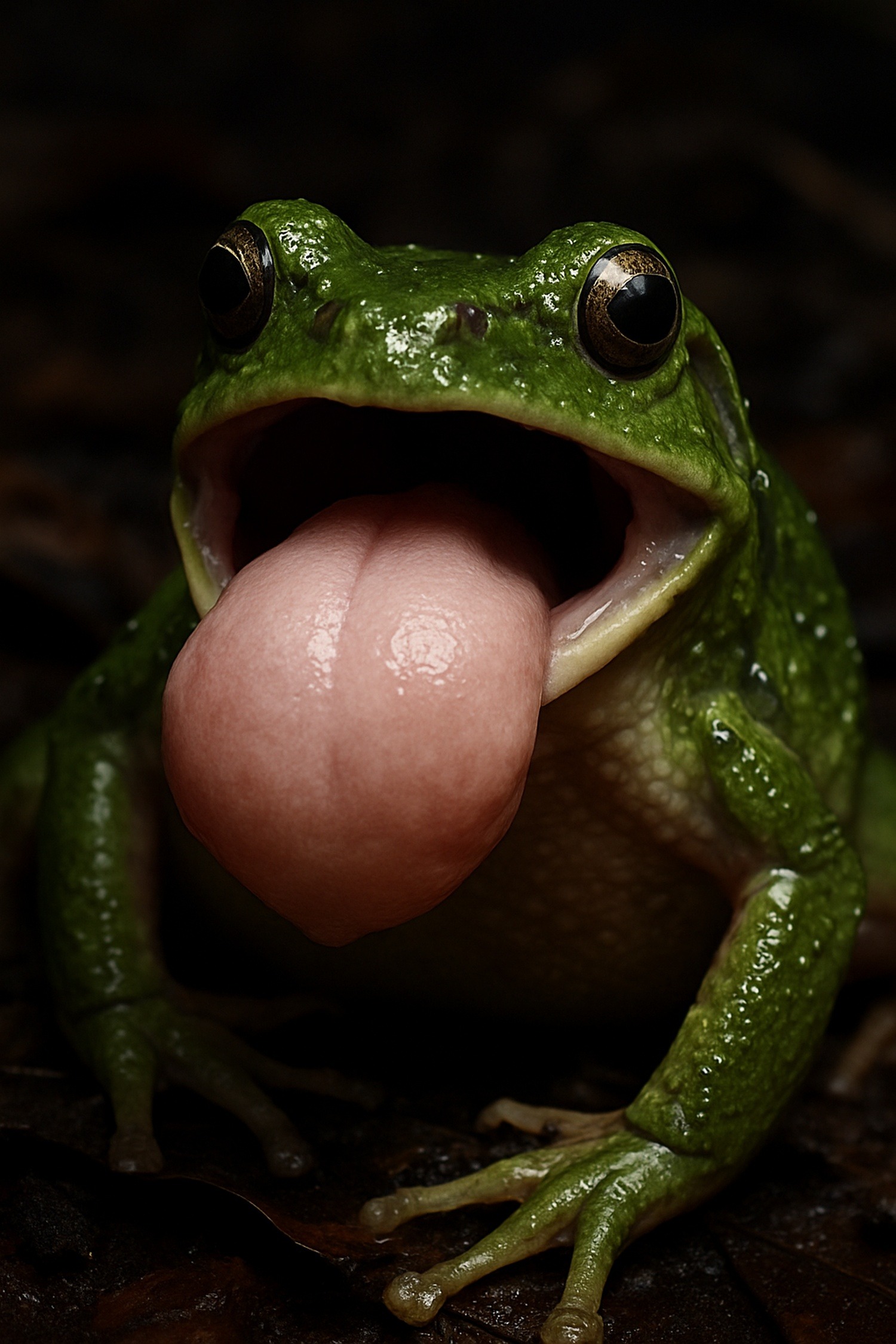
A frog’s stomach emerges through its own mouth, glistening and inverted, dangling in open air while the animal remains perfectly calm. This is frog gastric eversion — and the truly unsettling part isn’t that it happens, but that the frog then wipes the organ clean with a front leg and swallows it back down as if nothing remarkable just occurred. Not an injury. Not an accident. Not even distress. Just Tuesday in the amphibian world, repeated across dozens of species from European gardens to tropical canopies, and we’re still struggling to explain why it works at all.
The behavior stops a room cold the first time someone describes it in detail. Common toads perform it. Tree frogs clinging to wet bark perform it. Laboratory documentation stretches back a century, yet the truly puzzling part — that deliberate wiping motion — only entered serious scientific focus in the last twenty years. Somewhere in the gap between what we assumed about “simple creatures” and what they’re actually doing lives something we haven’t quite named yet.
Key Facts
- Frogs can evert their stomach through their mouth, wipe it clean with a forelimb, and swallow it back — a behavior called gastric eversion.
- In the common toad (Bufo bufo) the entire eversion-and-wipe sequence typically completes in under 30 seconds.
- Gastric eversion was documented as far back as the early twentieth century, but the deliberate forelimb wipe was filmed at UC Berkeley in the 1990s.
- A 2004 study in Herpetologica found the forelimb wiping motion varied with the extent of the everted surface — calibrated, not reflexive.
- Some 1980s studies estimated eversion removes up to 90% of ingested toxins from the stomach surface.
In short: Frogs can push their entire stomach out through their mouth, wipe it clean with a front leg, and swallow it back — gastric eversion. In the common toad the sequence takes under 30 seconds. Filmed at UC Berkeley in the 1990s and studied in Herpetologica in 2004, the calibrated wipe helps ambush predators expel toxic prey, removing up to 90% of toxins.
The Stomach That Lives Outside the Body
Scientific literature formally documented gastric eversion as far back as the early twentieth century. But something crucial went unnoticed for decades: the frogs weren’t just passively everting their stomachs. They were actively using a forelimb to scrub the exposed surface before reinserting the organ. Researchers at UC Berkeley studying amphibian toxin response in the 1990s caught this distinction on film, and the precision they observed changed how the entire behavior should be classified.
The forelimb wipe isn’t a spasm. It’s directional, covering the exposed stomach surface in what researchers describe as functionally analogous to cleaning a lens — short strokes, specific coverage, no thrashing, no apparent distress. According to herpetologists tracking Bufo bufo, the common toad, the entire eversion-and-wipe sequence typically completes in under thirty seconds. The behavior is consistent enough across individuals to rule out random motor activity. The stomach itself lines with a mucous membrane durable enough to survive brief atmospheric exposure without cellular damage — a tolerance with no real parallel in mammalian gastric anatomy.
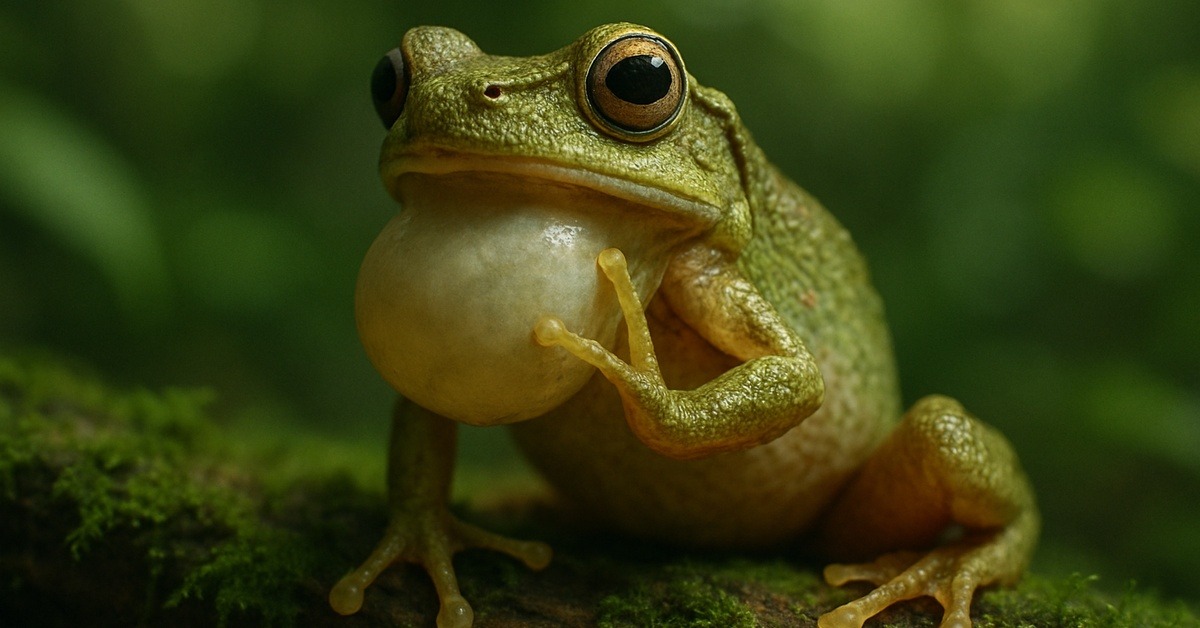
Field herpetologists working in British wetlands documented the sequence in wild common toads after accidental ingestion of toxic prey, including certain beetle species. The toad everts, wipes, and within minutes resumes normal activity. No visible trauma. No prolonged recovery. The speed is almost offensive.
Why Frogs Do What Mammals Simply Cannot
Contrast this with mammalian anatomy, and the barrier becomes obvious. Human gastric tissue isn’t designed to tolerate exposure to open air, atmospheric pressure differentials, or mechanical abrasion by a hand. Gastric eversion in a human would rupture blood vessels, trigger catastrophic infection, and almost certainly prove fatal within hours. Frogs possess several intersecting anatomical features that prevent this fate. Their stomachs connect to the esophagus via a relatively short, flexible tube. Gastric walls contain smooth muscle arranged to permit full inversion without tearing. And crucially — unlike mammals — frogs lack a true cardiac sphincter that would resist eversion under pressure.
Why does this matter? Because it means the behavior isn’t some fragile accident waiting to fail — it’s locked into the frog’s basic architecture. Evolution didn’t design this exactly, but it didn’t remove it either. Somewhere in the ancient lineage of anurans, the capacity to evert and recover became a survival advantage. You might find yourself reading this and thinking of other animals whose calmly alien behaviors we’ve barely begun to catalogue — like the mossy frog of Vietnam and Laos, which vanishes into plain sight with a single shift of posture, a reminder of how much amphibians continue to surprise us.
The evolutionary pressure driving gastric eversion is straightforward: frogs are ambush predators who eat fast and ask questions later. A toad doesn’t inspect its meal carefully before swallowing — it sees movement, strikes, and ingests. Against toxic beetles, hairy caterpillars, and chemically defended insects, that strategy creates an urgent problem. Gastric eversion solves it without requiring the energy cost of full digestion followed by elimination. Some 1980s studies estimated that eversion removes up to 90% of ingested toxins from the stomach surface, which would make it one of the most efficient detoxification mechanisms in the amphibian world.
Juvenile toads as young as six weeks post-metamorphosis have been documented performing the full eversion-and-wipe sequence. The wiping motion appears fully formed that early — not learned behavior in any gradual sense, but functionally present almost immediately. That fact alone narrows the explanatory options considerably.
The Wiping Motion: More Than Reflex
Here’s where the story gets genuinely complicated. A reflex — a true, simple reflex — doesn’t require directional motor control. It fires and stops. The wiping component of frog gastric eversion doesn’t fit that definition, and this is the part that matters more than it sounds. Research published in Herpetologica in 2004 examined high-speed video footage of multiple frog species performing stomach eversion and found that the forelimb motion showed variable pressure and coverage depending on the extent of the everted surface. Animals with fully everted stomachs wiped more extensively than those with partial eversions.
That’s not reflexive behavior. That’s calibrated behavior. National Geographic’s documentation of toad biology notes the extraordinary sensory sensitivity of amphibian skin, which likely extends to the gastric mucosa — meaning the frog may actually be responding to tactile feedback from the everted stomach surface during the wipe. Whether that constitutes something like sensation in any meaningful sense remains a question researchers carefully avoid answering.
Some tree frog species have been observed wiping the stomach multiple times in succession when initial passes didn’t remove visible debris. Repetition in response to incomplete results isn’t a hallmark of pure reflexive action — it suggests some form of feedback loop, internal or sensory, that the animal is acting on.
This challenges a persistent assumption that small, cold-blooded animals operate on something close to autopilot. The calibrated wipe is one example. But there are others. What that feedback loop actually involves neurologically is a question the field hasn’t fully answered. And there’s something productive about that gap: it sits between too complex to dismiss as pure reflex and too alien to map onto mammalian cognition, which is exactly where interesting biology tends to live.
What Frog Gastric Eversion Reveals About Amphibian Survival
Amphibians are the most threatened vertebrate class on Earth — over 40% of species face extinction risk according to the IUCN’s 2022 assessment — yet they’ve survived roughly 370 million years, outlasting mass extinctions that eliminated far more structurally complex animals. Part of that durability comes from exactly this kind of anatomical flexibility: bodies that do unexpected things in unexpected circumstances. The Smithsonian National Museum of Natural History’s amphibian research division catalogued dozens of physiological responses unique to anurans.
From freeze tolerance in wood frogs to the ability of certain species to absorb water entirely through their skin rather than drinking — these are the features that never made it into popular imagination. Gastric eversion sits in that same category, a behavior that looks bizarre from outside the clade but makes perfect functional sense once you understand the pressures that shaped it. Watching a species accumulate this many survival mechanisms across 370 million years, you stop seeing amphibians as evolutionarily simple and start seeing them as systematically brilliant at staying alive.
What remains less understood is how frog gastric eversion interacts with the immune response. Exposing the gastric lining to open air and then mechanically abrading it should introduce contamination risk in theory. Yet documented cases of infection following the behavior are essentially absent from the literature. That absence suggests either a robust local immune response along the gastric mucosa, antimicrobial compounds in the mucus coating the stomach lining, or some combination of both. Researchers at the American Museum of Natural History raised this question in a 2018 review paper on amphibian toxin tolerance, and it remains an open line of inquiry.
If the gastric lining carries antimicrobial properties strong enough to survive eversion without infection, those compounds might have pharmaceutical relevance. Frog skin has already yielded medically significant peptides — the leap from skin to stomach lining isn’t enormous. It’s a thread worth pulling.
How It Unfolded
- Early 1900s — First formal descriptions of gastric eversion in anurans appear in European herpetological literature, noted primarily as an anatomical curiosity rather than a functional behavior.
- 1980s — Studies on amphibian toxin response begin quantifying eversion as an active detoxification strategy, with estimates suggesting up to 90% of surface toxins removed per eversion event.
- 2004 — High-speed video analysis published in Herpetologica documents calibrated forelimb wiping motion across multiple species, shifting the behavior’s classification from reflex toward purposeful motor action.
- 2018 — American Museum of Natural History review paper raises the open question of antimicrobial gastric mucosa as a potential research direction, connecting eversion biology to pharmaceutical interest in amphibian compounds.
By the Numbers
- Over 40% of the world’s amphibian species are threatened with extinction, according to the IUCN Red List assessment published in 2022.
- Frog gastric eversion and reinsertion typically completes in under 30 seconds in documented Bufo bufo observations.
- Estimated 90% of surface toxins removed from the stomach during a single eversion event, based on 1980s toxin-response studies.
- Approximately 7,000 known amphibian species exist globally, of which anurans (frogs and toads) account for roughly 6,500.
- Juvenile toads as young as six weeks post-metamorphosis have been documented performing the full eversion-and-wipe sequence, suggesting the behavior is present essentially from the onset of terrestrial life.
Field Notes
- In 2004, researchers analyzing high-speed footage found that frogs with only partially everted stomachs performed shorter, less extensive wipes — suggesting the animal responds to the actual extent of exposure rather than executing a fixed sequence. The footage, gathered across three European species, was the clearest early evidence that something beyond simple reflex was operating.
- The stomach lining of most frog species is coated in a mucus layer with suspected antimicrobial properties — meaning the organ may effectively sanitize itself during the eversion, not just rely on the wipe to do the cleaning work.
- Wood frogs in North America can survive being frozen solid in winter — their hearts stop, their blood doesn’t flow, and they thaw in spring without harm. Gastric eversion in the same clade suggests anurans carry a whole catalog of physiological tolerances that mammals simply never evolved.
- Researchers still can’t fully explain why the frog doesn’t gag or trigger a swallowing reflex during reinsertion of the everted stomach — the motor sequence required to reverse the eversion without triggering normal esophageal reflexes remains poorly mapped at the neurological level.
Frequently Asked Questions
Q: What exactly is frog gastric eversion, and which species do it?
Frog gastric eversion is the process by which a frog physically inverts its stomach through its mouth, exposing the organ’s inner lining to the outside. It’s been documented in multiple species including Bufo bufo (the common European toad), various tree frog species, and others. It’s distinct from vomiting — the entire stomach emerges, not just contents. The behavior was formally described in scientific literature in the early twentieth century and has since been observed across both Old and New World anuran species.
Q: Why does this not kill the frog?
Frogs avoid injury during gastric eversion because of several interlocking anatomical features. Their gastric walls contain smooth muscle arranged to permit full inversion without tearing. They lack the tight cardiac sphincter that would block the process in mammals. And the gastric mucosa — the inner lining — is coated with a protective mucus layer that appears to resist both atmospheric exposure and contamination. Unlike human gastric tissue, which requires continuous blood pressure and controlled chemical environments to function, the frog’s stomach tolerates brief external exposure without cellular damage.
Q: Is the wiping motion really deliberate, or is it just a reflex?
This is the genuinely open question. High-speed video analysis published in Herpetologica in 2004 found that the forelimb wipe varies in extent and pressure depending on the degree of stomach eversion — meaning it’s not a fixed motor pattern firing identically every time. That calibration doesn’t fit the classic definition of a simple reflex. A common misconception is that frogs operate almost entirely on hardwired autopilot. The wiping behavior suggests otherwise: there’s a feedback element involved, even if its neurological basis isn’t yet fully mapped.
Editor’s Take — Alex Morgan
What keeps me thinking about frog gastric eversion isn’t the act itself — it’s the wipe. The eversion you can file under “amphibians are built differently.” But the calibrated forelimb cleaning, varying in coverage based on how much stomach is actually exposed? That’s the part that doesn’t sit quietly. We’re looking at an animal with a brain the size of a small pea making adjustments in real time to a task it didn’t learn from another frog. Whatever is happening in that gap — between sensation and response, between stimulus and measured action — we don’t have a clean word for it yet.
Right now, in a pond in Somerset or a rainforest gully in Costa Rica, a frog is pulling its stomach out of its mouth and wiping it down with quiet efficiency. Nobody’s watching. No camera is rolling. The behavior has been happening for millions of years in exactly that private, functional way — long before any human was around to find it strange. What else is out there, in the leaf litter and the shallow water, doing something we haven’t thought to look for yet? The honest answer is: probably quite a lot. And that, more than any single behavior, is the thing worth sitting with.
Illustrations are AI-generated. Article fact-checked and human-edited.