Giant Panda Cubs: The Most Extreme Birth in Nature
Ninety grams. That’s what emerges into the world when a 100-kilogram mother gives birth to a giant panda cub — smaller than a stick of butter, smaller than most human hands can comfortably cradle. No placental mammal on Earth comes close to this size ratio. The panda makes the biologically impossible look routine, which means something fundamental about evolution got solved here that we’re still working to understand.
Inside Sichuan Province’s bamboo-dense valleys, keepers at the China Conservation and Research Center for the Giant Panda watch these births with surgical focus. A pink comma of life appears — blind, nearly translucent, its thin skin barely containing the fragile machinery beneath. The question isn’t whether it survives the first week. The question is what this radical biology tells us about the stubborn, strange logic of how species actually adapt when survival depends on the impossible.
Key Facts
- A newborn giant panda cub typically weighs between 80 and 200 grams (90 to 130 grams most common), while its mother weighs 100 kilograms or more, a size ratio of roughly 1 to 900.
- Researchers at the Chengdu Research Base of Giant Panda Breeding logged birth weights across hundreds of captive deliveries through the 1990s and 2000s, confirming the tiny cub size is the species’ consistent biological strategy.
- Pandas must eat bamboo for up to 14 hours a day, and a 2019 analysis in Smithsonian Magazine documented that they retain less than 20 percent of the nutrients in the bamboo they consume.
- A panda cub doubles in weight in its first week, reaches close to 500 grams by four weeks, and may reach a kilogram by eight weeks.
- Roughly 50 percent of captive panda pregnancies result in twins, but a wild mother can only care for one cub and abandons the other.
In short: Giant panda cubs are born astonishingly small—around 90 grams from a 100-kilogram mother, a roughly 1-to-900 size ratio unmatched among placental mammals. This extreme birth size is an evolutionary workaround for the panda’s nutrient-poor bamboo diet, offloading growth to the postnatal phase where the mother acts as a living incubator, and it explains why twin births require human intervention in conservation programs.
The Numbers That Break Every Mammal Rule
A newborn giant panda cub typically arrives weighing between 80 and 200 grams — 90 to 130 grams being most common. Its mother weighs 100 kilograms or more. That’s a size ratio of roughly 1 to 900. Consider the alternatives: a human baby represents about 1/20th of its mother’s body weight. A blue whale calf is roughly 1/40th. Among placental mammals — the group that includes every land animal gestating its young internally with a full placenta — the panda occupies a category entirely its own.
Researchers at the Chengdu Research Base of Giant Panda Breeding documented this disparity systematically through the 1990s and 2000s, logging birth weights across hundreds of captive deliveries. Their records confirmed what field biologists had long suspected: the giant panda cub birth size isn’t a quirk of captivity. It’s the species’ actual, consistent biological strategy, refined over millions of years.
Here’s the thing: the reason traces back to diet. Pandas subsist almost entirely on bamboo — a food source so nutritionally poor that the animal must eat for up to 14 hours a day just to meet its energy needs. Bamboo delivers calories, but barely. There’s almost no fat reserve available to fuel a long, metabolically expensive pregnancy. So the panda’s body found a workaround. Keep the fetus tiny. Deliver it early. Finish the job outside the womb. It’s a biological shortcut born of constraint, not elegance.
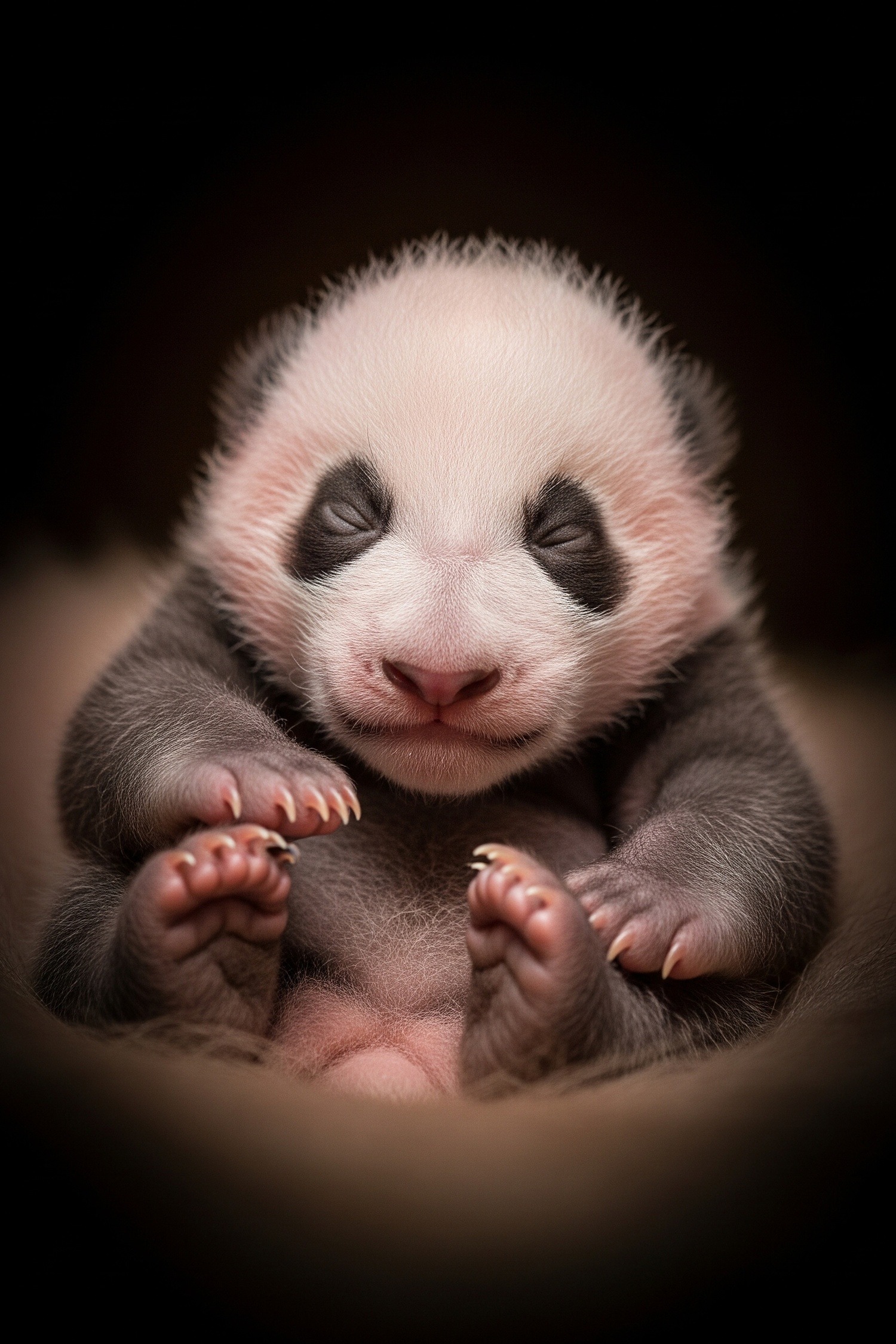
The result is a cub that looks, at birth, less like a bear and more like a larval organism — eyes sealed shut, ears flat against the skull, black-and-white markings entirely absent. Just pink skin, thin as tissue paper, and a heartbeat visible through the translucent surface.
What the Mother Does in the Weeks After Birth
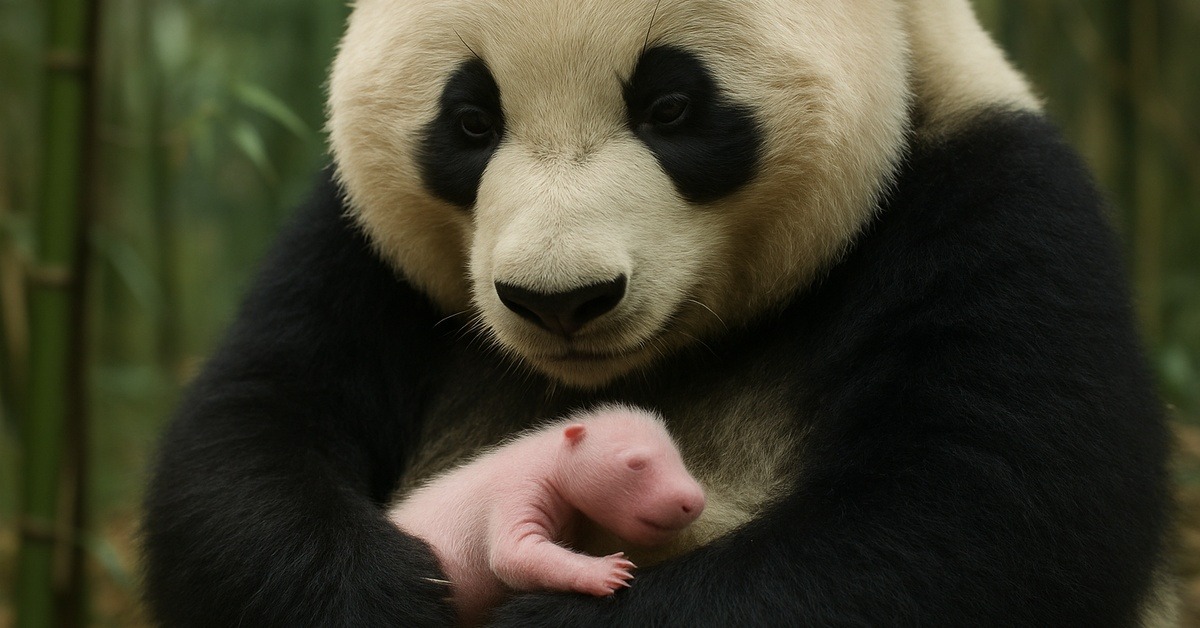
A giant panda mother weighs roughly 900 times more than her newborn. And yet, for the first several weeks of that cub’s life, she barely puts it down. Cradles it continuously against her chest — a warm, beating wall of fur and muscle that functions as a living incubator. She stops eating. She barely moves. In the wild, she may not leave the den for days at a time, forgoing the bamboo diet her own survival depends on.
Chinese and international researchers at the Wolong National Nature Reserve documented this behavior in remarkable detail in the late 1980s, the first systematic study of panda maternal behavior ever conducted. What they recorded looked less like instinct and more like devotion — a physiological sacrifice the mother makes repeatedly, even for cubs she seems to sense won’t survive. It’s a dynamic not unlike what’s been observed in other mammals where early attachment shapes survival odds (researchers actually call this “critical period bonding”), something explored in fascinating detail in studies on infant attachment behavior in macaques.
The growth acceleration inside that maternal cradle is astonishing. In the first week, the cub doubles in weight. By four weeks, it’s close to 500 grams. By eight weeks, it may reach a kilogram.
Researchers at the San Diego Zoo, which has overseen multiple successful panda births since 1999, describe the early growth curve as almost exponential — faster than nearly any other bear species relative to starting size. The cub is, in effect, completing a gestational phase that other mammals handle internally. The panda just does it on the outside, where thermal regulation and maternal contact replace placental nutrition.
Twin births complicate everything. Why does this matter? Because roughly 50 percent of captive panda pregnancies result in twins, but in the wild, a mother can only care for one. She’ll carry one cub and abandon the other. It’s not cruelty — it’s arithmetic. One cub can be kept warm. Two cannot.
Conservation facilities step in with round-the-clock care for the abandoned twin, rotating cubs between mother and incubator so both receive maternal contact and neither experiences permanent abandonment. It works. But it requires human intervention that wild pandas simply don’t have access to, which is why these programs exist at all.
What Evolution Was Actually Trying to Solve
Here’s the counterintuitive part: the panda’s extreme birth size ratio isn’t a flaw. It’s a solution to a problem most of us never considered. Pandas belong to the order Carnivora. Their digestive systems are those of a meat-eating predator, not a grazing herbivore — no rumen, no extended fermentation chambers, just a simple carnivore gut trying to extract nutrition from plant cellulose. A 2019 analysis published in Smithsonian Magazine documented that pandas retain less than 20 percent of the nutrients in the bamboo they consume — far less efficient than any true herbivore. Every calorie is precious.
A long, energetically expensive pregnancy simply isn’t viable under those conditions. So the species evolved toward the shortest viable gestation instead, offloading growth into the postnatal phase where thermal regulation — not placental nutrition — does the heavy lifting. It’s an elegant solution to a problem that sounds impossible: how do you birth a large mammal when you don’t have the metabolic surplus to build one inside your own body?
This strategy has a name in evolutionary biology: secondary altriciality. It means giving birth to young that are underdeveloped by the standards of the species’ body size, then compensating with intensive postnatal care. The giant panda cub birth size is, in this framework, a feature rather than a bug — the panda didn’t fail to build a bigger fetus, it evolved not to. The energy saved by skipping late-stage fetal development is redirected into the mother’s own survival through a Sichuan winter that, at elevation, can be brutal.
As late as the 1970s, Western zoologists weren’t entirely certain pandas were bears at all. Their evolutionary placement — carnivore body, herbivore diet, bizarre reproductive strategy — made them taxonomic wildcards for decades. Molecular biology in the 1980s finally confirmed their bear lineage and gave researchers the framework to interpret what they were seeing in the birth suite.
How Understanding Birth Size Changed Everything in Conservation
The Beijing Zoo recorded the first successful captive panda birth in 1963. For the next two decades, cub mortality in captivity was devastating — often exceeding 50 percent in the first month. Facilities lacked the knowledge to replicate what a mother’s body naturally provides: constant warmth, physical contact, stimulation for urination and digestion. The cubs were healthy at birth by panda standards, but the incubator technology of the era couldn’t compensate for what they were missing.
It took a combination of field observation and neonatal veterinary science — much of it pioneered at the Wolong Research Center through the 1980s and 1990s — to develop protocols that actually worked. Round-the-clock nursing rotations. Heated incubators calibrated to match maternal body temperature. Controlled feeding schedules that mimic the rhythm of a mother’s natural nursing pattern.
But here’s what actually matters: those deaths weren’t failures. They were data points that eventually unlocked survival.
By 2023, the global captive panda population had grown to more than 700 individuals — up from fewer than 100 in the 1980s. Survival rates for captive-born cubs in the first three months now exceed 90 percent at major facilities. That transformation reflects not just better technology but a deeper biological understanding of why the cub is born so small, and what it needs to survive that fact. Every percentage point of improvement maps directly to knowledge about neonatal physiology and maternal behavior.
Reintroduction programs have started carefully placing captive-born pandas into protected wild habitats in Sichuan and Shaanxi provinces. The challenge isn’t the adult animals — they adapt. It’s preparing cubs born in human facilities to survive the postnatal period without human backup. Researchers at the China Conservation and Research Center now work to maximize maternal-rearing time and minimize human handling, giving cubs the best possible start before the wild takes over.
Where to See This
- Chengdu Research Base of Giant Panda Breeding, Sichuan Province, China — the world’s most accessible panda conservation facility, open year-round; cubs are most frequently born between July and September, making late summer the optimal visit window for seeing young animals.
- The China Conservation and Research Center for the Giant Panda at Wolong National Nature Reserve, Sichuan — the longest-running giant panda research operation in the world, with active breeding and reintroduction programs available for visits with advance booking.
- For those unable to travel to China: the Smithsonian’s National Zoo in Washington D.C. and San Diego Zoo both maintain live cub-cam feeds during breeding seasons — check their official websites for stream schedules and birth announcements.
By the Numbers
- 90–130 grams: the most common birth weight range for giant panda cubs at the Chengdu Research Base, within the broader recorded range of 80–200 grams (Chengdu Research Base records, 2022).
- 1 to 900: the approximate mother-to-cub body weight ratio — the most extreme documented among all placental mammals on Earth.
- 95–160 days: the giant panda’s gestation period, compared to 660 days for an African elephant carrying a 100-kilogram calf.
- 700+: the global captive giant panda population as of 2023, up from fewer than 100 individuals in the early 1980s.
- Less than 20 percent: the nutrient absorption efficiency of a giant panda processing bamboo through its carnivore-adapted digestive system — the evolutionary pressure that created the extreme birth strategy in the first place.
Field Notes
- In 2006, keepers at the Wolong Research Center filmed a mother panda refusing to set down her newborn cub for 28 consecutive hours — ignoring food, water, and keeper interaction entirely. The cub weighed 98 grams at birth and survived to adulthood. The footage became foundational training material for neonatal panda care globally.
- Giant panda cubs don’t open their eyes until approximately six to eight weeks after birth — far later than most bear species. Their characteristic black eye patches appear as pigmentation in the skin weeks before the eyes themselves function.
- Delayed implantation is a phenomenon where the fertilized embryo can pause development for weeks or months before implanting in the uterine wall, making it almost impossible to predict exactly when a panda birth will occur — even with ultrasound monitoring.
- Researchers still can’t fully explain why panda twins are so common — approximately 50 percent of captive pregnancies — when the mother can only care for one. It may be an evolutionary hedge against maternal death, but the mechanism driving twin ovulation in a species with such constrained reproductive resources remains genuinely unresolved.
Frequently Asked Questions
Q: Why is giant panda cub birth size so dramatically small compared to the mother?
The extreme birth size is a direct result of evolutionary constraint, not developmental failure. Pandas evolved a shorter gestation to compensate for their energy-poor bamboo diet. A panda’s carnivore gut absorbs less than 20 percent of bamboo’s nutrients, leaving almost no metabolic surplus to sustain a long, intensive pregnancy. By delivering at roughly 90–100 grams, the mother offloads most fetal development into the postnatal phase, where warmth and physical contact replace placental nutrition. It’s an elegant trade-off that allows survival.
Q: How does a panda cub survive being born so underdeveloped?
Survival depends almost entirely on the mother’s behavioral response in the first days after birth. She cradles the cub continuously against her chest, providing thermal regulation that the cub’s underdeveloped system can’t yet manage independently. Growth accelerates dramatically outside the womb — the cub doubles its weight in the first week. In captivity, keepers replicate this care with heated incubators, physical stimulation, and timed feeding rotations when a mother cannot manage twins alone.
Q: Do giant pandas always give birth to twins, and if so, what happens to the second cub?
Twins occur in roughly half of all panda pregnancies, but a wild mother can only warm and carry one cub at a time. She’ll instinctively choose one and abandon the other — not from preference, but from physical limitation. In the wild, the abandoned cub doesn’t survive. At conservation facilities like the Chengdu Research Base, staff perform a “twin swap” technique — rotating both cubs between the mother and an incubator so each receives maternal contact and neither is permanently abandoned. First documented successfully in the 1990s, this method has since saved hundreds of second-born cubs.
Editor’s Take — Alex Morgan
What strikes me most about this story isn’t the 90 grams — it’s what those 90 grams reveal about the cost of a bad diet across geological time. The panda didn’t choose bamboo yesterday. It made that evolutionary commitment millions of years ago, and every strange reproductive quirk since then — the tiny cub, the exhausted mother, the twin it can’t keep — is the long-term invoice for that decision. Watching a species manage consequences that severe, generation after generation, you stop calling it survival. You start calling it what it actually is: biological genius under impossible pressure.
A 90-gram animal inheriting a 100-kilogram world. That gap — between what the panda is at birth and what it has to become — is one of the most dramatic biological journeys any creature makes. And it happens in the dark, against a mother’s chest, in a mountain den most of us will never see. The panda’s improbable survival asks a quiet question about every species we assume is thriving: what extraordinary compensations are happening just out of sight, and what happens when the conditions that make those compensations possible quietly disappear?
Illustrations are AI-generated. Article fact-checked and human-edited.