The House So Infested With Roaches It Had to Burn
A family signed away their house to a city. Not to foreclosure. Not to bankruptcy. To cockroaches — and the decision that followed was so extreme it required the local fire department to dig a trench around an entire residential structure in Pana, Illinois before striking the match. That controlled burn in 2010 remains one of the most documented cases of a cockroach infestation house fire ever recorded in municipal records, and it happened because conventional pest management had already failed.
The building was gone by the end of the day. But what led to that moment — the months or years of compounding infestation, the point where surrender felt like the only remaining option — that’s the part most people don’t think about. The family had walked away. They’d handed the deed to the city. When local officials took one look inside, the question wasn’t whether to demolish. It was how to destroy a building full of cockroaches without turning the entire neighborhood into the next colony.
Key Facts
- In 2010, the city of Pana, Illinois, conducted a controlled burn of a house so severely infested with cockroaches that pest control had reportedly declined to treat it.
- The family handed the deed to the city, and the fire department dug a two-foot-deep perimeter trench packed with combustible material as a firebreak to intercept fleeing roaches.
- The American cockroach (Periplaneta americana) lays an ootheca containing roughly 14 to 16 eggs, and a single female can produce up to 150 offspring in her lifetime.
- A 2019 Purdue University study led by Michael Scharf showed German cockroaches can develop insecticide resistance within a single generation (about three months), with populations sometimes increasing during treatment.
- University of Florida research found temperatures above 48°C (118°F) reliably kill most cockroach species within minutes, while a structural fire reaches 500°C to 800°C at its core.
In short: In 2010, the small city of Pana, Illinois, burned down an entire house because a cockroach infestation had grown so severe that conventional pest control failed and professionals declined to treat it. Firefighters dug a perimeter trench as a firebreak to catch roaches fleeing the heat. The case illustrates why fire succeeded where chemicals could not: cockroaches develop insecticide resistance rapidly, but their chitin exoskeletons cannot survive the extreme heat of a structural fire.
The Anatomy of a Breaking Point
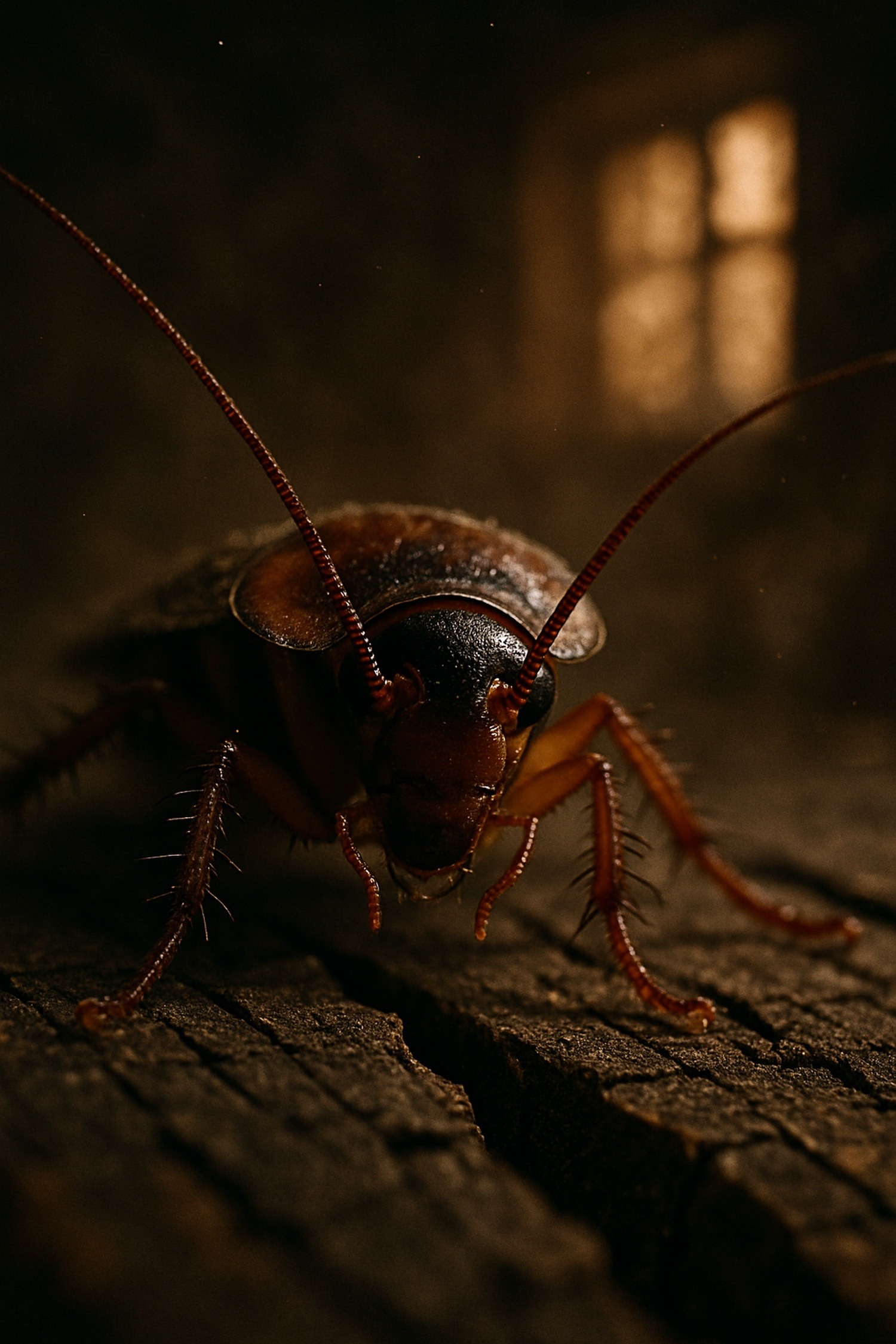
Cockroach infestations don’t happen overnight. According to the U.S. Environmental Protection Agency, the conditions that allow a home to reach critical infestation status typically develop over months — sometimes years — of unchecked breeding cycles, structural degradation, and failed or never-attempted pest management. The American cockroach (Periplaneta americana), the species most commonly implicated in severe domestic infestations, produces an egg case called an ootheca that contains roughly 14 to 16 eggs each.
A single female can generate up to 150 offspring across her lifetime. Under warm, humid, undisturbed conditions — the kind a neglected home provides in abundance — those numbers compound with brutal efficiency. By 2010, Pana city officials weren’t dealing with a pest problem. They were dealing with a structural takeover.
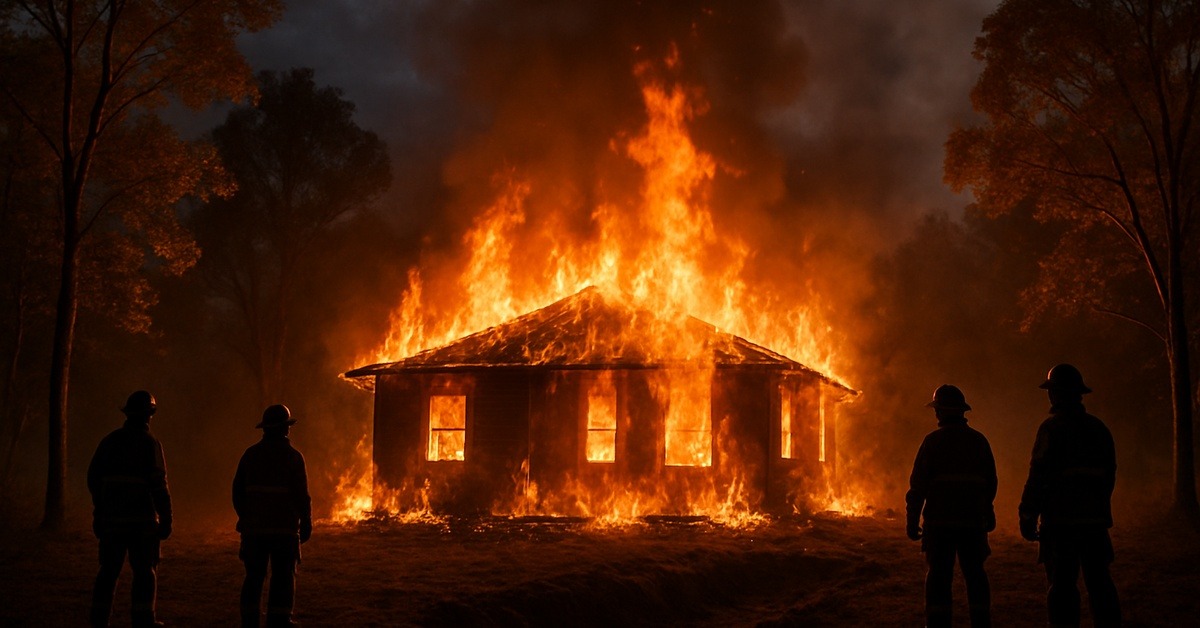
What made the Pana situation extraordinary wasn’t the infestation itself. Severe cockroach colonization, while rare at this scale, has been documented in uninhabited or semi-abandoned buildings before. What set this case apart was the city’s response. Pana isn’t a large municipality — it sits in Christian County with a population hovering around 5,500 people. Local government doesn’t typically have the budget, the protocol, or the precedent for burning a residence to the ground. But faced with a structure that pest control professionals reportedly declined to treat, city officials made the call. They called the fire department instead.
Two feet deep, packed with combustible material, lit around the full perimeter of the house — that was the trench.
It wasn’t aesthetic. It was functional — a firebreak designed to intercept any roaches attempting to flee the heat as it moved inward. Someone in Pana that day understood cockroach behavior well enough to account for mass escape. The improvisation spoke to a kind of practical desperation, the moment when a city stops trying to manage a problem and instead removes it from the landscape entirely.
Why Fire Worked — And Why Everything Else Didn’t
Here’s the thing: there’s a persistent belief that cockroaches could survive a nuclear war. It’s not entirely wrong. German cockroaches (Blattella germanica) can survive without food for up to a month and without water for two weeks. Some species can withstand radiation doses estimated at 15 times the lethal threshold for humans. They can live without their heads for up to a week, surviving on stored energy while their decentralized nervous system keeps basic functions running.
That resilience speaks to why the decision to burn the Pana house carries a certain grim logic. But cockroaches are not fireproof. Their exoskeleton, composed largely of chitin, ignites and desiccates under sustained heat. The thermal vulnerability of insects was documented extensively by entomologists at the University of Florida’s Institute of Food and Agricultural Sciences, which has published research on heat-based pest control methods showing that temperatures above 48°C (118°F) reliably kill most cockroach species within minutes.
A structural fire generates temperatures between 500°C and 800°C at its core. The trench burn in Pana would have reached temperatures the insects had no biological answer for. Still, the escape instinct is real — cockroaches respond to heat and vibration by dispersing outward, rapidly. The trench wasn’t paranoia. It was applied entomology.
What Happens When Chemistry Stops Working
Insecticide resistance in cockroaches is not theoretical. A landmark 2019 study from Purdue University’s Department of Entomology, led by professor Michael Scharf, demonstrated that German cockroaches can develop resistance to new insecticides within a single generation — roughly three months. The researchers tested rotation-based and mixture-based chemical strategies and found that under certain conditions, cockroach populations actually increased over the course of treatment.
Why does this matter? Because it reframes what “infestation control” actually means in the most severe cases.
Entomologists at the University of Kentucky’s College of Agriculture, Food and Environment have noted that at extreme infestation densities, conventional insecticides face a compounding problem: population pressure. Roaches reproduce faster than chemical treatments can eliminate them, particularly if the colony has developed resistance, which German cockroach populations have been doing with increasing efficiency since at least the 1990s. The 2019 Purdue study was stark in its conclusion: for heavy infestations, conventional chemical approaches may be functionally useless.
Pana’s fire department didn’t have that study in 2010. But they arrived at the same practical conclusion. When the biology outpaces the chemistry, you change the tool entirely. You go back to the oldest form of pest control on Earth. You use fire.
What the Pana Case Really Reveals
The cockroach infestation house fire sits at an uncomfortable intersection of public health, human psychology, and municipal policy. Extreme domestic infestations of this scale are almost never the result of a single decision or a single failure. Research published by the National Pest Management Association has consistently linked severe infestations to a constellation of factors: limited access to pest control services, housing instability, hoarding behaviors, and the social isolation that prevents early intervention.
A 2017 review by researchers at Rutgers University’s Department of Entomology found that low-income urban households are disproportionately affected by cockroach infestations, with health consequences that extend well beyond the cosmetic. Cockroach allergens are a documented trigger for asthma, particularly in children, and Smithsonian Magazine has reported on the growing body of evidence linking chronic cockroach exposure to respiratory illness and antibiotic resistance in the bacteria the insects carry.
What quietly emerges from the Pana story — if you’re willing to sit with it — is how far a situation must deteriorate before official action is taken. A family lived in that house. They reached a point where surrender, literally signing over the deed to a city, felt like the only remaining option. That moment doesn’t arrive quickly. It arrives after months or years of compounding circumstances that no single agency or neighbor addressed in time. Illinois has housing codes. Christian County has health inspectors. The system has mechanisms designed to catch exactly this kind of case before it becomes irreversible. That the Pana situation reached the point of a controlled burn tells you something about the gaps between what those mechanisms are designed to do and what they actually manage to catch.
How It Unfolded
- 1970s–1990s: Widespread insecticide resistance in Blattella germanica populations first documented across U.S. urban centers, beginning a decades-long arms race between chemical manufacturers and cockroach biology.
- 2010: The Pana, Illinois cockroach infestation house fire takes place — city officials accept the property deed from the occupying family and coordinate a controlled perimeter burn with the local fire department.
- 2017: Rutgers University entomology researchers publish a comprehensive review linking severe domestic cockroach infestations to asthma triggers, antibiotic-resistant bacteria, and socioeconomic housing instability.
- 2019: Purdue University’s Michael Scharf publishes the resistance study in Scientific Reports, confirming that German cockroaches can develop multi-insecticide resistance in a single three-month generation cycle.
By the Numbers
- 150 — maximum number of offspring a single American cockroach female can produce across her lifetime, each emerging from an egg case (ootheca) carrying 14–16 eggs.
- 48°C (118°F) — minimum sustained temperature required to kill most cockroach species within minutes, per University of Florida IFAS pest control research.
- 15× — the radiation dose cockroaches can survive relative to the lethal threshold for humans, according to entomological studies on insect radiological tolerance.
- 1 generation (~3 months) — the time it takes German cockroaches to develop resistance to a new insecticide class, per the 2019 Purdue University study.
- 2 feet — the depth of the perimeter trench dug around the Pana, Illinois structure before ignition in 2010, designed to prevent colony dispersal into neighboring homes.
Field Notes
- German cockroaches don’t actually come from Germany. The species likely originated in South Asia and spread globally through trade routes. The naming confusion dates to 18th-century European naturalists who documented them in Germany — but the insect had already been distributed worldwide by then.
- Cockroaches communicate using chemical signals called aggregation pheromones, which are present in their feces. In heavy infestations, the accumulation of these pheromones actively attracts more roaches to a location — meaning the infestation’s own byproducts accelerate its growth (and this matters more than it sounds, because it explains why removal becomes exponentially harder as time passes).
- The Pana case isn’t the only time a U.S. municipality has used a controlled structure fire to address a biological contamination problem. Rodent and bat infestations have occasionally triggered similar decisions, though full-scale burns for insect infestations remain exceptionally rare in the documented record.
- Researchers still can’t reliably predict the tipping point at which a cockroach infestation becomes chemically unmanageable. The variables — colony density, resistance profile, structural complexity of the building — interact in ways that no current model fully accounts for. That uncertainty is itself a public health problem.
Frequently Asked Questions
Q: What actually happened during the cockroach infestation house fire in Pana, Illinois?
In 2010, the city of Pana, Illinois took ownership of a residential property after the occupying family surrendered the deed due to an overwhelming cockroach infestation. City officials, determining that conventional pest control was not viable, coordinated a controlled burn of the structure with the local fire department. A two-foot perimeter trench was dug around the house, packed with combustible material, and ignited to prevent the insects from escaping into adjacent properties as the structure burned.
Q: Can cockroaches really survive nuclear radiation — and if so, why couldn’t they survive a house fire?
Cockroaches are genuinely more radiation-resistant than humans — their simpler cell division cycles make them less vulnerable to radiation-induced DNA damage. But radiation resistance and heat resistance are completely different biological properties. At temperatures above 48°C (118°F), cockroach exoskeletons desiccate and their proteins denature rapidly. A structural fire reaching 500°C or more overwhelms any biological defense they have. Surviving a radiation event and surviving a direct flame are not the same challenge.
Q: Why didn’t exterminators just treat the Pana house with chemicals instead of burning it?
The common assumption is that enough pesticide will always solve an infestation. That’s not how insect biology works at extreme densities. A 2019 Purdue University study demonstrated that German cockroaches can develop resistance to new insecticide classes within a single generation — roughly three months. In a heavily colonized structure, roaches reproduce faster than chemical treatments eliminate them, particularly if resistance is already present. Pest control professionals reportedly declined the Pana job, and current entomological research explains why that decision was scientifically defensible.
Editor’s Take — Sarah Blake
Watching a municipal government burn a house to the ground as the only remaining pest control option, you stop calling it a local incident. The detail I can’t stop thinking about is the trench — someone in Pana, Illinois, probably a fire marshal or a city official working from gut instinct, designed a roach containment system that aligns almost perfectly with what behavioral entomologists now document in cockroach dispersal studies. They accounted for the escape reflex. That improvised knowledge, applied in a small Illinois town with no budget and no precedent, says something about what humans learn when they’re forced to reckon with a biology they can’t control any other way.
The cockroach infestation house fire in Pana, Illinois was a local event with a very local solution — a trench, some straw, a fire department willing to do something it had almost certainly never done before. But it points to something larger: the biological limits of the tools we rely on, the gaps in the systems meant to catch problems before they become irreversible, and the stubborn persistence of creatures that have been living alongside humans for longer than civilization has existed. Somewhere right now, in a building no inspector has visited in years, a colony is counting generations. The math is patient.
Illustrations are AI-generated. Article fact-checked and human-edited.