The Moment a Wild Animal Looks Back at You
For one suspended second, a shutter clicks and something shifts. Mary Schrader’s Gold-winning image “Shared Wonder” at the 2026 World Nature Photography Awards captured the exact moment two different kinds of consciousness noticed each other — and wildlife portrait photography stopped being craft and became something closer to conversation.
Thousands of photographers across more than 60 countries submit entries to the World Nature Photography Awards each year. The competition ranks among the most rigorous honors in natural history imaging. The Animal Portraits category is its most unforgiving discipline. Animals don’t pose. They don’t wait. They don’t care about your aperture settings. But Schrader’s title — “Shared Wonder” — raises a question that lingers long after you’ve stopped looking at the frame: what, exactly, was the animal thinking when it looked back?
Key Facts
- Mary Schrader’s image “Shared Wonder” won Gold in the Animal Portraits category at the 2026 World Nature Photography Awards.
- The World Nature Photography Awards draws thousands of photographers from more than 60 countries each year.
- Ethologists call the threshold at which an animal decides a threat warrants escape the flight initiation distance, which can stretch to hundreds of meters in prey species.
- Max Planck Institute research found mutual gaze activates the superior temporal sulcus, a region tied to social cognition, in both humans and non-human primates.
- A 2021 University of Exeter study found European robins respond differently to a person facing toward them versus away, even when physical distance stays constant.
In short: Mary Schrader’s Gold-winning photograph “Shared Wonder” at the 2026 World Nature Photography Awards captured a wild animal looking directly back at the camera, the rare moment that turns wildlife portraiture into something like mutual recognition. Science explains the power of that gaze: mutual eye contact activates the brain’s superior temporal sulcus in both humans and primates, and studies show wild animals read the direction of human eyes for threat. The result is a two-way exchange where both minds assess each other.
What Makes an Animal Portrait Truly Unforgettable
Wildlife portrait photography occupies a strange corner of visual art. Unlike landscape photography, where the subject holds still, or documentary photography, where you’re tracking human behavior, animal portraiture depends entirely on a creature doing something it has absolutely no obligation to do: acknowledge your presence without fleeing. Researchers at the Royal Society for the Protection of Birds have long noted that even habituated wild animals display what ethologists call a flight initiation distance — the threshold at which an animal decides a perceived threat is close enough to warrant escape.
In prey species, that distance can stretch to hundreds of meters. In predators, it’s often tighter, but no less real. Getting inside that invisible perimeter, with a camera raised, without triggering panic — that’s not luck.
That’s years of fieldwork compressed into a single breath. The image that earns a Gold at a competition of this scale isn’t the sharpest one submitted. It’s not necessarily the most technically pristine. What judges at international natural history competitions consistently identify as the differentiating quality is emotional authenticity — a phrase that sounds vague until you see it fail. Most animal photographs feel transactional. You see the animal; the animal doesn’t see you. “Shared Wonder” apparently breaks that contract entirely. The animal looked back. And that changes everything about how you read the frame.
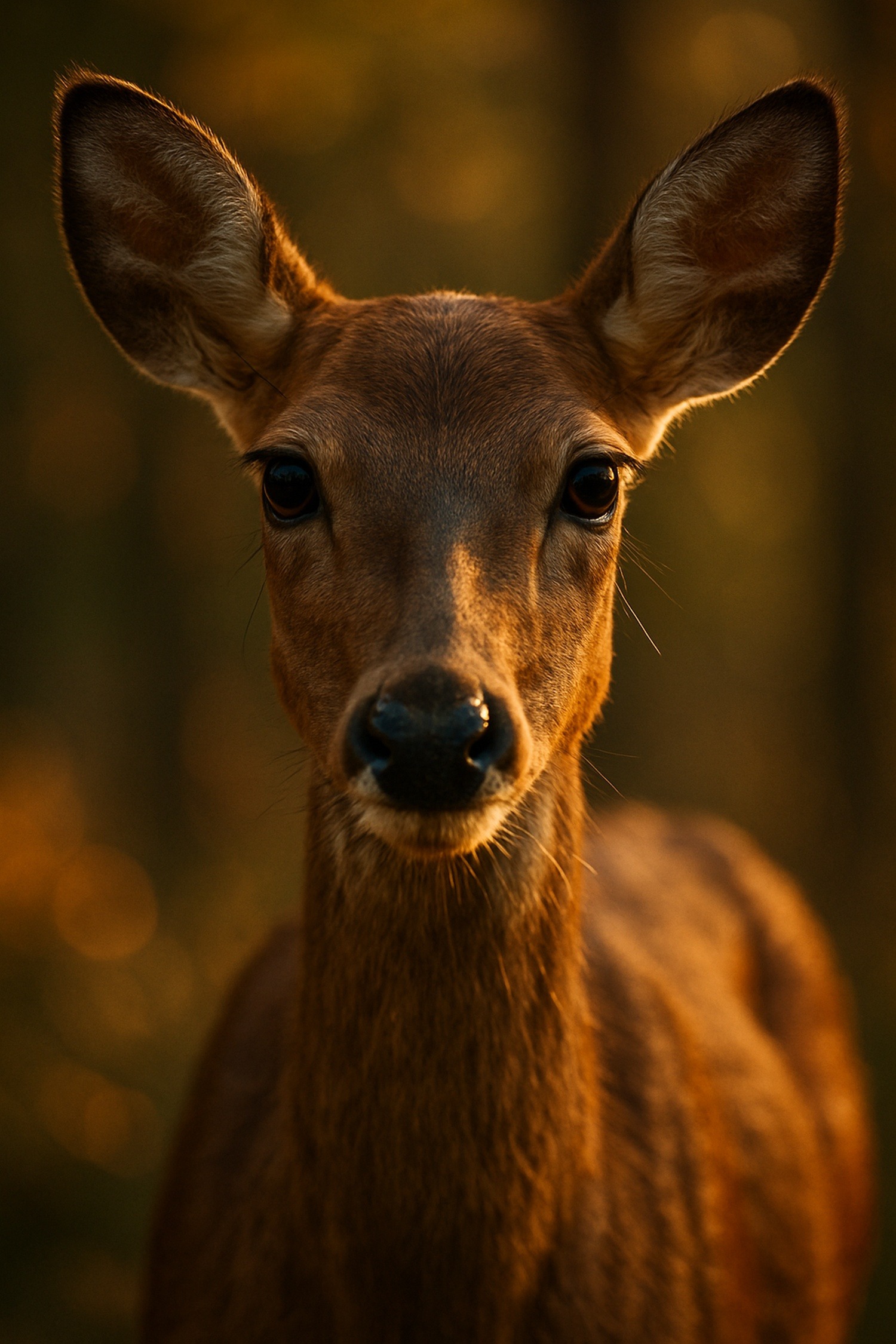
There’s a reason photographers talk about the eyes. Not because it’s a cliché — it’s because eyes are where the recognition lives. When a wild animal holds your gaze through a lens, something neurological fires in the viewer. You stop being an audience. You become a participant.
That’s the whole game.
The Science of the Mutual Gaze in the Wild
What actually happens in the brain, in the body, when a human and a wild animal lock eyes? It’s more layered than you’d expect. Researchers at the Max Planck Institute for Evolutionary Anthropology have been studying gaze behavior across species for well over a decade. Their 2019 studies on great apes produced particularly compelling findings. The mutual gaze activates the same neural circuitry in non-human primates that it activates in humans: the superior temporal sulcus, a region associated with social cognition and the processing of intentional behavior. It’s the part of the brain that asks, in essence, “does this other being have a mind?” That same question, it turns out, is what gives wildlife portrait photography its emotional punch. When you look at “Shared Wonder,” your brain isn’t just processing pixels. It’s running a very old program — one that predates photography by several million years — trying to figure out whether something out there is thinking about you. Why does this matter? Because animal portraits featuring direct eye contact consistently outperform other wildlife images in viewer engagement studies.
Wild animals assess human eyes for threat signals with extraordinary precision. A 2021 study from the University of Exeter found that European robins respond differently to a person facing toward them than away from them, even when physical distance stays constant. The direction of human eyes alone was enough to alter bird behavior. What this suggests is that the mutual gaze in wildlife portraiture cuts both ways. The animal is doing its own reading. It’s trying to figure you out, just as you’re trying to figure it out. That’s what “Shared Wonder” is probably showing us — not a photographer watching an animal, but two minds assessing each other across a very old divide.
Here’s the unsettling part: the animal almost always concludes the exchange first. It looks away, or it leaves, or it simply goes back to whatever it was doing before you arrived. The connection that compels us to understand how a baby monkey clings to a stuffed toy for comfort draws from the same root — a deep primate need to find recognition in another face. You’re the one who stays transfixed. You’re the one who keeps looking at the photograph three days later. Watching a species make that choice to look back, knowing it could have turned away — you stop calling it a transaction.
American Wildlife Photography and Its Long, Restless History
1872 changed how Americans saw their own wilderness. Congress approved Yellowstone’s designation as the world’s first national park that year, partly on the strength of what photographs and paintings had already told the public about what was at stake. The tradition stretches back to the 1870s Yellowstone expeditions, where photographers like William Henry Jackson hauled glass-plate cameras through hostile terrain to document a landscape most Americans would never see in person. Those images didn’t just document wilderness — they helped build the political case for the national parks movement. National Geographic’s archives hold over a century of evidence for how wildlife portrait photography has shifted public opinion on conservation, species protection, and humanity’s place in the food web. Each era produced its defining images — the lone wolf at the edge of the frame, the eye of a whale surfacing alongside a boat. Schrader’s “Shared Wonder” arrives into that tradition carrying a title that quietly argues for a different kind of relationship entirely.
Ethics transformed contemporary wildlife portrait photography. The old model — bait an animal, call it in, shoot it in controlled conditions and call it wild — has been largely discredited among serious practitioners. The International League of Conservation Photographers, founded in 2005, helped formalize a code of conduct that prioritizes animal welfare over image quality. The shift matters because it changes what a winning photograph actually represents. A Gold-winning wildlife portrait in 2026 is, implicitly, a certificate of patience. It says: I found this animal living freely, and it chose, briefly, to share the same moment with me. That patience isn’t passive. Schrader, like every serious wildlife photographer working today, would have spent significant time reading terrain, understanding animal behavior, and making herself — in some meaningful sense — invisible before the animal ever turned around.
Wildlife Portrait Photography and What Judges Actually See
Inside a competition like the World Nature Photography Awards, judging processes for wildlife portraiture are considerably more rigorous than most entrants anticipate. Panels typically include working wildlife photographers, conservation biologists, and photo editors from major natural history publishers. The Wildlife Photographer of the Year competition, run annually by the Natural History Museum in London since 1965, uses a multi-stage blind review process where images are evaluated without any identifying information about the photographer. What survives into later rounds is almost always about narrative. Technical quality is essentially a baseline — if the image isn’t sharp in the right places, it’s gone in the first round. Does this photograph tell a story that couldn’t be told any other way? Does it contain a moment that will not happen again? That’s a high bar. It’s why a competition drawing tens of thousands of annual entries produces only a handful of images that most people can recall five years later. “Shared Wonder” has those qualities.
The title alone does significant work — framing what could have been a technically impressive portrait as something more philosophically ambitious. The animal’s identity in Schrader’s winning image hasn’t been widely reported, which is itself interesting. In most winning wildlife portraits, the species is front and center — the snow leopard, the mountain gorilla, the wandering albatross. When the species stays unnamed, it suggests the photograph is doing something different. It’s emphasizing the relationship over the subject. The gaze over the body. The moment over the taxonomy. That’s a bold compositional choice in a field that still defaults to cataloguing.
Wildlife portrait photography at this level isn’t natural history illustration. It’s closer to portraiture in the classical sense — the revelation of an inner state through a face. Schrader joins a short list of American photographers who’ve taken top honors in international natural history competitions in the past decade. She earned it in the hardest category there is.
Where to See This
- The World Nature Photography Awards showcases winning and shortlisted images annually on their official website and through rotating gallery exhibitions — the 2026 collection, including “Shared Wonder,” is accessible online and worth the time of any serious nature photography enthusiast.
- The Natural History Museum in London hosts the Wildlife Photographer of the Year exhibition each year, typically running from October through spring — one of the most concentrated displays of elite wildlife portraiture anywhere in the world.
- For photographers wanting to develop their own eye for the mutual gaze, the Nature First photography alliance (naturefirst.online) offers ethics guidelines and field workshops focused on low-impact, behavior-led wildlife photography practice.
By the Numbers
- The World Nature Photography Awards received entries from more than 60 countries in 2025, making it one of the broadest-reach natural history photography competitions globally.
- The Wildlife Photographer of the Year competition, the field’s longest-running major honor, has judged over 100,000 entries annually in recent years across its 60+ category history since 1965.
- A 2021 University of Exeter study found that European robins altered their escape behavior based solely on the direction of a human’s gaze — without any change in physical distance or movement.
- Flight initiation distance in wild birds can range from less than 1 meter in habituated urban species to over 300 meters in sensitive mountain-dwelling raptors — a 300× variance driven almost entirely by learned experience with humans.
- The International League of Conservation Photographers, established in 2005, now represents photographers whose collective images have been used in over 40 major conservation campaigns worldwide.
Field Notes
- In 2019, researchers at the Max Planck Institute for Evolutionary Anthropology documented that chimpanzees follow a human’s gaze to a target object even when the human’s eyes are closed — suggesting that gaze-tracking in great apes may be based on head direction as much as visible eye contact, which complicates how we interpret “mutual recognition” in wildlife photography.
- The camera’s lens itself may function as a proxy eye for wild animals. Several field studies on bird behavior have observed that animals respond to a telephoto lens pointed at them with the same alertness they show to a direct human stare — even when the photographer is partially concealed.
- Winning titles in elite wildlife photography competitions are rarely chosen by the competition — they’re chosen by the photographer before submission. A title like “Shared Wonder” carries deliberate philosophical weight, and judges report that titles influence their reading of ambiguous images more than most photographers realize.
- Researchers still can’t fully explain why some individual wild animals appear comfortable with sustained human eye contact while members of the same species in the same habitat flee immediately. Whether this reflects individual personality variation — now well-documented in species from octopuses to wolves — or learned tolerance remains an open and genuinely compelling question.
Frequently Asked Questions
Q: What makes wildlife portrait photography different from other types of nature photography?
Wildlife portrait photography focuses specifically on the face, expression, and individual presence of a wild animal — treating it as a subject with an interior life rather than a component of a landscape or ecosystem scene. Where wildlife photography broadly captures behavior, habitat, or action, portraiture asks for something harder: a moment of apparent awareness. Judges in major competitions have consistently identified direct eye contact and emotional legibility as the defining qualities of the genre’s best work.
Q: How do wildlife photographers get close enough for a compelling portrait without disturbing the animal?
Most serious wildlife portrait photographers spend far more time not photographing than photographing. The process involves learning an individual animal’s patterns over days or weeks, understanding its flight initiation distance, and positioning at the outer edge of that threshold consistently until the animal habituates to the presence. Long telephoto lenses — typically 500mm or longer — allow photographers to work at distances that don’t register as threatening. The critical rule recognized by the Nature First alliance and similar bodies is that the animal’s behavior must not change as a result of the photographer’s presence. If it does, you’re too close.
Q: Why do people assume the “best” wildlife portrait is the technically sharpest one?
Technical sharpness became the dominant metric in wildlife photography partly because early competitions used it as the most objective and defensible standard — easy to evaluate, hard to argue with. But the field’s most decorated images from the past two decades consistently show that emotional resonance outweighs resolution at the highest levels of judging. A slightly soft image of genuine mutual gaze will beat a razor-sharp frame of an animal looking away almost every time. The misconception persists because most amateur critique focuses on what gear achieved, not what the moment contained.
Editor’s Take — Alex Morgan
What strikes me about “Shared Wonder” isn’t the Gold — it’s the title. Most award-winning wildlife portraits get named for the species, the place, the behavior. Schrader named hers for an emotional state shared between two different beings. That’s not modesty; it’s a claim. It says the animal’s experience of that moment matters as much as hers. In a field still fighting to be taken seriously as portraiture rather than documentation, that’s a genuinely radical position — and the award suggests the judges agreed.
There’s something that happens when you look at a photograph like “Shared Wonder” long enough. The animal stops being a subject. You start wondering what it saw — this large, strange creature crouching behind a black cylinder, not fleeing, not threatening, just watching. The history of wildlife photography is really a history of humans trying to close that gap between observer and observed. Schrader may have gotten closer than most. The question she’s left us with isn’t about photography at all. It’s about what we owe the creatures that bother to look back.
Illustrations are AI-generated. Article fact-checked and human-edited.