The 31% Fat Secret Keeping Polar Bear Cubs Alive
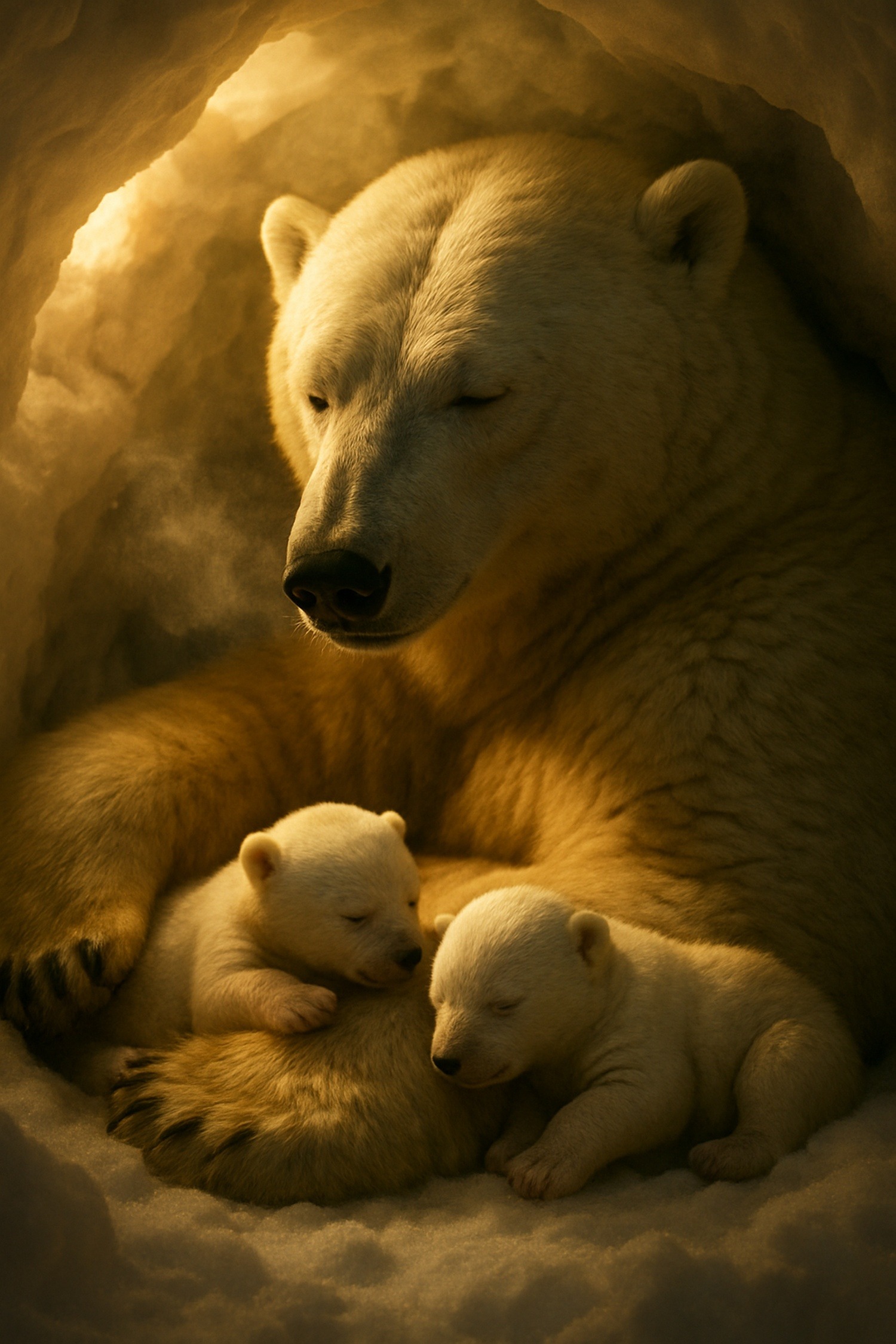
A polar bear cub emerges from a snow den weighing less than a kilogram — blind, hairless, completely helpless. It shouldn’t survive the next few weeks. And yet, because of something its mother produces from her own body, it almost always does.
That something is milk. Not the kind you’d recognize. At 31% fat, it’s roughly eight to ten times richer than what comes out of a cow, and many times what human babies drink. It pours thick, closer to cream or custard than to anything you would call a beverage. The cub’s entire first year — and arguably the rest of its life — turns on this one biological fact. Everything else the bear becomes is built on the foundation that milk lays down in the dark.
In short: Polar bear milk is the fattiest of any land mammal — about 31–36% fat at peak lactation. A fasting mother burns her own stored body fat to make it, turning a one-kilogram newborn into a 10–15 kilogram cub before either of them eats again. As Arctic sea ice shrinks, mothers reach their dens leaner, carry less fat to convert, and produce thinner milk — so the cubs born today start from a smaller margin than the cubs of 1990.
Key Facts
- Polar bear milk is roughly 31–36% fat at peak lactation—about eight to ten times richer than cow’s milk (near 3.5%) and far richer than human milk (3–5%).
- A newborn cub weighs less than one kilogram, blind and hairless; by den emergence in March or April it weighs 10–15 kilograms.
- The mother fasts for months, converting stored body fat from the previous summer’s seal hunts into milk.
- Some seal species produce milk exceeding 40% fat, showing the same fasting-mother, rich-milk pattern.
- A large male polar bear (Ursus maritimus) can weigh up to 700 kilograms, and cubs must be ready to face wind toward −40°C on leaving the den.
In short: Polar bear milk is the fattiest of any land mammal, about 31–36% fat at peak lactation—far richer than cow or human milk. A fasting mother burns her own stored fat to make it, turning a sub-one-kilogram newborn into a 10–15 kilogram cub before either eats again, ready to face Arctic cold.
Why Fat Is Everything in a Snow Den
Start with the numbers, because they’re genuinely strange once you sit with them. Human milk runs about 3–5% fat. Dairy cow milk hovers near 3.5%. And then there’s this — 31 to 36% fat, measured in wild polar bears during lactation. That’s not a small difference. That’s a different category of substance, closer in composition to whipping cream than to the milk in your refrigerator.
The mother hasn’t eaten since autumn. She’s been fasting for months, living entirely off stored fat from the previous summer’s seal hunts. Every calorie in that milk came out of her own body. Her metabolism has narrowed to a single purpose: convert reserves into the densest, richest food possible so that cubs born in total darkness can triple their birth weight before they ever see daylight. A nursing female in a den is, in effect, slowly disassembling herself and rebuilding the result as cubs.
The fat does more than fuel growth — it builds the cub’s own insulation. Brown fat and subcutaneous blubber laid down in the den are what let a three-month-old walk out into a polar spring. Some of that energy also goes into the cub’s coat, the first dense underfur growing in just as the family prepares to leave the safety of the snow.
Cubs born in December or January in dens along the Arctic coastline emerge in March or April. By then they’ll weigh 10–15 kilograms. All of that growth, all of that fat insulation, all of that readiness to face wind that can drop toward −40°C — it comes from milk and nothing else. There is no other food source. The den has no pantry. The mother is the pantry.
The architecture of the den itself matters too. Polar bears dig into south-facing snowdrifts where wind has packed the snow hard enough to hold a ceiling. The entrance tunnel slopes upward, which traps the warmer air the way a cold-air sink works in reverse. Heat from the mother’s body pools near the sleeping chamber, and the temperature difference between inside and outside can reach forty degrees. That thermal pocket, combined with the milk, is what carries cubs through the darkest months. A well-built den is a survival appliance — insulation, shelter from wind, and a nursery rolled into a single hollow in the snow.
The Chemistry Behind the Richness
Why fat instead of sugar or protein? Because fat is the most energy-dense fuel a body can move. Gram for gram, fat carries roughly twice the calories of carbohydrate or protein, so a high-fat milk delivers the most usable energy in the smallest, lightest package. For a mother who is running her whole operation off finite reserves, that efficiency isn’t a luxury. It’s the only way the budget closes.
High-fat milk also has a second advantage in the cold: it leaves the cub with a body that runs on fat rather than sugar. Fat metabolism produces a steady, slow-burning supply of energy and lays down insulating tissue at the same time, which is exactly what an animal facing months of cold needs. A cub raised on watery, sugary milk would have neither the calories to grow quickly nor the blubber to stay warm.
Polar bears aren’t alone in this trick — they share it with other animals that nurse while fasting or living at the edge of the cold. Seals are the classic comparison: some seal species produce milk that can exceed 40% fat, and a seal pup can double its weight in days. The pattern is consistent across the Arctic and Antarctic. When a mammal mother has to pour energy into her young fast, against a hard clock, and often without eating herself, evolution converges on the same answer — make the milk almost unbelievably rich.
The Animal That Shouldn’t Work in the Arctic
Polar bear survival isn’t only about lactation chemistry, though. The whole animal is a stack of cold-weather solutions.
Those guard hairs that make a polar bear look white? They’re hollow, and they’re not actually white at all. Each hair is transparent and colorless — the whiteness comes from how light scatters off the hollow shafts, the same physics that makes snow and crushed glass look white even though both are clear. The dense underfur beneath traps a layer of warm air against the skin, and it works so well that infrared cameras struggle to see a resting polar bear at all; almost no body heat leaks out. The skin under all that fur is black, which helps absorb whatever weak solar radiation the Arctic offers. Every layer is a problem solved.
The paws do two jobs at once. On ice, they spread the bear’s weight — up to 700 kilograms in a large male — across a wide surface, so the animal can cross thin sea ice that would crack under a more concentrated load. Small bumps called papillae and tufts of fur between the pads add grip. In water, slightly webbed toes turn the front paws into broad paddles. The bear’s name in Latin says exactly what it is: Ursus maritimus — the sea bear. These are not land animals that happen to swim. They are marine predators that happen to walk.
All of this evolved over thousands of years — the milk, the fur, the paws, the den-building instinct — and all of it was tuned for one thing: a stable, reliable, frozen Arctic. The system assumes the ice will be there.
What Happens When Ice Stops Being Reliable
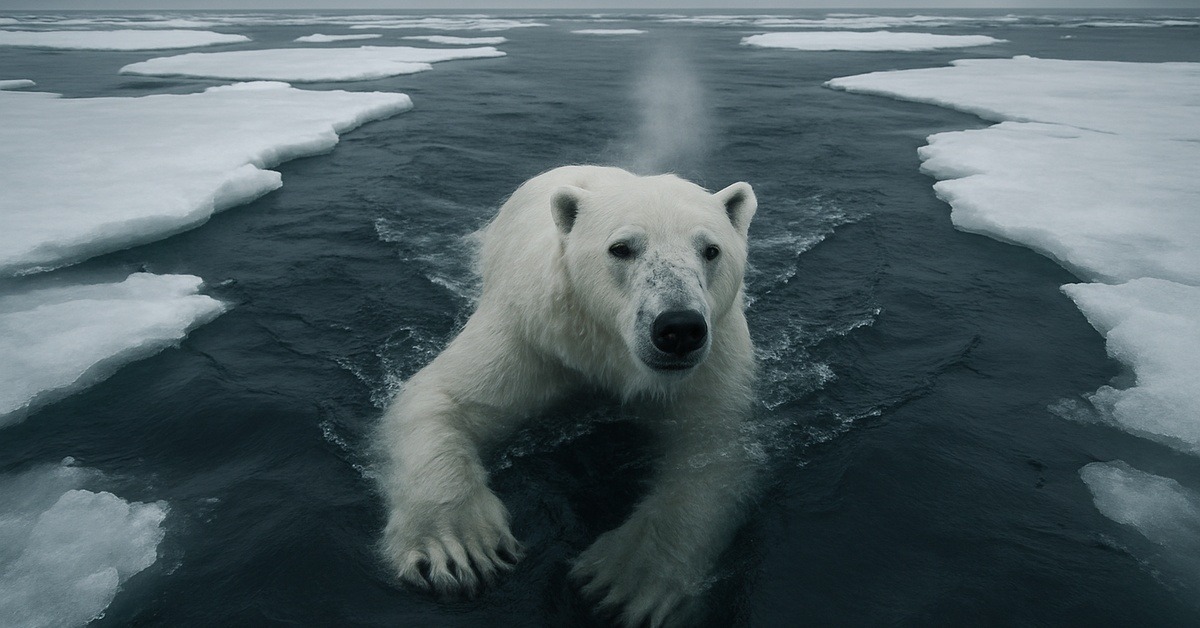
Arctic sea ice is shrinking at roughly 13% per decade, measured in September minimums by satellites that have watched the ice cap since 1979. That’s not an abstract trendline on a chart. On the ground — or rather, on the water — it means the gaps between ice floes grow wider every year, and the platforms bears use to hunt seals form later in autumn and break up earlier in spring.
That timing is everything. Polar bears do almost all of their serious feeding on the sea ice, ambushing ringed and bearded seals at breathing holes and along ice edges. When the ice forms a few weeks late and melts a few weeks early, the hunting season shortens at both ends. The bear that should be packing on fat instead spends those weeks on land, where there is little it can catch.
Bears that once swam two or three kilometers between hunting platforms now swim twenty, thirty, sometimes far more. One tracked female swam 687 kilometers over nine continuous days in the Beaufort Sea. She lost 22% of her body weight on that journey. She also lost her cub. The long-distance swim that the species evolved to handle occasionally has become, in some regions, a routine demand — and routine is exactly what a body running on reserves cannot afford.
Longer swims burn more energy. Energy that should be going into fat reserves. Fat reserves that have to feed milk that has to feed cubs. The math turns against them. And it turns against the cubs first.
When Adaptation Isn’t Fast Enough
Here’s the part that’s hard to look away from: polar bear biology is so precisely tuned to Arctic conditions that its strengths become liabilities the moment those conditions shift. The milk that builds a cub in a single winter requires a mother who hunted enough seals the previous summer to enter the den fat. Fewer ice platforms means fewer hunting opportunities. Lighter mothers enter dens with less fat to convert, and you cannot make rich milk out of reserves you don’t have.
Thinner mothers produce less milk, and milk with lower fat content. Cubs born to those mothers emerge smaller, weaker, and less insulated than they need to be — and a smaller cub in a colder spring is a cub closer to the edge of what its body can withstand. The effect compounds: a lean year for the mother becomes a hard start for the cub, which becomes a smaller adult less able to bank fat in turn.
Researchers tracking the Western Hudson Bay population — one of the most-studied groups of polar bears on Earth, because the bears gather near Churchill, Manitoba each autumn — have documented declining body condition in adult females across roughly the past three decades, alongside a falling population. The cubs being born right now are starting from a thinner margin than the cubs born in 1990. That isn’t a projection or a worst-case model. That’s measured data, gathered bear by bear, year after year.
The Numbers That Matter
- 31–36% fat during peak lactation — versus roughly 3.5% in cows and 4% in humans. The fattiest milk of any land mammal.
- Arctic sea ice declining at approximately 13% per decade since satellite records began in 1979 (NSIDC September-minimum data).
- A cub can grow from under 1 kilogram at birth to 10–15 kilograms by spring emergence, powered entirely by maternal milk with no other food source.
- One female polar bear swam 687 kilometers over nine continuous days in the Beaufort Sea and lost her cub in the process (Pagano et al., 2012).
- Polar bear mothers don’t just feed cubs — they lick them constantly to stimulate circulation and digestion. Without that contact, newborns can’t regulate basic body functions.
Strange Facts Worth Knowing
- Polar bear fur isn’t actually white. Each hair is transparent and colorless; the white appearance comes from light scattering off hollow shafts — and that same hollow structure also helps trap insulating air.
- They’re classified as marine mammals under U.S. law, not land mammals — grouped legally with seals and whales, which tells you how much of their life happens in and around water.
- The mother’s milk fat content varies with what seals she hunted that summer, so the richness of the milk fluctuates from year to year depending on ice conditions and hunting success.
- Litters are usually one or two cubs; twins are common, triplets rare. A mother typically nurses for around two and a half years, which means she breeds only every few years — a slow reproductive pace that leaves little room to recover from a bad season.
Why This Matters Beyond One Species
Polar bear survival has become shorthand in climate conversations — sometimes so overused that people tune it out. That’s a mistake. What’s happening to these animals is a precise, measurable demonstration of how a finely-tuned biological system, built over thousands of years, gets pushed past its margins faster than any adaptation can respond.
The milk, the hollow fur, the webbed paws, the den architecture — none of it was designed for a world that changes this quickly. Evolution works in generations; the ice is changing within a single bear’s lifetime. A polar bear cannot grow a body adapted to open water in time to outpace the loss of the ice it depends on. The toolkit is superb and almost entirely fixed.
And the consequences don’t stop at the bears. Polar bears are apex predators, and apex predators shape the systems beneath them — culling sick and weak seals, redistributing nutrients, keeping prey populations in check. Remove them significantly and the ripples move outward through the food web. The Arctic isn’t a remote corner anymore; it’s a climate engine for the whole planet, helping regulate ocean currents and reflect sunlight back into space. What reads as one species’ problem is really a readout on the health of a system the rest of us live inside.
Frequently Asked Questions
Q: Why is polar bear milk so much fattier than cow or human milk? Because a polar bear mother is feeding her cubs while fasting, inside a freezing den, against a hard deadline. Fat is the most energy-dense fuel a body can make and move, so packing the milk with fat delivers the most calories — and the most insulation-building material — in the smallest package. Cows and humans feed their young while eating regularly in mild conditions, so they don’t need milk that runs like cream.
Q: How long does a cub depend on its mother’s milk? Cubs nurse for roughly two and a half years. Milk is their entire diet inside the den and for the first months after emergence, then it’s gradually supplemented as the cub learns to hunt seals alongside its mother. That long dependency is part of why polar bears reproduce slowly — a female usually raises only one litter every three years or so, which makes each cub’s survival count more.
Q: How does shrinking sea ice actually threaten the cubs, not just the adults? The connection runs through the mother’s body. Polar bears hunt seals from the sea ice, so less ice means a shorter hunting season and fewer seals caught. A mother who couldn’t fatten up over summer enters her den lean, with less stored fat to turn into milk. Thinner mothers make less milk, and milk with lower fat, so their cubs emerge smaller and less insulated. The ice loss hits the adults first, but it lands on the cubs hardest.
A cub weighing less than a bag of sugar, kept alive by milk richer than anything else a land mammal makes. That’s where the story starts. Where it ends depends on decisions made far from any snow den. Polar bear survival isn’t a future problem — it’s happening right now, each winter, in dens we’ll never see. If you want to fall deeper into this kind of thing, this-amazing-world.com has more — stories that kept me up longer than I expected.
Illustrations are AI-generated. Article fact-checked and human-edited.