The Bloodhound Who Crashed a Half Marathon and Won
In January 2016, a two-and-a-half-year-old Bloodhound named Ludivine wandered out of her yard during a bathroom break and finished seventh overall in the Trackless Train Trek Half Marathon — a half-marathon she never entered, never trained for, and didn’t know existed until she literally joined the race. She beat hundreds of prepared humans across 13.1 miles on a cool Alabama morning. Nobody had planned for this. Nobody could have.
Her owner, April Hamlin of Elkmont, Alabama, got a phone call from a friend shortly after letting her out. The dog had joined the race. The dog had nearly won it. Ludivine kept returning to the course even when she veered off to sniff the tree line or splash through creek crossings — the kind of detours that should have slowed her down but didn’t. She trotted past the thinning field of human runners and kept going.
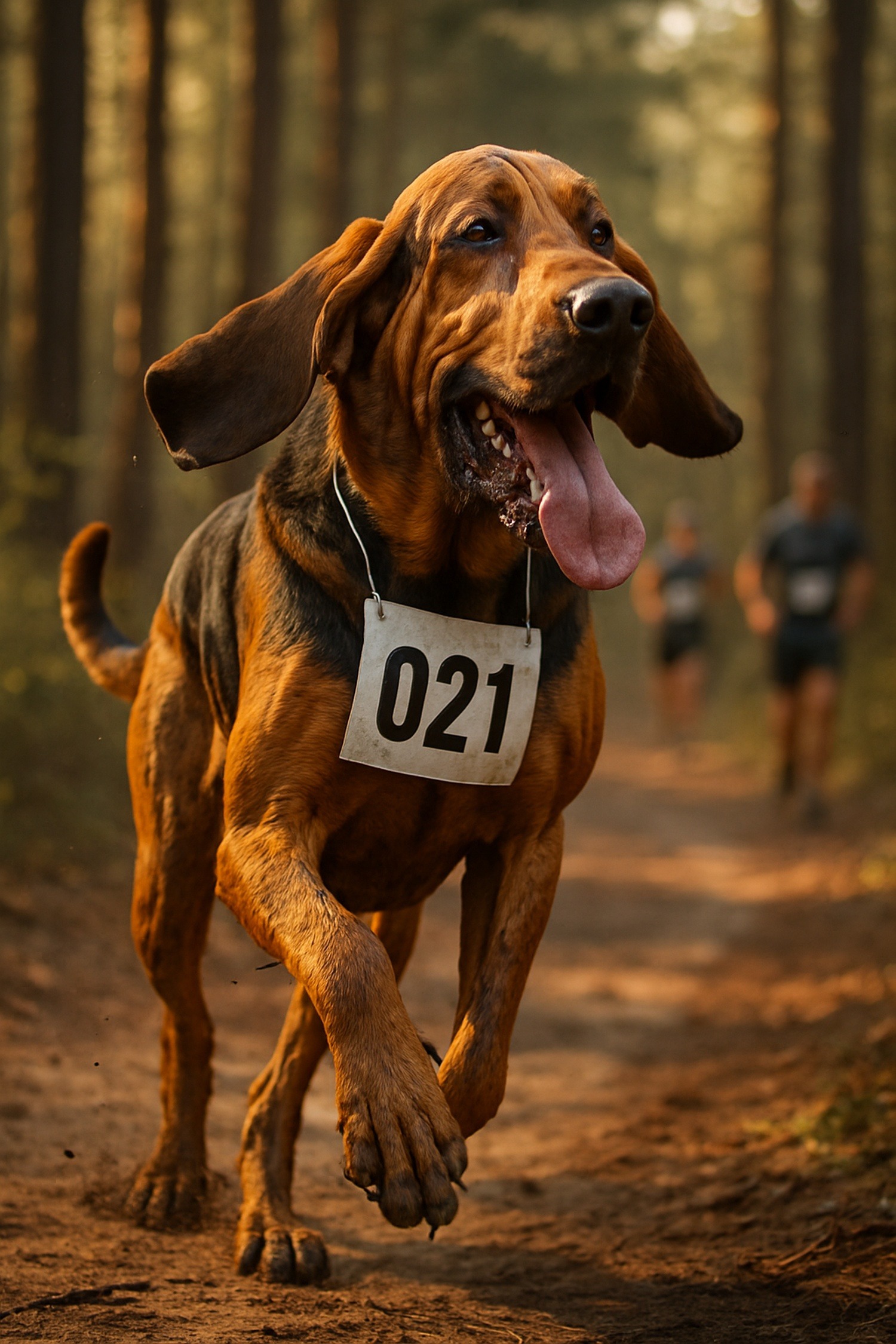
Race director Gretta Armstrong had organized this first-ever half marathon in the small town to raise money for local kids’ cross-country programs. The event wasn’t supposed to have a famous finish. It wasn’t supposed to have a Bloodhound at the front pack within the first mile. What it got instead was a finisher who would remain the most talked-about racer in the event’s history.
Key Facts
- In January 2016, a 2.5-year-old Bloodhound named Ludivine finished seventh overall in the 13.1-mile Trackless Train Trek Half Marathon in Alabama—a race she never entered.
- She placed first among all female finishers; her owner, April Hamlin of Elkmont, Alabama, does not run.
- Race director Gretta Armstrong organized the town’s first-ever half marathon to raise money for local kids’ cross-country programs.
- The American Kennel Club has recognized the Bloodhound breed since 1885, describing an animal built for the long chase.
- Bloodhounds have been documented following scent trails for 40 miles or more without stopping.
In short: In January 2016, a 2.5-year-old Bloodhound named Ludivine wandered into Alabama’s Trackless Train Trek Half Marathon and finished seventh overall across 13.1 miles, first among females. Bred for endurance tracking and AKC-recognized since 1885, she was operating comfortably within her limits—raising questions about whether animals experience joy.
The Race Course Ran Past Her Yard
Ludivine, being a Bloodhound, followed her nose straight into the middle of the race. She didn’t stay with the front pack the whole time. That’s the part that matters. Miles passed. Then more miles. The field thinned out around her, as race fields do, and Ludivine trotted on.
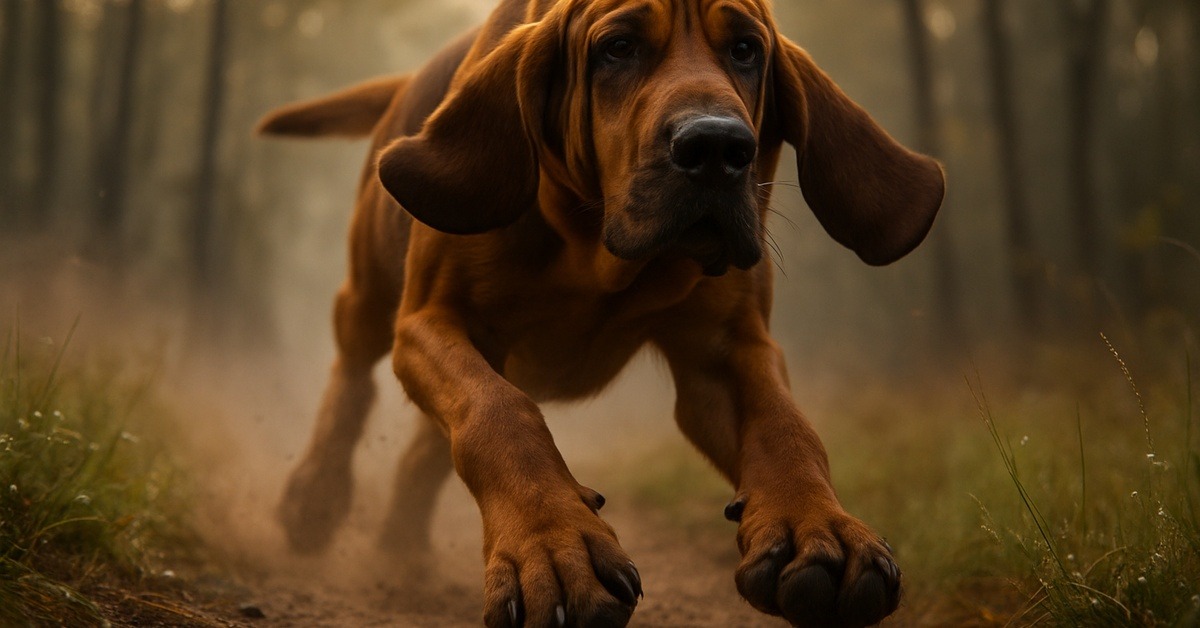
She finished seventh overall. First among all female finishers. Race director Armstrong gave her a finisher’s medal, which Ludivine accepted with what eyewitnesses described as complete indifference. April Hamlin found out by phone. She doesn’t even run.
What a Bloodhound’s Body Is Actually Built to Do
Bloodhounds were never meant to chase prey at a sprint. They were bred — over centuries, refined by monasteries in Belgium and hunting estates across Europe — for one specific, extraordinary task: sustained endurance tracking across vast distances of terrain. The kind of single-minded commitment to a biological purpose that keeps an animal moving long after a human would stop defines this breed with unusual purity.
Their deep, barrel-shaped chest houses enormous lung capacity. Their muscular hindquarters drive a low, efficient gait that eats up ground without burning the reserves that a greyhound’s explosive stride would demand. The American Kennel Club has recognized the breed since 1885, and the standard they’ve maintained since then specifically describes an animal built for “the long chase.”
Bloodhounds have been documented following scent trails for 40 miles or more without stopping — distances that would break most athletic dogs.
A 2015 review published by the National Canine Research Council noted that working scent hounds regularly demonstrate cardiovascular endurance profiles that outpace comparably-sized athletic breeds, largely because they were never bred to stop. When Ludivine “decided” to run 13.1 miles, she wasn’t pushing past her limits the way a human runner does. She was operating comfortably within them. The half marathon was, for her, an afternoon. The biology isn’t about want. It’s about architecture.
She wasn’t tracking a scent trail either — at least not a single one. She was doing what Bloodhounds do in open terrain: sampling everything, moving forward, curious and unhurried. The race just happened to be going the same direction.
Can Animals Experience Joy?
What Ludivine’s run raises, beyond the obvious delight of the story, is something animal behaviorists have been circling for decades. Can animals experience something that meaningfully resembles joy? Not contentment. Not the satisfaction of a satiated appetite. But the active, kinetic, forward-moving state that a running dog appears to embody when it has no practical reason to keep going.
Ethologist Marc Bekoff, professor emeritus of ecology and evolutionary biology at the University of Colorado Boulder, argued as early as 2002 in his book Minding Animals that the emotional lives of non-human animals are far richer and more complex than mainstream science had been willing to accept. By 2012, a group of prominent neuroscientists — including Bekoff — signed the Cambridge Declaration on Consciousness, formally acknowledging that non-human animals possess the neurological structures necessary for conscious emotional states. National Geographic has reported extensively on the growing scientific consensus that dogs, in particular, experience emotions with remarkable structural similarity to human ones.
The neurochemistry of a running dog — the dopamine release, the endorphin cascade that accompanies sustained aerobic effort — maps closely onto what humans describe as a runner’s high. Studies at the University of Arizona in 2021 found that domesticated dogs show measurable endocannabinoid system activation during prolonged running, the same system implicated in exercise-induced euphoria in humans. Ludivine may not have had a finish line in mind. She may have had something better: no finish line at all.
And here’s what this reframes: She wasn’t lost. She wasn’t confused. She was, by every biological measure available to us, doing exactly what she wanted to do — and doing it extremely well. The temptation is to say she “just wanted to.” But that’s not a small thing. Watching a dog move through 13 miles with that kind of unselfconscious commitment to the task — no finish-line anxiety, no time-goal pressure, no external validation needed — you realize we’ve built an entire motivational industry around something she understood without being taught.
Why This Story Still Resonates
The story broke out of Alabama in 2016 and went global within days. Runner’s World covered it. The BBC picked it up. Social media did what social media does, and suddenly Ludivine was everywhere — photos of a jowly, loping Bloodhound with a finisher’s medal around her neck, April Hamlin looking simultaneously proud and bewildered.
Why does a dog accidentally finishing a race generate more response than a thousand “athlete overcomes odds” narratives? Part of it is the accidental nature of the achievement. Ludivine didn’t train. She didn’t set a goal. She didn’t download a couch-to-5K app or hire a coach or buy the right shoes. She walked out a door on an ordinary morning and ran 13.1 miles because the opportunity was there and her body said yes.
In 2016, a year when conversations about motivation, productivity, and self-optimization were reaching a kind of cultural saturation, a Bloodhound who ran a half marathon for no reason at all felt like the most honest thing anyone had encountered in months. She finished because she kept going. That was the whole plan. The University of Alabama’s sports science department didn’t issue a statement. No formal study was commissioned. The research world largely left Ludivine alone. But the response from ordinary people — runners, non-runners, dog owners, people who had never owned a dog — was immediate and visceral.
Race director Armstrong gave her the medal because there was nothing else to do. It was the right call. The rules of the Trackless Train Trek Half Marathon had not anticipated this scenario — and honestly, why would they have? Ludivine walked home afterward. She took a nap. She had no idea she’d gone viral.
Where to See This
- Elkmont, Alabama, USA — the town where Ludivine’s run happened remains a small community in Limestone County; the Trackless Train Trek Half Marathon has continued as an annual event and draws runners from across the Southeast, typically held in January when the Alabama weather cooperates.
- The American Kennel Club (AKC) — akc.org — maintains detailed breed profiles on Bloodhounds including working endurance data, scenting capabilities, and breed history going back to the St. Hubert’s Hound lineage developed by Belgian monks in the medieval period.
- If you want to understand what Ludivine’s body was actually doing during those 13.1 miles, Marc Bekoff’s The Emotional Lives of Animals (New World Library, 2007) remains one of the most accessible and rigorous starting points for understanding animal joy as a legitimate biological phenomenon.
By the Numbers
- 13.1 miles — the exact distance Ludivine completed, equivalent to a standard half marathon, entirely uninvited (Trackless Train Trek Half Marathon, January 2016).
- 7th place overall out of the full field of registered human runners — Ludivine’s finishing position, making her also the top female finisher in the race.
- 40+ miles — the documented endurance range of a working Bloodhound on an active scent trail, according to the National Canine Research Council’s 2015 working-dog endurance review.
- 2.5 years old — Ludivine’s age at the time, equivalent to a young adult in human developmental terms, well below the breed’s physical peak of 3–5 years.
- 1885 — the year the American Kennel Club formally recognized the Bloodhound breed, codifying the endurance and scenting standards the breed had been selectively developed toward for centuries.
Field Notes
- Ludivine didn’t run clean. Multiple eyewitnesses at the 2016 Trackless Train Trek confirmed she left the course at least twice to sniff the underbrush and waded through a water crossing well off the marked route — then returned to the race of her own accord and kept pace with the lead group. The detours did not noticeably affect her finishing position.
- Bloodhounds have such a powerful scenting drive that they’ve been used to track trails over 300 hours old — meaning a cold scent trail nearly two weeks stale can still register to a trained dog. Ludivine was essentially running through a wall of olfactory information most animals couldn’t begin to process.
- The race was the first half marathon ever organized in Elkmont. Ludivine didn’t just crash a race — she crashed a historic first. Every record from that inaugural event includes her name in the results.
- Researchers still can’t fully explain what determines when a dog chooses to disengage from a scent-driven activity versus continue. Ludivine’s decision to keep returning to the course after her detours — rather than simply wandering home — remains genuinely unexplained by current behavioral models. Was it the crowd? The pace? The accumulated scent of dozens of running humans? Nobody knows.
Frequently Asked Questions
Q: How far can a Bloodhound run — and is a Bloodhound running a half marathon actually unusual?
For a healthy adult Bloodhound, 13.1 miles is well within normal physical range. The breed was developed specifically for sustained endurance work, and working dogs of this type regularly cover 20 to 40 miles on active tracking assignments. What made Ludivine’s half marathon remarkable wasn’t the distance — it was the context. She ran it spontaneously, on flat race terrain, at competitive pace, among humans who had trained for months. That combination is, yes, extremely unusual.
Q: Was Ludivine in any danger during the race?
By all accounts, no. The race took place in January in northern Alabama, meaning temperatures were cool — favorable conditions for a large-breed dog with a thick coat. The course was well-staffed with volunteers who, once they realized what was happening, kept an eye on her throughout. Bloodhounds are generally not at risk of overexertion in moderate temperatures during sustained trotting, unlike short-faced breeds. April Hamlin, when she found out, said her first reaction was relief that Ludivine was fine — and then laughter.
Q: Did Ludivine ever race again?
There’s no public record of Ludivine entering — officially or unofficially — any subsequent race events after January 2016. She returned home after the Trackless Train Trek and, as far as anyone can tell, resumed normal dog life. The race organizers have reportedly kept a place in their results for her in spirit, and she remains the most famous finisher in the event’s history. Sometimes one great performance is enough. Ludivine appears to agree.
Editor’s Take — Alex Morgan
What gets me about this story isn’t the feel-good angle — it’s the mirror it holds up. Ludivine ran 13.1 miles with no goal, no plan, and zero anxiety about her time. She stopped to sniff things. She waded through water. She finished anyway. We’ve built an entire industry around optimizing that experience, and a dog accidentally did it better by ignoring every principle we’ve invented. The question isn’t whether she had fun. The question is why it’s so hard for us to do what she made look effortless.
Somewhere in Elkmont, Alabama, there’s a finisher’s medal that belongs to a Bloodhound who never asked for it and probably chewed it twice before April Hamlin put it somewhere safe. The race still runs every January. The course still passes April’s property. And every year, according to people who were there in 2016, someone looks over at the start line as the field lines up — just to check. Because once a Bloodhound decides a race looks worth running, you don’t assume it can’t happen again. You just leave a little room at the front.
Illustrations are AI-generated. Article fact-checked and human-edited.