What Animal Can Kill an Elephant? The Honest Answer
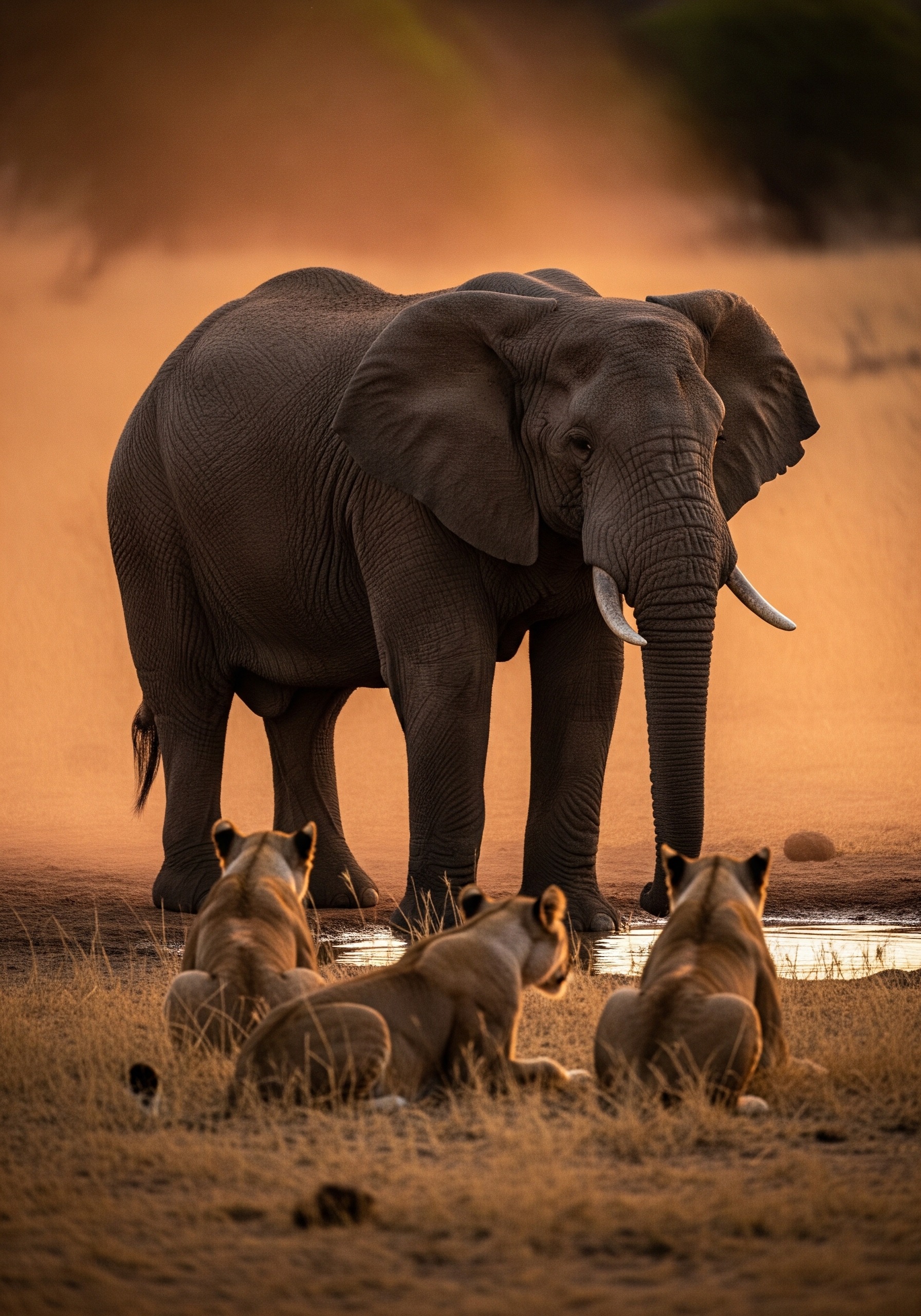
The question of what animal can kill an elephant has a tidier answer than the internet suggests. Outside humans, only one species reliably brings down adult elephants in the wild, and even that takes a coordinated pack and a particular set of conditions. Everyone else on the usual list — crocodiles, hyenas, leopards, even tigers — is hunting calves, not the six-ton matriarchs of the herd.
Key Facts
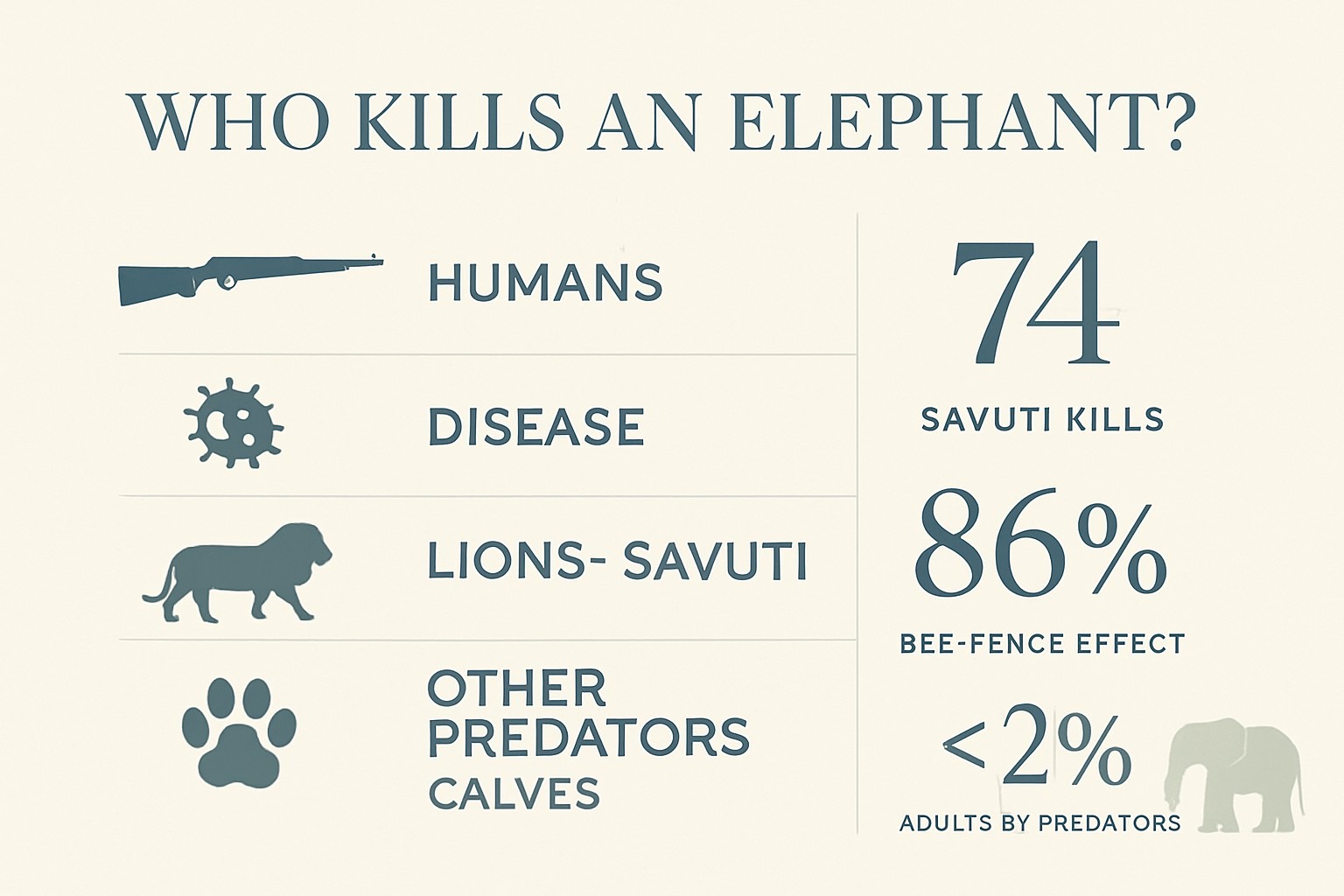
- A single pride of Savuti lions killed an estimated 74 elephants over three years, almost all between 4 and 11 years old, as documented by Power and Compion in African Zoology (2009).
- Fewer than 2% of adult African savanna elephants die from predation. Disease, drought and humans account for the overwhelming majority of mortality.
- African honey bees do not kill elephants, but Oxford zoologist Lucy King’s playback experiments showed elephants retreat from bee sounds and emit a specific “bee rumble” alarm call.
- Nile crocodiles can latch onto an elephant’s trunk during a river crossing — and a damaged trunk is, slowly, fatal, because an elephant cannot drink or feed without one.
- Beehive fences now span 97 sites across Africa and Asia and reduce crop-raiding elephant attempts by up to 86.3%, according to a 2024 Save the Elephants and University of Oxford report.
In short: The only animal that can kill an elephant routinely is the human. The only non-human predator that regularly takes down adults is a specific kind of lion pride, in a specific kind of dry-season landscape. Almost everyone else on the standard “elephant predators” list — including tigers, leopards, crocodiles and hyenas — is opportunistically killing calves, not adults.
Key Facts
- A single Savuti lion pride killed an estimated 74 elephants over three years, almost all aged 4 to 11, per Power and Compion in African Zoology (2009).
- Fewer than 2% of adult African savanna elephants die from predation; disease, drought and humans dominate mortality.
- Oxford zoologist Lucy King’s playback experiments showed elephants retreat from bee sounds and emit a specific bee-rumble alarm call.
- Nile crocodiles can latch onto an elephant’s trunk during a river crossing, and a damaged trunk is slowly fatal.
- Beehive fences now span 97 sites across Africa and Asia, reducing crop-raiding attempts by up to 86.3%, per a 2024 Save the Elephants and University of Oxford report.
In short: Outside humans, only a specific type of lion pride—like the Savuti lions of Botswana—reliably kills adult elephants, and even then mostly 4-to-11-year-olds. Fewer than 2% of adult elephants die from predation. Crocodiles, hyenas and leopards target calves, while bees, though harmless, are the one animal a herd will flee.
What animal can kill an elephant? The honest answer
Most of the internet’s lists conflate three very different questions: what animal can kill an elephant, what kills the most elephants, and what predators target the species. The answers do not overlap.
An adult African bush elephant stands up to four metres at the shoulder and weighs four to six tonnes. Its skin is two centimetres thick over the back. Its tusks are weapons. Its trunk is a hundred kilograms of pure muscle, capable of crushing a lion’s skull. A healthy adult cow defending herself, or a fifty-year-old bull in his prime, is — for every predator on Earth except humans — a bad investment.
That is why every entry on the standard predator list comes with the same quiet asterisk: “…but only calves, or weakened individuals, and only sometimes.” The question is really about three different elephants — calf, juvenile, adult — and three very different killers: predators, pathogens, and people.
The hierarchy of risk to an African elephant
- Adults: humans (poaching, retaliation) > disease (anthrax, septicaemia) > drought > lions (Savuti-type prides only).
- Juveniles (4–11 yrs): lions in specific dry-season landscapes; disease; humans.
- Calves (under 4 yrs): hyenas, lions, crocodiles, leopards, wild dogs, drought, infanticide by stressed bulls.
- The wildcard: African honey bees — non-lethal, but the only animal a herd will visibly flee.
Lions: the only predator that hunts grown elephants
Lions are the only natural predator known to repeatedly kill grown elephants. Even then it is the exception, not the rule — and that exception belongs to one population: the Savuti lions of Chobe National Park in Botswana.
Why Savuti? Water. Specifically, the disappearance of natural water in the Savuti Channel in 1981 and the artificial waterholes that replaced it, which kept thousands of elephants in place year-round long after their normal ungulate prey had migrated out. The lions adapted.
Researchers R. John Power and R.X. Shem Compion documented the behaviour in African Zoology in 2009, confirming earlier field observations by filmmaker-biologist Dereck Joubert. Their finding: a pride of around thirty lions was killing roughly one elephant every three days during the worst of the dry season. The Marsh Pride alone took an estimated 74 elephants over a three-year window.
The targets were not bulls in their prime. Of eight elephants Power and Compion aged by molar wear, seven were between four and eleven years old — adolescents, large enough to feed the pride for days but small enough to be pulled down. The lions worked at night, in groups of twenty or more, latching onto the hindquarters until the elephant collapsed from exhaustion and blood loss.
Plainly put: outside Savuti, lion predation on adult elephants is rare. Lions across the rest of Africa almost exclusively take calves, and only when the herd has been disrupted or a calf strays. Savuti is a textbook case of how prey availability and water engineering can rewrite a predator’s menu — not evidence that any random pride could topple an adult elephant.
{IMAGE_2}
Crocodiles, hyenas, leopards: the calf-hunters
Below lions, the rest of the predator list is essentially a roster of opportunistic killers of calves. Each has a niche.
Nile crocodiles do not stalk elephants — they ambush them. At a river crossing, an adult crocodile may grab the trunk of an elephant reaching for water. Even if the elephant rips free, the injury can be fatal: an elephant whose trunk is severed or paralysed cannot drink without lying down, cannot feed efficiently, and slowly starves. Crocodiles also take calves outright, gripping a leg and rolling them under.
Spotted hyenas and African wild dogs run exactly the same playbook on land — they wait. A calf cut off from the matriarch. A juvenile lost in a sandstorm. A sick adult unable to keep up. Hyena clans of twenty or more can isolate and exhaust a calf; wild dog packs occasionally do the same in Hwange and the Okavango. Leopards, much smaller, have been recorded killing calves at night, when a sleeping herd’s vigilance dips.
In Asia, tigers play the leopard’s role and the lion’s role combined. There are documented cases of Bengal tigers taking Asian elephant calves in northeast India, and rarer reports of large male tigers attacking juveniles. Adult cow elephants travelling in groups are generally safe — a defending matriarch outweighs the tiger by a factor of twelve.
Hippos, rhinos and rogue bulls: the heavyweight encounters
The other large herbivores of the savanna are not predators, but they can kill an elephant in a fight. Hippos are responsible for more human deaths in Africa than any other large mammal, and a defensive hippo’s bite — designed to crush bone — has been documented to fatally injure young or sub-adult elephants that crowd into the wrong pool. Rhinos have killed elephants in captivity and, very rarely, in the wild; the white rhino’s horn can puncture an elephant’s ribcage.
And then there are other elephants. In South Africa’s Pilanesberg reserve in the 1990s, an infamous group of orphaned young bull elephants — raised without older males to discipline them — killed more than forty white rhinos and were implicated in violence within their own herds. Veteran elephant researchers Joyce Poole and Cynthia Moss have long argued that the absence of mature bulls in cull-disrupted populations produces exactly this kind of social pathology: young males in extended musth, no elders to suppress them, aggression poorly channelled.
Stripped of sentiment, the conclusion is uncomfortable. The most dangerous animal an elephant ever meets, after the human, is usually another elephant.
The animal everyone forgets: the African honeybee
Here is the surprise on every list that omits it.
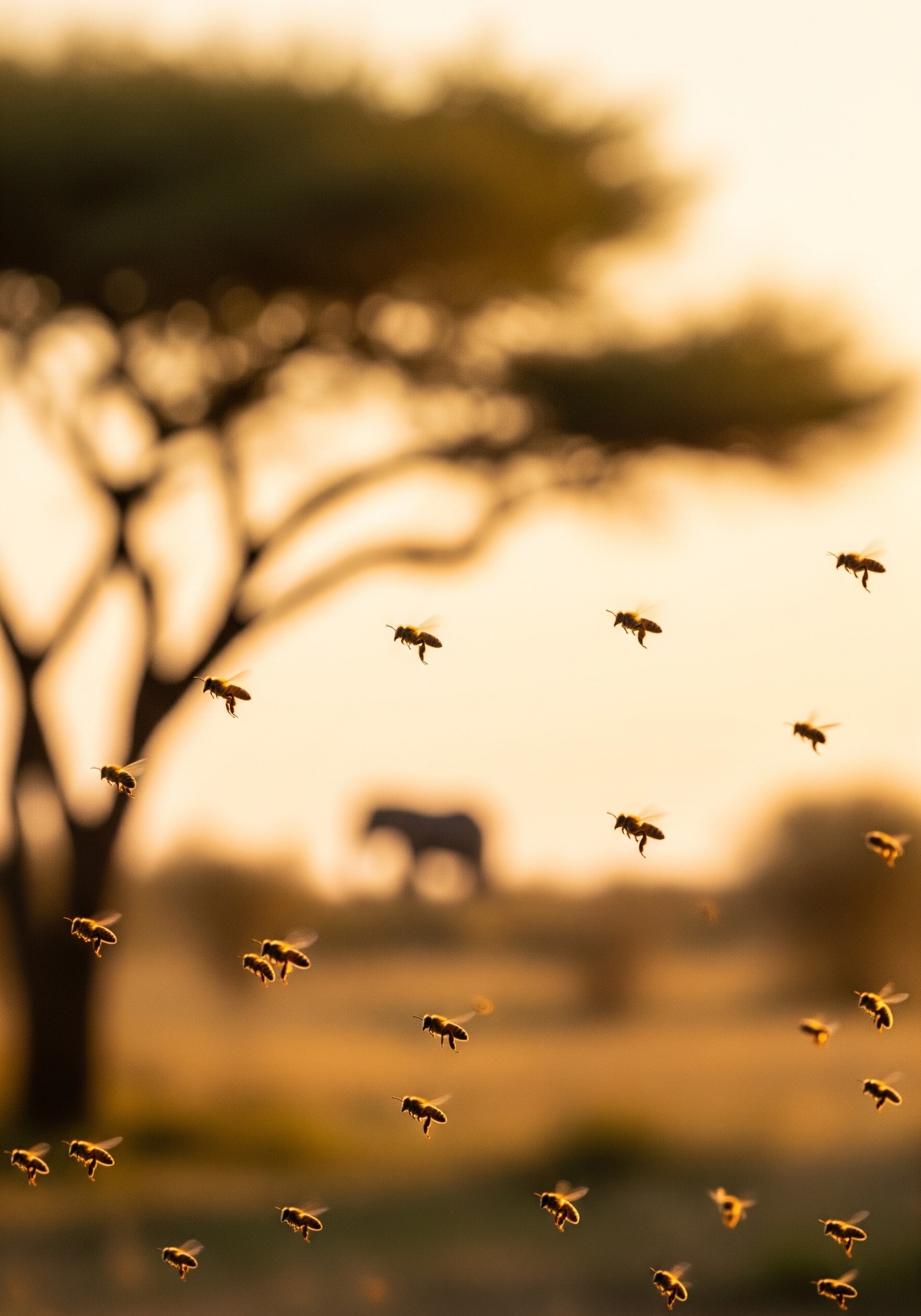
African honey bees cannot kill an adult elephant. They can, however, terrify one — and a panicked, fleeing elephant in dense bush will hurt itself, separate from the herd, and become vulnerable in a hundred small ways. Elephant skin is thick over the back, but the inside of the trunk, the eyelids, the soft folds behind the ears, around the genitals — none of those are armoured. A swarm can deliver hundreds of stings to those zones in seconds.
The most rigorous work on the bee–elephant relationship belongs to Oxford zoologist Lucy King, who began her doctoral research at Save the Elephants in 2007. Her now-famous playback experiments — broadcasting recorded bee sounds at unsuspecting wild elephant herds — produced the same response again and again: heads up, ears flared, swift retreat. In 2010 her team identified a specific low-frequency alarm call given only in response to bees: the “bee rumble.” It is the first documented case of an elephant alarm call specific to an invertebrate threat. The full story of why a six-ton elephant flees in terror from a bee is worth reading on its own.
King’s group has since installed more than 14,000 beehive fences across 97 sites in Africa and Asia. A 2024 follow-up by Save the Elephants and the University of Oxford reported that the fences cut crop-raiding attempts by up to 86.3% during peak harvest. Bees do not kill elephants. But they are the only living thing a herd will run from on the sound of wings alone.
What actually kills elephants: disease, drought and people
Now the uncomfortable answer that the listicles avoid. Almost no elephant dies in the jaws of a predator. The real killers are microbial, climatic and human.
Anthrax — Bacillus anthracis, the same soil pathogen that periodically kills cattle — is a documented driver of elephant mortality across sub-Saharan Africa. A 2024 demographic study in Biological Conservation on the long-watched Tarangire population in Tanzania found that episodic anthrax outbreaks were a statistically significant influence on adult female survival, capable of regulating population numbers. In Namibia’s Etosha National Park, anthrax cases peak almost every dry season.
In 2020, hundreds of elephants died abruptly around Botswana’s Okavango Delta. Investigators eventually pointed to cyanobacterial toxins in drying waterholes — climate, not predator. The same year, a Zimbabwe die-off was traced to a Pasteurella-like bacterium previously seen in livestock. Drought alone can collapse calf survival in a single bad year, and a calf that survives the dry season has already outlived its most dangerous predators.
Then humans. Poaching for ivory remains the single largest cause of unnatural elephant deaths across the African range; the IUCN’s 2021 reassessment moved African forest elephants to Critically Endangered and savanna elephants to Endangered. Habitat loss compresses elephant ranges into farmland, where retaliatory killings follow crop raids. The honest answer to “what animal can kill an elephant” — and to “what kills the most” — is the one writing the list.
A 2026 update: what has changed since the standard lists were written
Two strands of research have shifted the picture since most “10 animals that can kill an elephant” articles were written. First, the Savuti lion predation is no longer the runaway anomaly it was. When the Savuti Channel began flowing again in 2008, the elephant-specialist pride fragmented and elephant kills dropped sharply. Lion predation on adults appears to be a local response to artificial water and depleted ungulate prey — fragile, contingent, not innate.
Second, the disease story has moved fast. Anthrax, EEHV (elephant endotheliotropic herpesvirus, a major killer of Asian elephant calves), and the Botswana cyanotoxin episode have, between them, almost certainly killed more elephants in the last decade than every lion in Africa combined. The next honest version of any predator list ought to have a column labelled microbes.
Frequently Asked Questions
Q: Can a lion kill an adult elephant on its own?
A: No. Even in Savuti, where lions take adults, kills are made by groups of ten to thirty animals working together at night. A solitary lion attacking a healthy adult elephant would almost certainly be killed itself by trunk and tusk.
Q: Can a tiger kill an elephant?
A: A tiger can kill an Asian elephant calf, and there are rare credible records of large male tigers attacking juveniles in northeast India. Adult elephants are essentially safe — a defending cow weighs ten to fifteen times what the tiger does.
Q: What kills elephants the most?
A: Humans, by a wide margin — through poaching, habitat conflict and retaliatory killings. Disease (anthrax, EEHV, bacterial septicaemia) and drought-driven calf mortality come next. Predators account for a small minority of natural deaths, and those are almost always calves.
Q: Are elephants really afraid of bees and mice?
A: Bees, yes — and the evidence is unusually strong. The mouse story is folklore; controlled tests show elephants are mildly curious about mice, not afraid of them. The bee fear is real, measurable, and now used in conservation projects worldwide.
Sources
- Power, R. J. and Compion, R. X. S. — “Lion Predation on Elephants in the Savuti, Chobe National Park, Botswana,” African Zoology, 44(1), 2009.
- King, L. E. and colleagues — Save the Elephants and the University of Oxford, beehive fence and “bee rumble” research, 2007–2024.
- National Geographic — reporting on the 2020 Botswana elephant die-off and the cyanobacterial toxin investigation.
- Etosha Ecological Institute, Namibia — long-term anthrax monitoring in African savanna elephants.
- IUCN Red List — 2021 reassessment of African forest and savanna elephant species.
An elephant is a fortress. The animal that can kill an elephant in the wild is almost never the one in the storybook — it is the one carrying a pathogen, the one carrying a rifle, or, occasionally and in just the right desert, the one with a pride at its back. The herd’s most patient enemies are very small, very smart, or entirely microscopic.
Illustrations are AI-generated. Article fact-checked and human-edited. Our editorial standards.