The African Grey Parrot Who Talked His Way Home
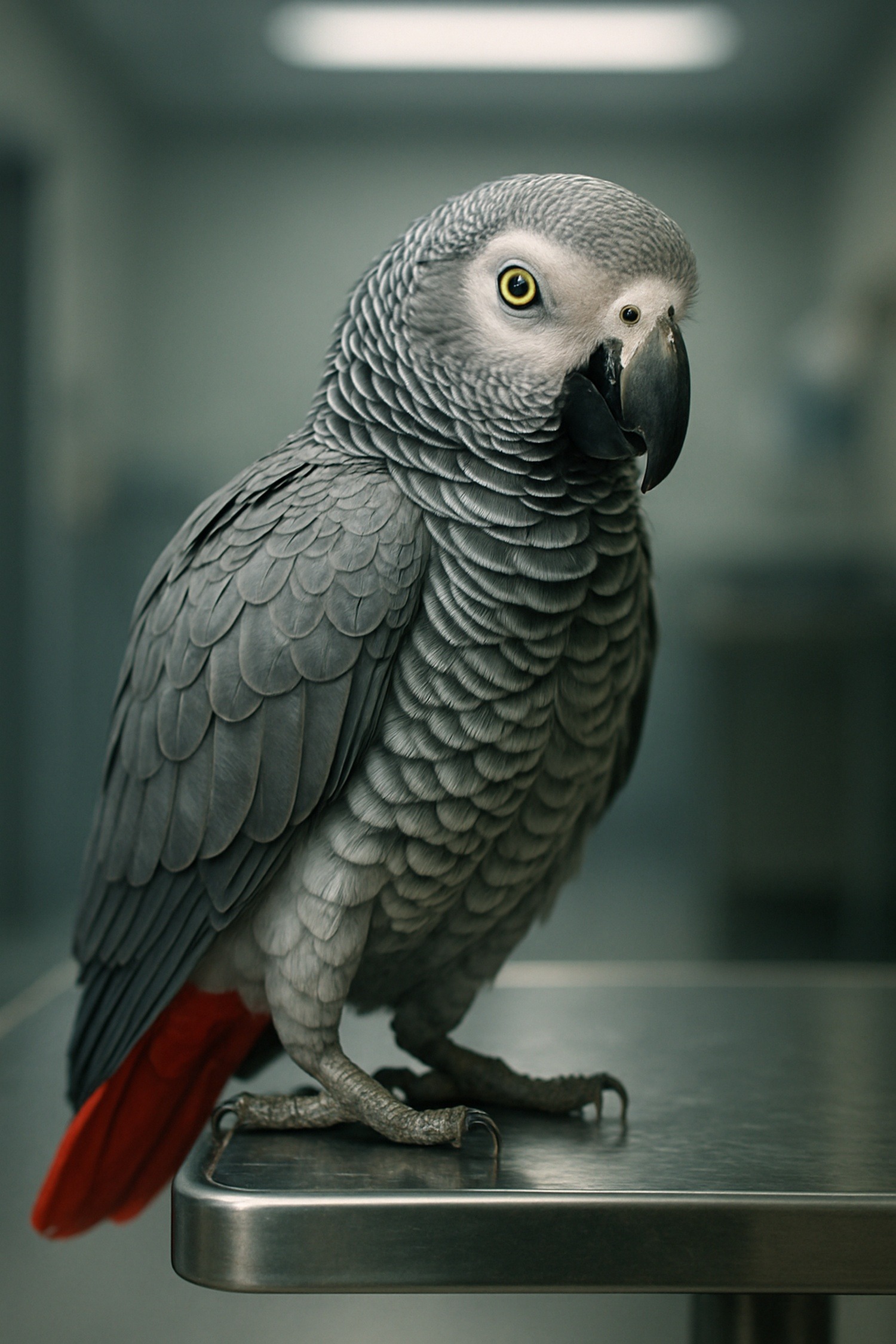
A grey parrot walked into a veterinary clinic outside Tokyo and did something that should have been impossible: he introduced himself. Not performed. Not mimicked. Introduced — with his name, his address, spoken calmly to a stranger. African grey parrot intelligence didn’t just make headlines that day. It brought one bird home. The room must have gone very quiet.
Somewhere in the Tokyo area, a family had lost him. He ended up in a clinic — disorienting, full of strange smells and unfamiliar hands. Most animals panic. Most revert to survival instinct. This one didn’t. He stayed composed. He communicated. Within days, the clinic tracked down his owners. But here’s the thing: what made a bird do that? What does it tell us about what’s happening inside that grey, feathered skull?
Key Facts
- A grey parrot near Tokyo was returned to its family after calmly stating its name and address at a veterinary clinic.
- Scientific study of the African grey (Psittacus erithacus) began in the 1970s; Dr. Irene Pepperberg started working with the parrot Alex in 1977.
- Alex could identify objects by color, shape and material, quantify sets up to six, and grasp the concept of zero.
- African greys with engaged owners regularly demonstrate vocabularies of 200 to 500 words, with some documented above 1,000.
- African grey parrots can live 40 to 60 years in captivity.
In short: When a lost African grey parrot near Tokyo calmly told a veterinary clinic its name and address, it was reunited with its family — a striking display of the species’ cognition. Research since the 1970s, notably Irene Pepperberg’s work with Alex, shows African greys map words to concepts, count to six, grasp zero and can live 40–60 years.
African Grey Parrot Intelligence: What the Science Actually Shows
Formal study of the cognitive abilities of Psittacus erithacus — the African grey parrot — began in the 1970s. But everything changed in 1977 when Dr. Irene Pepperberg, then at Purdue University and later at Harvard, started working with a bird named Alex. Over three decades, Alex demonstrated something that made neuroscientists deeply uncomfortable: he didn’t just mimic. He understood. He could identify objects by color, shape, and material. He could quantify sets of up to six items. He grasped the concept of zero — a cognitive milestone that human children don’t typically reach until age three or four.
Alex the parrot became one of the most studied non-human animals in scientific history. Every extraordinary parrot story since has been measured against him. The Tokyo bird is measured against him too.
Pepperberg’s decades of work revealed something critical: African greys don’t just store sounds and replay them. They map words onto concepts. They use language functionally — to request, to label, to refuse, to ask. Alex famously said “I’m sorry” when he sensed Pepperberg was frustrated with him. Whether that was empathy or learned association remains debated. But the fact that the distinction is even debatable tells you something about how far beyond simple mimicry these birds operate.
They’re doing something with language. The Tokyo parrot was doing something with language too — something very specific, very purposeful, and very well-timed.
What distinguishes African greys even among parrots is the density of their neural circuitry. Their forebrains, proportional to body size, rival those of many primates. They’re not working with a bird brain in the dismissive sense of the phrase. They’re working with a compact, highly efficient cognitive engine that evolution spent millions of years refining in the rainforests of West and Central Africa.
How One Bird Held Himself Together
Fear does strange things to animals. Prey animals freeze or flee. Even domesticated animals, when genuinely disoriented, often revert to survival instincts that override learned behavior. The Tokyo incident is remarkable not just because the bird knew his address — it’s remarkable because he used it. He stayed composed in a clinical environment, surrounded by strangers and strange smells, and reached for the most useful thing he had: the words his family had apparently taught him.
That’s a form of emotional self-regulation that we rarely credit to non-human animals. It echoes what researchers studying bird cognition and stress behavior have noted — that social attachment in African greys isn’t just affection. (Researchers actually call this “socially-mediated stress regulation.”) It’s structural. It shapes how the bird processes threat. Think of how a baby monkey, separated from its mother, will cling to any available comfort object — the drive to reconnect is that deeply wired. The greys seem to channel that same drive into language. They reach out with words the way we do.
Watching a species with this capacity for attachment get trapped in unsuitable environments, you stop calling it a hobby — keeping parrots becomes a question of what we actually owe them.
Between one and two years of age, African greys in captivity typically begin acquiring vocabulary. By adulthood, individuals with engaged owners regularly demonstrate vocabularies of 200 to 500 words. Some documented cases push beyond 1,000. But why does raw vocabulary size matter less than context? Because the more significant finding — confirmed in multiple studies at institutions including MIT and the University of Arizona through the 1990s and 2000s — is that African greys use context. They don’t randomly deploy stored sounds. They select words appropriate to the situation they’re in. The Tokyo bird didn’t recite a shopping list or sing a song. He gave his name and his address. Situationally appropriate, maximally useful, economically precise.
Repetition, probably. Consistent reinforcement of the address, the name, over months or years of daily interaction — his family had clearly done something right. The bird stored it, attached significance to it, and retrieved it under stress. That’s memory working exactly the way it should — not as a recording, but as a resource.
The Grief, the Bonding, and the Weight of 60 Years
African greys can live 40 to 60 years in captivity. That number deserves a pause. A bird acquired today might be alive in 2080. It might outlive its owner. It will almost certainly outlive the furniture it first perched on, the neighborhood it first learned to call home.
National Geographic’s profile of the species notes that this extraordinary lifespan, combined with their intense social bonding, creates welfare challenges unlike those of almost any other companion animal. African greys don’t just tolerate human presence — they bond to specific individuals so deeply that the loss of that person can trigger behavior that looks indistinguishable from grief. Feather-plucking. Refusal to eat. Prolonged silence. Researchers at the University of Lincoln in the UK have documented behavioral changes in grey parrots following the death or departure of a primary caregiver that parallel the stress responses seen in bereaved primates.
African grey parrot intelligence isn’t just about IQ-style performance. It’s about attachment. This context matters when we think about the Tokyo story. The bird who told the vet his address wasn’t performing a trick. He was, in the most fundamental sense, trying to get back to the person he loved. The words were the tool. The emotion was the engine. Whether or not we’re comfortable attributing something like longing to a bird, the behavior is consistent with it — and more importantly, the behavior worked.
There’s something quietly extraordinary about that. A creature operating on instinct and learned language, in a frightening situation, making a choice that required both memory and something that at least functions like hope. He said the words. He waited. They came for him.
What African Grey Parrot Intelligence Means for How We Keep Them
Most of these birds are probably bored. That’s what the scientific literature on African grey cognition carries as an uncomfortable implication. A 2016 study published in the journal Applied Animal Behaviour Science, conducted in part through collaboration with researchers at the University of Guelph in Canada, found that grey parrots kept in social isolation showed significantly elevated stress hormones and reduced problem-solving performance compared to birds housed with conspecifics or with highly interactive human caregivers. The study didn’t suggest that solo ownership was impossible — but it strongly implied that the cognitive demands of the species require an environment that most standard companion-bird setups simply don’t provide. These are animals built for complex social forests. They’re keeping it together in living rooms and home offices, but often just barely.
Foraging challenges produced remarkable results in the same research. African greys given access to problems to solve for food rewards showed measurable improvements in mood-related indicators within just four weeks. Four weeks. The cognitive hunger is that acute and that responsive. This has practical consequences for owners: enrichment isn’t optional for this species, it’s biological necessity.
The birds that decline — that pluck their feathers, that develop repetitive behaviors, that go silent — are often not sick in the conventional sense. They’re understimulated. Their remarkable minds have nothing to work on.
Sanctuaries and avian welfare organizations across Europe and North America have begun redesigning enclosures specifically for grey parrots based on this research. Updated care guidelines from the World Parrot Trust, headquartered in the UK, now emphasize foraging complexity, social contact hours, and cognitive challenge as primary welfare metrics — not just physical health. And yet the Tokyo bird had owners who understood what this animal needed. He knew his name. He knew where he lived. That doesn’t happen by accident.
How It Unfolded
- 1977 — Dr. Irene Pepperberg begins working with Alex the African grey at Purdue University, launching the first rigorous scientific study of parrot cognition.
- 1999 — Pepperberg publishes The Alex Studies, compiling decades of evidence that African greys understand concepts rather than merely mimicking sounds.
- 2005 — Alex demonstrates comprehension of the concept of zero, a cognitive milestone previously thought exclusive to humans and great apes.
- 2016 — Applied research at the University of Guelph confirms that social enrichment directly improves cognitive performance and measurable welfare indicators in captive grey parrots.
By the Numbers
- 40–60 years: average lifespan of an African grey parrot in captivity, making them one of the longest-lived companion birds on record.
- ~700,000: estimated number of African greys exported from the wild between 1994 and 2003, before CITES Appendix I trade restrictions were tightened (CITES trade database).
- 500+: typical vocabulary range documented in adult African greys with engaged, language-rich home environments.
- 49%: population decline recorded in African grey parrots across their range in Ghana between 1992 and 2015, driven by trapping and habitat loss (BirdLife International).
- 4 weeks: time required for foraging enrichment interventions to produce measurable improvements in stress indicators in captive grey parrots (University of Guelph, 2016).
Field Notes
- In a 2012 experiment at Harvard, Alex’s successor — a grey named Griffin — spontaneously used English phrases to communicate with a second parrot during a shared task, suggesting that grey parrots may use human language interspecifically, not just as a tool directed at humans. The finding hadn’t been anticipated by the researchers.
- African greys are the only non-human animal known to ask questions — not in response to a prompt, but spontaneously and referentially, apparently to gather information about their environment.
- Wild African greys in Central Africa engage in coordinated group foraging with alarm-call systems that researchers have shown are regionally distinct — a form of vocal culture passed between generations, not encoded genetically.
- It’s still not fully understood why African greys bond so much more intensely than other highly intelligent parrots like macaws or cockatoos. The neural and hormonal mechanisms behind their particular brand of attachment remain an open research question, and no study has yet produced a definitive answer.
Frequently Asked Questions
Q: How does African grey parrot intelligence compare to other animals?
African grey parrot intelligence is consistently ranked among the highest documented in non-human animals. Pepperberg’s research at Harvard placed Alex’s cognitive performance at roughly the level of a five-year-old human child in tasks involving counting, categorization, and conceptual understanding. African greys outperform chimpanzees on certain language-based tasks and match dolphins in some memory tests. The comparison isn’t perfect — these are different kinds of minds — but the data consistently puts them in a small group of cognitively exceptional species.
Q: Can African grey parrots really understand what they’re saying, or are they just mimicking?
The mimicry explanation was largely discredited by Pepperberg’s work beginning in 1977. African greys don’t just replay stored sounds — they demonstrate context-appropriate use of language, meaning they select words based on the situation they’re in. Alex the parrot asked for specific items he wanted, identified objects he’d never seen before, and corrected humans who gave wrong answers. That’s functional language use, not playback. The Tokyo bird’s use of his address in a stressful, novel situation is consistent with this same mechanism.
Q: What’s the biggest mistake people make when keeping African grey parrots?
The most common misconception is treating African greys like decorative pets that need food, water, and occasional attention. In reality, they’re cognitively demanding animals that require daily mental engagement, social interaction, and foraging challenges to maintain psychological health. Isolation and boredom are the most common causes of feather-destructive behavior and anxiety in captive greys — not disease. Research from the University of Guelph confirms that enrichment directly improves measurable welfare. A grey in a plain cage with minimal interaction isn’t thriving. It’s coping.
Editor’s Take — Alex Morgan
What strikes me about the Tokyo story isn’t the trick of it — the clever bird, the happy ending. It’s the weight of forty-plus years that sits behind it. This bird will probably still be alive when people reading this article today have grandchildren. He’s not a pet in the goldfish sense of the word. He’s a decades-long relationship, a mind that accumulates experience the way we do, a creature who used everything he’d learned about the people he trusted to find his way back to them. That’s not a curiosity. That’s a responsibility.
The question Pepperberg spent forty years asking — what’s actually happening inside a grey parrot’s mind — still doesn’t have a clean answer. But the Tokyo bird offered one small, precise data point: that somewhere in that dense, ancient neural architecture, a home address was stored not as noise but as meaning, as need, as something worth saying out loud to a stranger in a frightening place. If these birds are holding onto memories and emotions and understandings we haven’t thought to ask about, it might be because we haven’t yet found the right questions. Or perhaps we haven’t been listening carefully enough to the answers they’re already giving.
Illustrations are AI-generated. Article fact-checked and human-edited.