Lost Cities Found Underwater: 7 Real Sunken Cities
The phrase lost cities found underwater conjures Atlantis, but the real list is stranger and far better documented — drowned harbours where Cleopatra’s priests once walked, a Bronze Age town under thirteen feet of Aegean water, a Roman pleasure resort sinking centimetre by centimetre as the seabed itself breathes. Across the past century, side-scan sonar, drought-revealed shorelines and a single curious oceanographer have pulled at least a dozen genuine ancient cities back into view from beneath the world’s seas, lakes and reservoirs.
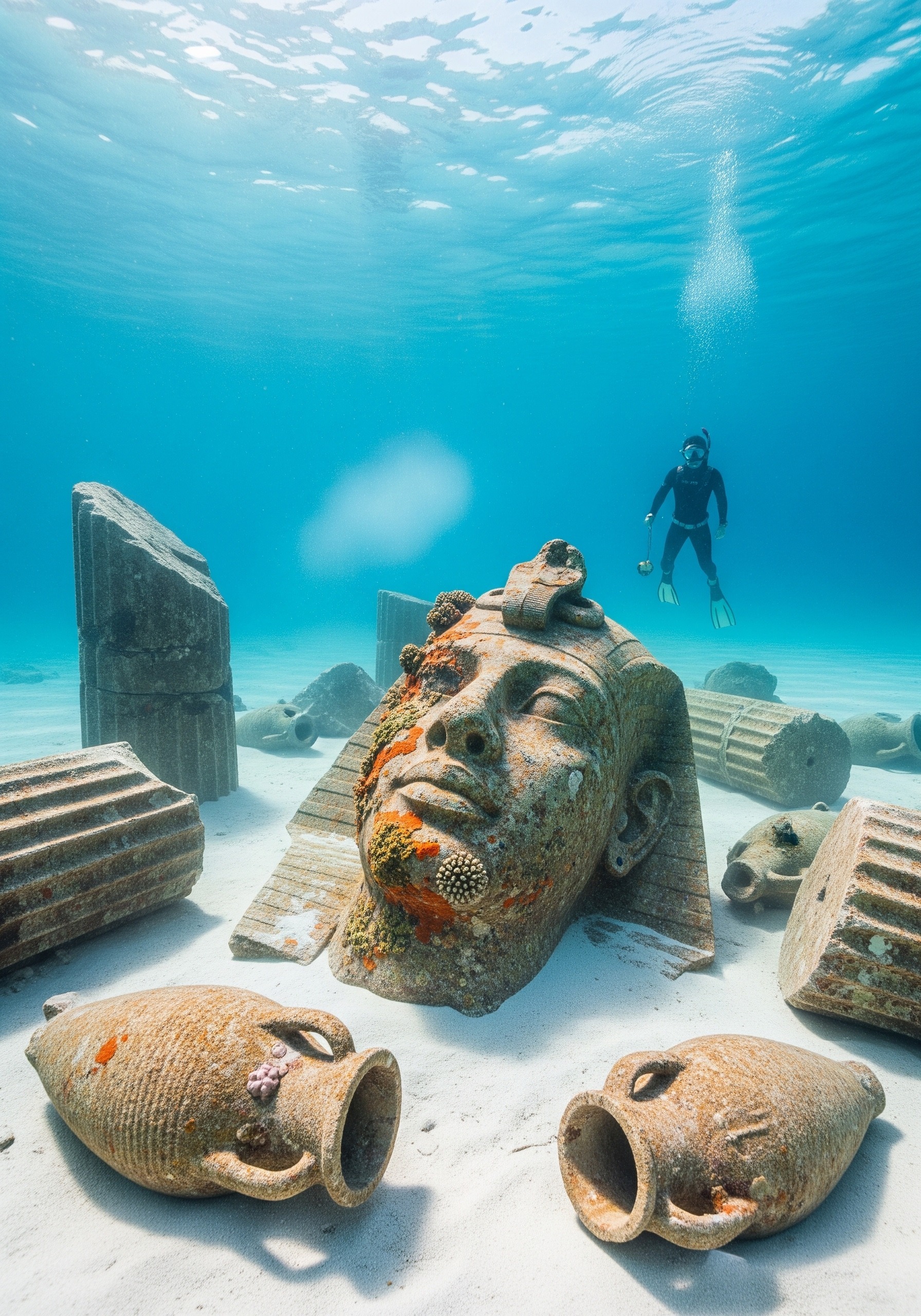
Key Facts
- Pavlopetri (Greece) is the oldest known planned town under the sea — laid out by about 3500 BC and submerged around 1000 BC at a depth of roughly 3–4 metres.
- Thonis-Heracleion (Egypt), Cleopatra’s gateway port, was relocated in 2000 by underwater archaeologist Franck Goddio 6.5 km off Aboukir Bay; more than 60 ancient shipwrecks lie around its ruins.
- Port Royal, Jamaica sank in 35 seconds at 11:43 a.m. on 7 June 1692, when a magnitude-7.5 earthquake liquefied the sand spit it stood on and killed roughly 2,000 people outright.
- Baiae, Italy was not destroyed by a single disaster but is sinking continuously via bradyseism — slow ground movement above the Phlegraean Fields caldera that has dropped parts of the coast more than 6 m since Roman times.
- The most recent major rediscovery is Zakhiku, a 3,400-year-old Mittani Empire city revealed in 2022 when drought drained Iraq’s Mosul reservoir.
In short: Lost cities found underwater are not myths but archaeological sites with names, dates and excavators. They sank for five distinct reasons — earthquakes, tsunami, slow ground subsidence, post-Ice-Age sea-level rise and deliberate flooding — and the most spectacular examples lie in the Mediterranean, the Caribbean and, increasingly, the lakes of Asia and the Middle East.
Key Facts
- Pavlopetri in Greece is the oldest known planned town under the sea — laid out by about 3500 BC and submerged around 1000 BC at a depth of roughly 3–4 metres.
- Thonis-Heracleion in Egypt, Cleopatra’s gateway port, was relocated in 2000 by underwater archaeologist Franck Goddio 6.5 km off Aboukir Bay; more than 60 ancient shipwrecks lie around its ruins.
- Port Royal, Jamaica, sank in 35 seconds at 11:43 a.m. on 7 June 1692, when a magnitude-7.5 earthquake liquefied the sand spit it stood on, killing roughly 2,000 people outright.
- Baiae, Italy, is sinking continuously through bradyseism — slow ground movement above the Phlegraean Fields caldera that has dropped parts of the coast more than 6 metres since Roman times.
- Zakhiku, a 3,400-year-old Mittani Empire city, was revealed in 2022 when drought drained Iraq’s Mosul reservoir.
In short: Lost cities found underwater are real archaeological sites with names, dates and excavators, not myths. They sank for five distinct reasons — earthquakes, tsunami, slow subsidence, post-Ice-Age sea-level rise and deliberate flooding — with the most spectacular examples in the Mediterranean, the Caribbean and the lakes of Asia and the Middle East.
Why ancient cities end up under the sea
Before the names, the mechanism. Every drowned settlement is the work of one (sometimes two) of five forces, and grouping them this way is the fastest path to understanding the whole catalogue.
1. Earthquake liquefaction and tsunami. Strong shaking can turn waterlogged sand into a brief fluid; whole districts simply drop. Port Royal in 1692 is the textbook case, and a tsunami a few minutes later finished the job. 2. Bradyseism and tectonic subsidence. Over centuries the coast itself sinks — gently above a volcanic caldera, as at Baiae, or along fault-controlled deltas, as at Thonis-Heracleion. 3. Post-Ice-Age sea-level rise. Global mean sea level has climbed roughly 120 m since the Last Glacial Maximum 20,000 years ago. Coastal Neolithic and Bronze Age villages on what was once dry land — Atlit-Yam in Israel, Pavlopetri in Greece — were quietly invaded by the sea. 4. Catastrophic flooding from rivers, storms or dyke failure. Saeftinghe in the Netherlands was lost to the All Saints’ Flood of 1570; New Orleans came uncomfortably close in 2005. 5. Deliberate human flooding. Twentieth-century hydro-dams have drowned more towns than every tsunami in recorded history — Shicheng in China, Zakhiku in Iraq, the lost villages of Ontario along the St Lawrence Seaway.
Hold this five-part frame in your head; the rest of this article is a tour through it.
Pavlopetri: the oldest planned city beneath the waves
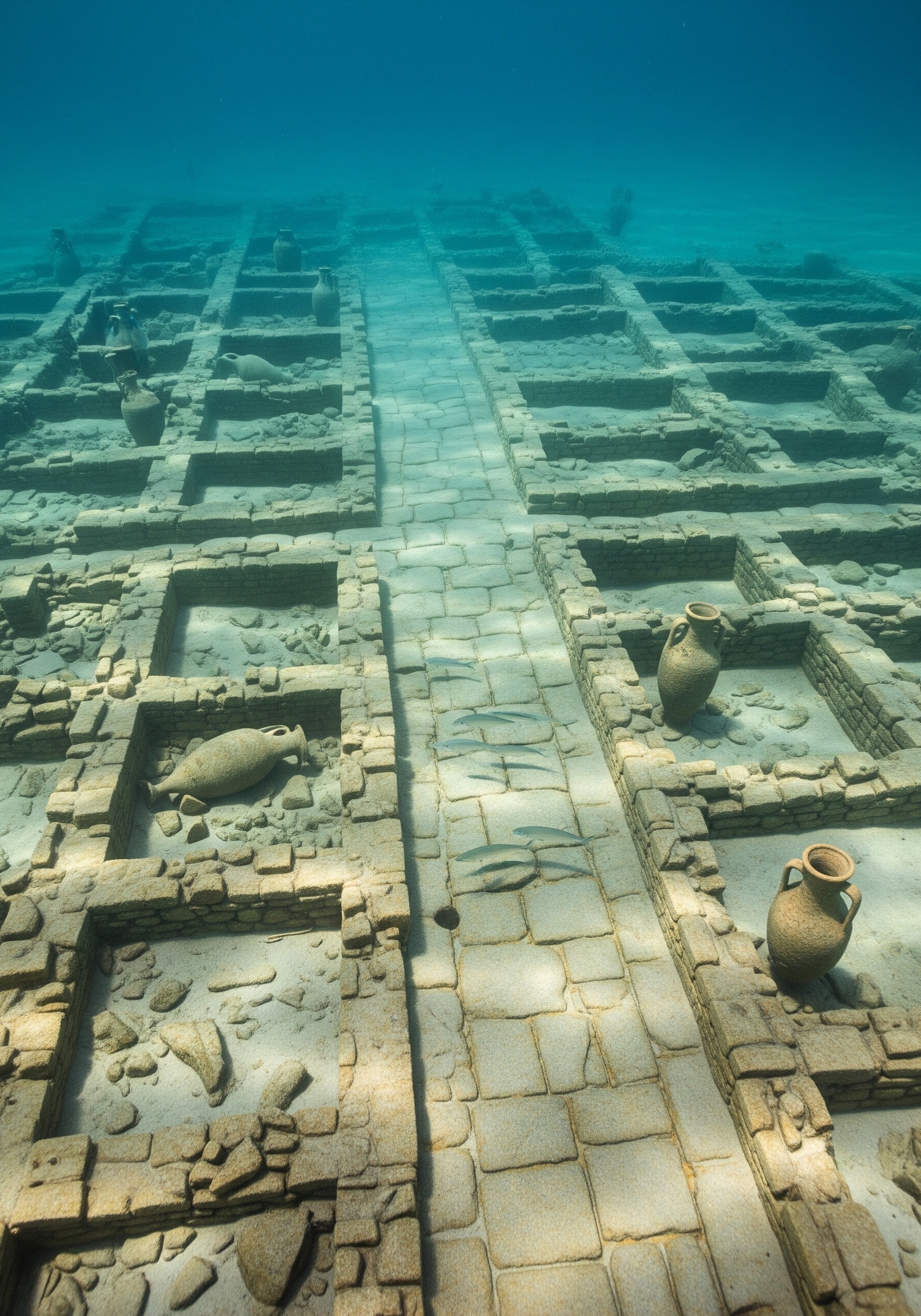
In 1967, the British oceanographer Nicholas Flemming was mapping prehistoric sea-level change off the Peloponnese when he swam over what looked unmistakably like stone-paved streets. He was right. Pavlopetri, in three to four metres of clear Laconian water, is now accepted as the oldest known submerged planned town anywhere on Earth. Ceramic dating by the joint University of Nottingham–Hellenic Ministry of Culture project (2009–2013) showed occupation from about 3500 BC, well into the Mycenaean period, before earthquakes lowered the coastline around 1000 BC.
{IMAGE_2}
What makes Pavlopetri unusual is not its age but its zoning. The submerged layout reveals a planned grid of at least 15 stone buildings with open courtyards, a cemetery, rock-cut chamber tombs and what appears to be a textile workshop — evidence of a sophisticated Bronze Age economy a full thousand years older than Homer. The site is on UNESCO’s World Monuments Watch list precisely because the same shallow water that preserved it now exposes it to anchor damage from yachts.
Thonis-Heracleion: Egypt’s lost seaport, rediscovered
Until the year 2000, “Heracleion” was a name in Herodotus and a temple inscription. Then the French underwater archaeologist Franck Goddio and his European Institute for Underwater Archaeology, working with nuclear-resonance magnetometers, located the city’s basalt foundations 6.5 km off the modern Egyptian coast in Aboukir Bay, about 5 m below the surface. It turned out to be the same place — the Egyptians called it Thonis, the Greeks Heracleion — and it had been the obligatory port of entry for every Greek ship sailing to pharaonic Egypt.
The finds keep coming. Goddio’s team has now catalogued more than 60 wrecks, hundreds of anchors, colossal granite statues of Hapi, Ptolemaic coins and, in 2019, the remains of a previously unknown Greek-style temple inside the harbour. The leading explanation for the city’s drowning is liquefaction of the soft Nile-Delta sediment beneath it during a series of earthquakes in the 2nd–8th centuries AD, accelerated by rising relative sea level. It is the single richest underwater archaeological site in the Mediterranean.
Baiae: the Roman Las Vegas that the seabed swallowed
Baiae, on the north shore of the Bay of Naples, was the imperial Roman party town — thermal baths, marble nymphaea, villas of Caesar, Nero and Hadrian, and a reputation for vice that scandalised the Senate. It did not die in a single night. The whole coast sits above the Campi Flegrei caldera, and the ground breathes: bradyseism, a slow vertical oscillation driven by hydrothermal pressure beneath the volcano, has dropped parts of Baiae more than 6 m below sea level since antiquity. The process is still active — between 1982 and 1984 the nearby town of Pozzuoli rose almost 2 m, then began slowly subsiding again.
Today the submerged half of Baiae is the Parco Sommerso di Baia, a protected marine archaeological park established in 2002. Divers and glass-bottomed boats glide above intact mosaic floors, statue-filled nymphaea and the colonnaded villa of Claudius. It is the only Roman city in the world where you can swim through the front door.
Atlit-Yam, Port Royal, Shicheng, Zakhiku: a global tour
Atlit-Yam, Israel. A Neolithic fishing village off Haifa, occupied around 6900 BC, found in 1984 at 8–12 m depth by marine archaeologist Ehud Galili. It includes a megalithic stone circle, an intact well and the skeleton of a mother and child — the oldest known cases of human tuberculosis. It is the oldest submerged human settlement of any kind yet identified.
Port Royal, Jamaica. The richest, wickedest English town in the New World vanished in 35 seconds on 7 June 1692. A magnitude-7.5 quake liquefied the sand cay; two-thirds of the city slid into the harbour. Texas A&M’s underwater excavations from 1981–1990 recovered a pocket-watch frozen at 11:43, the clearest forensic timestamp in maritime archaeology.
Shicheng (Lion City), China. Not a sunken disaster but a planned drowning. In 1959 the Xin’an River Dam was sealed and a Ming- and Qing-era walled city, parts dating to AD 25, disappeared beneath what is now Qiandao Lake. Lying 26–40 m down, Shicheng’s wooden beams and stone arches are preserved by cold, dark, anoxic water; technical divers have been allowed limited access since 2001.
Zakhiku, Iraq (2022). The newest entry on every credible list. During an extreme drought in early 2022, the Mosul reservoir on the Tigris fell sharply, exposing a Bronze Age city with mudbrick palace walls, cuneiform tablets and ceramic vessels. A Kurdish–German team identifies it as Zakhiku, an administrative centre of the Mittani Empire (c. 1550–1350 BC). It has since been re-submerged.
Other genuine, well-documented sites worth knowing: Phanagoria on the Black Sea (a Greek colony founded c. 540 BC, partially submerged by tectonic subsidence); Olous off northern Crete; Canopus beside Thonis-Heracleion; Dunwich, the medieval English “Atlantis of the North Sea”; and Saeftinghe in the Netherlands.
A side-by-side comparison of the most important sunken cities
| City | Founded | Sank | Cause | Rediscovered | Depth |
|---|---|---|---|---|---|
| Atlit-Yam, Israel | c. 6900 BC | c. 6300 BC | Sea-level rise | 1984 | 8–12 m |
| Pavlopetri, Greece | c. 3500 BC | c. 1000 BC | Earthquake | 1967 | 3–4 m |
| Zakhiku, Iraq | c. 1550 BC | AD 1985 (reservoir) | Deliberate flooding | 2022 (drought) | variable |
| Thonis-Heracleion, Egypt | c. 800 BC | 2nd–8th c. AD | Liquefaction + subsidence | 2000 | 5 m |
| Baiae, Italy | c. 200 BC | 4th–8th c. AD (ongoing) | Bradyseism | 1940s | 5–13 m |
| Port Royal, Jamaica | 1518 (Spanish), 1655 (English) | 7 June 1692 | Earthquake + tsunami | 1959/1981 | 0.5–12 m |
| Shicheng, China | AD 25 | 1959 (dam) | Deliberate flooding | 2001 | 26–40 m |
How underwater archaeologists actually find lost cities
Three technologies have done more for submerged-city archaeology than any other. Side-scan sonar, towed behind a survey vessel, paints a high-resolution acoustic shadow map of the seabed; rectangular geometries jump out against sediment. Sub-bottom profilers and magnetometers reach through sediment to image walls and metal-rich layers buried under millennia of silt. Multibeam bathymetry produces the centimetre-accurate 3-D maps that allowed Franck Goddio to plot Heracleion’s street grid without lifting a single stone.
The fourth tool is older than all of them: drought. The Zakhiku rediscovery, the periodic re-emergence of Thailand’s Muang Badan and the documentation of Spain’s Aceredo all happened because reservoir levels collapsed in extreme dry years. As climate change pushes droughts harder, expect more “lost cities found underwater” headlines that are really lost cities found again.
Lost cities found underwater you can actually visit
Several of these sites are accessible to ordinary travellers, not just credentialled archaeologists. Baiae is the easiest: certified divers can tour the Parco Sommerso di Baia year-round, and glass-bottomed Aquavision boats let non-divers see the mosaics from above. Pavlopetri is so shallow you can snorkel it from the beach at Pounta on the Greek mainland opposite Elafonisos. Port Royal requires a Jamaican National Heritage Trust permit but is open to experienced wreck divers. Shicheng is restricted to advanced technical divers via a single Chinese tour operator. Atlit-Yam, Thonis-Heracleion and Zakhiku are working archaeological sites and are not open to recreational visitors.
For armchair explorers, the British Museum’s Sunken Cities programme and the Smithsonian’s archived “Egypt’s Sunken Treasures” features are the best curated entry points, and the authoritative list of sunken cities on Wikipedia is kept reasonably current.
A note on Atlantis — and on the other “Lost City”
None of the sites in this article is Atlantis. Atlantis is a literary device introduced by Plato in Timaeus and Critias around 360 BC; no archaeological evidence corresponding to his description has ever been found, and most classicists read it as allegory. The genuine lost cities of the sea are humbler — port towns, fishing villages, baths — but their accuracy is what makes them interesting.
One other naming clash is worth clearing up. NOAA’s Lost City Hydrothermal Field, discovered in 2000 in the mid-Atlantic, is sometimes confused with a submerged human settlement. It is not. It is a field of towering carbonate chimneys — the tallest, “Poseidon,” reaches 60 m — built by hot alkaline fluid venting through the seabed at 700 m depth. It is geologically extraordinary and astrobiologically important, but it was never a city. If you came here looking for human ruins, the rest of the article is the right page; if you came for the chimneys, follow the NOAA link.
If you enjoyed this — read next on This Amazing World
To explore further, our cluster on submerged civilisations continues with the full story of Thonis-Heracleion, a closer look at Baiae and the slow drowning of Roman bradyseism, and a deep dive into the 35 seconds that ended Port Royal.
Frequently Asked Questions
Q: What is the most famous lost city found underwater?
A: Thonis-Heracleion, on the Egyptian coast, is the most famous and the richest in finds. Discovered in 2000 by Franck Goddio’s team, it has produced colossal statues, more than 60 shipwrecks, gold jewellery and Cleopatra-era temples — and excavation is still ongoing more than two decades later.
Q: What is the oldest underwater city ever discovered?
A: Two answers, depending on how you define “city.” Pavlopetri in Greece (c. 3500 BC) is the oldest known submerged planned town with streets, blocks and a cemetery. Atlit-Yam off Israel (c. 6900 BC) is older, but it is a Neolithic village rather than a planned city.
Q: Has Atlantis ever actually been found?
A: No. Atlantis is described only in Plato’s dialogues from c. 360 BC; no underwater site matches his account of a continent-sized civilisation destroyed in a single day. The real sunken cities are all far smaller and far better documented.
Q: Can tourists visit any underwater cities?
A: Yes — three are realistically accessible. Baiae in Italy has a dedicated marine archaeological park with diving tours and glass-bottomed boats; Pavlopetri in Greece is shallow enough to snorkel from shore; and Port Royal in Jamaica is open to permitted scuba divers. Shicheng in China admits a small number of technical divers per year.
The reason lost cities found underwater keep multiplying is not magic and not mystery. It is the slow, patient improvement of sonar, the relentless drift of coastlines, and the fact that every drought year now drains another reservoir somewhere. The sea is a remarkable archive, neither malicious nor mystical — and somewhere off a coast you have never visited, the next chapter of it is already being mapped.
Illustrations are AI-generated. Article fact-checked and human-edited.