The Only Animal That Can Survive the Vacuum of Space
In September 2007, a Russian capsule the size of a beach ball carried the only known animal that can survive the vacuum of space into low Earth orbit, popped open its sample tray, and exposed the passengers — eight-legged, half-millimeter creatures called tardigrades — to a place no animal had ever been: hard vacuum, with no shielding at all. Ten days later they came home. Most were still alive.
Key Facts
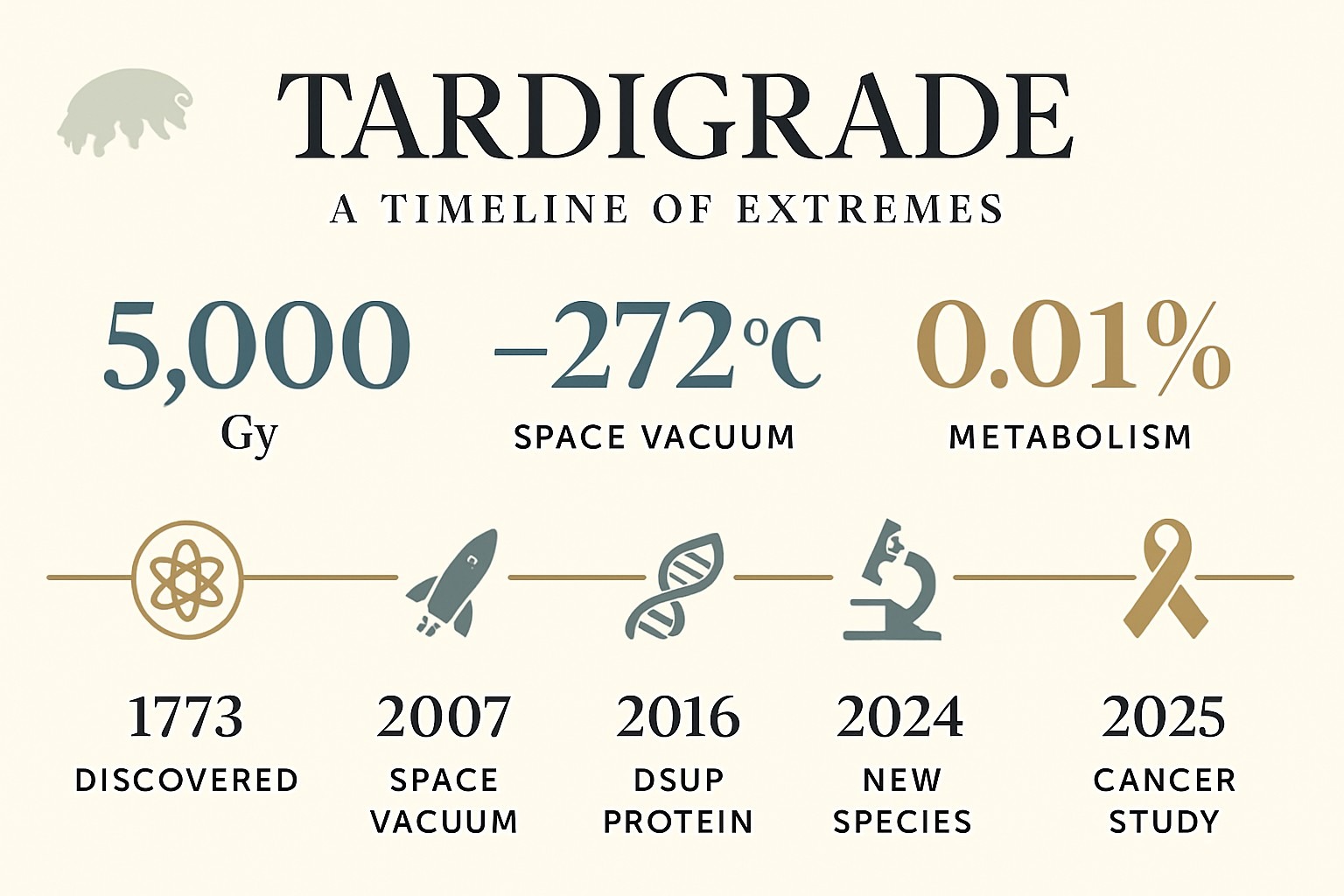
- In the 2007 FOTON-M3 mission, two tardigrade species (Richtersius coronifer and Milnesium tardigradum) were exposed to open space at roughly 270 km altitude for 10 days; the majority survived the vacuum and produced viable eggs after return.
- Tardigrades survive these conditions by entering a dry, glass-like state called a “tun,” in which their metabolism crashes to about 0.01% of normal.
- They tolerate ionizing radiation roughly 2,000–3,000 times the lethal human dose, in part because of a tardigrade-only protein called Dsup that physically shields DNA.
- A new species, Hypsibius henanensis, described in Science in October 2024, uses a gene called DODA1 to make antioxidant pigments (betalains) that mop up radiation damage from the inside.
- They are tiny (0.05–1.2 mm) and globally abundant — more than 1,300 described species live in moss, soil, beach sand, hot springs and the deep sea.
In short: Tardigrades, also called water bears, are the only animals confirmed to have survived open exposure to the vacuum of space. The trick isn’t a force field — it’s a controlled near-death state, paired with a small armory of evolved molecules that protect DNA and dry cell membranes long enough for life to resume.
Key Facts
- In the 2007 FOTON-M3 mission, two tardigrade species (Richtersius coronifer and Milnesium tardigradum) were exposed to open space at roughly 270 km altitude for 10 days; the majority survived the vacuum and produced viable eggs after return.
- Tardigrades survive by entering a dry, glass-like state called a tun, in which metabolism crashes to about 0.01% of normal.
- They tolerate ionizing radiation roughly 2,000 to 3,000 times the lethal human dose, partly because of a tardigrade-only protein called Dsup that physically shields DNA.
- A new species, Hypsibius henanensis, described in Science in October 2024, uses a gene called DODA1 to make antioxidant pigments (betalains) that mop up radiation damage.
- Tardigrades are tiny (0.05-1.2 mm) and globally abundant, with more than 1,300 described species living in moss, soil, beach sand, hot springs and the deep sea.
In short: Tardigrades, or water bears, are the only animals confirmed to survive open exposure to the vacuum of space. In the 2007 FOTON-M3 mission two species survived ten days in orbit and laid viable eggs afterward. They endure by entering a glass-like tun state with metabolism near 0.01% of normal, aided by DNA-protecting molecules like the protein Dsup.
The Experiment That Changed What “Alive” Means
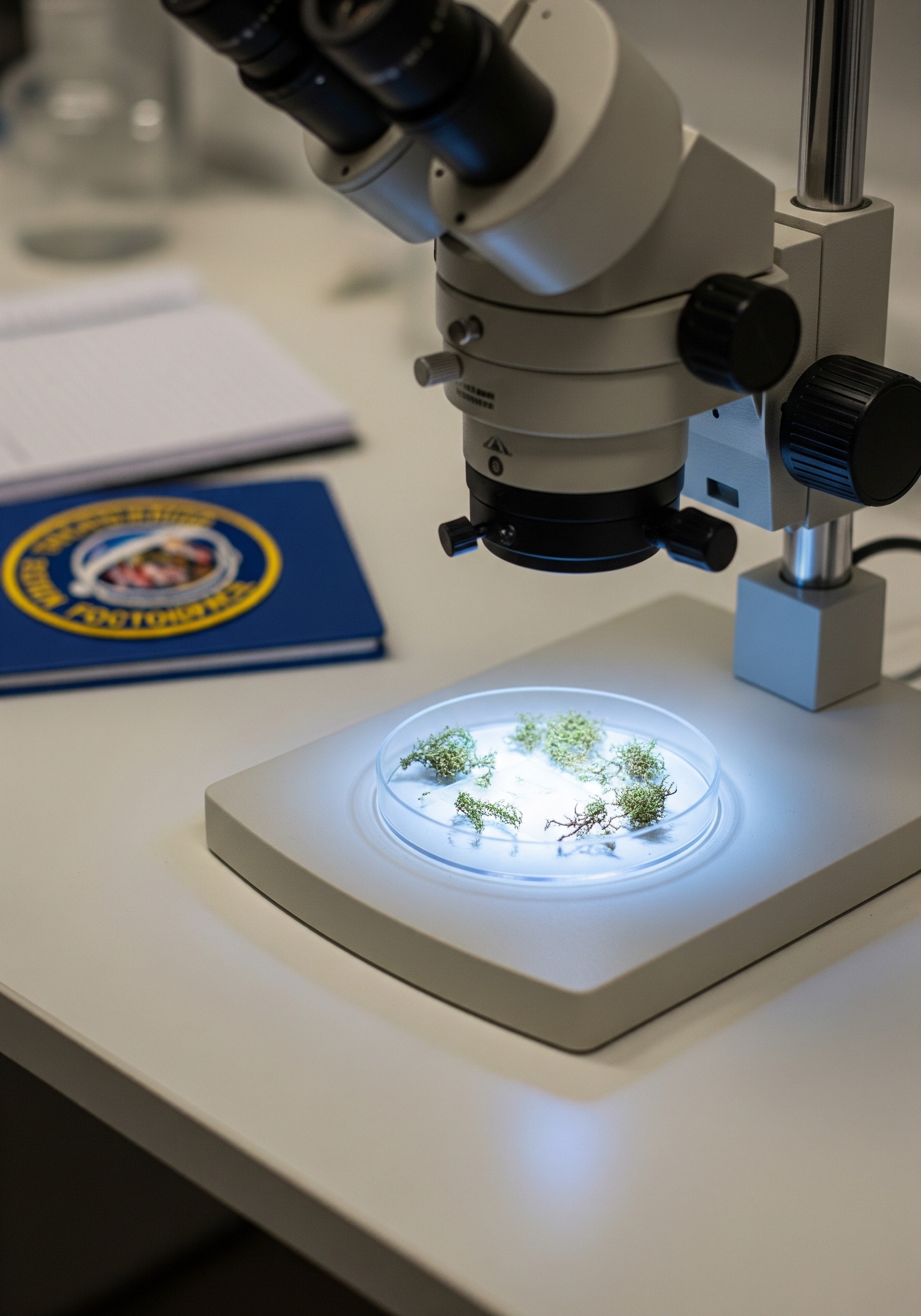
The launch was almost boring. On 14 September 2007, a Soyuz rocket lifted FOTON-M3 from Baikonur, carrying a payload chosen by the European Space Agency: among other experiments, a tray of dried tardigrades from a project called TARDIS — Tardigrades In Space. The lead investigator was Ingemar Jönsson, a Swedish zoologist at Kristianstad University who had spent years asking a stubborn question: just how far does this animal’s tolerance go?
Outside the capsule, the conditions were brutal even by spaceflight standards. Pressure dropped to roughly 10⁻⁶ pascals — a vacuum so deep that liquid water would not exist on any exposed surface. Temperatures swung between roughly −80°C in shadow and well above +60°C in direct sunlight. Some samples were shielded from ultraviolet light; others were not, and got a UV dose hundreds of times stronger than a Mediterranean beach in August.
After ten days the capsule came back. Jönsson’s team rehydrated the dried animals and waited. Within minutes, legs began to move. Most of the vacuum-only animals not only walked again but laid eggs that hatched normally. The UV-blasted ones fared worse — that radiation shreds DNA on contact — but a handful still came back. The 2008 paper in Current Biology was quiet in tone and revolutionary in content: an animal had been to open space and lived.
What an “Animal That Can Survive the Vacuum of Space” Actually Looks Like
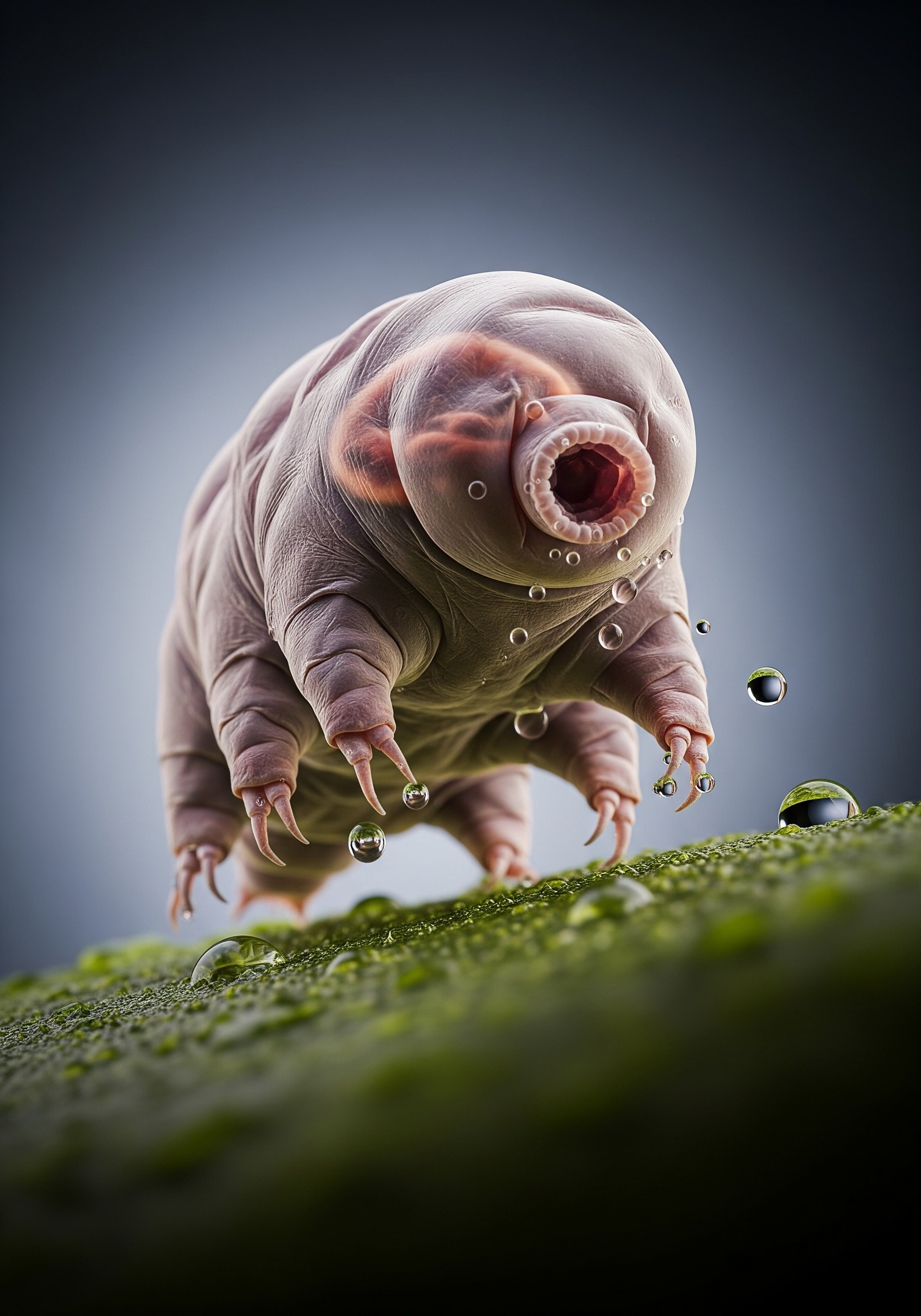
Tardigrades are not what astrobiology covers usually look like. They are not microbes. They are animals — with a mouth, a brain, a gut, muscles, and four pairs of stubby legs ending in tiny claws. Through a microscope they look like a cross between a piglet and a bear, which is exactly why German pastor Johann Goeze called them “kleiner Wasserbär” — little water bear — when he first described them in 1773.
They are also everywhere. Pick up a patch of moss in your back yard, soak it in water for an hour, and you can usually find them rolling under a basic microscope. Researchers have recovered tardigrades from Antarctic ice, Himalayan glaciers, the abyssal plain of the Pacific, and the boiling sulfur springs of Japan. Of more than 1,300 described species, a relative handful — perhaps a few dozen — appear to have the full toolkit needed to survive truly extreme conditions like spaceflight.
{IMAGE_2}
The “Tun”: A Controlled Near-Death
The single most important fact about tardigrades is this: when conditions go bad, they stop being alive in any normal sense. They pull their legs into the body, expel almost all their water, and curl into a wrinkled barrel shape called a tun. Metabolism does not slow. It essentially halts — measurements suggest it drops to around 0.01% of normal, the threshold at which biologists argue about whether the animal is, technically, still living.
This is called cryptobiosis (“hidden life”), and tardigrades aren’t the only animal to do it. The African midge Polypedilum vanderplanki can dry out for 17 years and come back, and certain mosses have stayed dormant across geological timescales of survival. But tardigrades push the trick further than any other animal we know.
In the tun, water inside the cell is replaced by trehalose, a non-reducing sugar that forms a glassy matrix instead of crystallizing. That glass holds membranes and proteins frozen in place, preventing the cellular collapse that normally kills dehydrated tissue. In Ramazzottius varieornatus, one of the best-studied species, trehalose content can reach about 2.3% of dry body weight as the tun forms — and on rehydration, the animal burns through that sugar in roughly twelve minutes as it switches the lights back on.
What a tardigrade survives in tun state
- Temperature: roughly −272°C (near absolute zero) to +150°C, briefly
- Pressure: from open vacuum up to about 6,000 atmospheres (about six times the deepest ocean trench)
- Radiation: around 4,000–5,000 grays of gamma exposure (humans die at roughly 5–10 Gy)
- Dehydration: decades dry in some species; revival from century-old herbarium moss has been claimed but not cleanly reproduced
- Time in tun: at least 30 years confirmed in R. coronifer with viable revival (2016 Japanese study on Antarctic samples)
Dsup: The DNA Bodyguard Nothing Else Has
Vacuum and cold are one problem. Radiation is another, and it is the one that should kill them. In space, a tardigrade is hit by ultraviolet light from the sun, cosmic rays from beyond the solar system, and a steady drizzle of charged particles, all of which break DNA strands. Most animals can repair a few breaks. Tardigrades absorb astonishing amounts of damage and walk away.
In 2016, Takuma Hashimoto and Takekazu Kunieda at the University of Tokyo isolated a protein from R. varieornatus they named Dsup — short for “damage suppressor.” It is a peculiar molecule: largely unstructured, highly charged, found nowhere else in the animal kingdom. Dsup binds directly to nucleosomes, the spool-like packaging of DNA, and acts as a physical shield. When human cells engineered to make Dsup were blasted with X-rays, they suffered about 40% fewer DNA breaks than control cells.
The implications were not lost on medicine. In February 2025, a team led by Ameya Kirtane (Harvard Medical School), Jianling Bi (University of Iowa), James Byrne (Iowa) and Giovanni Traverso (MIT) published in Nature Biomedical Engineering a proof of concept: messenger RNA encoding Dsup, injected into the cheek tissue of mice, produced enough of the protein locally to cut radiation-induced DNA breaks by about 50%. The point of the work is not to make superhumans. It is to shield the healthy mouth and rectal tissue of cancer patients during radiotherapy — about 60% of U.S. cancer patients receive radiation, and side effects in normal tissue are often the limiting factor. A tardigrade molecule may quietly end up in oncology clinics within the decade.
A 2024 Plot Twist From a Chinese Moss Sample
Just when the field thought it understood radiation resistance, a separate mechanism walked in. In October 2024, a team at the Beijing Institute of Lifeomics, including senior author Lingqiang Zhang, published in Science the discovery of a new species, Hypsibius henanensis, collected from moss in China’s Henan province. It is also exceptionally radiation tolerant — and the reason is not Dsup.
When the team irradiated the animal and read which genes switched on, 2,801 of them responded. The standout was DODA1, a gene that lets the tardigrade build pigments called betalains — the same red-purple antioxidants that color beetroot. Inside the cell, betalains scavenge reactive oxygen species, the chemical shrapnel that radiation creates. When researchers fed synthetic betalains to human cells in a dish and then irradiated them, the cells survived at significantly higher rates than controls. Here, then, is the editorial part: the takeaway from the last decade of tardigrade biology is that there is no single trick. There is a stacked arsenal — trehalose for membranes, CAHS proteins for cytoplasm, Dsup as a DNA shield, betalains as chemical mop — and different species mix the kit differently. That stack, not any one molecule, is the real reason an animal that can survive the vacuum of space exists at all.
Tardigrades vs. The Other Champions of Extreme
It is fashionable to call the water bear “indestructible.” It is not. So how do they actually compare to the other organisms biologists usually put on the medal stand?
| Organism | Radiation (LD50, gamma) | Vacuum? | Temperature low |
|---|---|---|---|
| Tardigrade (in tun) | ~4,000–5,000 Gy | Yes (confirmed, animal) | ~ −272°C briefly |
| Deinococcus radiodurans (bacterium) | ~12,000 Gy | Yes (microbe) | survives freezing |
| Cockroach | ~ 64 Gy | No | −5°C and dies |
| Human | ~ 5 Gy | No | ~ 21°C clothed |
The honest verdict: a tardigrade is not the toughest organism on Earth. Deinococcus radiodurans, a single-celled bacterium discovered in irradiated canned meat in 1956, shrugs off radiation that turns water bears to mush. But among animals — multicellular things with nerves and muscles and guts — tardigrades stand alone. That distinction matters: it means the same biochemistry could in principle be engineered into other animals, including us.
The Moon Crash, and the Tardigrade Limit
In April 2019, the Israeli Beresheet lander failed during its descent to the Moon. Onboard, in a payload from the U.S.-based Arch Mission Foundation, were thousands of dehydrated tardigrades sealed in epoxy on metal disks. The story flashed around the world as “tardigrades on the Moon,” and there were sober warnings about contamination.
Here’s the thing — they almost certainly did not survive. Subsequent analysis estimated impact shock at thousands of times Earth gravity, and lab tests by William Crowe at Queen Mary University of London suggested tardigrade tuns can tolerate impacts up to around 900 m/s before cellular damage becomes catastrophic. Beresheet hit much harder. The episode is a useful corrective: tardigrades have specific tolerances, not magic, and the surface of the Moon — with its hard vacuum, deep cold, and constant radiation — would slowly kill even healthy tuns over months to years.
Why This Animal Matters Beyond the Headlines
It is easy to file tardigrades under “internet curiosities.” That undersells what they have taught us. The proteins that protect their DNA are now being tested to protect cancer patients. Trehalose — the glassy sugar that holds their cells together when dry — is already used to stabilize vaccines and donor blood. The CAHS proteins discovered in the 2010s are being engineered to dry-preserve human cells for medicine in regions with no reliable cold chain. The molecule we may, one day, use to send astronauts safely to Mars likely came from a creature smaller than a comma.
And there is the philosophical part, which the data cannot quite reach. An animal can stop being alive — fully stop — for thirty years, then turn the engine back on without losing memory or function. Whatever life is, it is not just chemistry running continuously. It is a pattern that can be paused. That is a humbling thing to learn from something you can fit ten of on a grain of rice.
Frequently Asked Questions
Q: Is the tardigrade really the only animal that can survive the vacuum of space?
A: As of 2026, yes — tardigrades are the only animal confirmed to have survived direct exposure to open space (the 2007 FOTON-M3 experiment). Some bacteria and lichens have also done so, but among animals tardigrades stand alone. They survive vacuum, not by being “tough” while active, but only when dried into the tun state first.
Q: How long can a tardigrade survive in space?
A: The longest confirmed exposure is the 10-day FOTON-M3 mission in 2007, where the majority of vacuum-only individuals revived. Theoretical estimates suggest dried tuns could last years in deep cold, but radiation — particularly UV and cosmic rays — slowly degrades them. They are not immortal in space, just stubborn.
Q: Can tardigrades survive on Mars?
A: Probably not as an active population. The Martian surface has lethal UV, radiation, and no liquid water for active life. A buried tardigrade tun could in principle persist for a long time below the surface, but the animal would never “wake up” without water — and waking up is the whole point. So: a museum specimen, perhaps. A colonist, no.
Q: Are tardigrades dangerous? Could they hurt humans?
A: No. No known tardigrade species parasitizes or feeds on humans. They eat plant cells, algae, bacteria, and sometimes smaller invertebrates. The biggest “danger” they pose is changing how we think about the limits of life — which is, on balance, useful.
Sources
- Jönsson, K.I. et al. (2008), Current Biology — “Tardigrades survive exposure to space in low Earth orbit”
- National Geographic — coverage of the 2007 FOTON-M3 / TARDIS experiment
- Hashimoto, T. & Kunieda, T. et al. (2016), Nature Communications — discovery and characterization of the Dsup protein
- Kirtane, A., Bi, J., Byrne, J. & Traverso, G. et al. (2025), Nature Biomedical Engineering — Dsup mRNA radioprotection of healthy tissue in mice
- Li, L., Zhang, L. et al. (2024), Science — description of Hypsibius henanensis and the DODA1/betalain radiation-defense pathway
- Wikipedia, “Tardigrade” and “Tardigrades in space” (used for cross-checking dates and mission details)
The next time you walk past a patch of moss after rain, you are almost certainly passing within arm’s reach of an animal that has, somewhere in its family tree, ridden a rocket into space, slept for decades in a desert drawer, and shrugged off radiation that would kill you in an hour. It is sitting in the wet, eating algae, waiting for the next bad day to practice not being alive.
Illustrations are AI-generated. Article fact-checked and human-edited. Our editorial standards.