Strange Animals That Are Real (and the Photos Aren’t Faked)
The most famous “strange animals that are real” photograph on the internet — that puffy, frowning blobfish — is a corpse. Dragged up roughly a kilometre from the deep sea, ruined by decompression before anyone aimed a camera at it. Down where it actually lives, it looks like an ordinary fathead sculpin, not a sagging blob. That photo isn’t a fake. It’s something stranger: a real animal we are seeing through circumstances our eyes weren’t built for.
Key Facts
- The viral “ugliest animal” blobfish photograph is a damaged surface specimen — at 1,000-metre depth, Psychrolutes microporos resembles a normal fish, not a sad blob.
- Mantis shrimp carry 16 classes of photoreceptors (humans have three) — yet 2014 research led by Justin Marshall at the University of Queensland found they actually discriminate close colours worse than we do.
- A star-nosed mole identifies, captures, and swallows prey in an average 230 milliseconds — the fastest mammalian feeding time ever recorded, documented by Kenneth Catania of Vanderbilt University in 2005.
- Pacific hagfish can produce, from a handful of specialised cells, enough slime in seconds to clog a shark’s gills mid-bite — a defence so effective the predator usually swims away.
- Saiga antelope numbers crashed below 40,000 in 2005 and recovered to 2.83 million by 2024 — one of the largest documented mammal rebounds in the IUCN’s modern record.
In short: Most weird-animal photos circulating online aren’t faked — they’re real species photographed in conditions our brains struggle to parse: extreme depth, extreme speed, or extreme miniaturisation. Below are some of the genuinely strangest real animals, what makes their bodies look impossible, and which famous “facts” about them are quietly wrong.
Key Facts
- The viral ugliest-animal blobfish photograph is a damaged surface specimen; at 1,000-metre depth Psychrolutes microporos resembles a normal fish, not a sad blob.
- Mantis shrimp carry 16 classes of photoreceptors (humans have three), yet 2014 research led by Justin Marshall at the University of Queensland found they discriminate close colours worse than we do.
- A star-nosed mole identifies, captures and swallows prey in an average 230 milliseconds the fastest mammalian feeding time ever recorded, documented by Kenneth Catania of Vanderbilt University in 2005.
- Pacific hagfish can produce, from a handful of specialised cells, enough slime in seconds to clog a shark’s gills mid-bite.
- Saiga antelope numbers crashed below 40,000 in 2005 and recovered to 2.83 million by 2024, one of the largest documented mammal rebounds in the IUCN’s modern record.
In short: Most viral weird-animal photos are not faked they are real species seen in conditions our brains struggle to parse: extreme depth, speed or miniaturisation. The famous blobfish photo is a decompression-damaged specimen; at depth it looks like a normal fish. The star-nosed mole eats prey in about 230 milliseconds, the fastest mammalian feeding ever recorded.
Why these strange animals that are real look like CGI
Three things tend to make a real animal read as photoshopped to a casual eye. The first is scale. A pink fairy armadillo (Chlamyphorus truncatus) is roughly 13 centimetres long — about the length of a smartphone — and almost never seen above ground. When a photo crops out the human hand holding it, the brain reaches for “toy” or “rendered” before “rodent-sized mammal”.
Environment is the second factor. Deep-sea light, water pressure, and slow drift change how a body behaves. A siphonophore at 700 metres looks like a string of fairy lights because, in a sense, that’s what it is: dozens of cloned, specialised bodies linked into one colonial organism. Anything that long and that gentle, drifting in the dark, will look CGI on a phone screen.
And the third is speed. A peacock mantis shrimp’s strike is so fast — accelerating its dactyl clubs at over 10,000 g — that the surrounding water actually vaporises into cavitation bubbles, which then collapse with a faint flash of light. Slow-motion footage looks animated because the event itself is faster than anything our eyes are trained to follow.
Bodies that read like rough sketches
Some real strange creatures look invented because their anatomy is a list of mismatched fixes. Take the saiga antelope (Saiga tatarica): a bulbous, drooping nasal apparatus filters dust during summer migrations across the Eurasian steppe and warms freezing air in winter. The result is a face that, in profile, looks like a small horse wearing a tapir mask. It is not a mask. The saiga has been wearing it for tens of thousands of years.
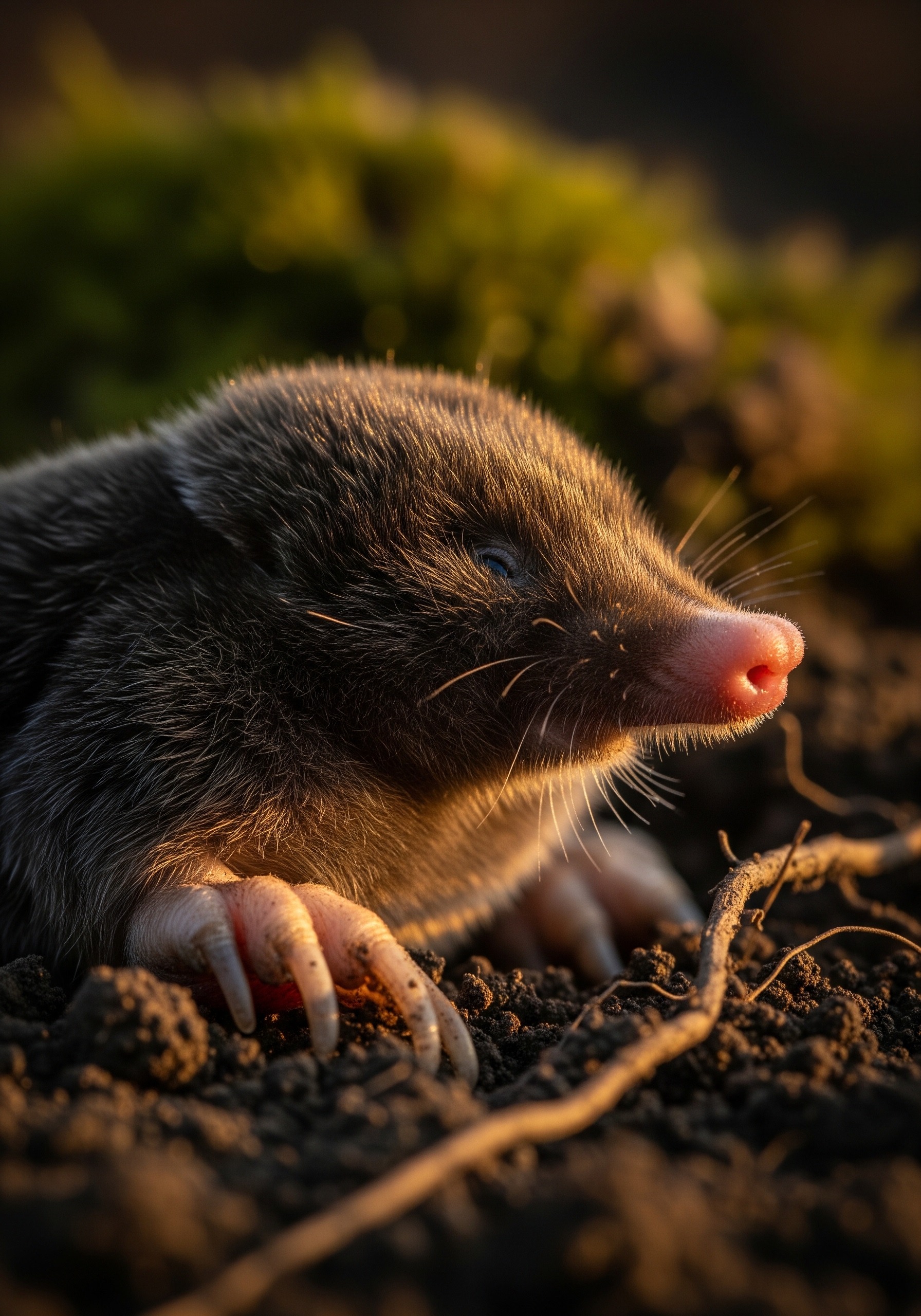
Then there is the star-nosed mole. Twenty-two pink, fleshy rays bloom around its snout — not nostrils, but a touch organ packed with about 25,000 sensory receptors in less than a square centimetre of skin. Working with high-speed video at Vanderbilt, Kenneth Catania showed the mole uses that star to inspect roughly thirteen objects per second, sorting “food” from “not food” before tunnels collapse around it. The whole sequence — find, decide, eat — averages 230 milliseconds. Human red-light reaction time is roughly three times slower.
{IMAGE_2}
Other animals look unreal because their proportions are dialled past what we expect. The gerenuk, an East African antelope, stands on its hind legs to browse like a deer playing giraffe; its neck is so disproportionately long it looks edited. Mexican axolotls keep their frilly external gills their entire life, never undergoing the metamorphosis their salamander cousins go through — a body that reads, to a non-biologist, like a tadpole that simply stopped.
Strange real creatures with chemistry you wouldn’t believe
Hagfish — eel-shaped, jawless, older than dinosaurs by hundreds of millions of years — are mostly famous for their slime. A few specialised cells release a coiled bundle of threads that swells, on contact with seawater, into a transparent gel so vast a single hagfish can fill a five-gallon bucket within seconds. Footage of a shark biting a hagfish and recoiling, gills choked with mucus, is the kind of thing that makes people accuse a video editor.
And then there’s the regal horned lizard of the American Southwest, which, when cornered by a coyote, increases the blood pressure in its head until vessels around its eyes rupture — squirting a foul-tasting stream up to about 1.5 metres at the attacker’s face. Here’s the thing: that defence isn’t a quirk. It’s an evolved chemical deterrent — the lizard’s blood contains compounds canids in particular find repulsive. Of every adaptation on this list, the horned lizard’s blood-shot defence is the one most likely to make a reader pause: it costs nothing the rest of the time, works only against the predators that matter, and was found by selection, not designed.
Mantis shrimp belong in this category too. Their strike is not just fast — it’s heated and luminescent, because cavitation collapse releases enough energy that the water briefly emits visible light. A peacock mantis shrimp can crack a snail’s shell, or a researcher’s aquarium glass, with the same blow.
Bizarre real animals from the deep
Why does so much deep-sea life look unfamiliar? Because almost none of it evolved to be seen — least of all by us. Most “fake-looking” animal photos come from depths below 200 metres, where sunlight stops mattering and bodies stop following the rules our intuition learned on land.
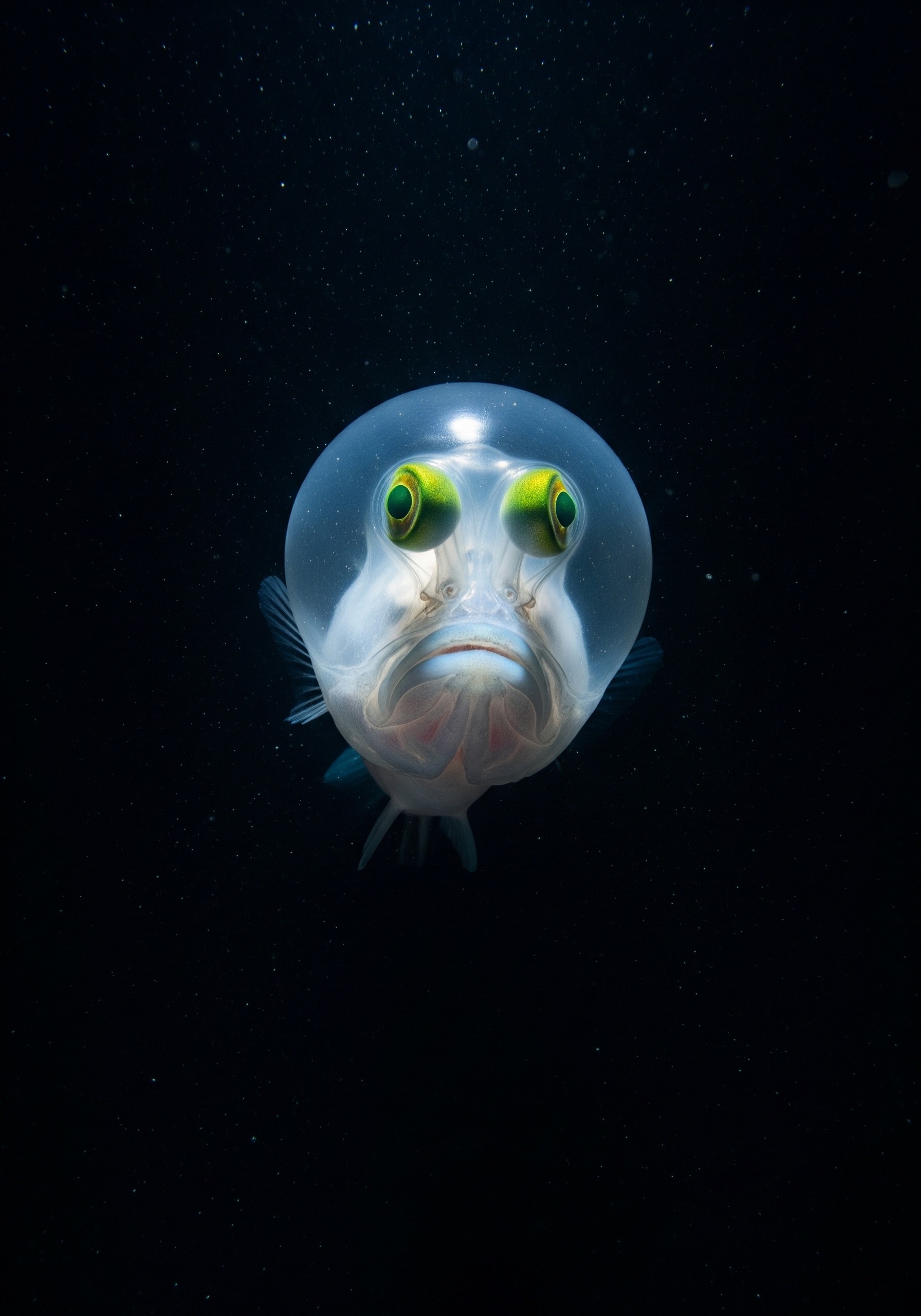
Consider the Pacific barreleye (Macropinna microstoma): a small fish with a transparent dome on its head, its green tubular eyes pointing upward through the skull, scanning silhouettes overhead. The Monterey Bay Aquarium Research Institute first filmed a living barreleye intact in 2009. Until then, the species was known only from torn-up nets, where the dome always shattered — so for almost half a century, science had the animal slightly wrong.
Sea pigs (Scotoplanes globosa) are pink, plump, walking sea cucumbers with hydraulic tube-feet, living thousands of metres down in slow-moving herds. Their behaviour is vaguely livestock-like — exactly the sort of thing the abyss wasn’t supposed to have.
And the siphonophore Praya dubia may grow longer than a blue whale: over 40 metres of linked, specialised bodies, drifting like a slow lightning bolt. It is alive, it is one organism, and it is also, technically, many. The category “individual” simply doesn’t fit it cleanly.
Beyond the deep sea, some land animals seem equally impossible — like the genuinely real all-black serval cats photographed in Kenya, whose darkness comes from a melanism mutation, not staging.
Strange animals that almost weren’t real anymore
Some of the strangest creatures on this list are, conservation-wise, fragile to the point of nearly vanishing. Pangolins — mammals covered in overlapping keratin scales, the same protein as your fingernails — are the most trafficked wild mammals in the world. IUCN currently lists three of the eight pangolin species as critically endangered (Chinese, Sunda, and Philippine), with the rest ranging from vulnerable to endangered. Their scales, valuable in some traditional medicine markets despite being chemically identical to hair, drive roughly 20% of all illegal wildlife trade.
Axolotls cling on in the wild only along a few canals around Mexico City, even as captive populations thrive in laboratories worldwide.
And then there is the saiga.
Twenty years ago, this animal looked finished. Soviet collapse, poaching for horn, and a freak 2015 bacterial outbreak that killed more than 200,000 individuals in three weeks dropped the global population below 40,000. The Altyn Dala Conservation Initiative — a coalition of Kazakhstan’s Ministry of Ecology, the Association for the Conservation of Biodiversity of Kazakhstan, Fauna & Flora, the Frankfurt Zoological Society, and the RSPB — spent two decades rebuilding the steppe and dismantling trafficking routes. According to Altyn Dala’s 2024 aerial census, Kazakhstan’s saiga population now stands at roughly 2.83 million. The initiative won the 2024 Earthshot Prize. The IUCN has shifted the species from Critically Endangered to Near Threatened. That recovery is not a footnote; it is one of the largest documented mammal comebacks of the modern era.
The numbers behind the strangeness
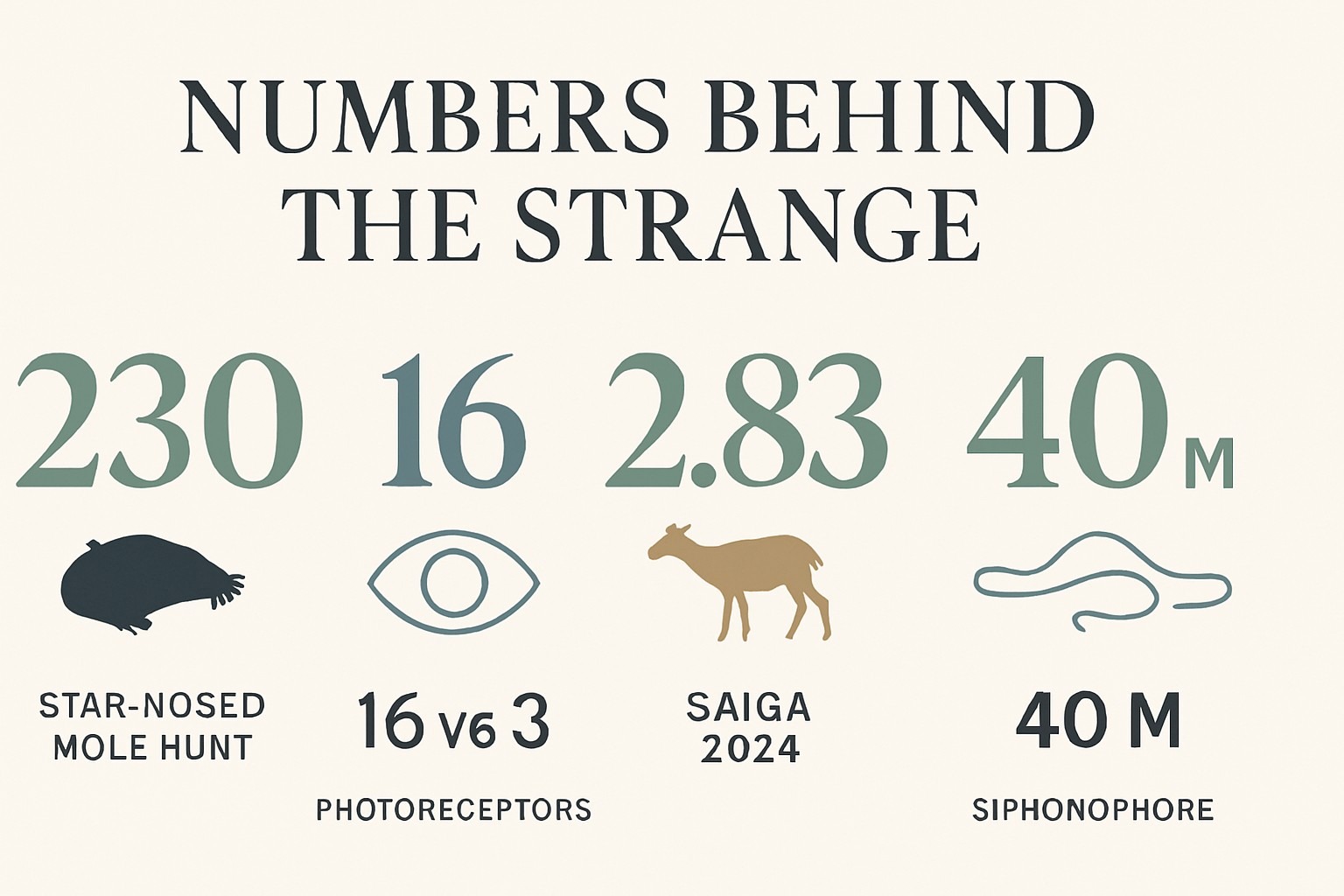
- 230 ms — average prey-handling time of the star-nosed mole (Catania, Vanderbilt, 2005)
- 16 vs 3 — photoreceptor classes in mantis shrimp vs. humans (Marshall lab, University of Queensland)
- 2.83 million — Kazakh saiga population in the 2024 aerial census (Altyn Dala Conservation Initiative)
- ~40 metres — recorded length of the siphonophore Praya dubia (Monterey Bay Aquarium Research Institute)
- ~1.5 metres — distance a regal horned lizard can squirt blood from its eyes (Smithsonian)
- 3 of 8 — pangolin species rated Critically Endangered (IUCN Red List, 2025)
Myths the internet keeps repeating about these animals
This is where most listicles go wrong, because they recycle each other. Three corrections worth filing away.
Blobfish are not naturally a sad blob. The viral photograph — “Mr Blobby”, hauled up by the New Zealand research vessel Tangaroa in 2003 — is a damaged corpse, lifted from roughly a kilometre down. At depth, the fish’s gelatinous body holds its shape and looks broadly normal. The “ugliness” is a side effect of bringing a deep-pressure animal into our atmosphere. We invented its face by killing it.
Mantis shrimp don’t have “supercolour” vision. The 16-photoreceptor headline is true, but in 2014 Justin Marshall’s team at the University of Queensland tested actual colour discrimination and found mantis shrimp performed worse than humans at separating closely related hues. Marshall’s current best hypothesis: the eye sacrifices fine discrimination for speed — fast recognition of broad colour categories, useful when your nervous system is also driving the world’s fastest punch.
Naked mole rats are mammals, but they barely behave like them. They are nearly cold-blooded, live in eusocial colonies with a single breeding queen like an ant nest, can survive roughly eighteen minutes without oxygen by switching to fructose-based metabolism, and almost never develop cancer. Taken together, those features make them one of the strangest mammals alive — and arguably the most useful, scientifically, of every animal on this page.
Frequently Asked Questions
Q: Are these strange animals real, or are the photos edited?
A: They are real species, all photographed without digital manipulation in the original source images. What’s often misleading isn’t a photoshop layer — it’s circumstance: an unusual angle, a damaged surface specimen of a deep-sea fish, or a tiny animal cropped out of human scale. The “Mr Blobby” blobfish photo is the textbook example.
Q: What is the weirdest real animal in the world?
A: It depends on the criterion. By biology, hagfish are arguably the strangest — jawless chordates that produce gallons of slime from a few cells. By behaviour, the star-nosed mole’s 230-millisecond hunt is hard to top. By sheer evolutionary improbability, the platypus (egg-laying, venomous, duck-billed mammal) usually takes the title.
Q: Are bizarre real animals usually endangered?
A: Many famous “weird” species are under serious pressure. Pangolins are the most trafficked mammal on Earth, with three of eight species critically endangered. Wild axolotls survive only in a handful of Mexico City canals. Saiga antelopes, though, are the rare success story — a recovery from under 40,000 to roughly 2.83 million between 2005 and 2024.
Q: Where can I actually see strange real creatures?
A: For deep-sea species, footage from the Monterey Bay Aquarium Research Institute, the Schmidt Ocean Institute, and NOAA’s Okeanos Explorer is more accessible than any aquarium — most deep-sea animals cannot survive captivity. For land species, the Smithsonian’s National Zoo, San Diego Zoo, and large European institutions such as Berlin’s Tierpark keep pangolins, axolotls, or naked mole rats on display.
Sources
- Kenneth Catania, Department of Biological Sciences, Vanderbilt University — star-nosed mole foraging research (2005, published in Nature)
- Justin Marshall and colleagues, Queensland Brain Institute, University of Queensland — mantis shrimp colour vision experiments (2014, Science)
- Altyn Dala Conservation Initiative — 2024 aerial saiga census, Kazakhstan (Earthshot Prize 2024 laureate)
- IUCN Red List of Threatened Species — pangolin and saiga assessments
- Monterey Bay Aquarium Research Institute (MBARI) — barreleye and siphonophore records
- BBC Science Focus Magazine, Smithsonian, and the Australian Museum — species reference data
The point of the list isn’t that nature is wacky — though it is. The point is that almost every “this can’t be real” reaction is our eyes catching up to an evolutionary problem that’s already been solved, in private, for tens of millions of years. The blobfish is dignified at depth. The saiga is breathing dust on the Kazakh steppe right now. And somewhere in a Vanderbilt lab, a star-nosed mole is, by a wide margin, still beating us at speed.
Illustrations are AI-generated. Article fact-checked and human-edited. Our editorial standards.