Platypus Facts: The Egg-Laying Mammal That Breaks Every Rule
Platypus facts have a way of breaking your brain. This is an egg-laying mammal with a duck’s bill, an otter’s body, a beaver’s tail, venom in its heel, no stomach, no teeth, electric sensors in its face, ten sex chromosomes, and fur that glows green under ultraviolet light. When the first dried specimen reached Britain in the late 1790s, naturalists tugged at the bill looking for stitches — convinced someone had sewn a duck onto a beaver and tried to sell them a fake.
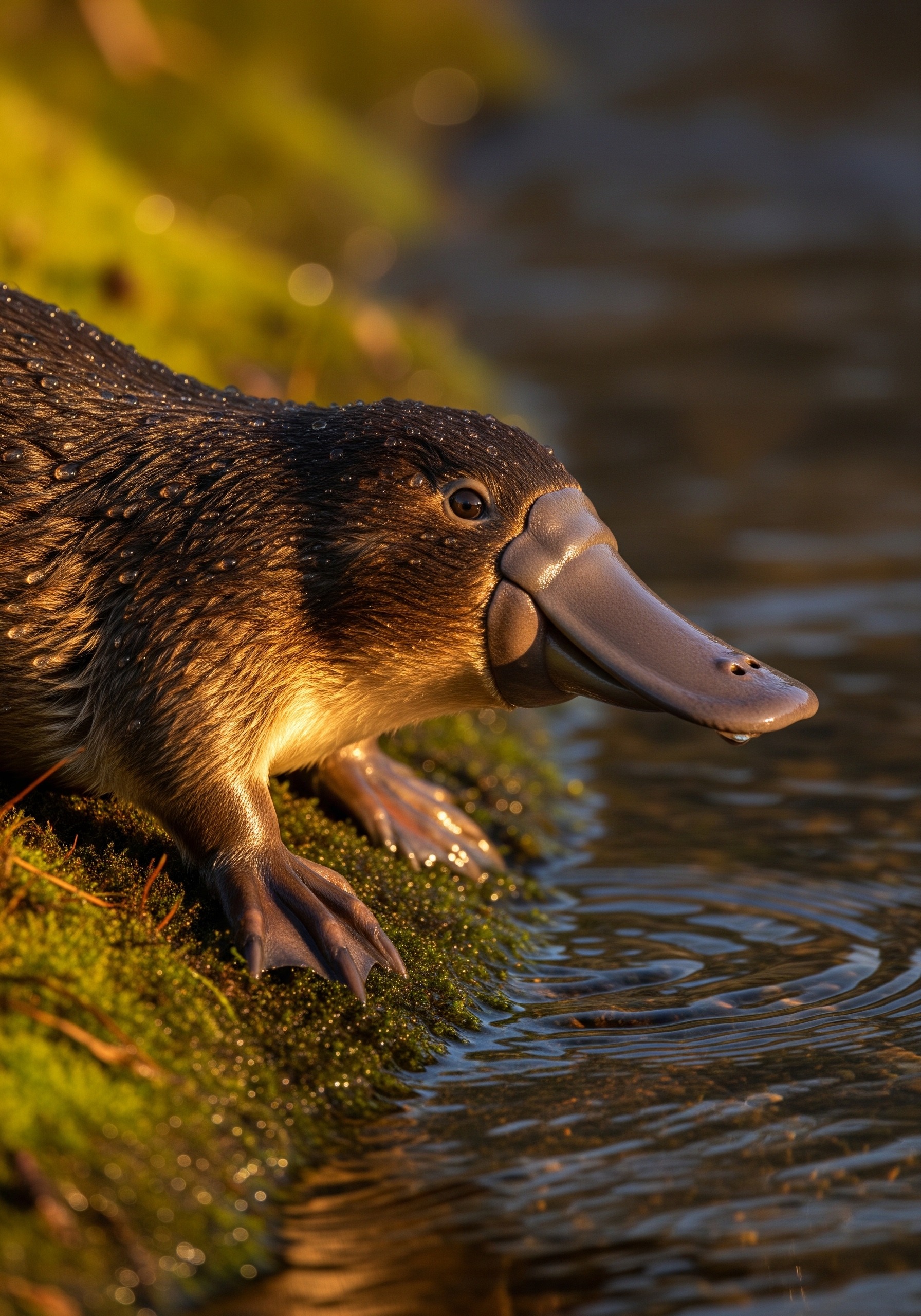
Key Facts
- One of only five surviving monotremes — egg-laying mammals — alongside four echidna species, all living in Australia and New Guinea.
- It hunts blind. A platypus closes its eyes, ears and nostrils underwater and steers entirely by electroreceptors in its bill that pick up the faint electric fields of muscle twitches in prey.
- Males are venomous. A hollow spur on each hind ankle delivers a sting that has hospitalised adult humans but has never killed one.
- Their fur biofluoresces. Under UV light it glows a greenish-cyan — a trait only confirmed in 2020.
- They carry ten sex chromosomes (5X, 5Y), more than any other known mammal — a relic from a vertebrate ancestor that birds, reptiles and mammals each later rewrote in different ways.
In short: The platypus (Ornithorhynchus anatinus) is a small, semi-aquatic mammal native to eastern Australia and Tasmania, and almost every assumption you have about what a mammal is gets bent by one. Egg-laying, venomous, electric-sensing, glow-in-the-dark, and now classified as Near Threatened by the IUCN.
Key Facts
- The platypus is one of only five surviving monotremes (egg-laying mammals), alongside four echidna species, all living in Australia and New Guinea.
- It hunts blind, closing its eyes, ears and nostrils underwater and steering by roughly 40,000 electroreceptors and 60,000 mechanoreceptors in its bill.
- Males are venomous: a hollow spur about 15 mm long on each hind ankle delivers a sting that has hospitalised adult humans but never killed one.
- Its fur biofluoresces a greenish-cyan under ultraviolet light, a trait only confirmed in 2020.
- It carries ten sex chromosomes (5X, 5Y), more than any other known mammal; a 2021 Copenhagen team published the genome in Nature.
In short: The platypus (Ornithorhynchus anatinus) is a small semi-aquatic Australian mammal that breaks nearly every mammalian rule: it lays eggs, hunts blind using electroreceptors in its bill, carries venom in the males’ ankle spurs, glows greenish under UV light, and has ten sex chromosomes. It is one of only five surviving monotremes and is classed as Near Threatened.
What a Platypus Actually Looks Like
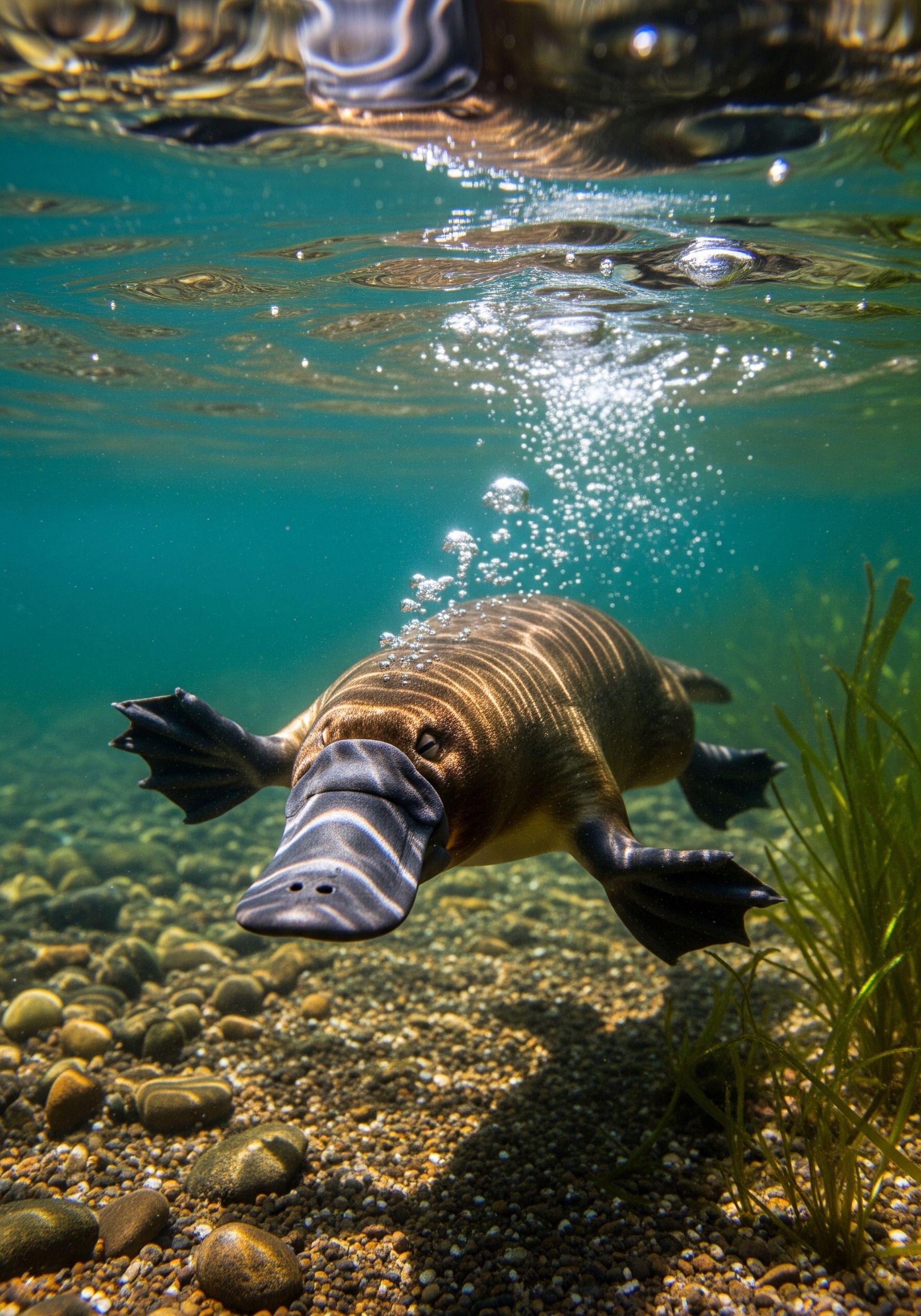
Body the length of a forearm. Tail flat and paddle-shaped, more beaver than fish. Bill soft and rubbery — a fleshy sensory organ, not a hard one, more dolphin-skin than duck-beak. The whole animal weighs roughly 1 to 2.4 kilograms (about 2 to 5 lb), with males notably larger than females.
Then the fur. Two layers — a woolly underlayer for insulation and longer waterproof guard hairs above — that trap a film of air against the skin. When a platypus dives, it travels inside a tiny suit of air. That’s why one will surface and shake itself dry like a Labrador, rather than emerging soaked like a swimmer.
The feet are webbed, but only the front pair are paddles. The webbing folds back when the animal walks on land or burrows, revealing strong claws underneath. It’s a clever piece of engineering — and it’s also why platypuses look so awkward out of water. They evolved for the river, not the bank.
The Sixth Sense in Its Bill
Here is the part that stops biologists. Platypuses hunt with their eyes, ears and nostrils shut. They don’t need them. The bill is studded with roughly 40,000 electroreceptors and 60,000 mechanoreceptors, packed into rows along its surface. Every flick of a shrimp’s muscle, every twitch of an insect larva burrowing in mud, gives off a microscopic electric signal — and the platypus reads them like braille.
This is one of only a handful of cases in mammals. Sharks have it. The Guiana dolphin has a hint of it. Among land mammals, it’s essentially monotremes and almost nothing else. Researchers at the Australian Museum describe it as a “sixth sense” not as a metaphor but as taxonomy — it is a genuine, distinct sensory modality with a 100-million-year backstory we are only beginning to fully untangle.
Turns out this is also why the bill is so soft. It needs to be saturated with nerve endings, not armoured with keratin. In your hand, a platypus’s bill feels more like a wet wallet than a beak.
{IMAGE_2}
An Egg-Laying Mammal — and a Genome Like No Other
The line that splits monotremes from the rest of the mammals is ancient. Around 187 million years ago, by current genomic estimates, the lineage leading to platypuses and echidnas branched away from the lineage that produced everything else with fur — kangaroos, dogs, whales, us. They never gave up the egg.
Female platypuses lay one to three small, leathery, grape-sized eggs in a burrow, incubate them by curling the tail around them, and the eggs hatch in about ten days. The young — yes, really called puggles — are born blind and bean-sized. The mother has no nipples. She sweats milk through specialised patches of skin on her belly, and the puggles lap it from her fur. Pause on that for a moment. The mammal lineage that invented milk delivery still hadn’t quite got round to inventing the breast.
In 2021, a team led by Yang Zhou at the University of Copenhagen published the first chromosome-level platypus and echidna genomes in the journal Nature, and the strangeness deepened. Platypuses carry ten sex chromosomes — five X and five Y — that align as a chain during cell division. Most mammals manage with two. The Copenhagen team found that some of those platypus sex chromosomes share genes with bird and reptile sex chromosomes, hinting that the platypus’s system is a living museum of a vertebrate ancestor that birds, reptiles and mammals each modified in different ways. The platypus didn’t get weirder. The rest of us did.
The Venomous Spur — And What It Does to a Human
Adult male platypuses have a hollow, calcaneal spur about 15 millimetres long on each hind ankle, fed by a crural gland that swells with venom during the breeding season. It is one of very few venom systems anywhere in the world’s mammals.
The venom isn’t designed for humans, and there are no recorded human deaths. But the pain has a reputation among Australian wildlife veterinarians. Survivors describe agony that standard painkillers — including morphine — reportedly fail to fully relieve, lasting days to weeks, sometimes followed by months of heightened pain sensitivity in the limb that was stung. The Australian Museum and venom researchers publishing in the journal Toxicon have catalogued the venom’s mix of defensin-like peptides, several of them unique to the platypus; some are now being studied as leads for new human pain-pathway drugs.
Females are born with spur buds but lose them in their first year. Nobody knows precisely why — though the most-cited hypothesis is that the spur evolved as a male-male combat weapon during mating season, and females simply don’t need to fight other females the same way.
The Glow-in-the-Dark Discovery
In late 2020, biologist Paula Spaeth Anich and colleagues at Northland College in Wisconsin shone an ultraviolet light at platypus specimens borrowed from the Field Museum in Chicago and the University of Nebraska State Museum, on a hunch. The dull brown fur lit up greenish-cyan, peaking around 500 nanometres. They published the finding in the journal Mammalia. It was the first record of biofluorescence in any monotreme.
And we still don’t know why.
The honest answer is the interesting answer. Leading guesses — UV-vision predators that platypuses might be hiding from, mate signalling in the low light of dawn and dusk, or simply a chemical quirk of the fur’s protein chemistry — are still being tested. Follow-up studies in 2022 and 2023 have since reported similar UV glow in springhares, wombats and several opossums, which suggests biofluorescence may be common among nocturnal and crepuscular mammals; we just hadn’t bothered to point the UV torch at them. This is, in this editor’s view, the most quietly thrilling thing about platypus biology right now — a 250-year-studied animal still revealing first-of-its-kind traits in a museum drawer.
How Many Platypuses Are Left?
The honest answer: we don’t know precisely. There has never been a continent-wide platypus census. Estimates from the University of New South Wales’ Platypus Conservation Initiative put the wild population somewhere between roughly 30,000 and 300,000 — a range wide enough to tell you how much uncertainty remains. The IUCN Red List has classified the species as Near Threatened since 2016. Australia has not yet listed it as nationally threatened, though several state listings have tightened in the last few years and Victoria upgraded it to Vulnerable in 2021.
The pressures are not mysterious. Severe drought (the Millennium Drought and the 2017–2019 dry years dried out platypus rivers across southern Australia), the 2019–2020 “Black Summer” bushfires, dam construction that fragments river populations, illegal fishing — those enclosed mesh “opera-house” yabby traps drown them by the dozen each year — and rivers that run warmer and lower under climate change. Where rivers go, platypuses go. They cannot walk far overland to find a new one.
Platypus vs. Echidna: A Quick Comparison
The platypus’s only living cousins are the four echidna species. Both are monotremes; almost everything else about them differs.
| Trait | Platypus | Echidna |
|---|---|---|
| Habitat | Freshwater rivers, eastern Australia + Tasmania | Land — forest, scrub, desert; all of Australia + New Guinea |
| Body covering | Dense waterproof fur | Fur interspersed with sharp keratin spines |
| Diet | Aquatic invertebrates — shrimp, larvae, worms | Ants, termites and soil invertebrates |
| Venom | Males have a venomous ankle spur | Males have a spur but it is non-functional |
| Electroreception | Highly developed (~40,000 receptors) | Present but far weaker (hundreds to a few thousand) |
| Egg incubation | In a riverbank burrow, curled around the eggs | In a temporary belly pouch the female grows |
If you ever wondered why monotremes are treated as a separate mammalian order — that table is the reason.
The platypus in numbers
- ~187 million years since monotremes split from other mammals (genomic estimate, Zhou et al., 2021).
- 10 sex chromosomes — 5X / 5Y, more than any other known mammal.
- ~40,000 electroreceptors in a single platypus bill.
- 500 nm — the peak wavelength of platypus fur biofluorescence (Anich et al., 2020).
- Late 1790s — the first specimen reached Europe and was dismissed as a hoax.
Platypus Facts: Frequently Asked Questions
Q: Is the platypus dangerous to humans?
A: Only adult male platypuses can sting, using the venomous spur on each hind ankle, and only when handled or accidentally stepped on. The venom isn’t lethal to people — there are no recorded human deaths — but the pain is severe and long-lasting, and standard painkillers (including morphine) are reported to be only partly effective. Treat any platypus encounter as a look-don’t-touch situation.
Q: Why is the platypus a mammal if it lays eggs?
A: Because the definition of “mammal” hinges on milk and fur, not on giving live birth. Platypuses produce milk for their young (sweated through skin patches, since they have no nipples) and have a full coat of hair — both core mammalian traits. They belong to a small, ancient mammalian group called monotremes that branched off before live birth evolved in the rest of the mammal lineage.
Q: Where do platypuses live?
A: Only in freshwater rivers and streams along eastern Australia, from north Queensland down through New South Wales and Victoria, and across Tasmania. They aren’t found anywhere else in the wild. Captive populations live at Healesville Sanctuary and a handful of other Australian facilities; reliable breeding in zoos outside Australia has never been achieved.
Q: Are platypuses endangered?
A: The IUCN Red List classifies the platypus as Near Threatened, with population trends declining due to drought, river fragmentation, habitat loss and illegal fishing-net drownings. Wild estimates range from roughly 30,000 to 300,000 individuals — the wide range reflects how poorly surveyed the species still is, not genuine stability.
Sources
- Zhou, Y. et al. (2021). Platypus and echidna genomes reveal mammalian biology and evolution. Nature.
- Anich, P. S. et al. (2020). Biofluorescence in the platypus (Ornithorhynchus anatinus). Mammalia.
- Australian Museum — Platypus species profile.
- WWF Australia — Platypus conservation pages.
- IUCN Red List — Ornithorhynchus anatinus, Near Threatened assessment.
- University of New South Wales Platypus Conservation Initiative — Bino, Kingsford et al., population research.
Studied for two and a half centuries and still surprising us — the platypus is a quiet reminder that the rules we write for nature are scaffolding, and nature keeps finding holes in it. Look after the rivers. The strangest mammal on Earth lives in them.
Illustrations are AI-generated. Article fact-checked and human-edited. Our editorial standards.