Rare Animals You’ve Never Heard Of: 7 on the Edge
Most lists of rare animals you’ve never heard of are full of weirdly photogenic creatures that aren’t actually rare — just unfamiliar. The truly rare ones are different. They’re gone from most of their range, often down to double-digit populations, and many have never sat for a clear photograph in their lives.
Key Facts
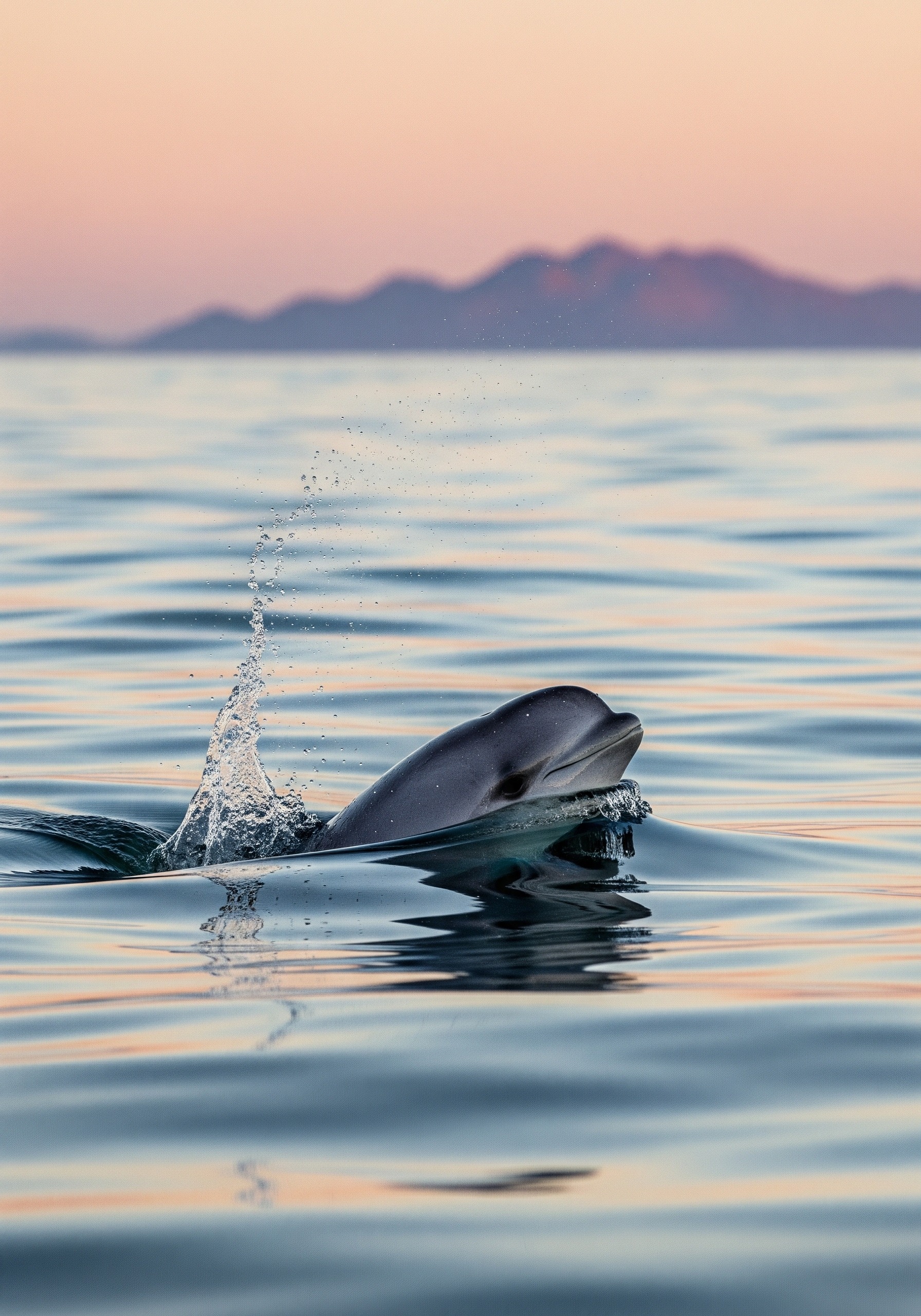
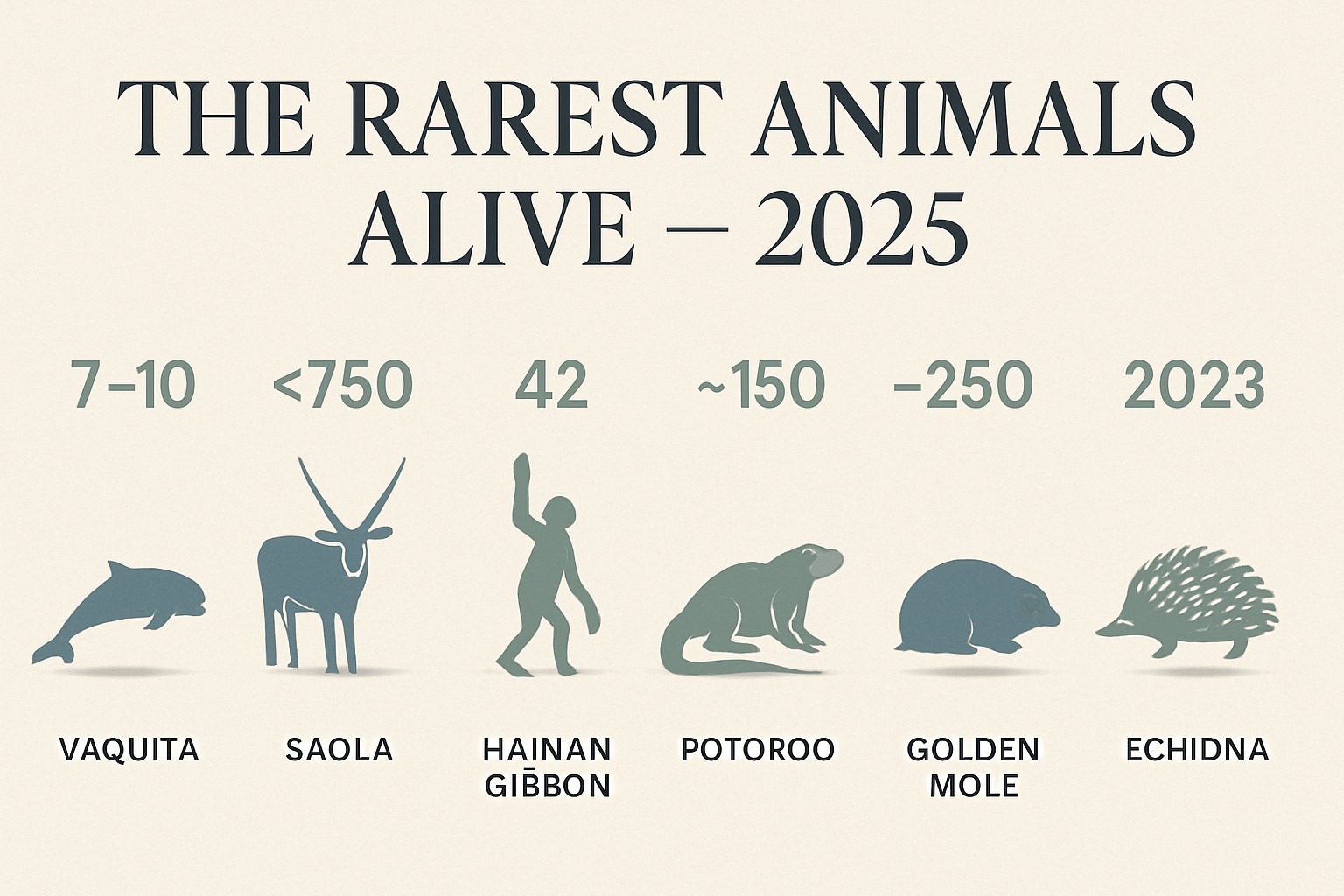
- Only 7–10 vaquita porpoises were detected in Mexico’s Gulf of California during Sea Shepherd’s 2025 survey — the lowest number ever recorded.
- The saola, called the “Asian unicorn,” has been photographed in the wild just five times by camera traps since its discovery in 1992.
- De Winton’s golden mole was rediscovered in South Africa in November 2023 using environmental DNA, after 87 years missing from the scientific record.
- Attenborough’s long-beaked echidna was caught on camera in November 2023 by an Oxford-led expedition, ending a 62-year silence.
- Gilbert’s potoroo, the world’s rarest marsupial, totals roughly 100–150 animals across four small Australian subpopulations.
In short: The rarest animals alive aren’t strange-looking listicle filler — they’re species hanging on by their fingernails, in single forests, single bays, single dune systems. Some are critically endangered with their entire family trees known by name. Others were “lost” to science for decades and only recently confirmed alive.
Key Facts
- Only 7-10 vaquita porpoises were detected in Mexico’s Gulf of California during Sea Shepherd’s 2025 survey, the lowest number ever recorded.
- The saola, called the Asian unicorn, has been photographed in the wild just five times by camera traps since its discovery in 1992.
- De Winton’s golden mole was rediscovered in South Africa in November 2023 using environmental DNA, after 87 years missing from the scientific record.
- Attenborough’s long-beaked echidna was caught on camera in November 2023 by an Oxford-led expedition, ending a 62-year silence.
- Gilbert’s potoroo, the world’s rarest marsupial, totals roughly 100-150 animals across four small Australian subpopulations; the Hainan gibbon numbered 42 individuals in late 2024.
In short: These seven critically endangered species sit on the edge: only 7-10 vaquita porpoises remain, the saola has been camera-trapped just five times since 1992, and the Hainan gibbon numbers 42. Some were lost for decades De Winton’s golden mole and Attenborough’s echidna were both confirmed alive in November 2023 after long silences.
What “rare” actually means
Three meanings get tangled together when people use the word “rare,” and that’s why most internet lists are a mess. There is rare-as-in-tiny-population (a few dozen alive). There is rare-as-in-tiny-range (more common locally, but found in one valley on Earth). And there is rare-as-in-rarely-seen — a species that may have decent numbers but is so cryptic, nocturnal, or remote that even the scientists studying it spend years between sightings.
These seven species cover all three. Some are clinging on after decades of decline. Some live on one volcano slope. Some have been photographed five times. All of them are real animals you can verify on the IUCN Red List right now — and almost none of them appear in the listicles that come up when you Google the same question.
Rare animals you’ve never heard of, side by side
Before we go in close, here’s the headline data — pulled from 2023–2025 surveys and the latest IUCN Red List assessments. Numbers move; these are the most recent verified counts at time of writing.
| Species | Where it lives | Population (verified) | IUCN Status |
|---|---|---|---|
| Vaquita porpoise | Gulf of California, Mexico | 7–10 (2025) | Critically Endangered |
| Saola | Annamite Mountains, Vietnam/Laos | Under 750, likely far fewer | Critically Endangered |
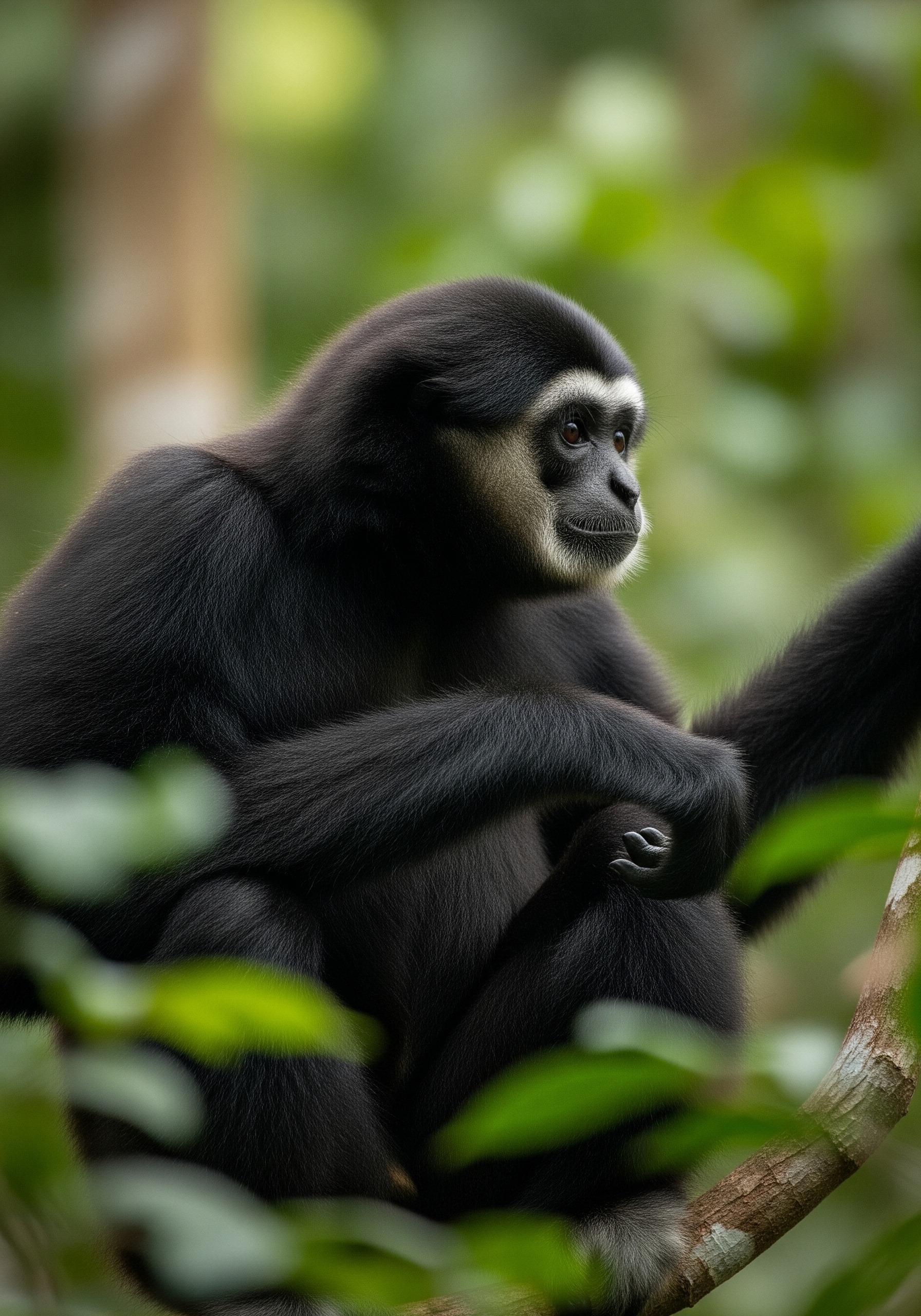
| Hainan gibbon | Bawangling Reserve, Hainan, China | 42 (late 2024) | Critically Endangered |
| Gilbert’s potoroo | SW Western Australia | ~100–150 (across 4 sites) | Critically Endangered |
| Galápagos pink iguana | Wolf Volcano, Isabela Island | ~200–300 | Critically Endangered |
| De Winton’s golden mole | Coastal dunes, NW South Africa | Unknown; eDNA-confirmed 2023 | Critically Endangered |
| Attenborough’s echidna | Cyclops Mountains, Papua, Indonesia | Unknown; first photo Nov 2023 | Critically Endangered |
The Asian unicorn nobody can find
Start with the saola. Discovered in 1992 in the Annamite Mountains between Vietnam and Laos, it remains the strangest large-mammal find of the modern era — a forest ox with two pencil-straight horns, dark almond-shaped face markings, and a documented presence in the wild that fits, comfortably, on one hand.
Five camera-trap photos in roughly thirty years. That’s the whole archive.
“Extinction is inevitable without a dedicated and intensive push,” warns William Robichaud, founding coordinator of the IUCN Saola Working Group, who in 1996 spent two weeks observing a captive female and remains the only Western scientist to have studied a live one. In 2025, his network and partners across Laos and Vietnam are running sniffer-dog patrols and environmental DNA sampling across the Annamites, hunting for any signal at all. The saola’s killer isn’t logging or hunters who want saola; it’s industrial-scale wire snaring set for other animals. The forest is full of snares. The saola walks into them and is gone.
{IMAGE_2}
Single-forest survivors: Hainan gibbon and Gilbert’s potoroo
Some rare animals you’ve never heard of are rare in a very specific way: there is exactly one place left where they live, and if anything happens to that place, the species ends.
Take the Hainan gibbon, the world’s rarest primate, which lives in a single patch of forest on Hainan Island in southern China. By the late 1970s, fewer than ten were left. A 2024 joint census by the Kadoorie Farm and Botanic Garden and the Bawangling National Nature Reserve put the figure at 42 individuals across seven family groups — the highest in over forty years, but still recoverable from a single typhoon or disease outbreak. That isn’t a recovery; it’s a foothold.
On the other side of the world, Gilbert’s potoroo — Australia’s rarest marsupial — does the same job in fewer animals. Rediscovered in 1994 after being presumed extinct for over a century, it now sits at roughly 100–150 animals across four sites: a tiny natural population at Two Peoples Bay (gutted by a 2015 bushfire), an enclosure at Waychinicup, and translocated insurance colonies on Bald and Middle islands. Three of those sites are deliberate, built by Western Australia’s Department of Biodiversity, Conservation and Attractions specifically because a single fire could erase the species. It has nearly happened.
Lazarus species: back from “extinct”
Then there are the animals the scientific world was sure had gone — and hadn’t.
In late 2023, a team from the Endangered Wildlife Trust and the University of Pretoria announced they had rediscovered De Winton’s golden mole, a blind, iridescent, sand-swimming little animal not officially recorded since 1936, in the dunes near Port Nolloth on South Africa’s west coast. The find was made not by trapping but by sniffing out environmental DNA: skin cells, hair, and traces the mole had shed into the sand. It was the 11th of Re:wild’s “most wanted” lost species to be relocated since that program launched in 2017.
A few weeks earlier, on the last day of a four-week Oxford-led expedition into the Cyclops Mountains of Indonesian Papua — and on the very final memory card the team checked — a trail camera caught Attenborough’s long-beaked echidna walking past in the dark. It was the first confirmed sighting since 1961, when a single specimen was collected by a Dutch botanist. The echidna has hedgehog spines, an anteater snout, and the gait of a mole, and it lays eggs. To the local Yongsu Sapari people, it had never been lost; it’s woven into their oral traditions. To science, it had been missing for sixty-two years.
Here’s the thing about Lazarus finds: each one quietly rewrites the extinction list, and each one was won by somebody who refused to stop looking long after the file was closed.
The newcomer: a species described inside our lifetime
Not every rare animal has been known for centuries. Some are new to science — properly new.
First spotted by a park ranger on the slopes of Wolf Volcano, on Isabela Island, in 1986, the Galápagos pink iguana (Conolophus marthae) wasn’t formally described as a species until 2009. The genetic and morphological work, published in the Proceedings of the National Academy of Sciences, showed that this rose-pink, dark-striped lizard is the oldest divergent lineage in its entire genus — splitting off before most of the present-day Galápagos archipelago even existed. Roughly 200 to 300 adults are believed to survive, all on one volcano slope. In 2022, and again in 2024, researchers from the Galápagos Conservancy confirmed multiple wild hatchlings and located nesting sites for the first time, a small but genuinely hopeful turn for a species many feared would slip away before anyone outside science had heard of it.
What these animals actually share
Look at the seven side by side, and a pattern emerges that you won’t find in a “weird animals” listicle. Almost all of them live in one place — one bay, one slope, one forest, one dune system. Almost none of them were brought low by being hunted for themselves; they were ground down by accident — gillnets, snares set for other animals, bushfires, habitat compression. And the people fighting hardest for them are rarely on TV: regional reserve teams, a handful of university labs, dogged small NGOs running on grants and patience.
The same pattern shows up well beyond this list — in the world’s rarest bird, the Araripe manakin, holding on in a single Brazilian valley, and in the Arabian leopard, the rarest big cat alive, scraping by in fewer than 200 individuals across the Arabian Peninsula.
That, more than any single fact in the table above, is the real story of the rarest animals alive in 2025. The reason you’ve never heard of most of them — and why you’ll keep finding lists of “rare animals nobody knows about” that somehow always include the quokka — isn’t that they’re obscure. It’s that the people keeping them alive are too busy doing the work to make them famous.
Frequently Asked Questions
Q: What is the rarest animal alive right now?
A: By verified census, the vaquita porpoise is the rarest mammal on Earth, with only 7–10 individuals confirmed in Sea Shepherd’s 2025 acoustic-and-visual survey of the Gulf of California. The saola is likely as rare or rarer, but cannot be precisely counted: it has been photographed in the wild only five times since 1992.
Q: Are there really animals nobody has ever seen?
A: Yes — many. Scientists describe roughly 18,000 new species each year, mostly insects, fungi, and deep-sea life. Even among vertebrates, “Lazarus” rediscoveries like De Winton’s golden mole and Attenborough’s long-beaked echidna (both in 2023) show that animals presumed extinct for decades can still be alive in remote habitats. The Galápagos pink iguana itself was only described as a distinct species in 2009.
Q: How is “rare” different from “endangered”?
A: “Endangered” is a formal IUCN Red List category based on extinction risk; “rare” is informal and usually means a species has very few individuals, a tiny range, or is very rarely encountered. An animal can be rare without being endangered (a remote single-island species with a stable population), and endangered without being truly rare in numbers (a once-common species in steep decline).
Q: Can any of these animals still be saved?
A: Several already are being. Hainan gibbon numbers have more than tripled from the 1970s low through habitat protection at the Bawangling Reserve. Gilbert’s potoroo has been pulled back from the edge through translocations to predator-free islands. In 2025, vaquita sightings included calves, which conservationists called a “flicker of hope.” Survival depends on eliminating the specific threat — gillnet, snare, fire, habitat loss — that drove each species down in the first place.
Sources
- IUCN Red List of Threatened Species
- Sea Shepherd Conservation Society — 2025 Vaquita Monitoring Effort report
- Kadoorie Farm and Botanic Garden — 2024 Hainan gibbon population census
- Endangered Wildlife Trust and the University of Pretoria — De Winton’s golden mole rediscovery, 2023
- Re:wild — Search for Lost Species program
- The Saola Working Group (IUCN SSC Asian Wild Cattle Specialist Group)
- Gentile, G. and Snell, H. — “An overlooked pink species of land iguana in the Galápagos,” Proceedings of the National Academy of Sciences, 2009
The rarest animals you’ve never heard of are not a curiosity. They’re the narrow edge of what’s still alive — and what’s still alive is mostly being kept that way by a small number of people in unglamorous places, working species by species, season by season, against very long odds.
Illustrations are AI-generated. Article fact-checked and human-edited. Our editorial standards.