How Many Beetle Types Are There? Tour of 400,000 Species
Of every four animal species ever named by science, one is a beetle. That single ratio is the cleanest way to grasp the staggering diversity of beetle types: roughly 400,000 species described to date, with hundreds of thousands more still unnamed in tropical canopies and leaf litter. Beetles are not merely successful. Statistically, they are what life on land mostly looks like.
Key Facts
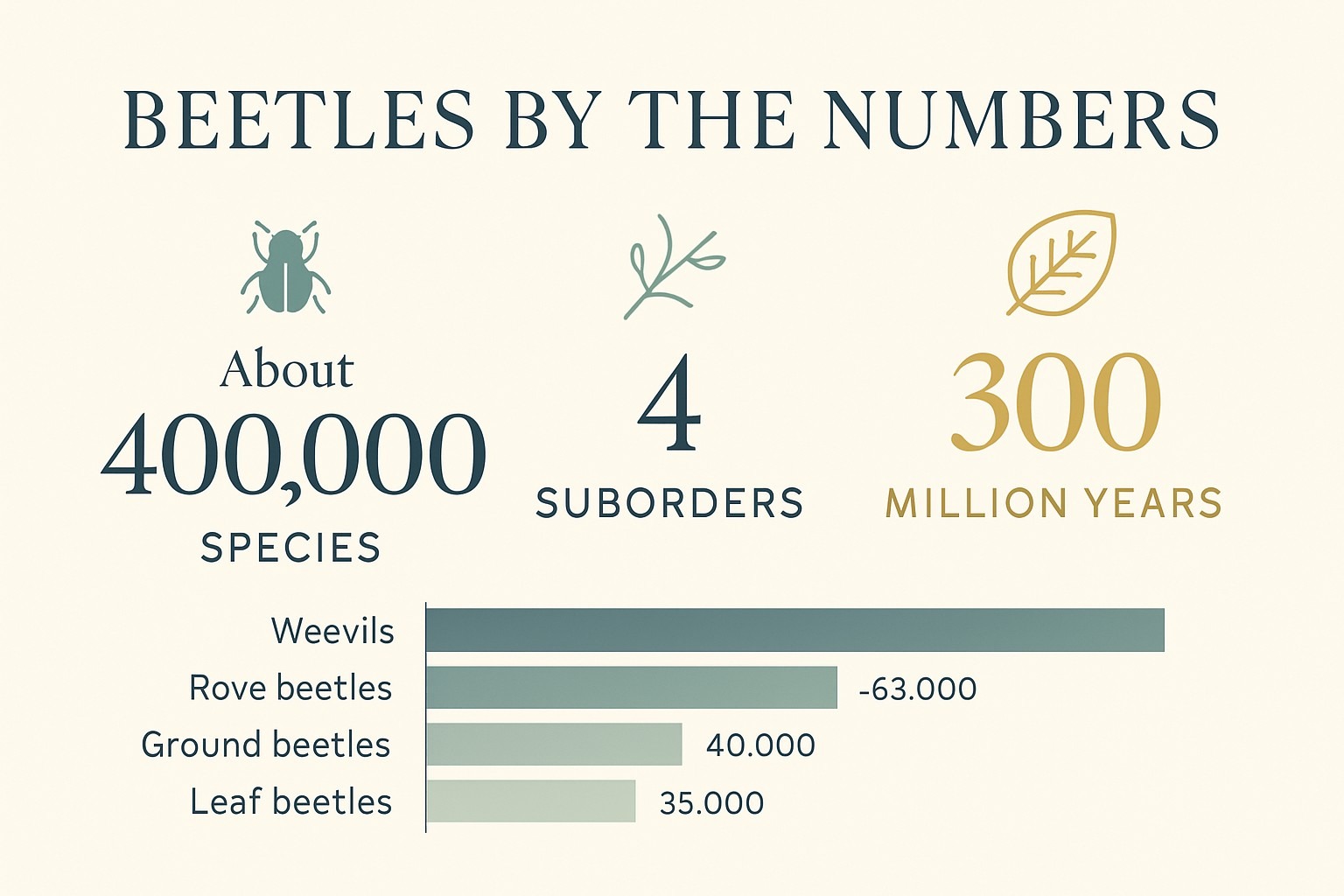
- About 400,000 beetle species have been formally described — roughly 25% of all known animals and close to 40% of all described insects.
- All beetles belong to one order, Coleoptera, split into four suborders. The giant of the four, Polyphaga, alone contains over 300,000 species in more than 170 families.
- The weevil superfamily (Curculionoidea) holds about 97,000 species — a single beetle family larger than all mammals, birds, reptiles, amphibians and fish combined.
- The smallest known free-living insect on Earth is a beetle, Scydosella musawasensis, just 0.325 mm long — measured precisely in 2015 by Alexey Polilov of Lomonosov Moscow State University.
- A 2019 PNAS phylogenomic study led by Duane McKenna of the University of Memphis dated the beetle lineage to the Carboniferous, around 300 million years ago.
In short: The “30 types of beetles” you often see online is shorthand for a handful of popular families. The real picture is four suborders, more than 200 families, and roughly 400,000 named species — a single insect order that outnumbers every vertebrate group on Earth by a wide margin.
Key Facts
- About 400,000 beetle species have been formally described—roughly 25% of all known animals and close to 40% of all described insects.
- All beetles belong to the order Coleoptera, split into four suborders; Polyphaga alone contains over 300,000 species in more than 170 families.
- The weevil superfamily (Curculionoidea) holds about 97,000 species—more than all mammals, birds, reptiles, amphibians and fish combined.
- The smallest known free-living insect is a beetle, Scydosella musawasensis, just 0.325 mm long, measured in 2015 by Alexey Polilov of Lomonosov Moscow State University.
- A 2019 PNAS phylogenomic study led by Duane McKenna of the University of Memphis dated the beetle lineage to about 300 million years ago.
In short: Roughly 400,000 beetle species have been described—about a quarter of all known animals—all within the order Coleoptera and its four suborders. The giant suborder Polyphaga holds over 300,000. Beetles range from the 0.325 mm Scydosella musawasensis to 16-cm giants, and true totals may exceed a million species.
So how many beetle types are there, really?
It depends on what you mean by “type”. If you mean species, the current count sits at roughly 400,000 — the figure used by the Smithsonian and most modern coleopterists. If you mean families, there are more than 200. If you mean the loose, popular sense — kinds you can tell apart on sight — the answer is far smaller: maybe two dozen everyday silhouettes, ladybugs and weevils and ground beetles and the rest.
The honest answer is that nobody knows the true total. Estimates of how many beetle species actually exist range from about 0.9 million to 2.1 million. New species turn up every week, most in forest canopies no entomologist has sampled. A single fogged tree crown in Panama has been known to drop more than a thousand beetle species onto the collection sheet, dozens of them new to science.
So the right number to keep in your head is two: about 400,000 known, and probably more than a million in total.
The four suborders, demystified
Every beetle alive today belongs to one of four suborders. They sound like medieval orders of knights, and they are worth knowing because they organise the chaos.
Polyphaga is the giant — more than 300,000 described species in over 170 families. Weevils, scarabs, ladybugs, fireflies, longhorns, leaf beetles, rove beetles. If you have ever noticed a beetle, it was almost certainly a polyphagan. Adephaga, the second suborder, is the predators’ club — ground beetles, tiger beetles, water beetles, whirligigs. Archostemata contains only a handful of relict wood-eaters, including the strange American “telephone-pole beetle”. Myxophaga is the smallest of all: about 65 species of minute algae-feeders that live in wet moss and around the spray of waterfalls.
That uneven split — one suborder swallowing roughly three-quarters of all beetles — is the real shape of beetle diversity. The Coleoptera are not a balanced tree. They are a vast bushy explosion on one branch, with three quiet twigs to the side.
{IMAGE_2}
The families that hold almost everything
Inside Polyphaga, a handful of families do most of the work. They are not just large — each is, individually, bigger than entire vertebrate classes. The figures below are those cited in modern entomological references; where sources disagree, the spread is given in the text. (Staphylinidae and Curculionidae trade places at the top depending on whether you count the family or the broader superfamily, and the totals climb every year.)
The big beetle families — approximate described species
- Curculionidae (true weevils) — about 97,000
- Staphylinidae (rove beetles) — about 63,000
- Carabidae (ground beetles) — about 40,000
- Chrysomelidae (leaf beetles) — about 35,000
- Scarabaeidae (scarabs & dung beetles) — about 30,000
- Cerambycidae (longhorn beetles) — about 25,000
- Tenebrionidae (darkling beetles) — about 20,000
- Elateridae (click beetles) — about 10,000
Add those eight numbers together and you reach roughly 320,000 — about four out of every five known beetles on Earth.
From a Hercules to a grain of dust
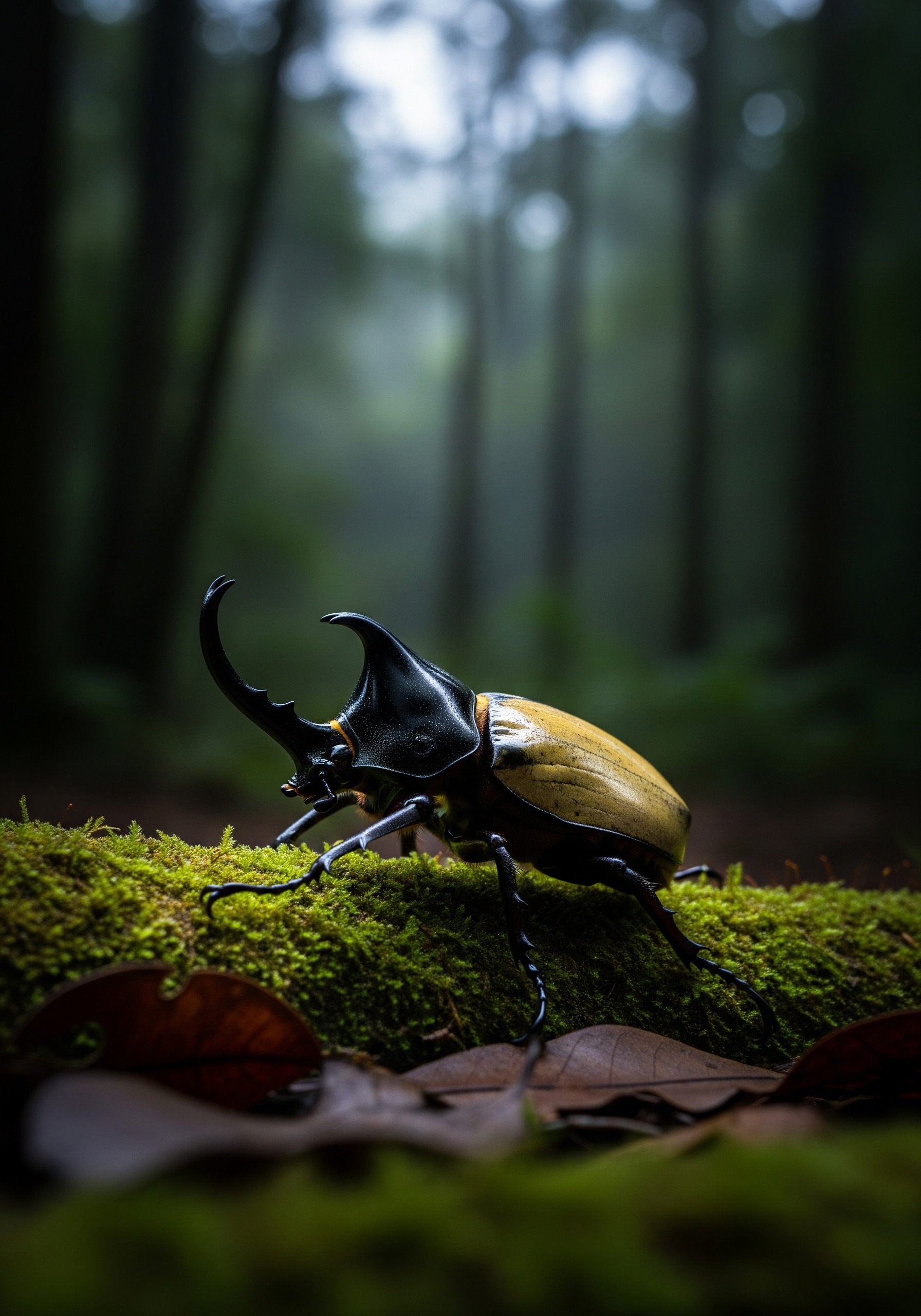
The size range inside Coleoptera is genuinely cinematic. At one end, the South American titan beetle (Titanus giganteus) and the Hercules beetle (Dynastes hercules) push past 16 centimetres — the length of a paperback. At the other, in the leaf litter of Colombia’s Chicaque National Park, the featherwing beetle Scydosella musawasensis measures 0.325 millimetres. That is the lower bound of free-living adult insect life on this planet, and it was nailed down only in 2015, when Polilov collected and remeasured 85 specimens.
| Beetle | Family | Size | Record |
|---|---|---|---|
| Dynastes hercules (Hercules) | Scarabaeidae | up to 17 cm including horn | longest beetle overall |
| Titanus giganteus (Titan) | Cerambycidae | 15–17 cm body, no horn | longest body alone |
| Goliathus goliatus (Goliath) | Scarabaeidae | 10–11 cm, 40–60 g adult | heaviest adult beetle |
| Scydosella musawasensis | Ptiliidae | 0.325 mm (325 µm) | smallest free-living insect |
The smallest beetle is shorter than some single-celled amoebae. Side by side, the Hercules is roughly half a million times longer. Both still wear the same body plan — six legs, two pairs of wings, hardened forewings called elytra. That a single design can stretch across that range is one of the quiet miracles of insect evolution.
Why so many beetles? The angiosperm partnership
For most of the 20th century, the answer to that question was a shrug and a joke. The geneticist J.B.S. Haldane is famously credited with saying that a study of creation suggested its Creator had “an inordinate fondness for beetles”. The exact phrasing is almost certainly apocryphal — Haldane never wrote those words on paper — but his friend Kenneth Kermack later said he did utter something very close, and a 1959 footnote in The American Naturalist preserves the anecdote. The line stuck because the question stuck.
The serious answer arrived in 2019. A team led by Duane McKenna of the University of Memphis, publishing in PNAS, used 4,818 genes from 146 species to reconstruct the beetle family tree, and 89 genes from 521 species to date it. They placed the order’s origin in the Carboniferous, around 300 million years ago. More importantly, they showed that beetles co-diversified with flowering plants — and that bacteria and fungi gifted beetle ancestors the enzymes for digesting plant cell walls through horizontal gene transfer. Once a lineage of insects could metabolise lignocellulose, every leaf, stem and seed on Earth turned into food. Beetles ran the table.
This is the real answer, and it is better than the joke. Beetles are not lucky. They are the insects that picked the right partner — angiosperms — and arrived at the party with the right enzymes in hand.
The beetle types you actually meet
For the curious gardener or hiker, the names that matter are a much shorter list. Ladybugs (Coccinellidae) eat aphids and overwinter in attic corners. Ground beetles (Carabidae) are the dark fast runners under stones. Rove beetles (Staphylinidae), often mistaken for earwigs, patrol leaf litter for fly larvae. Click beetles (Elateridae) snap their bodies into the air when overturned; their wireworm larvae are the bane of potato farmers. Stag beetles (Lucanidae), with outsize jaws, live and breed in rotting oak. Fireflies (Lampyridae) are beetles too — the only kind that talks in light. Weevils (Curculionidae), the tiny long-snouted family, turn up in your kitchen pantry and in tropical canopies alike.
One observation worth making, mid-tour: the popular obsession with the “30 types of beetles” undersells the order by four orders of magnitude. The truth is funnier and more useful. There are a few dozen common silhouettes — and then 400,000 variations on those themes, most of them in tropical countries we have not finished cataloguing.
What we still don’t know
Every honest answer about beetles has an asterisk. The 400,000 figure counts described species — animals that have a Latin name and a type specimen sitting in a museum drawer somewhere. The total estimate has a range, not a number, because tropical canopies have not been fully sampled. Phylogenetic relationships between deep families were a mess until McKenna’s 2019 paper, and even now several major branches remain under revision. There is no current global red list of beetle conservation status, because the order is too large to assess at species level — researchers track families or feeding guilds instead.
Here’s the thing: we know more about the surface of Mars than about the beetles of the Amazon basin.
The frontier of zoology, it turns out, is small, brown, and six-legged.
Frequently Asked Questions
Q: How many types of beetles are there in the world?
A: About 400,000 described species, organised into more than 200 families and four suborders (Polyphaga, Adephaga, Archostemata, Myxophaga). True total estimates range from roughly 0.9 to 2.1 million species, since tropical forests remain undersampled.
Q: What is the largest beetle family?
A: The weevil superfamily Curculionoidea, with around 97,000 described species. Within it, the true weevils (Curculionidae) are the single largest beetle family. By some counts the rove beetles (Staphylinidae) are now overtaking them — these things shift as taxonomists revise.
Q: What is the largest beetle in the world?
A: The Hercules beetle (Dynastes hercules) is the longest including its horn, at up to 17 cm. The titan beetle (Titanus giganteus) is the longest by body alone, at 15–17 cm. Goliath beetles (Goliathus) are the heaviest adults, at roughly 40–60 g.
Q: What is the smallest beetle?
A: Scydosella musawasensis, a featherwing beetle in the family Ptiliidae, at 0.325 mm — the smallest known free-living insect of any kind, measured precisely in 2015 by Alexey Polilov from 85 specimens collected in Chicaque National Park, Colombia.
Sources
- Smithsonian Institution — Bug Info: Beetles (Coleoptera)
- Duane D. McKenna et al., “The evolution and genomic basis of beetle diversity”, PNAS, 2019
- Alexey Polilov, “How small is the smallest? New record and remeasuring of Scydosella musawasensis“, ZooKeys, 2015
- Natural History Museum, London — beetle size and diversity records
- Encyclopaedia Britannica — Coleoptera: annotated classification
Behind the joke about an inordinate fondness lies a real biological story: a partnership with flowering plants, a gift of enzymes from microbes, and 300 million years of patient radiation through every corner of the land. The next time a small dark insect crosses your path, the odds favour a beetle — and the odds favour, slightly, a species nobody has yet bothered to name.
Illustrations are AI-generated. Article fact-checked and human-edited. Our editorial standards.