How Strong Is Spider Silk? The Honest Answer in Numbers
How strong is spider silk really? Strong enough that one famous claim — “stronger than steel” — has been repeated for fifty years, and strong enough that the same claim, read strictly, is also false. Both can be true at once, because “strong” turns out to mean three different things.
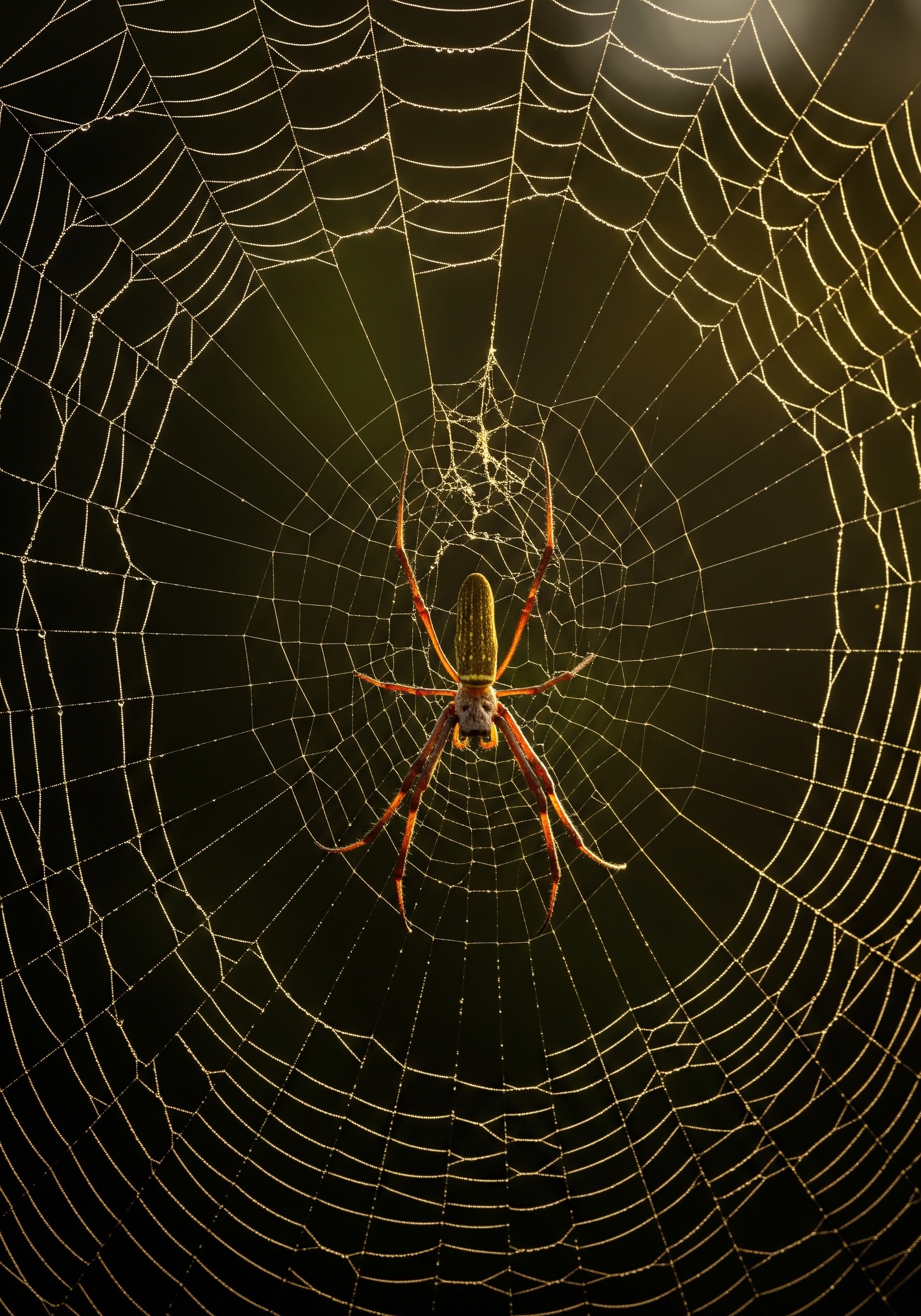
Key Facts
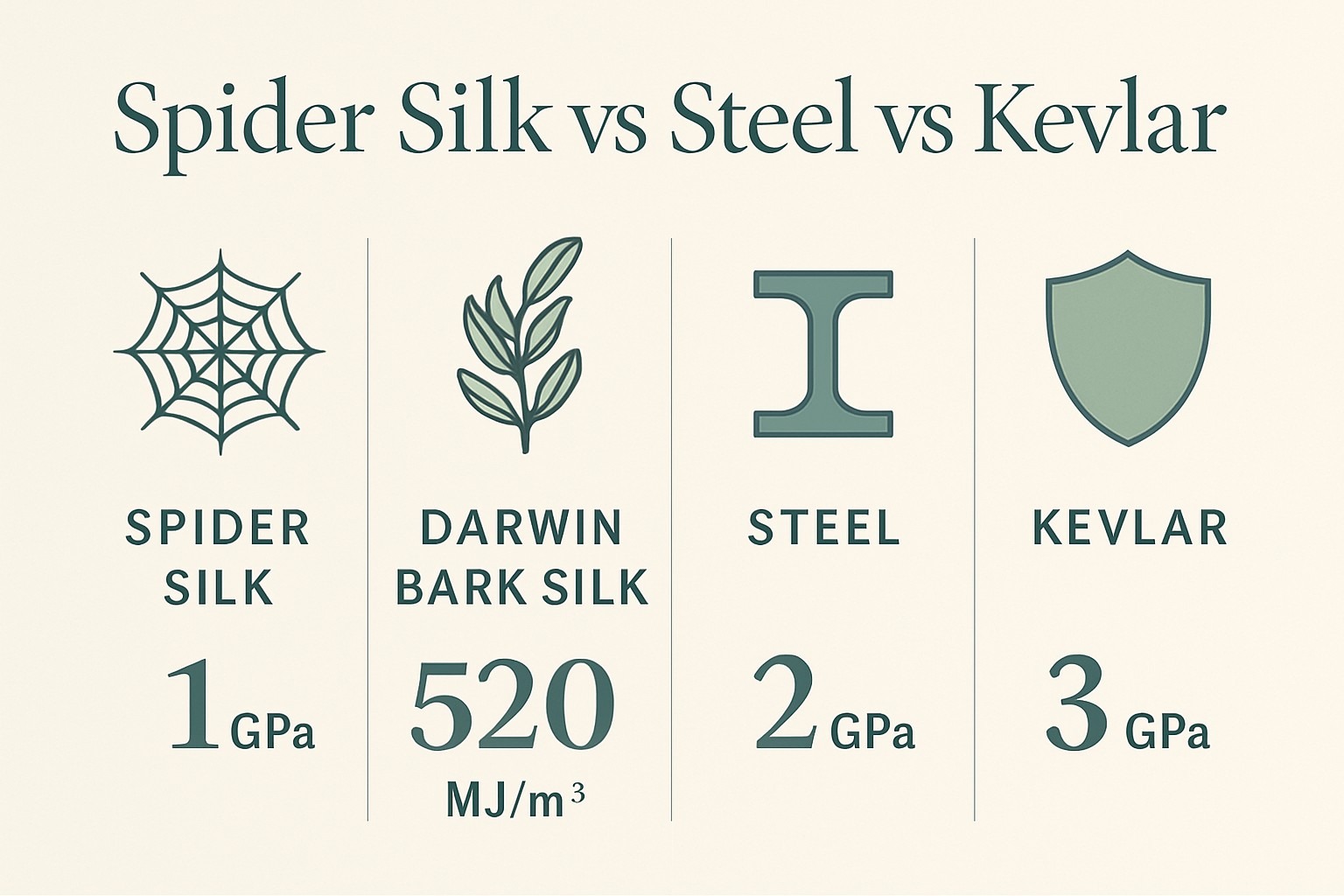
- Spider dragline silk has a tensile strength of roughly 1,000 MPa (1 GPa), which sits inside the range of mid- to high-grade alloy steel (450–2,000 MPa).
- By weight, spider silk beats steel by about a factor of five — silk’s density is around 1.3 g/cm³, while steel is 7.85 g/cm³.
- Kevlar is roughly three times stronger than ordinary spider silk in raw tensile pull (around 3,000 MPa), but spider silk is far tougher.
- Darwin’s bark spider (Caerostris darwini), described in 2010, spins dragline silk with toughness averaging 350 MJ/m³ and peaking at 520 MJ/m³ — over ten times tougher than Kevlar.
- A single strand of dragline silk long enough to wrap around the Earth would weigh only about 2 kilograms.
In short: Spider silk is comparable to mid-grade steel in raw pull strength and crushes it by weight, but it’s only about a third as strong as Kevlar. Silk’s real superpower isn’t strength — it’s toughness, the ability to absorb energy without snapping. On that measure, no man-made fibre comes close.
Key Facts
- Spider dragline silk has a tensile strength around 1,000 MPa (1 GPa), within the range of mid- to high-grade alloy steel (450–2,000 MPa).
- By weight, spider silk beats steel by about a factor of five—silk’s density is around 1.3 g/cm³ versus steel’s 7.85 g/cm³.
- Kevlar is roughly three times stronger than ordinary spider silk in raw tensile pull (around 3,000 MPa), but far less tough.
- Darwin’s bark spider (Caerostris darwini), described in 2010, spins silk averaging 350 MJ/m³ toughness and peaking at 520 MJ/m³—over ten times tougher than Kevlar.
- Silk is a protein fibre made of spidroins, combining hard alanine-rich β-sheets with a stretchy glycine-rich matrix.
In short: Spider dragline silk has a tensile strength near 1,000 MPa—comparable to mid-grade steel and about five times stronger by weight—but only a third as strong as Kevlar in raw pull. Its real superpower is toughness: Darwin’s bark spider silk reaches 520 MJ/m³, over ten times tougher than Kevlar.
How strong is spider silk, really? Decoding the “stronger than steel” claim
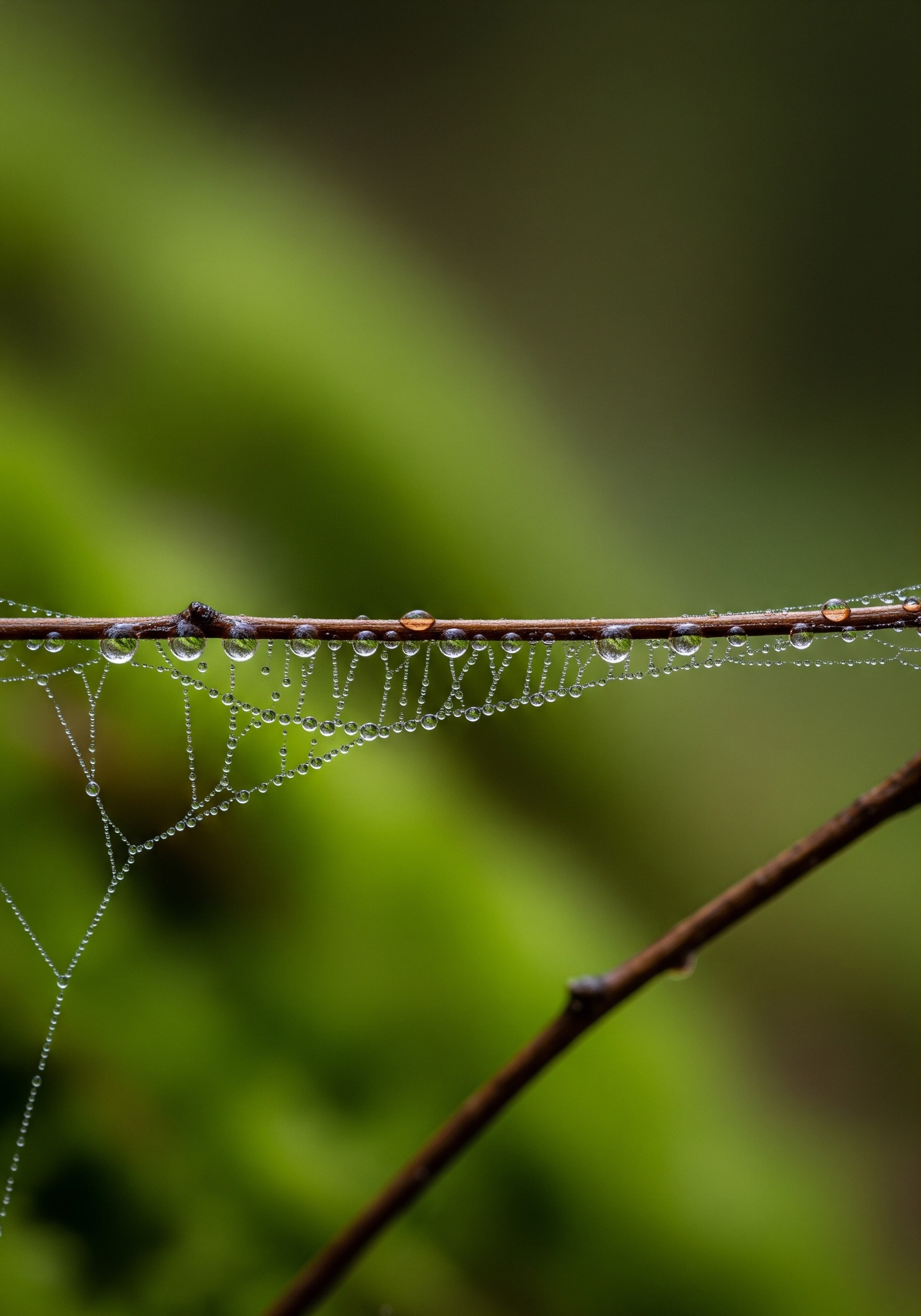
The slogan is everywhere. Documentaries repeat it, school textbooks repeat it, and so does every breathless headline about lab-grown silk fibre. The trouble is that materials scientists use three separate properties, and the slogan quietly conflates them.
Tensile strength is the maximum pulling force a fibre can take before it snaps, measured in megapascals (MPa). Specific strength divides that by density — how strong something is for its own weight. Toughness is a different beast: the total energy a material can absorb before failure, measured in megajoules per cubic metre (MJ/m³). A glass rod is stiff and reasonably strong, but you can shatter it with a tap. Spider silk is the opposite kind of material.
Here is how the numbers actually line up:
| Material | Tensile strength | Density | Toughness |
|---|---|---|---|
| Spider dragline silk | ~1,000 MPa | 1.3 g/cm³ | ~160 MJ/m³ |
| Caerostris darwini silk | ~1,650 MPa | 1.3 g/cm³ | 350 MJ/m³ avg, 520 max |
| High-grade alloy steel | 450–2,000 MPa | 7.85 g/cm³ | ~6 MJ/m³ |
| Kevlar (aramid) | ~3,000 MPa | 1.44 g/cm³ | ~50 MJ/m³ |
So — is spider silk stronger than steel? On a raw pull, no. High-grade steel matches or beats most silks. By weight, yes, comfortably. By toughness, silk is in a class of its own, and Darwin’s bark spider sits at the top of that class. The “stronger than steel” line isn’t a lie. It is just half a sentence.
What spider silk is actually made of
Silk is a protein fibre, and the proteins are called spidroins. Each one is a long chain stitched together from two very different kinds of region. One region is rich in the amino acid alanine and folds into stacked, tightly packed sheets called β-sheets — the hard, crystalline parts. The other region is rich in glycine and stays loose and rubbery, the disordered matrix that holds everything together.
Picture a brick wall poured into a slab of rubber. The β-sheet “bricks” supply the strength; the glycine matrix lets the whole thing stretch instead of shatter. When a fly slams into a web, the stretchy matrix gives, the crystalline blocks slide and reorient, and the kinetic energy of the collision is bled off as heat.
Nothing breaks.
{IMAGE_2}
This two-phase architecture is why spider silk is not really a “strong” material in the steel sense — it is a tough one. It cheats the usual engineering trade-off, in which strong materials tend to be brittle and stretchy ones tend to be weak. The real story isn’t that silk beats steel; it’s that evolution solved a different problem than we did, and solved it better.
The toughness record: Darwin’s bark spider
In October 2010, biologists Ingi Agnarsson and Matjaž Kuntner, working with the Smithsonian Institution, described a new species from Madagascar’s Andasibe-Mantadia rainforest. They named it Caerostris darwini, Darwin’s bark spider, and they timed the announcement for the 150th anniversary of On the Origin of Species. The species was peculiar for two reasons. Its orb webs were enormous — bridge lines up to 25 metres long, slung across entire rivers. And the silk testing nearly broke the equipment.
Dragline samples averaged a toughness of 350 megajoules per cubic metre, with the best fibres reaching 520 MJ/m³. Kevlar measures roughly 50 MJ/m³. That makes Darwin’s bark spider silk, by current measurements, the toughest biological material ever recorded — and more than ten times tougher than the aramid fibre engineered for stopping bullets.
What’s behind the record? A 2019 study led by Jessica Garb of the University of Massachusetts Lowell, published in Communications Biology, sequenced the spider’s silk-gland transcriptome and identified two new spidroin proteins, MaSp4 and MaSp5, with unusual repetitive motifs. A follow-up published in 2021 in the Royal Society’s Open Biology showed that closely related Caerostris species carry the same genes but express them less strongly. The toughness, in other words, is not only what proteins the spider can build. It is also how loudly it builds them.
Different silks for different jobs: seven glands, one spider
The strand a spider drops down on as you walk through a doorway is not the same fibre as the sticky one that catches a fly. A single orb-weaver can produce up to seven distinct kinds of silk from seven different glands, though no individual spider uses all seven at once. Each silk is tuned for a specific job.
The two that matter most for “strength” questions are dragline silk, made in the major ampullate gland, and capture-spiral (flagelliform) silk. Dragline is the structural cable — the radial spokes of the web, and the safety line a spider plays out behind itself as it moves. It is strong and only modestly stretchy, extending about 27% before breaking. Flagelliform silk is the opposite: gummy, sticky, and capable of stretching to roughly 2.7 times its original length. When a fly hits, the radial cables hold the frame steady while the spiral threads stretch like rubber bands and soak up the kinetic shock.
Other glands handle specialised tasks. Aciniform silk wraps prey into neat bundles. Cylindriform silk builds egg sacs. Pyriform silk is the glue that anchors the web to bark and stone. The engineering is so good that some animals have learned to exploit it: the streaked spiderhunter, a bird of Southeast Asian forests, raids spider webs not to eat the spider but to steal the silk for the construction of its own hanging nest. Other large hunting species like huntsman spiders rely much less on web silk because they chase down prey on foot.
Why your shirt isn’t made of spider silk yet
For a material this good, there’s an obvious question. Why hasn’t anyone started farming it?
The short answer: spiders are cannibals. Stacked side-by-side, the way silkworms are, they eat each other. Commercial spider farming at scale is impossible. For the last twenty years, the only real path has been to take the genes that code for silk proteins, splice them into something more cooperative — yeast, bacteria, goats, even alfalfa — and harvest the protein from there.
Two companies have come closest. Bolt Threads, founded in 2009 in Berkeley, California, brews spidroin proteins in yeast fermenters and spins them into a fibre it calls Microsilk; in partnership with Stella McCartney it produced a Microsilk tie and dress as proof of concept. AMSilk, a German biotech spun out of the Technical University of Munich, supplies a similar fermented silk fibre called Biosteel; it has appeared in an Adidas concept shoe (2016), a limited-run Omega watch band (2019), and a Mercedes-Benz door pull (2022). AMSilk announced a 35% expansion of its fermentation capacity in 2024.
None of those products is a true Darwin’s-bark-spider replica. The lab-made proteins are shorter than the natural ones, and the spinning process — how a spider turns liquid protein dope into a solid fibre in milliseconds, at room temperature, with only water as a byproduct — has been very hard to copy. Synthetic silks are getting closer to natural dragline strength every few years. The toughness record set by C. darwini still belongs to the spider.
Frequently Asked Questions
Q: Is spider silk really five times stronger than steel?
A: Only by weight. Pound for pound, yes, silk dramatically outperforms steel because silk is roughly six times less dense. In raw tensile strength — what an engineer would simply call “strength” — high-grade alloy steel matches or beats spider silk.
Q: What is the strongest spider silk in the world?
A: The dragline silk of Darwin’s bark spider, Caerostris darwini, from Madagascar. Its silk holds the highest measured toughness of any known biological fibre — averaging 350 MJ/m³ and reaching 520 MJ/m³ in the best samples, more than ten times tougher than Kevlar.
Q: Why isn’t spider silk used for bulletproof vests?
A: Two reasons, for now. You cannot farm spiders, and lab-grown spider-silk proteins still fall short of natural silk’s toughness. Kevlar and Dyneema are far easier to mass-produce. If synthetic spider silk eventually matches the wild fibre, lightweight personal armour is one of the most likely applications.
Q: Can spider silk be made artificially?
A: Yes, but only in modest quantities. Companies like Bolt Threads and AMSilk ferment spider-silk proteins in genetically modified yeast or bacteria, then spin them into fibres. The result is real silk protein. The finished fibres, however, are not yet as tough as the dragline silk a wild spider produces.
Sources
- Kuntner, M. & Agnarsson, I., “Web gigantism in Darwin’s bark spider, a new species from Madagascar (Araneidae: Caerostris),” Journal of Arachnology, 2010.
- Garb, J. E. et al., “The transcriptome of Darwin’s bark spider silk glands predicts proteins contributing to dragline silk toughness,” Communications Biology, 2019.
- Royal Society, “Darwin’s bark spider shares a spidroin repertoire with Caerostris extrusa but achieves extraordinary silk toughness through gene expression,” Open Biology, 2021.
- University of Cambridge Department of Engineering, “Spider silk is a wonder of nature, but it’s not stronger than steel,” 2013.
- Smithsonian Insider, “Newly discovered Madagascar spider spins largest, toughest webs on record,” October 2010.
Spider silk is one of those materials that humbles engineers. It is grown, in milliseconds, by an animal the size of a fingernail, from a soup of folded proteins, at room temperature, with no byproduct more toxic than water. Whether or not it is strictly “stronger than steel” is almost beside the point. It is better than steel at the specific job evolution gave it. Stand in a Madagascar river valley at dawn, watch a 25-metre cable of C. darwini silk catch the light, and the question reframes itself — not how strong, but how clever.
Illustrations are AI-generated. Article fact-checked and human-edited. Our editorial standards.