How a Caterpillar Turns Into a Butterfly: Inside the Chrysalis
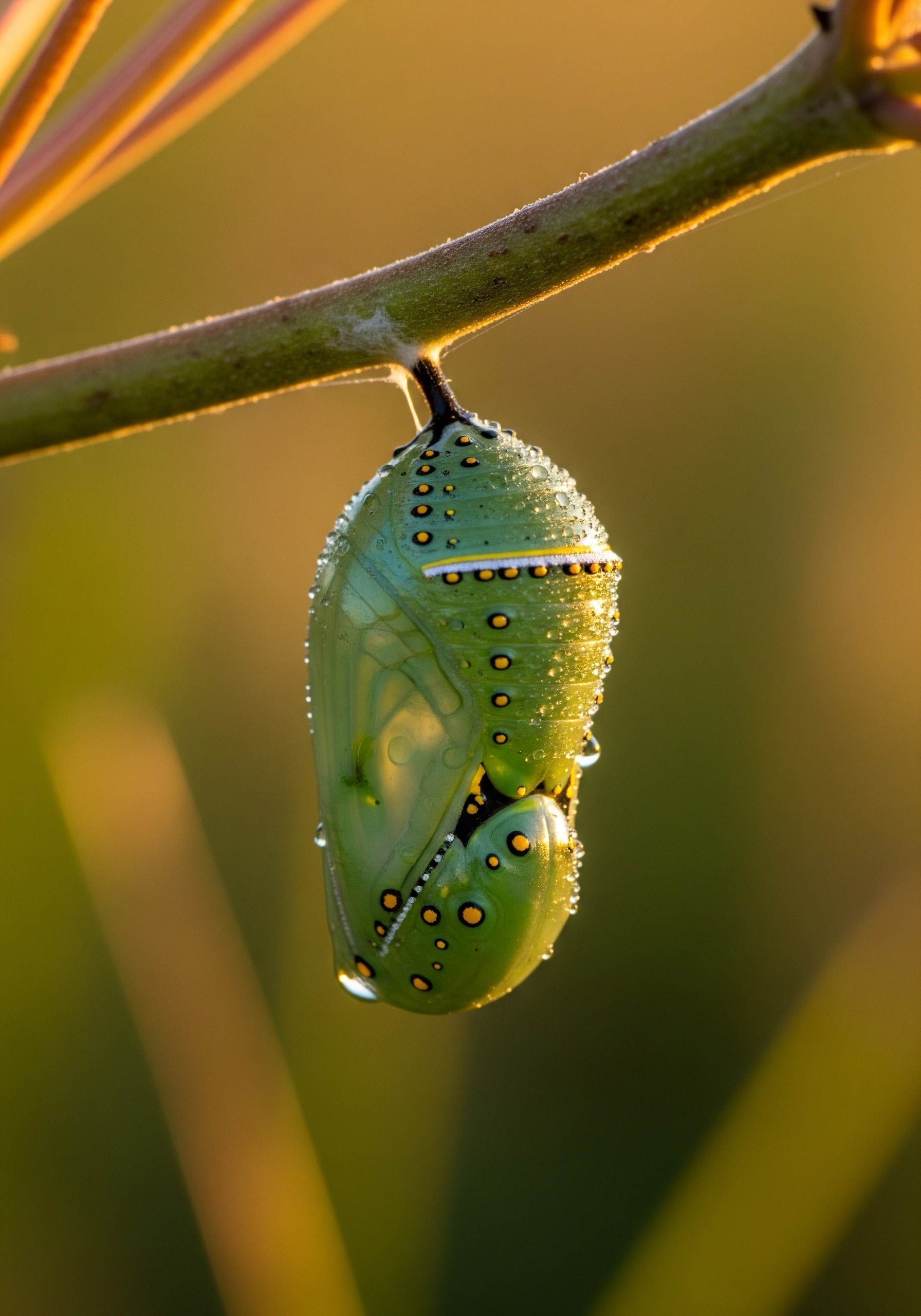
How does a caterpillar turn into a butterfly? Not gently. It hangs upside down, sheds its skin one last time, and then, sealed inside a hard green case the size of a paperclip, most of its body dissolves. What’s left is a soup — and a few stubborn islands of cells that have been waiting for this moment since before the caterpillar hatched. Those islands rebuild the animal. About two weeks later, something with wings climbs out.
Key Facts
- The four stages of complete metamorphosis are egg, larva (caterpillar), pupa (chrysalis), and adult — a development pattern called holometaboly, shared by butterflies, beetles, flies and bees.
- Inside the chrysalis, the caterpillar’s tissues are broken down by enzymes called caspases — the same family of “executioner” proteins that drive cell death in nearly every animal on Earth.
- Tiny clusters of cells called imaginal discs survive the meltdown. They were already present inside the caterpillar before it even hatched from the egg.
- A 2008 Georgetown University study published in PLOS ONE showed moths can remember what they learned as caterpillars — meaning at least some neural wiring survives the dissolution.
- A monarch’s chrysalis phase lasts roughly 8 to 15 days at warm summer temperatures; cooler weather can stretch it to weeks, and some species pause inside for months.
In short: A caterpillar does not “grow wings”. It is largely dismantled and rebuilt from a handful of pre-loaded cell colonies inside a chrysalis. The butterfly that emerges is almost a different animal — yet it remembers being the caterpillar.
Key Facts
- Complete metamorphosis (holometaboly) has four stages—egg, larva, pupa and adult—shared by butterflies, beetles, flies and bees.
- Inside the chrysalis, tissues are broken down by enzymes called caspases, the same executioner proteins that drive cell death in most animals.
- Small clusters called imaginal discs survive the meltdown; they were already present inside the caterpillar before it hatched.
- A 2008 Georgetown University study in PLOS ONE showed moths can remember what they learned as caterpillars.
- A monarch’s chrysalis phase lasts roughly 8 to 15 days in warm summer temperatures.
In short: A caterpillar doesn’t grow wings; inside the chrysalis its tissues largely dissolve via caspase enzymes, and small pre-loaded cell clusters called imaginal discs rebuild the animal into a butterfly. This four-stage metamorphosis takes about 8–15 days in a monarch, yet the adult can still remember lessons learned as a caterpillar.
What actually happens in the chrysalis (and what doesn’t)
The popular line is that the caterpillar “turns to soup.” That’s close to true, but the soup story leaves out the most important part: the survivors.
Once the caterpillar finishes its last molt and seals itself inside a chrysalis, it releases a wave of digestive enzymes that begin breaking down its own muscle, gut and fat into a thick, protein-rich liquid. This is called histolysis — literally, “the dissolving of tissue”. If you cut open a chrysalis in the first days after pupation, you would find a green-brown slurry, and very little structure.
But not everything dissolves. Scattered through the larval body are small, dormant pouches of cells — the imaginal discs — that the caterpillar has been carrying since before it hatched. There is a disc for each wing, each leg, each compound eye, the antennae, the proboscis. The soup is the building material. The discs are the blueprint and the construction crew.
From egg to wings: the four-stage life cycle, fast
Butterflies belong to a club of insects — the holometabolous ones — that develop in four sharply different stages: egg, larva, pupa, adult. Each stage looks like a completely separate animal. The strategy is so successful that holometabolous insects make up roughly 80 percent of all known insect species.
Egg. A female lays eggs on a specific host plant — milkweed for monarchs, fennel and parsley for swallowtails, nettles for red admirals. The choice isn’t romantic; the caterpillar that hatches will eat almost nothing else.
Larva (caterpillar). This is the eating stage. A monarch caterpillar can multiply its body mass roughly 2,000-fold in about two weeks — the equivalent of a human newborn growing to the size of a sperm whale in a fortnight. It molts four to five times to keep up.
Pupa (chrysalis). The transformation stage. Outwardly still; inwardly, a near-total rebuild.
Adult. The flying, mating, dispersing stage. Most adult butterflies live only two to four weeks. Some, like the overwintering generation of monarchs, can live eight months.
{IMAGE_2}
Inside the chrysalis: caspases, soup, and the imaginal discs
This is the part most explainers wave their hands at. The “enzymes” doing the dissolving have names. The main family is the caspases — short for cysteine-aspartic proteases — the same molecules that orchestrate programmed cell death (apoptosis) in everything from fruit flies to humans. In a caterpillar, hormonal cues at pupation flip a switch that lets caspases run wild through tissues that are no longer needed: the chewing jaws, the stubby legs, the digestive plumbing built for chewing leaves.
What stops the meltdown from being total are the imaginal discs. The biologist Carroll Williams at Harvard mapped these pouches in the 1950s and 60s, and his work still anchors the textbook picture. Each disc is a small, folded sheet of cells, anchored in the caterpillar’s body wall, dormant and protected from the caspase wave by its own chemistry. When the soup is ready, the discs unfold and divide — a process called histogenesis — pulling raw protein out of the slurry and assembling an entirely new body plan around it: long thin legs, a coiled proboscis, compound eyes the caterpillar never had, and the two pairs of scaled wings that define the order Lepidoptera.
Here’s the thing nobody tells you in primary school. The wings don’t grow inside the chrysalis from nothing — they were already there, in miniature, folded up inside the caterpillar’s flank the whole time, waiting.
Chrysalis vs cocoon — the difference most articles get wrong
The two words are not interchangeable, and this is one of those small accuracies that separates a real nature article from a rewrite.
A chrysalis is the hard, glossy pupal stage of a butterfly. It is the caterpillar’s own body, after its last molt — a fused, lacquered outer shell, often metallic green, gold or brown. A monarch chrysalis is unmistakable: jade-green with a rim of gold dots, hanging from a single silk pad.
A cocoon is something a moth caterpillar spins around itself from silk before pupating. The pupa is inside the cocoon, not the cocoon itself. Silk moths, including the domestic silkworm Bombyx mori, spin cocoons of a single unbroken silk thread up to a kilometer long — the source of every silk shirt in the world.
So: butterflies make chrysalises, moths make cocoons. There are edge cases — a few moth species skip the silk and pupate bare — but the rule holds for almost every species you will meet in a garden.
The memory that survived: what Martha Weiss found at Georgetown
If a caterpillar is dissolved and rebuilt, can the butterfly remember being the caterpillar? For a long time, biologists assumed no. The answer turned out to be yes, and that finding is one of the more quietly astonishing results in modern entomology.
In a 2008 study published in PLOS ONE, biologist Martha Weiss and her colleagues at Georgetown University trained tobacco hornworm caterpillars to avoid a specific odor — ethyl acetate — by pairing it with a mild electric shock. The caterpillars learned. They then pupated, dissolved, and re-emerged weeks later as adult hawkmoths. When the moths were tested, they too avoided ethyl acetate, even though they had never encountered the smell as adults. Untrained controls did not.
The implication is that at least some of the caterpillar’s neural circuitry — specifically, parts of the mushroom bodies in the brain — must survive the chrysalis intact. The body gets rebuilt; a thread of memory is carried across. Weiss has since argued, with care, that this changes how we think about the boundary between two life stages we used to treat as separate selves. The science is honest about its limits: nobody yet knows exactly which neurons survive, or how the rebuilt brain hooks back onto them.
How long does it take?
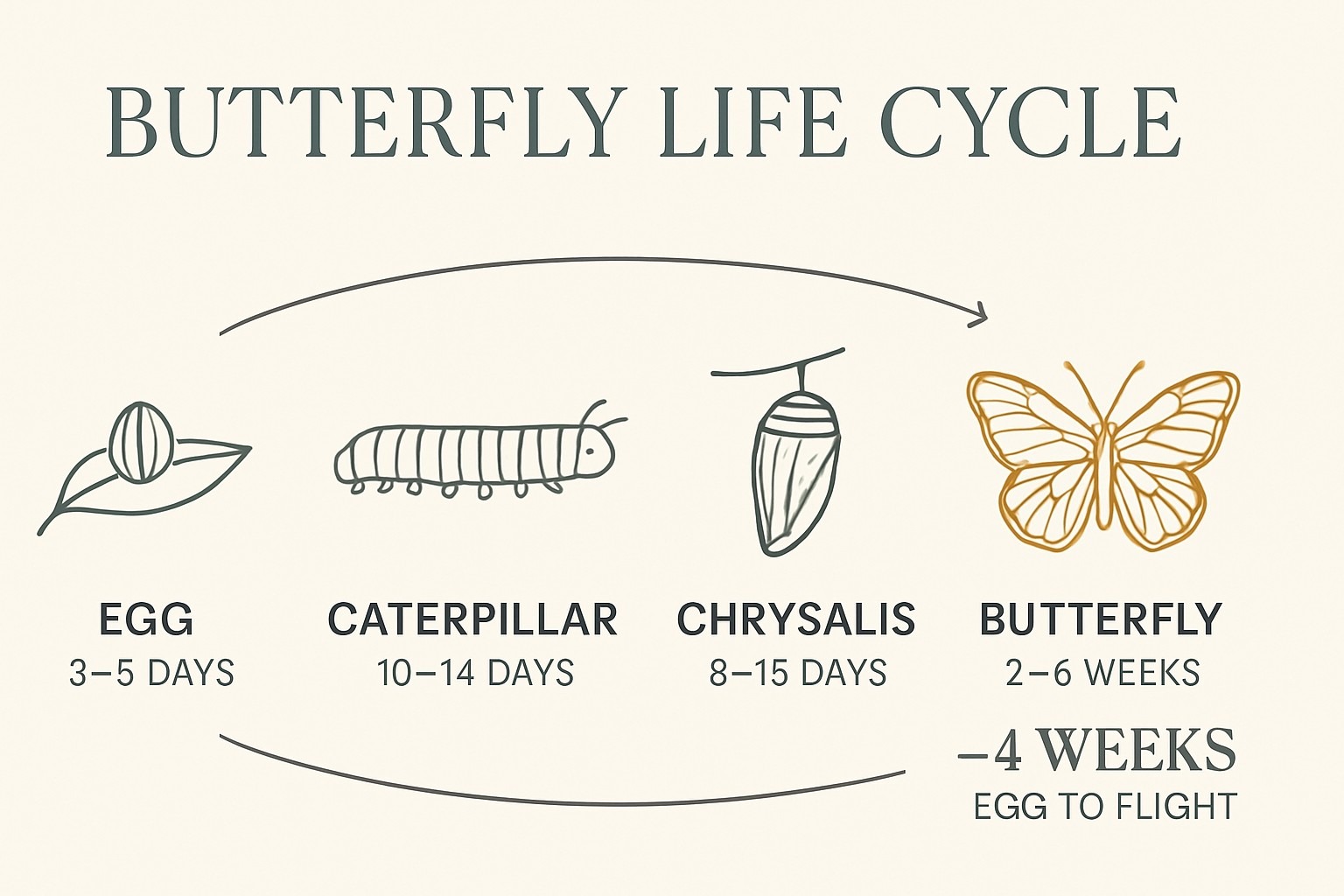
Stage durations — monarch butterfly (Danaus plexippus), summer generation
- Egg: 3 to 5 days
- Caterpillar (5 instars): about 10 to 14 days
- Chrysalis: 8 to 15 days, typically 10
- Adult: 2 to 6 weeks (summer generation); up to 8 months (overwintering generation)
- Total egg-to-flight: roughly four weeks
That timing assumes warm temperatures around 25 °C (77 °F). Cooler weather slows everything; some species — including the mourning cloak — overwinter as adults, and others as pupae, pausing the rebuild for months in a state called diapause until spring chemistry restarts it.
Emerging: a wet, crumpled animal that has to pump itself into shape
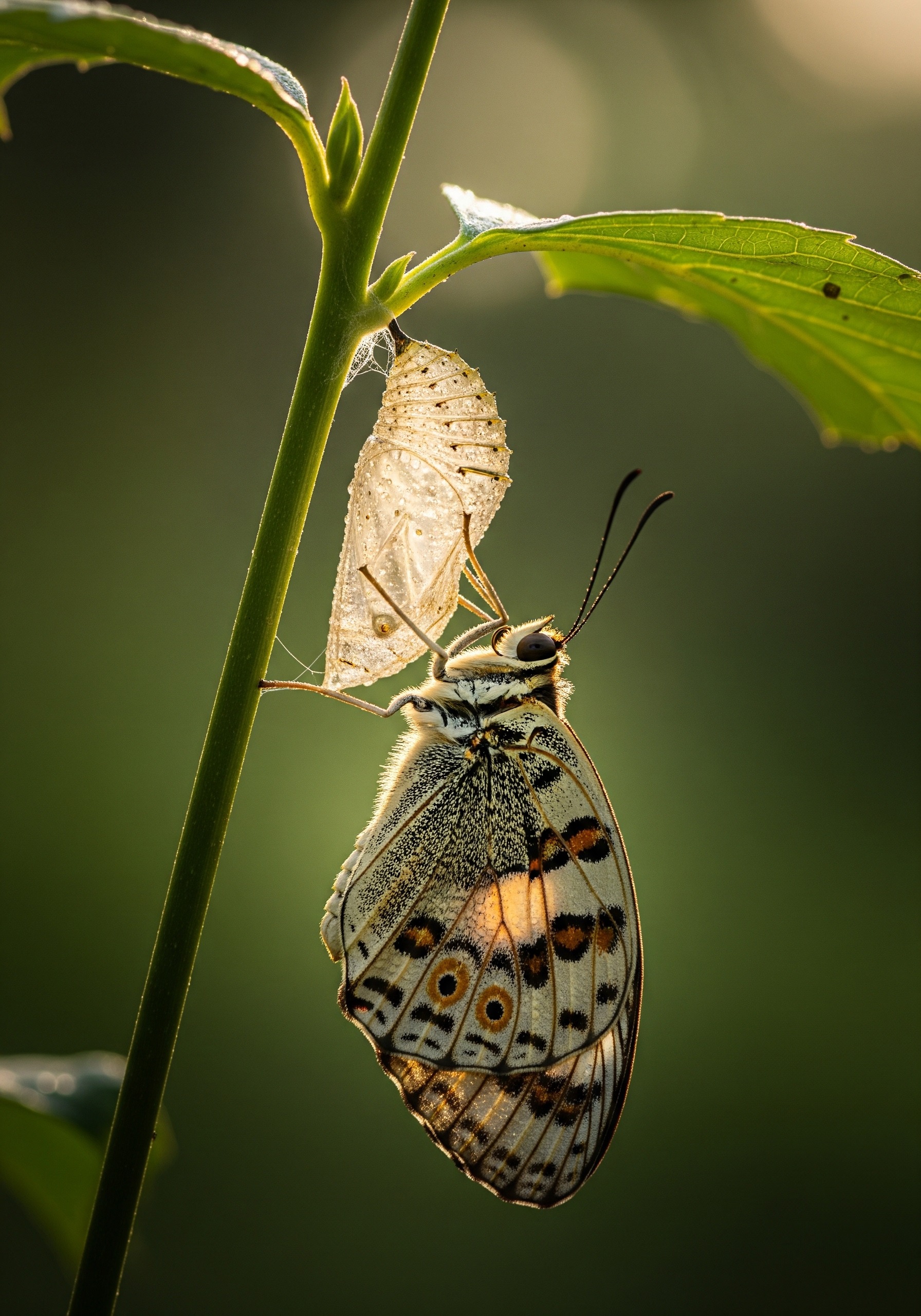
The newly-emerged butterfly — technically, an imago — looks nothing like the magazine version. It is wet, soft, and its wings are crumpled rags pressed against its back. It has minutes, not hours, to fix that.
It crawls to a vertical perch and hangs head-down. Then it begins to pump a fluid called hemolymph — the insect equivalent of blood — through the network of veins running through each wing. The veins inflate. The wing membrane, which was folded inside the chrysalis like origami, stretches taut. Within twenty to thirty minutes the wings are roughly full size; within an hour or two they have hardened enough to fly. Disturb a butterfly in this window and you can permanently deform the wings — they will set crooked, and the animal will never fly properly. Patience here is not a virtue; it is the difference between a butterfly and a casualty.
What science still doesn’t know
For a process humans have stared at for at least 2,000 years — Aristotle described butterfly emergence in Historia Animalium around 350 BC — metamorphosis still has open questions. We do not know exactly how many imaginal-disc cells survive the caspase wave, or why those specific cells are protected. We do not know which neurons carry memory across, or how the rebuilt brain re-establishes the right connections. We do not fully understand how the chrysalis’s hard outer cuticle senses temperature, light and predators while the animal inside is, structurally, a puddle. Plenty of textbook prose papers over this. Honest answer: a lot of the chrysalis is still a black box.
Frequently Asked Questions
Q: Is the caterpillar conscious during metamorphosis?
A: Almost certainly not in any sense we’d recognize. Most of the brain dissolves along with the rest of the larval tissue; only fragments — likely parts of the mushroom bodies — appear to persist. There is no functioning nervous system to be “aware” while the rebuild is underway. The animal is, briefly, somewhere between alive and not.
Q: What’s the difference between a chrysalis and a cocoon?
A: A chrysalis is a butterfly’s pupa — the animal’s own body, hardened after its last molt. A cocoon is a silken wrapper a moth caterpillar spins around itself before pupating. Butterflies make chrysalises; most moths make cocoons.
Q: Does the butterfly actually die and come back?
A: No, and this is where the poetry oversells the biology. The caterpillar’s body is largely destroyed, but a continuous line of living cells — the imaginal discs and some neural tissue — bridges the two stages without ever dying. It is closer to a radical rebuild than a death and rebirth.
Q: How long does the whole transformation take?
A: For a typical garden butterfly in summer, around 10 to 14 days inside the chrysalis, and roughly four weeks from egg to flying adult. Cool weather, diapause, and species differences can stretch the chrysalis phase from days to many months.
Sources
- Blackiston, D. J., Casey, E. S., & Weiss, M. R. (2008). “Retention of Memory through Metamorphosis: Can a Moth Remember What It Learned As a Caterpillar?” — PLOS ONE.
- American Museum of Natural History — “Butterfly Metamorphosis” exhibition material.
- Scientific American — “How Does a Caterpillar Turn Into a Butterfly?” explainer.
- Florida Museum of Natural History — Butterfly Rainforest, “Cocoon vs. Chrysalis”.
- National Geographic — “Metamorphosis, explained”.
The next time you find a chrysalis hanging from a stem, you are looking at a small, sealed building site. Inside, an animal is being taken apart and put back together around a memory it can’t possibly explain — and in two weeks, it will fly.
Illustrations are AI-generated. Article fact-checked and human-edited. Our editorial standards.