How Do Bees Make Honey? The Real Science of Every Drop
Ask “how do bees make honey” and most answers stop at three words: they collect nectar. The real process is stranger and far more chemical — a four-stage assembly line inside a 60,000-bee colony, two specific enzymes that split sugar at the molecular level, and a colony-wide signal that decides when a droplet has finally become something that can outlast empires.
Key Facts
- A single worker bee makes about 1/12 of a teaspoon of honey in her entire six-week summer life.
- Filling a one-pound jar takes roughly 2 million flower visits and 55,000 miles of cumulative flight.
- Nectar enters the hive at 60–80% water; bees seal it as honey at under 18%.
- Two enzymes — invertase and glucose oxidase — do most of the chemistry.
- Properly sealed honey is essentially immortal. Jars from Egyptian tombs were still edible after more than 3,000 years.
In short: Forager bees drink nectar into a specialized “honey stomach,” then pass it mouth-to-mouth through a chain of in-hive bees that add enzymes, evaporate water, and seal the result in wax. What looks like sweet drool is one of nature’s most precise chemistry projects — and it happens because a colony needs winter food, not because anyone asked for breakfast.
Key Facts
- A single worker bee makes only about 1/12 of a teaspoon of honey in her entire six-week summer life.
- Filling a one-pound jar of honey takes roughly 2 million flower visits and about 55,000 miles of cumulative flight.
- Nectar enters the hive at 60 to 80 percent water, and bees cap it as honey only when it drops below 18 percent water.
- Two enzymes secreted from the hypopharyngeal glands, invertase and glucose oxidase, do most of the honey chemistry.
- Honey jars from Egyptian tombs were still edible after more than 3,000 years because properly sealed honey is essentially immortal.
In short: Bees make honey on a four-stage in-hive assembly line: a forager drinks nectar into her honey stomach, then passes it mouth-to-mouth to receiver, processor, and capper bees. Along the way enzymes split sugars, the water content is driven from 60-80 percent down to under 18 percent, and hydrogen peroxide keeps the syrup sterile. The result is a winter food store stable enough to last thousands of years.
It Starts With One Forager and a Field of Flowers
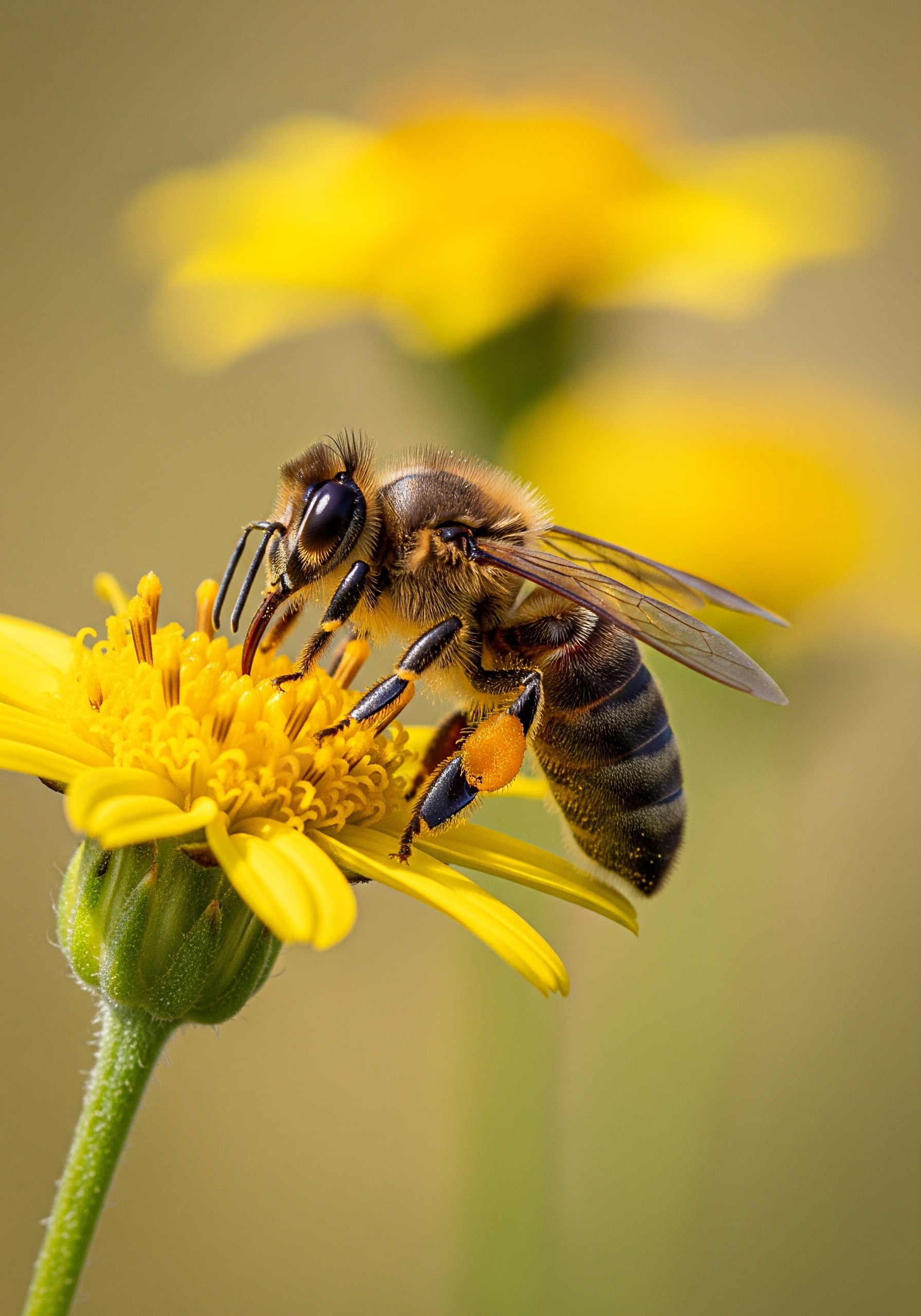
A forager bee is roughly three weeks into her short adult life when she leaves the hive to look for nectar. She is older than the bees doing housework and younger than she will be when she dies, usually of exhaustion, sometime in the next two weeks. Cornell biologist Thomas D. Seeley, whose tagged-bee studies in the Adirondacks helped redefine how scientists think about colony foraging, has shown that this stage of work is the most physically punishing thing a honeybee ever does.
On one trip she may visit anywhere from fifty to a thousand flowers, depending on how much nectar each one offers. She drinks the nectar into her crop — sometimes called the honey stomach — a separate organ from her digestive stomach, sealed off by a valve so the cargo stays untouched by digestion. When she flies home, she carries roughly her own body weight in liquid sugar.
Back at the hive entrance she does not deliver to anyone she pleases. She finds a receiver bee and offers her cargo. Seeley’s research showed that how quickly she finds a receiver tells the rest of the colony how good the foraging is. Long wait — flowers are thin out there. Quick handoff — switch on more foragers, fast.
Nectar Is Mostly Water, and That Is the Real Problem
Nectar is a sugar solution that flowers produce from glands called nectaries, specifically to bribe pollinators. By weight it is mostly sucrose, with smaller amounts of glucose and fructose, traces of amino acids, and — depending on the plant — a startling cocktail of phytochemicals. Entomologist May R. Berenbaum and her lab at the University of Illinois Urbana-Champaign have spent decades cataloguing exactly which plant compounds end up in different honeys, and why that matters for the bees that eat them.
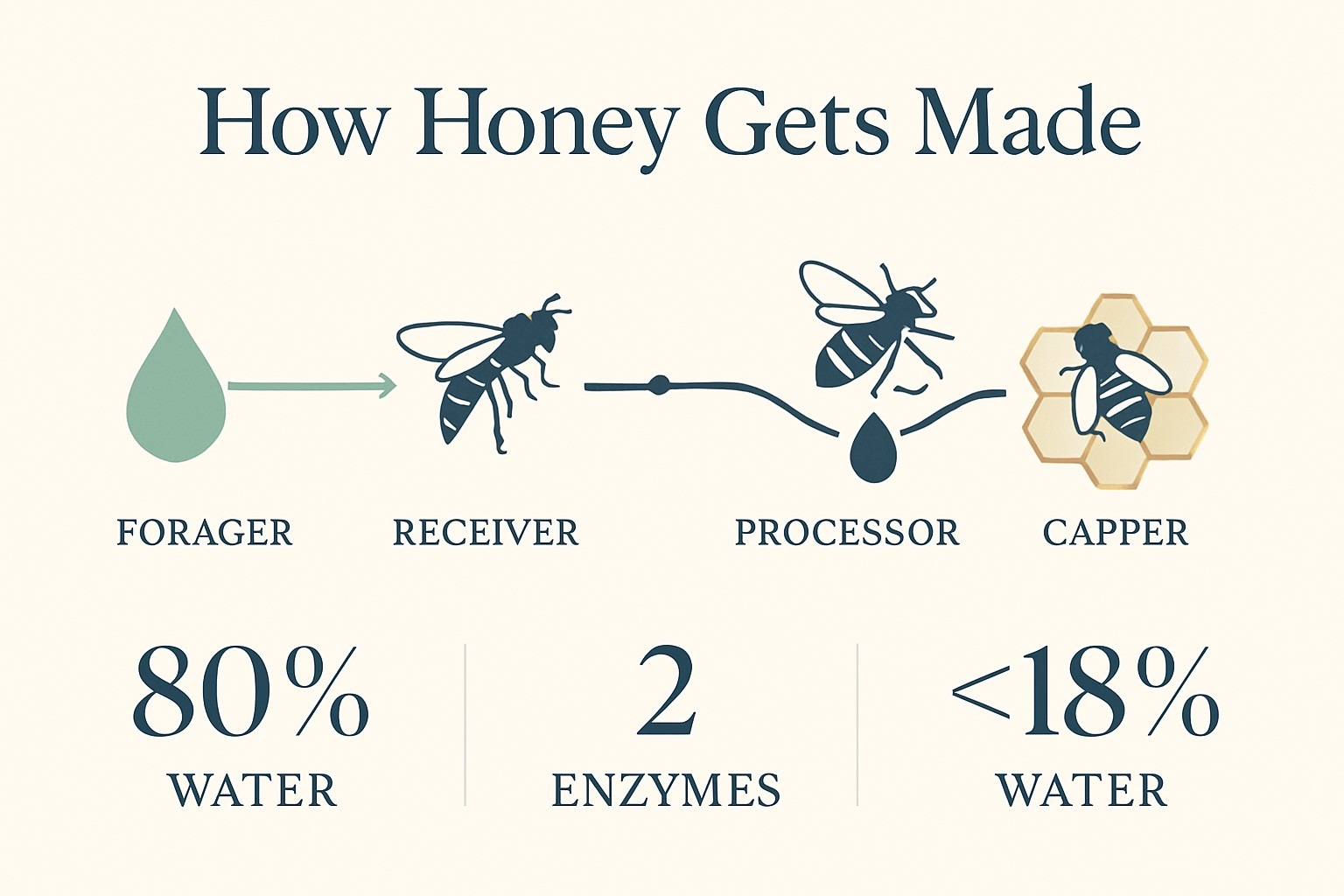
But here is the practical issue. Fresh nectar is 60% to 80% water. Capped honey is under 18%. So the question “how do bees make honey” is really the question: how does a colony remove four-fifths of the water from a sugar solution without spoiling it, and adjust the chemistry so the result never goes bad? The answer is not just fanning.
{IMAGE_2}
The Enzyme Trick Most Articles Skip
Inside that forager’s crop, and again inside every bee that handles the droplet after her, is a glandular kit that no honey explainer seems to want to name. The two key players are invertase and glucose oxidase, both secreted from the hypopharyngeal glands in a worker bee’s head.
Invertase splits sucrose into its two simpler sugars, glucose and fructose. That is what makes finished honey so much sweeter on the tongue than the raw nectar it came from, and what keeps it from crystallizing as quickly as a simple syrup would.
Glucose oxidase is the clever one. It converts a small fraction of the new glucose into gluconic acid and — here’s the thing — hydrogen peroxide. Yes, the same molecule that sits in a brown bottle in your medicine cabinet. The amounts in honey are tiny and slowly released, but they are antimicrobial enough to keep the syrup sterile while it is still wet and vulnerable.
Honey by the numbers
- 60–80% — water content of fresh nectar arriving at the hive.
- < 18% — water content at which bees cap a cell as finished honey.
- ~3.9 — typical honey pH; mildly acidic, hostile to most bacteria.
- 20–30 kg — honey a temperate colony needs to survive one winter.
- 1/12 tsp — total honey a single worker bee produces in her lifetime.
A third enzyme, diastase, breaks down any starch that wandered in with the nectar. Together these three rewrite the chemistry of a sugar solution into something that bacteria and yeasts cannot eat.
The Four-Stage Assembly Line Inside the Hive
Most articles call the bees doing this work “house bees” and leave it there. That flattens the most interesting part of the story.
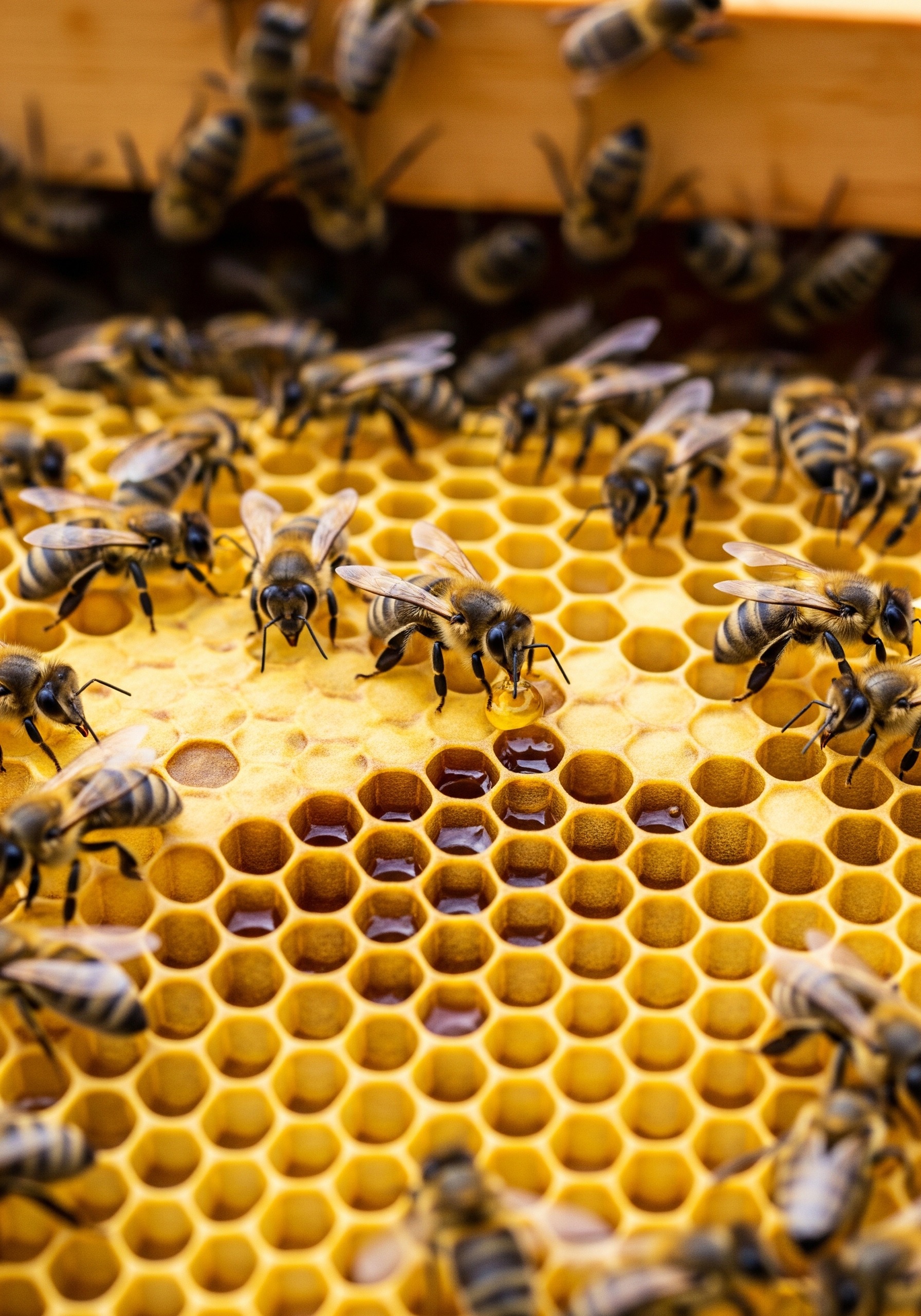
Inside a working hive, the nectar-to-honey pipeline is actually four roles, in order: forager, receiver, processor, and capper. The forager hands her cargo to a receiver at the hive entrance. The receiver passes it deeper inside via trophallaxis — mouth-to-mouth transfer — to a processor bee. That processor will spend the next twenty minutes opening and closing her mandibles, exposing thin films of the sugary droplet to dry hive air, again and again, adding more enzyme with every cycle. When the droplet has thickened, she deposits it into an open comb cell. House bees then fan it for hours, sometimes days, accelerating evaporation. Once a cell hits the right consistency, a capper bee seals it under a thin lid of fresh beeswax.
It is a relay race in which every runner adds a chemical reaction to the baton. The whole thing works because the workforce is large enough — a healthy summer colony runs 20,000 to 80,000 bees — that thousands of these reactions can happen in parallel without any single worker becoming a bottleneck.
How Bees Make Honey Without a Hygrometer
Here is something nobody seems to notice. A colony has no instrument for measuring moisture content. There is no bee whose job is “check humidity.” And yet the cells get capped reliably right around 18% water — the threshold below which honey will not ferment.
How? Not by measurement. By feel.
As bees handle a droplet, they sense its viscosity on the tongue and antennae. They sense whether it is still pulling water out of the air around it or whether it has reached equilibrium with the hive’s atmosphere. A young, watery droplet drinks moisture from the colony’s breath. A finished one stays still. When workers stop sensing that pull, capping begins. The whole colony behaves like a distributed sensor network, each bee a tiny probe, the wax going on when enough of them implicitly agree the work is done.
Why Honey Outlives Empires
Sealed honey is one of the only foods on Earth that essentially never spoils. Archaeologists working on tombs from the era of Tutankhamun, more than 3,000 years ago, have repeatedly recovered ceramic jars of honey that remained edible. The chemistry is what protects it.
Four things keep honey functionally immortal. It is extremely low in water — too dry for most microbes to grow. It is mildly acidic, with a pH of about 3.9, which suppresses bacteria. It carries slow-release hydrogen peroxide from glucose oxidase. And it is hygroscopic, meaning it actively pulls moisture out of any microbe that tries to live in it, dehydrating the invader before it can reproduce.
Honey that fails this preservation test usually fails because something went wrong upstream — it was capped too wet, the seal was broken, or it was diluted with water. A jar of properly capped honey, kept sealed, will outlast you, your house, and probably your country.
Why Bees Bother in the First Place
Honey is winter food. A temperate-climate colony needs roughly 20 to 30 kilograms of stored honey to survive a cold winter without foraging. That is the whole reason this elaborate chemistry exists. Bees are not making a gift for humans; they are making the only shelf-stable carbohydrate that can keep a 20,000-bee winter cluster alive until the first spring flowers open.
The numbers are merciless. A single worker bee will make about one-twelfth of a teaspoon of honey in her entire six-week summer life. Filling one pound jar — the small one on a supermarket shelf — takes roughly 2 million flower visits and 55,000 miles of cumulative flight, a distance we mapped out in detail in our story on the 55,000 miles behind one teaspoon of honey. The bee who collected the first drop of nectar will be long dead before her sister eats the finished honey. Generational chemistry, performed by an animal that lives six weeks.
Frequently Asked Questions
Q: Why do bees make honey?
A: To survive winter. A honeybee colony is one of the few insect societies that does not die off or hibernate when temperatures drop; instead, the bees cluster together inside the hive and slowly eat their stored honey for energy. Everything about honey — its low water content, its antimicrobial chemistry, its long shelf life — is engineered for that single job.
Q: How long does it take bees to make honey?
A: A single load of nectar can be processed into capped honey in about one to three days under good conditions, though dense or watery nectars take longer. Filling an entire hive frame can take weeks of continuous foraging by thousands of workers.
Q: Is honey really bee vomit?
A: Sort of, but the framing is misleading. The nectar travels in a bee’s “honey stomach,” a separate crop sealed off from her digestive stomach by a valve. It is regurgitated, but it is never digested. Calling it vomit is technically loose and biologically unfair to a remarkable piece of insect physiology.
Q: What is the difference between nectar and honey?
A: Water content and chemistry. Nectar is 60–80% water and mostly sucrose. Honey is under 18% water, with the sucrose already split into glucose and fructose by bee enzymes, plus traces of gluconic acid and hydrogen peroxide that keep it from spoiling.
Sources
- Thomas D. Seeley, Department of Neurobiology and Behavior, Cornell University — research on colony foraging decisions and the receiver-bee feedback loop.
- May R. Berenbaum, Department of Entomology, University of Illinois Urbana-Champaign — phytochemistry of honey and pollinator nutrition.
- USDA Agricultural Research Service Bee Research Laboratory, Beltsville, Maryland — honey composition and colony health research.
- National Honey Board — industry standards on honey moisture, grading, and processing.
- Encyclopædia Britannica — overview articles on honey chemistry and apiculture.
A spoonful of honey is the end of a chain of work that runs through a 60,000-bee colony, two named enzymes, four job roles, millions of flowers, and tens of thousands of miles of flight. Stir it into your tea and you are using a winter-survival product that bees figured out long before humans figured out fire. Worth a second look the next time you open the jar.
Illustrations are AI-generated. Article fact-checked and human-edited. Our editorial standards.