Hummingbird Facts: 25 Wonders of the Tiniest Bird
The most surprising hummingbird facts aren’t the small ones — they’re the absurd ones. A heart that runs at 1,260 beats a minute. A body the weight of a nickel that crosses 500 miles of open water without stopping. A nighttime body temperature, recorded high in the Peruvian Andes, of 3.3°C — colder than your refrigerator.
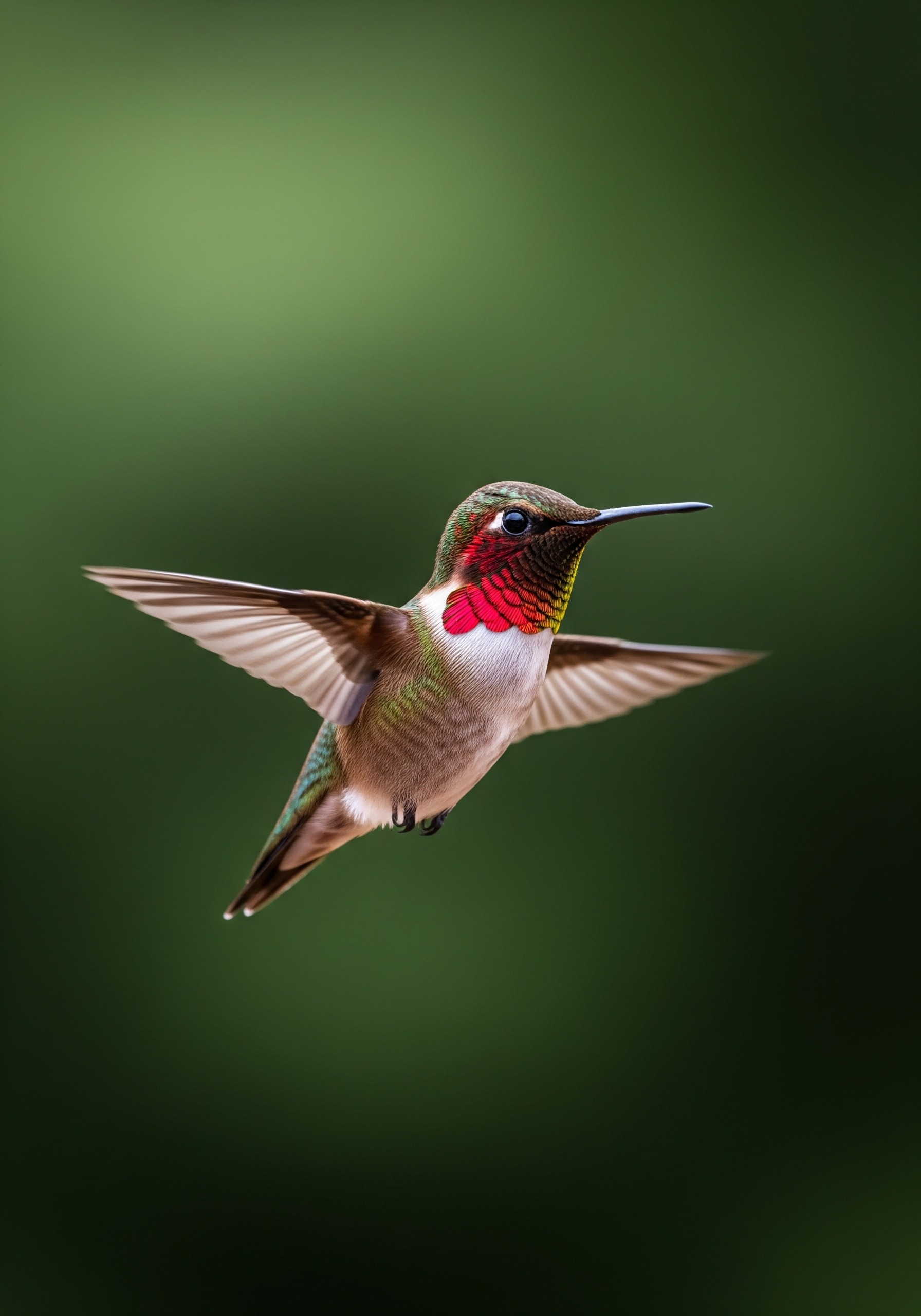
Key Facts
- Around 360 hummingbird species are recognised today, and every one of them lives ONLY in the Americas — from Alaska to Tierra del Fuego.
- The bee hummingbird of Cuba weighs about 1.95 grams, lighter than a U.S. penny — the smallest bird on Earth.
- A flying hummingbird’s heart beats 1,000 to 1,260 times a minute; in nightly torpor it can slow to about 50.
- Rufous hummingbirds fly a 6,000-mile round trip every year between Alaska and Mexico, the longest migration of any bird relative to body length.
- Ruby-throated hummingbirds cross the Gulf of Mexico in a single 18- to 22-hour non-stop flight over 500-plus miles of open water.
In short: Hummingbirds are the most extreme little engines in the vertebrate world — fastest metabolism, fastest wingbeat, only sustained hovering, longest migration per gram of body weight. The honest facts beat anything anyone has ever invented about them.
Key Facts
- Around 360 hummingbird species are recognised today, and every one lives only in the Americas, from Alaska to Tierra del Fuego.
- The bee hummingbird (Mellisuga helenae) of Cuba weighs about 1.95 grams, lighter than a U.S. penny, making it the smallest bird on Earth.
- A flying hummingbird’s heart beats 1,000 to 1,260 times a minute, slowing to about 50 in nightly torpor.
- Rufous hummingbirds fly a 6,000-mile round trip every year between Alaska and Mexico, the longest migration of any bird relative to body length.
- Ruby-throated hummingbirds cross the Gulf of Mexico in a single 18 to 22 hour non-stop flight over 500-plus miles of open water.
In short: Hummingbirds are the most extreme small engines in the vertebrate world, with the fastest metabolism and wingbeat, the only sustained hovering, and the longest migration per gram of body weight. Around 360 species live only in the Americas, and their real biology, from 1,260-beat hearts to torpor at 3.3 degrees C, outdoes any myth invented about them.
The engineering of a 4-gram helicopter
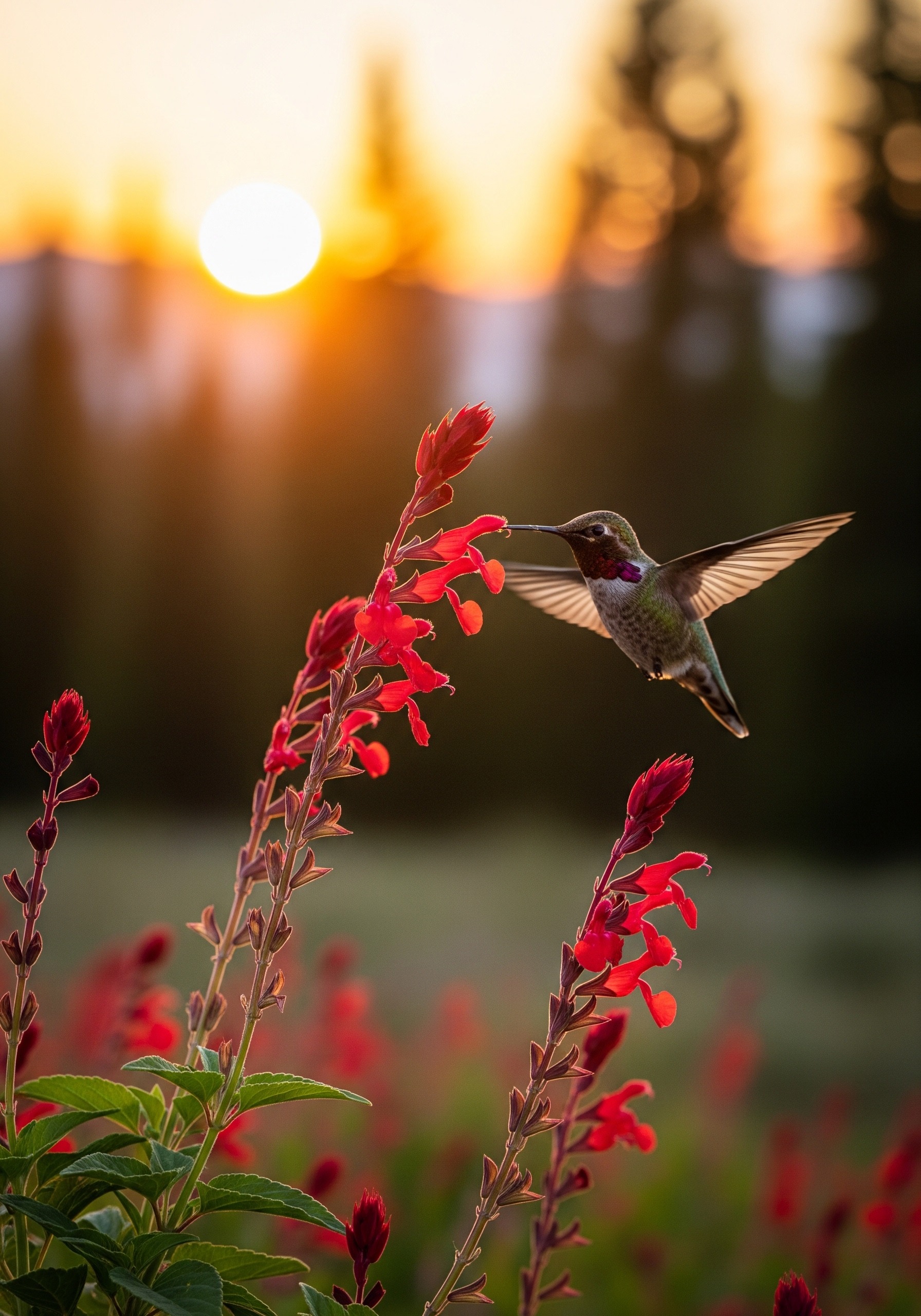
Think of a small bird and you probably picture a sparrow flapping. A hummingbird does not flap. It rotates. The shoulder joint allows the wing to twist almost 180 degrees, so the bird generates lift on the upstroke as well as the downstroke — a figure-eight motion closer to a helicopter rotor than to anything else with feathers. It is the only family of birds, anywhere, that can hover in place for minutes at a time. It can also fly backwards, sideways, and briefly upside-down.
By the numbers — a hummingbird in flight
- 50–80 wingbeats per second
- ~30 mph level flight; 60+ mph in a courtship dive
- 1,260 BPM peak heart rate
- ~100× faster metabolism than an elephant’s
The numbers are what make it almost unbelievable. A ruby-throated hummingbird beats its wings around 53 times a second; some smaller species hit 80. During the high-G courtship dive of an Anna’s hummingbird, the wings make a buzz that sounds, when slowed down, like a tiny violin string snapping. The whole apparatus runs on flower nectar — sugar water, basically — supplemented by tiny soft-bodied insects for protein. A hummingbird that does not eat for about three hours is in trouble.
Turns out the name is literal. The “hum” you hear is the wing tone — not a vocalization at all.
Hummingbird facts that surprise even biologists
The bee hummingbird (Mellisuga helenae), found only on Cuba and the Isla de la Juventud, is the smallest living bird and the smallest warm-blooded animal that can fly. A male weighs about 1.95 grams. Its egg is smaller than a coffee bean. That much-repeated line about mailing one in a first-class letter is, in fairness, true on paper — a U.S. first-class stamp covers up to about 28 grams, so the bird itself sits well under the limit. (Whether the postal service would actually deliver it is another question.)
{IMAGE_2}
According to the Smithsonian’s National Zoo and Conservation Biology Institute, a hummingbird’s metabolism runs about 100 times faster than an elephant’s. To keep that engine running, the bird must eat roughly half its body weight in sugar every day — and visit somewhere between 1,000 and 2,000 flowers to find it. The tongue, long misunderstood as a simple drinking straw, is actually a forked, fringed pump that traps nectar between two flexible plates and snaps it back into the bill 15 to 20 times a second. The mechanism was finally worked out by biologist Alejandro Rico-Guevara at the University of Washington, who filmed living birds drinking from transparent feeders and overturned a century of textbook physiology.
And the brain. A hummingbird’s brain accounts for about 4.2% of its body weight — proportionally larger than yours. That is part of why a single bird can remember the location of every flower in its territory, the precise time each one takes to refill with nectar, and the face of a particular human who tops up a feeder.
How a hummingbird survives a freezing night
Here’s the puzzle. A 4-gram body radiates heat almost as fast as it generates it. Tiny things lose warmth fast — that’s basic physics, surface area against volume. So how does an animal that needs to eat every twenty minutes by day survive a long, cold mountain night without starving in its sleep?
The answer is one of the most extreme tricks in the vertebrate world. The bird drops into torpor — a regulated, voluntary cooling so deep it looks like death. Heart rate falls from over a thousand beats per minute to fewer than 50. Breathing slows to occasional sighs. Body temperature collapses by 20°C or more. The bird saves up to 95% of the energy it would have spent staying warm. In the morning, it shivers itself back to operating temperature in about twenty minutes, like a cold engine warming up.
How deep can that go? In the high Peruvian Andes, biologist Anusha Shankar — now at the Cornell Lab of Ornithology — and colleagues recorded one black metaltail (Metallura phoebe) cooling itself to 3.3°C. That is the lowest body temperature ever measured in any bird, and it is colder than most household refrigerators. The 2020 study, published in Biology Letters, documented torpor in 24 of 26 individuals across six high-elevation species. Shankar’s broader work argues that torpor isn’t an emergency strategy — it is part of the normal nightly budget for many hummingbirds living above 3,000 metres.
That is the kind of fact that quietly rewrites a textbook.
The 6,000-mile journey: hummingbird migration
The folklore claim is famous and false: hummingbirds do not ride on the backs of geese. They migrate alone, by their own wingbeat, often for the first time as juveniles with no parent to follow. The map in their head, biologists believe, is partly genetic — written into the bird before it ever sees a flower.
The rufous hummingbird (Selasphorus rufus) holds the family’s distance record. Each year it commutes between summer breeding grounds in coastal Alaska and winter sites in southern Mexico — a round trip of roughly 6,000 miles, the longest migration of any bird relative to body length on Earth. The ruby-throated hummingbird does something different and arguably more dangerous: it crosses the Gulf of Mexico in a single non-stop flight of 500-plus miles, an 18- to 22-hour push over open water with no place to land. To prepare, the bird nearly doubles its weight by fattening on insects and nectar. It burns nearly all of that fat in flight.
The U.S. Fish & Wildlife Service notes that 12 to 15 hummingbird species breed regularly in the United States; the rest — the dazzling majority — live in the tropics, with Ecuador and Colombia alone hosting more than 130 species each.
Hummingbird facts for kids: the simple, true version
If a young reader is here, the three best facts are simple. One: hummingbirds are the only birds that can truly hover, like little helicopters. Two: a hummingbird’s heart beats so fast that if yours ran at the same speed, it would beat about twenty times every second. Three: a baby hummingbird, just hatched, is smaller than a jellybean — and grows up inside a nest the size of a walnut, woven from spider silk so the cup can stretch as the chicks get bigger.
The spider-silk nest is not a metaphor. Females really do raid spider webs for the strands, which are stronger than steel by weight and elastic enough to expand with the growing brood.
Myths people still believe
The migration-on-geese story is the most famous, but there are quieter ones — and they matter, because well-meaning humans act on them.
Myth: Red dye in sugar water helps hummingbirds find feeders. Evidence: Hummingbirds are powerfully drawn to red, but they find the colour in the plastic of the feeder itself. The Smithsonian and the major North American songbird labs recommend plain white sugar dissolved in water (one part sugar to four parts water) — no dye, which is unnecessary and which some researchers suspect may stress the birds’ kidneys. We won’t tell you how to feed yours; we’ll just say the science doesn’t support adding red dye.
Myth: Feeders left out in autumn keep hummingbirds from migrating. Evidence: Migration is triggered by day length and hormones, not food availability. A late feeder does not “trick” the birds; in fact, it can sustain stragglers and out-of-range vagrants. The Cornell Lab has tracked western species turning up at eastern feeders in November because someone kept the syrup fresh.
Myth: They sleep upside-down, like bats. Evidence: They sleep perched on twigs, sometimes with their feet still gripping while the body hangs sideways because torpor has frozen them into an odd posture. Viral photos of “hanging” hummingbirds are real, but the bird is in torpor, not dead, and not deliberately roosting like a fruit bat.
A field guide to the family’s extremes
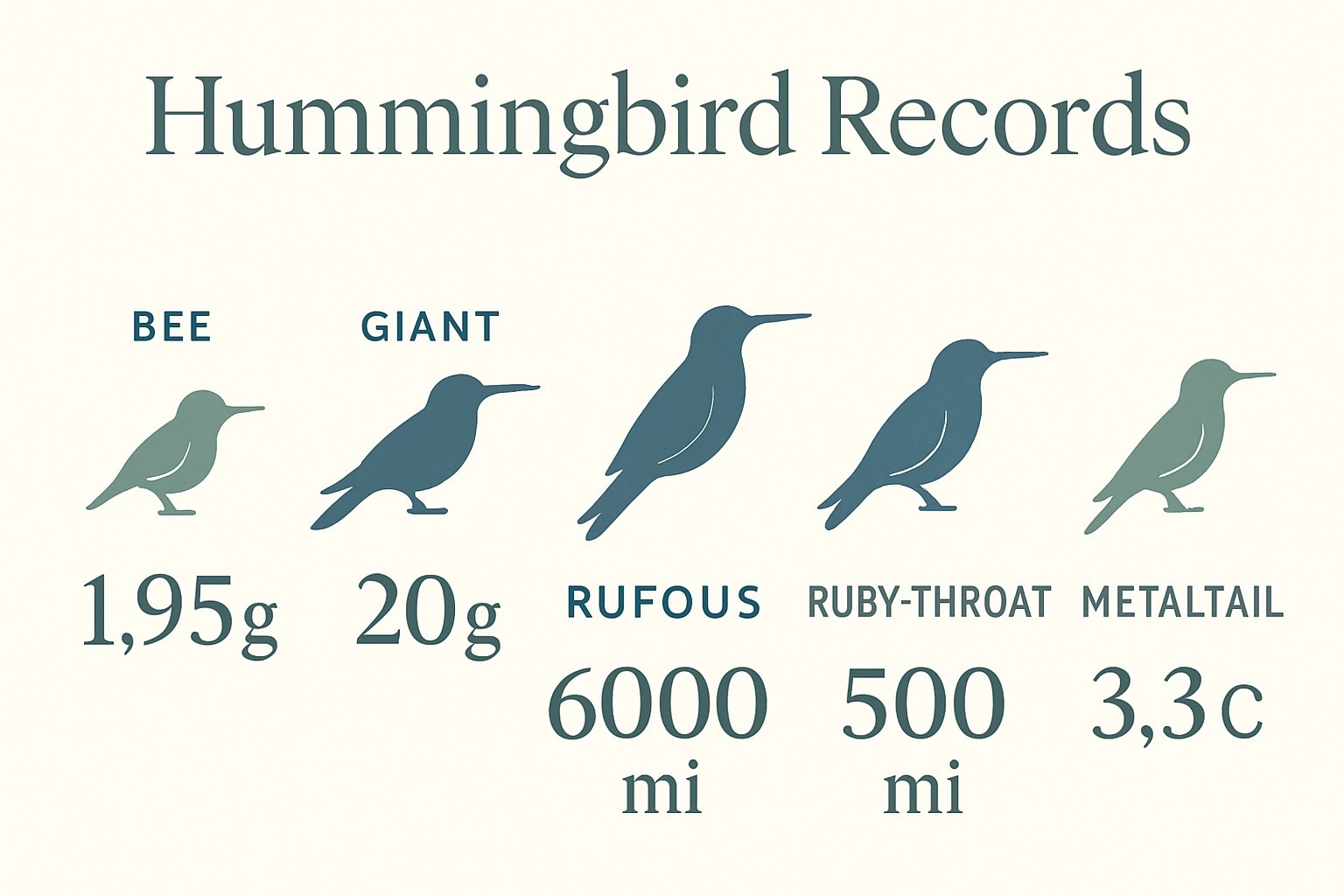
The hummingbird family (Trochilidae) is one of the most diverse bird families on the planet. A short comparison helps the records sink in.
| Record | Species | The number |
|---|---|---|
| Smallest bird on Earth | Bee hummingbird | ≈ 1.95 g, 5.5 cm |
| Largest hummingbird | Giant hummingbird | ≈ 20 g, 23 cm |
| Longest migration | Rufous | ≈ 6,000 mi round trip |
| Longest non-stop flight | Ruby-throated | 500+ mi over the Gulf |
| Lowest body temperature | Black metaltail | 3.3°C (Andes, 2020) |
| Longest bill (relative) | Sword-billed | Bill longer than the body |
What this means for the rest of us
Hummingbirds matter beyond their oddness. They pollinate roughly 7,000 plant species across the Americas, many of them — fuchsia, salvia, several columbines — co-evolved so tightly that they cannot reproduce without a hummingbird’s bill. Lose the bird and you lose the flower. The U.S. Fish & Wildlife Service and conservation groups including the American Bird Conservancy note that several species, particularly the rufous, have declined sharply in recent decades, almost certainly linked to climate shifts that desynchronize the bird’s arrival from the bloom of its food plants. Planting native nectar flowers, rather than non-natives bred for human eyes, is the single most useful thing a private garden can do for them.
Frequently Asked Questions
Q: How fast can a hummingbird fly?
A: Around 30 mph in level flight. Anna’s hummingbirds have been clocked at over 60 mph during the male’s courtship dive, accelerating fast enough to experience nearly 10G when they pull out — a force that would knock most fighter pilots unconscious.
Q: How long do hummingbirds live?
A: Most die in their first year — the world is hard on something that small — but a banded broad-tailed hummingbird recaptured in Colorado was at least 12 years and 2 months old, the verified longevity record for the family.
Q: Why do hummingbirds hum?
A: The sound is purely mechanical. Their wings beat 50 to 80 times per second, fast enough to push the air into a tone in the audible range. Different species hum at slightly different pitches, and a few even sing with their tail feathers during display dives.
Q: How many species of hummingbirds are there?
A: Roughly 360, depending on which taxonomy you follow; the International Ornithological Congress has steadily added newly-split species over the past decade. All of them live in the Americas — there has never been a wild hummingbird in Europe, Asia, Africa, or Australia.
Sources
- Smithsonian’s National Zoo and Conservation Biology Institute — hummingbird overview, metabolism, and behavior
- Cornell Lab of Ornithology / All About Birds — Anusha Shankar postdoctoral research on Andean torpor
- Biology Letters (2020) — Wolf, B.O., Shankar, A. et al., “How carbohydrate-rich diets and torpor shape the thermoregulation of high-elevation hummingbirds”
- U.S. Fish & Wildlife Service — “Hummingbirds of North America”
- American Bird Conservancy — population status of the rufous and broad-tailed hummingbird
The honest miracle of a hummingbird is not that it is small. It is that something this small refuses to be limited by being small — crossing oceans, climbing mountains, surviving freezing nights by switching itself almost off until dawn. Plant a sage. Skip the dye. Watch one hover. The story is better than any myth we have ever made up about it.
Illustrations are AI-generated. Article fact-checked and human-edited. Our editorial standards.