Snowy Owl Facts for Kids: The Arctic Hunter in White
The best snowy owl facts for kids start with a surprise: this giant white bird hunts in broad daylight, can hear a mouse moving under eight inches of snow, and the famous Hedwig from the Harry Potter films is almost certainly a boy.
Key Facts
- Scientific name: Bubo scandiacus. Wingspan up to 4.8 feet (1.5 m), weight up to about 6.5 pounds (3 kg) — the heaviest owl in North America.
- A single snowy owl can eat around 1,600 lemmings in a year when prey is plentiful.
- Their heads turn up to 270 degrees, and their hearing can pinpoint a lemming tunneling under eight inches of snow.
- They are diurnal — active in daylight — because the Arctic summer barely has any night.
- The IUCN moved the snowy owl to “Vulnerable” in 2017; recent research suggests only 14,000–28,000 breeding adults remain worldwide.
In short: Snowy owls are the largest owls of the Arctic tundra, daytime hunters built for a world of ice, wind, and 24-hour summer sun. Most of what kids think they know — including the look of Harry Potter’s Hedwig — turns out to be a little bit wrong, and the real story is even more interesting.
Key Facts
- The snowy owl (Bubo scandiacus) has a wingspan up to 4.8 feet (1.5 m) and weighs up to about 6.5 pounds (3 kg), making it the heaviest owl in North America.
- A single snowy owl can eat around 1,600 lemmings in a year when prey is plentiful, roughly four a day.
- Its head turns up to 270 degrees, and its hearing can pinpoint a lemming tunneling under about eight inches (20 cm) of packed snow.
- Snowy owls are diurnal, active in daylight, because the High Arctic summer sun barely sets, and females are almost completely silent while a male’s hoot can carry up to 8 miles (13 km).
- The IUCN moved the snowy owl to Vulnerable in 2017, and recent research suggests only 14,000-28,000 breeding adults remain worldwide.
In short: Snowy owls (Bubo scandiacus) are the largest owls of the Arctic tundra, daytime hunters built for ice, wind and 24-hour summer sun. Much of what people assume, including the look of Harry Potter’s Hedwig, is a little wrong, since pure-white birds are almost always older males.
The owl that lives where no trees grow
If you flew to the very top of the world — past Iceland, past the last spruce forest in Canada, out onto the flat, treeless tundra — you would land in snowy owl country. Scientists call the species Bubo scandiacus. People have called it the polar owl, the Arctic owl, and, beautifully, the “ghost owl.”
It is a true heavyweight. A big female can weigh up to 6.5 pounds (3 kilograms) and stretch her wings out 4.8 feet (1.5 meters) — wider than most kids are tall. That makes her the heaviest owl in North America, beating even the great horned owl. She needs that bulk. The tundra in winter drops to –40°F (–40°C), and a bigger body holds heat longer.
There is no forest, no barn, no hollow tree. So a snowy owl nests on the ground — usually on a small rise the mother scrapes bare with her feet, where she can see in every direction. That single design choice shapes almost everything else about her life.
Why Hedwig got it (a little) wrong
Here is the thing about snowy owls: the males and females do not look the same.
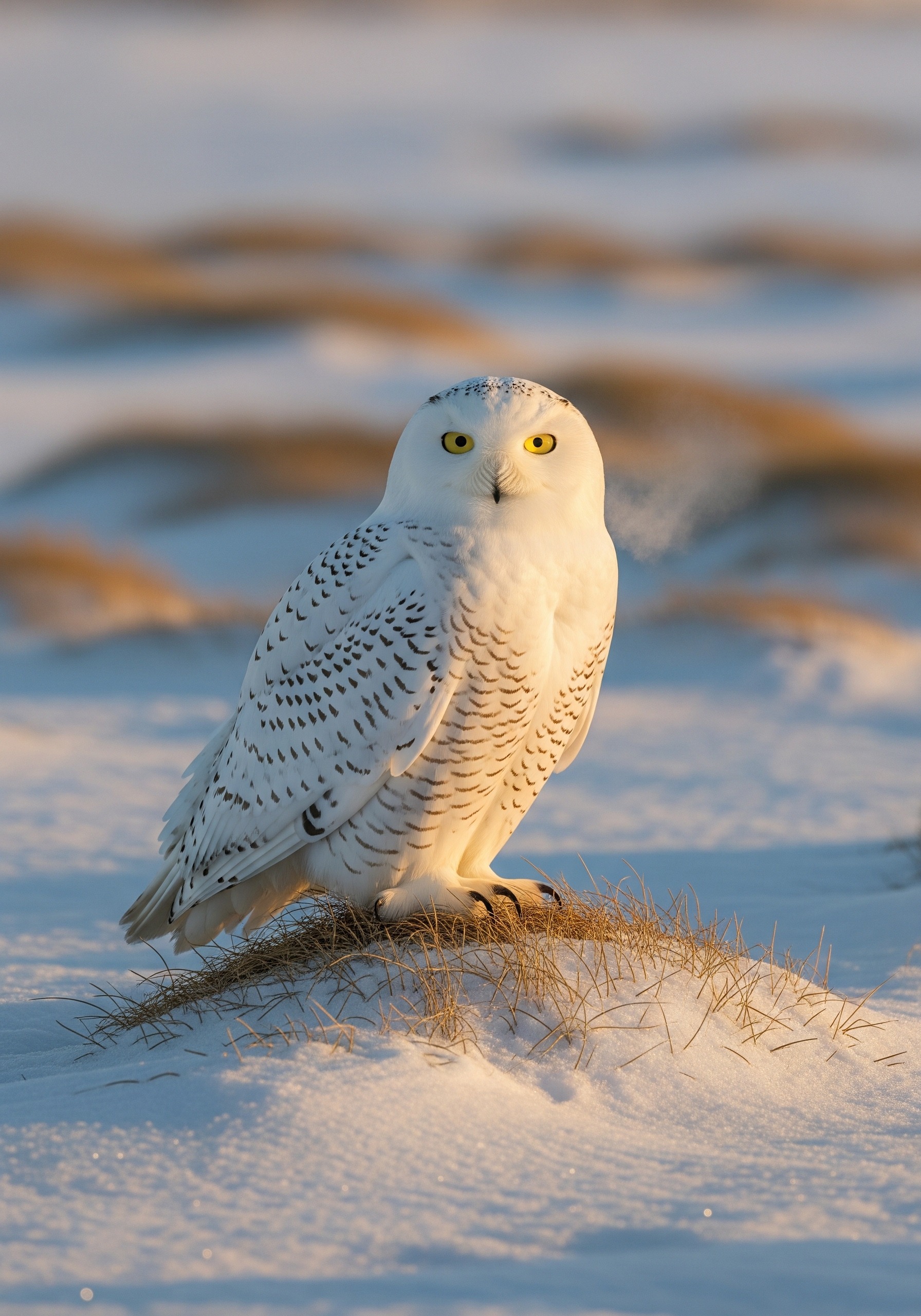
Adult males are the truly white ones. As a male ages, his feathers get cleaner and cleaner, until an old male can look like he was carved from a snowdrift. Females, even adult ones, keep dark brown bars and spots across their back, chest, and wings their whole lives. Those markings camouflage her when she’s sitting on eggs.
This is where the Harry Potter movies quietly broke the rules. Hedwig is supposed to be a female snowy owl named after a witch. But the seven owls trained to play Hedwig on screen were almost all males, because the filmmakers wanted that pure-white “magical” look. Author J.K. Rowling has admitted she got several snowy owl facts wrong in the books, too — real snowy owls are almost silent (not hooty), are awake in the day, and definitely do not eat bacon.
So next time you spot a “snowy owl” picture, look at the feathers: heavy dark barring almost always means a female or a young bird, while a near-pure-white owl is almost always an older male.
{IMAGE_2}
Eyes for snow, ears for tunnels
A snowy owl’s eyes are huge, forward-facing, and the color of egg yolk. They take up so much room inside the skull that the owl cannot roll them — instead it swivels the whole head, up to about 270 degrees in either direction. (Humans manage about 90.)
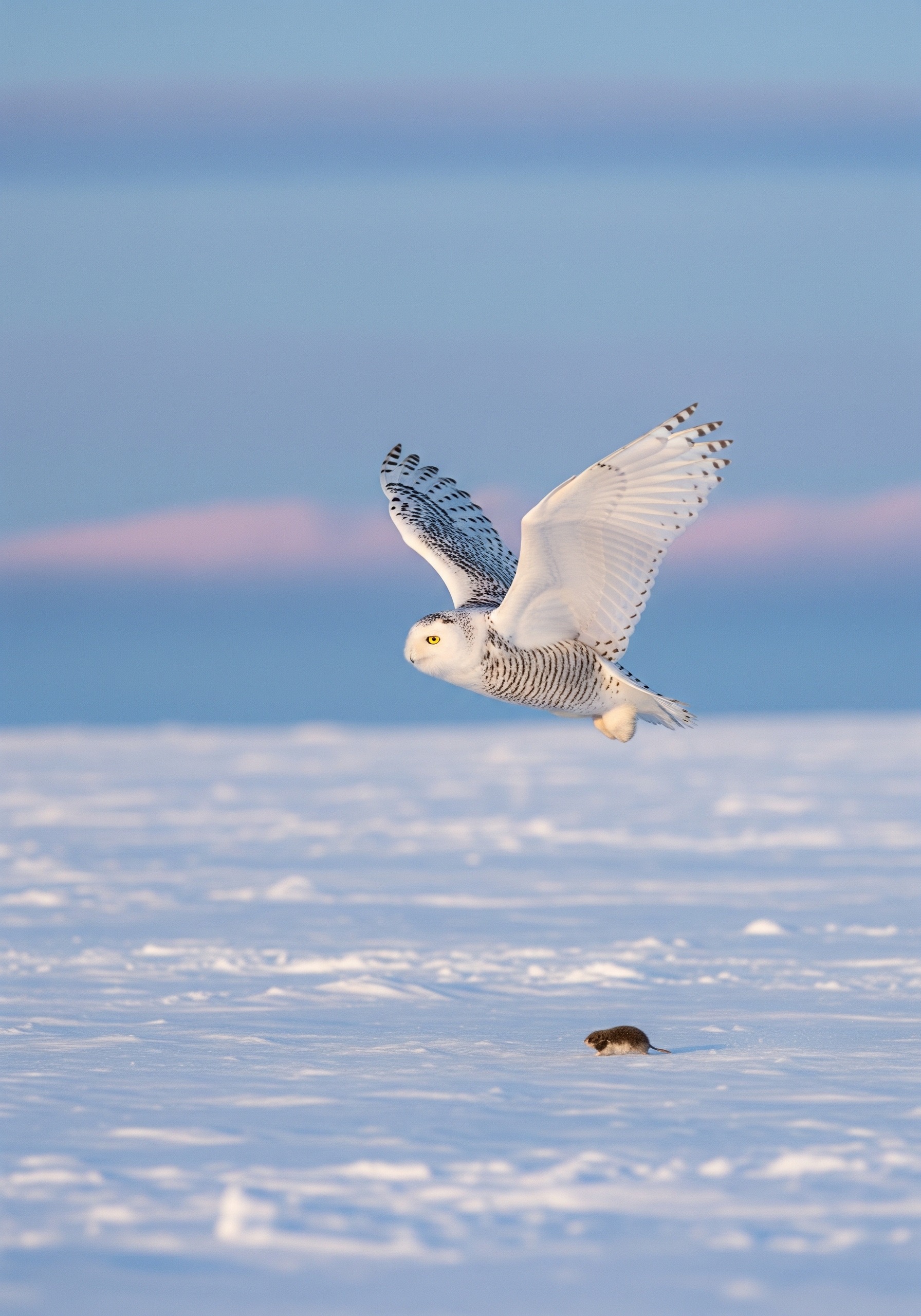
Those yellow eyes are tuned for low contrast: spotting a moving shape against endless white. But eyesight alone cannot save you when your dinner lives under the snow. So a snowy owl listens. Its hearing is sharp enough that, sitting on a rock, it can hear a lemming moving in a tunnel beneath eight inches (about 20 cm) of packed snow. Then it lifts off, glides in silently, and punches through the crust with its feet.
The silent gliding is a real, measurable thing. The leading edges of an owl’s flight feathers are fringed like a fine comb, which breaks up the rush of air and kills the sound. Engineers actually study owl wings to design quieter airplane parts and computer fans.
Built for –40°F: a snowy owl by the numbers
- Wingspan: up to 4.8 ft (1.5 m)
- Weight: 3.5–6.5 lb (1.6–3 kg)
- Body length: 20–28 in (50–70 cm)
- Head rotation: up to 270°
- Hearing range: prey under ~8 in of snow
- Male hoot carries: up to 8 miles (13 km)
- Lemmings eaten per year: ~1,600
- Eggs per clutch: 3–11 (depending on prey)
- Lifespan in the wild: ~10 years
1,600 lemmings a year, and the boom-and-bust seasons
Snowy owls eat birds, ducks, hares, and even fish, but the great love of their life is the lemming — a chubby, hamster-sized rodent that swarms across the tundra in good years and almost vanishes in bad ones. When lemmings are everywhere, one snowy owl will pack away around 1,600 of them in a single year. That works out to roughly four lemmings a day, every day.
This is where the snowy owl’s whole calendar gets strange. In a great lemming year a mother may lay as many as eleven eggs and raise a huge brood. In a bad year she may lay only three — or skip breeding entirely. Most birds do not adjust their family size that dramatically; snowy owls do.
The math is brutal but elegant: a snowy owl’s reproduction is basically a living lemming-counter.
Daylight hunters in a 24-hour sun
The cartoon idea of an owl — big eyes, midnight branch, “whoo-whoo” — does not really fit this bird. From late spring through late summer in the High Arctic, the sun never sets. There is no nighttime to hunt in. So snowy owls became diurnal: active by day, especially around dawn and dusk-style twilight.
They also barely talk. Females are almost completely silent. A breeding male can give a deep, booming hoot that carries up to 8 miles across the open tundra, but you will not get a chorus of hoots like in a forest at night. The snowy owl’s world is mostly wind, wingbeats, and the squeak of a lemming that just made a fatal mistake.
Where do snowy owls go in winter? (Hint: sometimes the airport)
Most snowy owls move south once the Arctic darkness sets in. Some only drop into Canada; others push much farther into the United States, Europe, and northern Asia. Every few years — in what scientists call an “irruption” — large numbers suddenly flood south, and people in places like New York, Ohio, and Germany find a giant white owl sitting on a fence post.
One favorite winter hangout is, oddly, the airport. Wide, flat, treeless runways look a lot like home to a tundra bird. That is also dangerous — snowy owls can collide with planes. For more than 40 years, biologist Norman Smith of the Massachusetts Audubon Society has been live-trapping snowy owls at Boston’s Logan International Airport and relocating them safely to the coast, work now woven into the wider Project SNOWstorm research effort, which uses GPS trackers to map where these owls really travel.
Project SNOWstorm has rewritten what we thought we knew. The owls do not all move on one tidy migration route — individuals roam, some skip seasons, and a single bird’s winter map can be hundreds of miles wide.
How many snowy owls are left?
For a long time, biologists guessed there were around 200,000 to 300,000 snowy owls in the world. Then someone actually checked.
In 2017, the IUCN Red List moved the species from “Least Concern” up to “Vulnerable,” citing a drop of around 30% over three generations. A 2024 study by scientists at Hawk Mountain Sanctuary and partners used genetic data — reading the owls’ own DNA — and concluded the real adult breeding population is much smaller than the old guesses: somewhere between 14,000 and 28,000 birds worldwide. As Hawk Mountain’s research director Dr. Jean-François Therrien has explained, the lower number does not mean snowy owls suddenly crashed — it means we had been counting them too generously for decades.
The pressures are real. A warmer Arctic disrupts the lemming cycles snowy owls depend on. Vehicles, planes, and power lines kill many during their southern winters. Rodent poisons used on farms can travel up the food chain into the owl. The honest answer is the one Project SNOWstorm researchers give: we still do not fully understand snowy owl numbers, and that uncertainty itself is a reason to keep watching.
Frequently Asked Questions
Q: Are snowy owls really white?
A: Adult males are nearly pure white. Females and young birds keep dark brown bars and spots their whole lives — so a “perfectly white” snowy owl in a photo is almost always a mature male.
Q: What do snowy owls eat?
A: Mostly lemmings — small Arctic rodents — at a rate of around 1,600 per owl per year in good seasons. They also catch other rodents, hares, ducks, seabirds, and occasionally fish.
Q: How big is a snowy owl?
A: Body length is 20–28 inches (50–70 cm), wingspan reaches 4.8 feet (1.5 m), and a big female can weigh up to 6.5 pounds (3 kg), making it the heaviest owl in North America.
Q: Why does a snowy owl hunt during the day?
A: It breeds in the High Arctic, where the sun does not set in summer. There is no real night to hunt in, so unlike most owls, the snowy owl became diurnal — active in daylight.
Sources
- U.S. Fish & Wildlife Service — “8 Fascinating Facts About Snowy Owls”
- National Geographic Kids — Snowy Owl species profile
- Project SNOWstorm — research updates and the 2024 global status assessment
- Hawk Mountain Sanctuary — Snowy Owl population trend study
- IUCN Red List — Bubo scandiacus assessment (Vulnerable, 2017)
- Cambridge Core / Bird Conservation International — “Status assessment and conservation priorities for a circumpolar raptor”
The snowy owl is one of those rare animals that gets more interesting the more closely you look at it: a daytime owl, an almost-silent owl, an owl whose family size rises and falls with the rodents under the snow. The truth — that we have fewer of them than we thought, and we are still learning where they go — is, in the end, a better story than the magical white bird from the movies.
Illustrations are AI-generated. Article fact-checked and human-edited. Our editorial standards.