Praying Mantis Life Cycle: From Ootheca to Garden Predator
The praying mantis life cycle begins not in motion, but in a state of suspended animation. Cling to a twig in any New Jersey hedgerow in January and you may find what looks like a tan styrofoam peanut, glued in place and indifferent to the snow on top of it. Inside, two hundred unborn predators are waiting for warmth.
Key Facts
- A praying mantis passes through three stages — egg, nymph, adult — making it a hemimetabolous insect (incomplete metamorphosis); there is no caterpillar, no pupa, no chrysalis.
- The egg case, called an ootheca, is laid in late summer or autumn and holds roughly 50 to 400 eggs depending on the species; the introduced Chinese mantis sits at the high end.
- Eggs overwinter inside the case and typically hatch in spring after about 10 to 15 days of sustained warmth near 75–80 °F (24–27 °C). Once eclosion starts, the whole brood often emerges in a few hours.
- Nymphs molt five to ten times before reaching adult size — each interval is called an instar, and each molt is the moment they are most vulnerable.
- Adults are short-lived: most temperate species finish their entire post-hatching life in six to twelve months, dying with the first hard frost after a single autumn season of mating and egg-laying.
In short: One foam-hardened case, dozens to hundreds of eggs, a single spring morning of mass emergence, several months of rapid-growth molts, and a final autumn of mating and egg-laying. That is the praying mantis life cycle, end to end — though, as we’ll see, the most famous chapter (her eating him) is mostly misunderstood.
Key Facts
- A praying mantis passes through three stages – egg, nymph, adult – making it a hemimetabolous insect with incomplete metamorphosis; there is no caterpillar, pupa, or chrysalis.
- The egg case, called an ootheca, is laid in late summer or autumn and holds roughly 50 to 400 eggs depending on species, with the introduced Chinese mantis at the high end.
- Eggs overwinter inside the case and typically hatch in spring after about 10 to 15 days of sustained warmth near 75-80 degrees F (24-27 degrees C).
- Nymphs molt five to ten times before reaching adult size, and each molt is the moment they are most vulnerable.
- Most temperate mantis species finish their entire post-hatching life in six to twelve months, dying with the first hard frost after a single autumn of mating and egg-laying.
In short: The praying mantis life cycle runs from one foam-hardened egg case holding dozens to hundreds of eggs, through a single spring morning of mass emergence, several months of rapid-growth molts, and a final autumn of mating and egg-laying. It is hemimetabolous, with incomplete metamorphosis, so there is no caterpillar or pupa – the nymph looks like a tiny adult from the moment it hatches.
How an ootheca becomes a hatchery
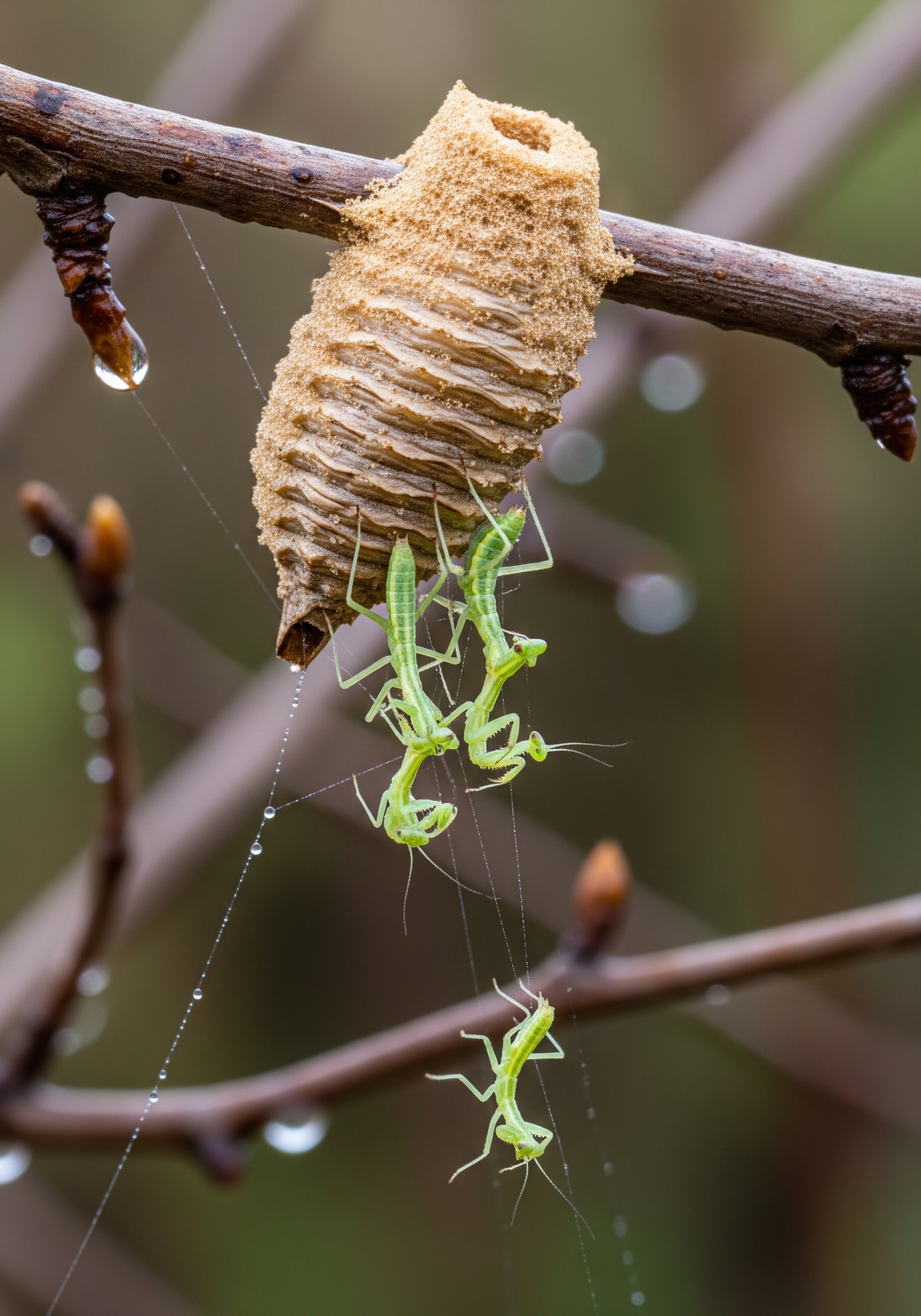
A female mantis builds the ootheca herself, on the spot, using a frothy protein-rich secretion she beats into foam with the tip of her abdomen. She works for one to three hours, hanging head-down, laying eggs in vertical chambers as the foam piles around them. Then she walks away. The egg case hardens in the open air within an hour, ending up the consistency of dense styrofoam, and that is the only protection her offspring will ever receive from her.
Mantis motherhood ends at the ootheca.
The chemistry is doing more than insulation. The hardened foam buffers temperature swings, sheds rain, deflects ovipositor-probing parasitic wasps (with mixed success), and conceals the eggs in plain sight — most oothecae match the weathered bark or stem they sit on. Winter cold is not the enemy. In fact, many temperate species require a chill period to break egg diapause; a case carried indoors too early often hatches in February into a warm living room full of nothing to eat.
The mass emergence: hours, not days
Hatching is triggered by warmth, not by date. Once daytime temperatures hold steady near 75–80 °F for roughly ten to fifteen days, the brood synchronises. A small slit forms along one edge of the ootheca and the first nymphs squeeze out — but they are not yet crawling. They are dangling from the case on thin silk-like threads, still wrapped inside a transparent “pronymph” membrane.
The pronymph stage lasts only seconds. As each tiny insect drops, it shrugs out of the membrane, unfolds its legs, and walks. Then the next one emerges. Then dozens at once. Within a few hours an entire brood of 100 to 400 miniature, fully-jointed predators is hanging off the twig like a pale beard, then dispersing in every direction. There is no parental care, no orientation, no welcome. The first thing they meet is each other.
{IMAGE_2}
Five to ten suits, one body — the molting nymph
A newly hatched mantis is perhaps 4 to 6 millimetres long and looks exactly like the adult it will become — that is the giveaway of incomplete metamorphosis. There is no caterpillar phase. The body plan is finished the moment the egg hatches; the animal only has to grow. The same is true of dragonflies, grasshoppers, and cockroaches. (For a striking comparison from the freshwater side, see our piece on the dragonfly nymph and its explosive ambush hunting — also a hemimetabolous predator, with a wildly different juvenile lifestyle.)
Because the exoskeleton cannot stretch, the nymph has to discard it. Between five and ten times in its life, it climbs upside down on a stem, splits the old cuticle along the back, and slowly extracts itself — soft, pale, and absurdly long-limbed. For about an hour it is rubber-armoured and almost helpless. Most nymphs that die before adulthood die during, or just after, a molt. A failed molt — a leg trapped in the old skin, a wing pad torn — is permanent. Mantis keepers call it a “mismolt”, and it is usually fatal.
Each phase between molts is called an instar. Early instars eat fruit flies and aphids. Later instars take crickets, flies, moths. The largest females, in late summer, are unfussy enough to grab the occasional hummingbird at a feeder — documented, but uncommon.
What most articles miss: the bloody first hour
Here is the part of the praying mantis life cycle that is usually skipped: most of those 100-to-400 newly hatched siblings will not see week two. Some are picked off by ants and spiders within minutes. Many simply starve. And — uncomfortable as it is — a meaningful fraction are eaten by their own brothers and sisters.
In a 2013 study in the Journal of Ethology, Jay V. Wong and Gregory I. Holwell of the University of Auckland tested whether nymphs of the springbok mantis (Miomantis caffra) avoid cannibalising relatives. They did not. Cannibalism was equally high in groups of full siblings as in mixed groups of unrelated nymphs. The team also found no asynchronous hatching and no rapid dispersal — none of the usual evolutionary off-switches for sibling cannibalism appeared to be operating. In other words, the species has not evolved to recognise kin at all. From a nymph’s point of view, the slowest, smallest mantis nearby is simply lunch.
This is also why home “hatch an ootheca with the kids” kits ship with a firm instruction: release within 24–48 hours, or separate. Kept together in a jar, the brood will eat each other down to a single fat survivor in about a week.
Autumn adults — and the cannibalism science most articles get wrong
Adults appear in late summer. Wings unfurl at the final molt, at least in winged species — some, like Miomantis caffra, have flightless females. Males are usually noticeably smaller and slimmer than females and tend to fly at night; females stay on a plant and wait. Mating happens between roughly August and October across most of the temperate Northern Hemisphere.
And then comes the part everybody thinks they know.
The female praying mantis eats the male — sometimes. Often not. The figure people repeat (90 percent) comes from indoor experiments with starved, brightly-lit females and is wildly unrepresentative; wild rates in Mantis religiosa field studies sit closer to 13–28 percent. But the more interesting science has only recently been settled, and it changes the story.
In 2016, Katherine L. Barry of Macquarie University and William D. Brown of SUNY Fredonia published a study in Proceedings of the Royal Society B in which they fed Chinese mantises (Tenodera sinensis) crickets dosed with radio-labelled amino acids, then let pairs mate. Half the males were allowed to be eaten; half were rescued. The cannibalised males ended up contributing about 89 percent of their tagged amino acids to the female’s developing eggs, against roughly 25 percent passed through normal ejaculate alone. The cannibalistic females also laid, on average, about 51 more eggs than the non-cannibalistic ones.
Read carefully, that is not a horror story. It is a paternal-investment story. The male’s body, eaten, is still building his own offspring — a brutal but mathematically rational form of fatherhood. Calling it “femme fatale” misses the point; this is one of the few documented cases in the animal kingdom where, beyond a certain threshold, getting eaten can out-perform escaping.
The praying mantis life cycle for kids — the simple version
Strip the science off and the praying mantis life cycle has three short chapters a child can hold in their head:
- Egg case. Mum makes a foam case full of eggs in the autumn and sticks it to a twig. She doesn’t come back.
- Tiny mantis. In spring, when the air feels properly warm, hundreds of teeny mantises come out at once, each the size of an ant. They have to grow up entirely on their own, and they shed their skin every few weeks because they keep getting too big for it.
- Grown-up mantis. By late summer they are the green-or-brown garden ninja you might see hunting on a flower. They mate, lay a new egg case, and that ends the year for them.
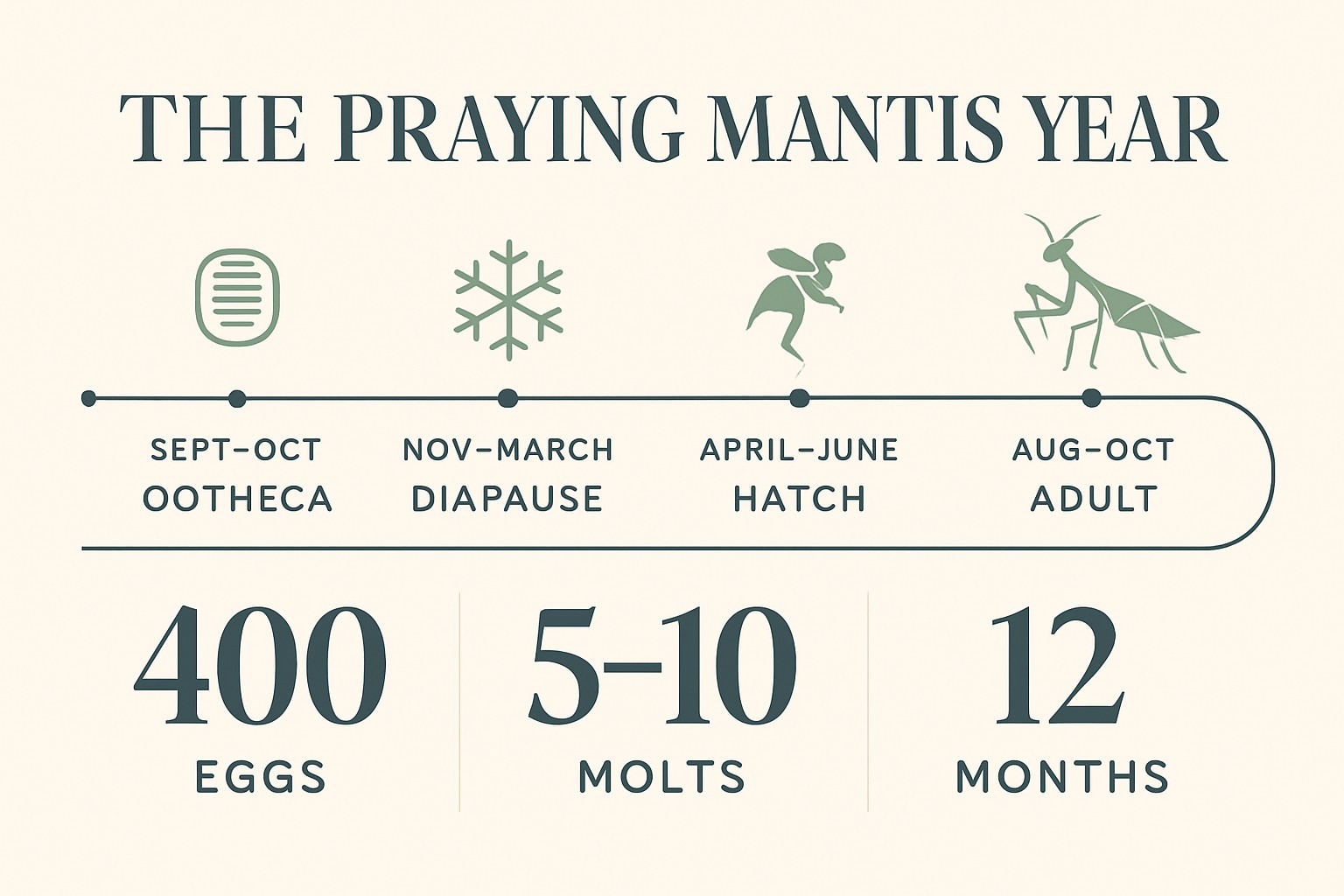
A typical year in the life of a temperate praying mantis
- Sept–Oct · Female lays the ootheca on a stem, branch, or fence. Eggs per case: 50–400, depending on species.
- Nov–March · Eggs overwinter in diapause inside the foam case. Most temperate species need this cold spell.
- April–June · Sustained warmth (~75–80 °F) triggers hatching; the whole brood emerges in a few hours.
- May–August · Five to ten molts; rapid growth from ~5 mm to 4–13 cm depending on species.
- Aug–Oct · Adulthood, mating, egg-laying. First hard frost ends the adults’ year.
One life cycle, three very different mantids — at a glance
Most North American gardeners who think they have “the praying mantis” are looking at one of three species, only one of which is native. The life cycle outline is the same. The ecological footprint is not.
| Species | Adult length | Eggs per ootheca | Status in North America |
|---|---|---|---|
| Tenodera sinensis (Chinese mantis) | 8–11 cm | ~100–400 | Introduced 1896 (Pennsylvania); now widespread; non-selective predator on pollinators and small vertebrates. |
| Mantis religiosa (European mantis) | 5–8 cm | ~100–200 | Introduced around 1899; state insect of Connecticut; less aggressive than the Chinese mantis. |
| Stagmomantis carolina (Carolina mantis) | 5–6 cm | ~30–80 | Native to the southeastern US; state insect of South Carolina; outcompeted (and sometimes eaten) by the Chinese mantis. |
That last column is the editorial point: buying a Chinese-mantis ootheca to “control pests” in a North American garden mostly amounts to releasing four hundred non-selective hunters that will eat as many ladybugs and bees as caterpillars, and that will outcompete a native species which was already doing the job. If you want garden mantises, find a wild Carolina ootheca and leave the imported ones on the shelf.
Frequently Asked Questions
Q: How long does the entire praying mantis life cycle take?
A: In most temperate species, about one year, end to end. Eggs are laid in autumn, overwinter in the ootheca, hatch the following spring, and the adults that emerge in late summer die with the first hard frost. In warmer climates and in captivity, the same species can stretch a few months longer.
Q: How many eggs are inside a praying mantis egg case?
A: It depends on the species. A native Carolina mantis ootheca holds around 30–80 eggs. A European mantis case holds 100–200. A Chinese-mantis case can hold up to about 400, which is why those are the ones sold for garden release.
Q: Do all the praying mantis nymphs in one ootheca hatch at the same time?
A: Essentially, yes. Once the brood breaks dormancy, eclosion typically finishes in a few hours rather than days. That synchrony is part of what creates the brief, dramatic “rain of nymphs” event gardeners sometimes catch on a warm spring morning.
Q: Does the female always eat the male after mating?
A: No. The famous “up to 90 percent” figure comes from artificially confined, hungry, brightly-lit pairs; field studies in Mantis religiosa typically record between 13 and 28 percent. The cannibalism is real, but the popular image is wildly exaggerated — and when it does happen, the eaten male contributes far more material to the next clutch of eggs than a male who escapes.
Sources
- Brown, W. D., & Barry, K. L. (2016). “Sexual cannibalism increases male material investment in offspring: quantifying terminal reproductive effort in a praying mantis.” Proceedings of the Royal Society B, 283: 20160656.
- Wong, J. V., Walker, L. A., & Holwell, G. I. (2013). “Cannibalistic siblicide in praying mantis nymphs (Miomantis caffra).” Journal of Ethology, 31: 247–252.
- University of California Statewide IPM Program (UC IPM), “Mantids, or Praying Mantises” — natural-enemies fact sheet.
- NC State Extension, Biological Control Information Center: “Chinese Mantid.”
- Connecticut Agricultural Experiment Station (CAES), “Praying Mantis (Mantidae)” fact sheet.
Three stages, one year, and a foam-hardened pause through every winter — the praying mantis life cycle is a strict economy. Almost everything about her, from the cold-resistant ootheca to the brutal hatch-day arithmetic to the calorically rational ending of a male’s life, is built around squeezing one more clutch of eggs out of a short northern summer. The next time you find a tan styrofoam peanut glued to a twig in February, you are looking at the entire next generation of a household name — already in place, already waiting, already counting heat.
Illustrations are AI-generated. Article fact-checked and human-edited. Our editorial standards.